
Introduction
You want to build skills in artificial intelligence. But every week there is a new model, a new tool, a new job title. Picking the right course for AI feels almost impossible when the field changes so fast.
Maybe you have searched for an online AI course only to drown in options.

Some promise to make you an expert in weeks. Others cost thousands and still leave you confused. The hype is loud. The signal is quiet.
Here is the truth: most people waste time and money on courses that do not prepare them for real work. They end up with certificates but no practical ability. That is frustrating. And it is completely avoidable.
This guide cuts through the noise. We have researched the top learning paths for 2026 and narrowed them down to ten clear options. Each path includes actual course recommendations that employers respect. Whether you want to become an AI engineer or explore a data science major, you will find a route that fits your goals.
We also cover specific programs like an artificial intelligence omscs and other well known degrees. But we focus on what actually gets you hired, not just what looks good on paper.
To stay ahead of the latest developments while you learn, we recommend ** [The AI Newsletter Worth Reading] **. It delivers clear daily updates so you never miss a breakthrough.
Now let us walk through the ten learning paths that will set you up for success in 2026 and beyond.
1. Start with Fundamentals: Machine Learning and Python
You might be tempted to jump straight to building chatbots or image generators. But every expert will tell you the same thing: skip the foundation and you will hit a wall fast. A strong grasp of Python, basic statistics, and classic machine learning algorithms is non-negotiable in 2026.
The best course for ai starts with these building blocks. Think of it like learning to cook. You need to know how to chop onions before you can make a five star meal.
So which online ai course should you pick for the foundation? Three names keep coming up year after year.
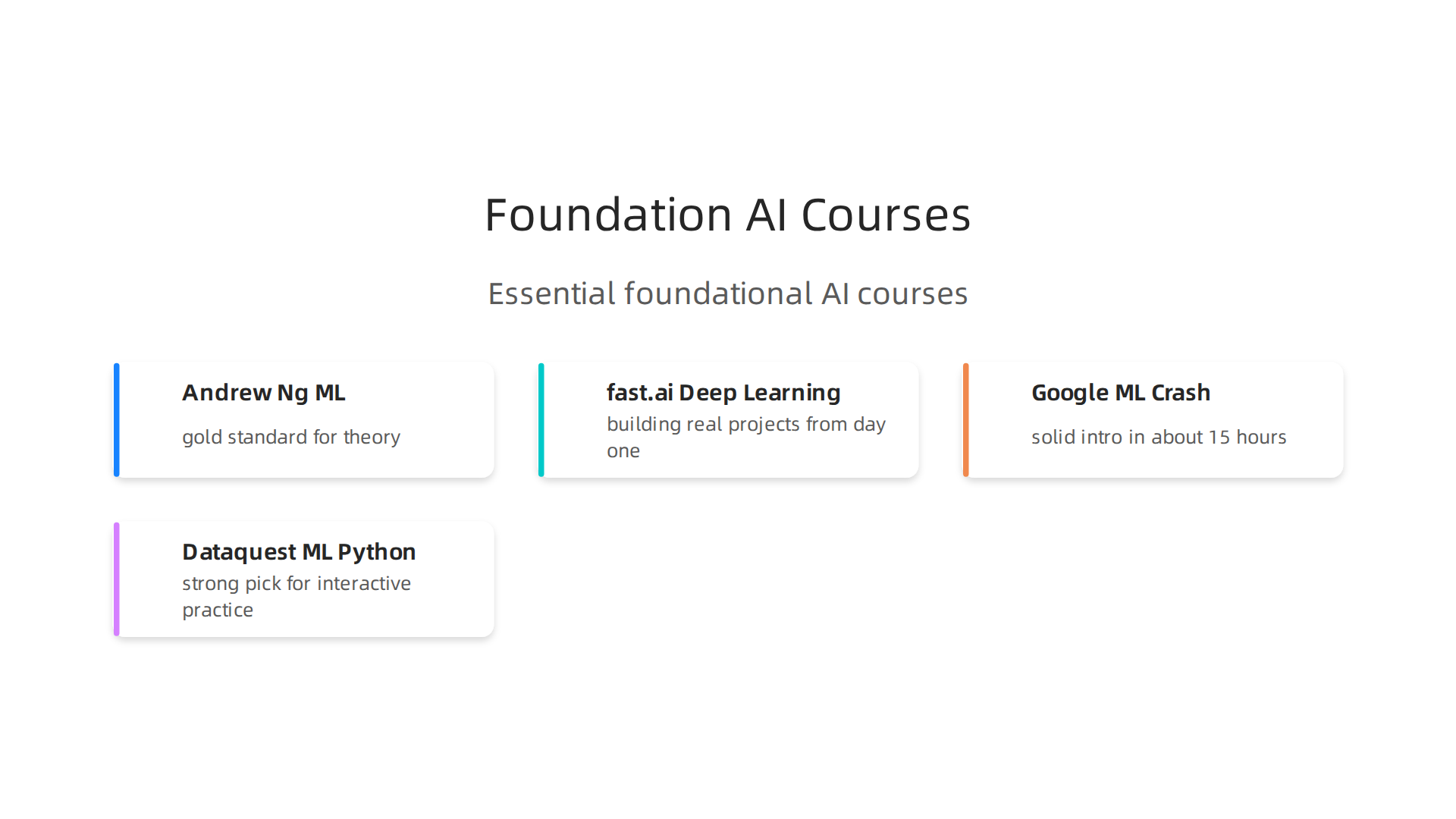
Andrew Ng’s Machine Learning Specialization on Coursera is still the gold standard for theory.
It walks you through linear regression, neural networks, and evaluation methods step by step. For a more hands on approach, fast.ai’s Practical Deep Learning for Coders teaches you by building real projects from day one.
And if you want something free and fast, Google’s Machine Learning Crash Course gives you a solid intro in about 15 hours.
According to a 2026 comparison of the best machine learning courses, Dataquest’s Machine Learning in Python is another strong pick for interactive practice. It focuses on building models with scikit learn and PyTorch inside your browser.
The real magic happens when you stop watching and start building. Every course you try should force you to write code, clean messy data, and train models yourself. If you only watch videos, you will not learn. Projects are what turn theory into a skill you can actually use.
For a deeper look at how to build this foundation, check out our guide on mastering practical machine learning for data science. It covers the exact skills you need and the projects that make them stick.
Start with the basics. Master them. Everything else will follow.
2. Dive into Deep Learning: Neural Networks and Transformers
Once you have the fundamentals down, it is time to dive into deep learning. This is where the real magic happens in 2026. Neural networks power everything from image recognition to language translation. A strong course for ai must cover convolutional neural networks (CNNs), recurrent neural networks (RNNs), and attention mechanisms like Transformers.
The best online ai course for this stage is Andrew Ng’s Deep Learning Specialization on Coursera. It walks you through building CNNs for computer vision and sequence models for text and audio. Another top pick is fast.ai’s Practical Deep Learning for Coders, which gets you building real models from day one using PyTorch.
Mastering PyTorch or TensorFlow is non-negotiable. These are the tools you will use in real jobs. According to a 2026 ranking of the best machine learning courses on DataCamp, courses that combine theory with hands on framework practice give you the best shot at job readiness.
For a deeper look at the online ai course options that prepare you for real careers, check out our guide on the best online AI courses of 2026.
Deep learning moves fast. Staying up to date matters. That is why many ai engineer course graduates subscribe to The AI Newsletter Worth Reading for daily insights on the latest breakthroughs in neural networks and Transformers.
3. Master Computer Vision: From CNNs to Generative Models
Computer vision is changing how machines see the world. In 2026, this field powers self-driving cars, medical scans that spot disease earlier, and retail systems that track inventory without human help. To break into this area, you need a course for ai that covers image classification, object detection, and generative models.
The options range from free to paid, and each fits a different learning style. For beginners who want to build a working model in a single day, Roboflow Learn is a smart starting point. For people who want rigorous theory, Stanford’s CS231N is still the gold standard. A roundup of the best computer vision courses online can help you compare these options side by side, including the University of Michigan’s free YouTube series and Udacity’s introductory program.
No matter which online ai course you pick, hands on practice with real datasets is non-negotiable. You learn more by building a simple object detector than by reading slides for weeks. Many of today’s top courses for ai include projects using OpenCV, PyTorch, and pretrained models from popular model zoos. These projects teach you how to handle real-world challenges like low lighting, occluded objects, and class imbalance. Generative models are another hot area this year. Understanding how tools like Stable Diffusion work gives you an edge whether you want to build creative tools or generate synthetic training data.
For a closer look at how AI actually processes visual information, read our guide on how image artificial intelligence works and why your business needs it.
4. Specialize in NLP and Large Language Models
Natural language processing is just as big as computer vision in 2026. Large language models (LLMs) like GPT-4 and Claude are changing how businesses handle customer support, content creation, and data analysis. If you want to work in this area, you need a smart course for ai that covers the right topics.
A solid NLP curriculum should teach you the full stack. Start with recurrent neural networks (RNNs) and LSTMs to understand sequence modeling.
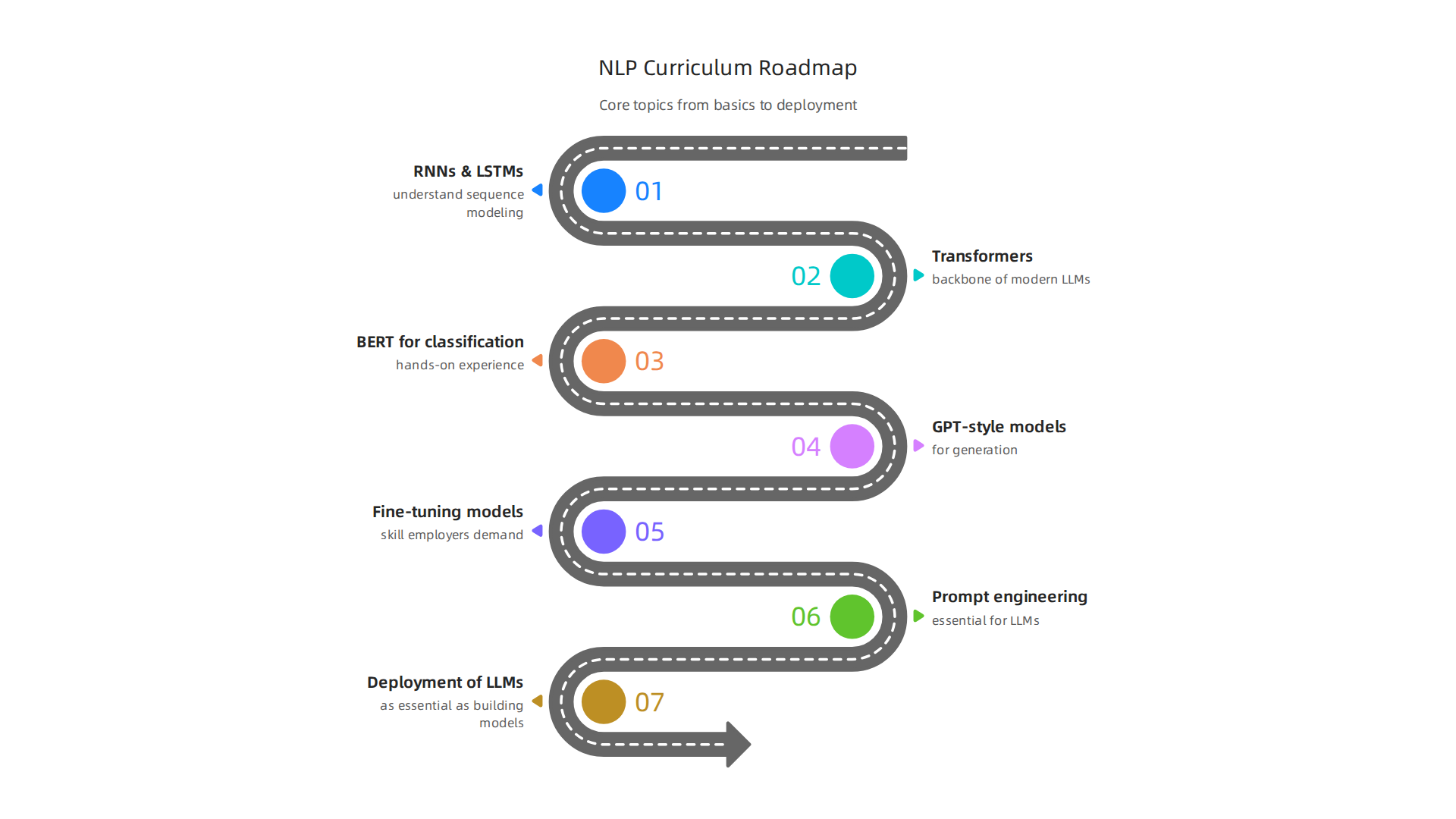
Then move to transformers, the backbone of modern LLMs. You will want hands-on experience with BERT for classification and GPT-style models for generation. Fine-tuning pretrained models on your own data is a skill employers demand. Prompt engineering and deployment of LLMs are becoming just as essential as building models from scratch.
The deep learning courses compared in 2026 include several options that teach these exact skills, from Stanford’s CS224N to Hugging Face’s free NLP course.
Many of these programs include real projects like building a question answering system or a text summarization tool.
This is also where your data science major or artificial intelligence omscs can pay off. Graduate programs often offer dedicated NLP tracks, but you can learn everything online with a focused online ai course from platforms like Coursera or DeepLearning.AI.
Stay current with the latest model releases and research by subscribing to a daily update. The AI Newsletter Worth Reading gives you clear summaries of what matters in LLMs and beyond, so you never fall behind.
5. Explore Reinforcement Learning and Robotics
Not all AI is about images or text. Some of the most exciting work happens when machines learn by trying things again and again. That is reinforcement learning (RL). It powers self-driving cars, helps robots grab objects, and creates game AI that beats the best human players.
If you want to work in robotics or autonomous systems, you need a course for ai that covers RL from the ground up. The best programs start with Markov decision processes and Q-learning. Then they move into policy gradients and deep reinforcement learning. But the real magic happens when you pair theory with practice inside simulated environments.
The most popular tool for this is OpenAI Gym. It gives you ready-made worlds like Atari games and robotic control tasks. You write the code, watch your agent learn, and see mistakes get fixed. Projects like these stand out to employers.
A good online ai course in RL also teaches control theory and how to connect software to physical robots. You do not need an engineering degree, but you should understand concepts like state estimation and how simulation mirrors the real world.
The ai engineer course you pick should include classic resources. David Silver’s RL course from DeepMind is a tried and true starting point. So is the UC Berkeley Deep RL course (CS 285). For a full overview of what works best, check out this guide to top reinforcement learning courses that focus specifically on AI and robotics.
Remember that a data science major or an artificial intelligence omscs often includes an RL track. But you can also learn through focused standalone programs. Browse this list of best online AI courses in 2026 that prepare you for real robotics jobs and beyond.
The best way to start is simple. Open a simulated environment, write your first Q-learning agent, and watch it improve. That single experience will show you how powerful reinforcement learning really is.
6. Understand AI Ethics and Responsible AI
Building powerful AI is great. But building it responsibly is just as important. In 2026, ethics is no longer optional. New regulations are popping up around the world. Companies face real penalties if their AI systems are unfair, biased, or unexplainable. That is why any good course for ai must include ethics training.
So what should an online ai course teach about ethics? First, it should cover bias detection.
AI models can pick up hidden biases from data. You need to know how to spot them and fix them. Second, it should cover explainability. If your AI makes a decision, can you explain why? That matters in healthcare, hiring, and finance. Third, it should cover governance frameworks. These are the rules and processes that keep AI safe and fair.
The best ai engineer course also uses real-world case studies. Learning about actual ethical failures helps you understand the stakes. You get to see what went wrong and how to avoid the same mistakes.
A data science major or an artificial intelligence omscs program now often includes a dedicated ethics module. But you can also find standalone resources. For example, this page about Anthropic AI’s safety-focused approach shows how one company builds responsible AI from the ground up.
The field changes fast. To stay on top of new rules and best practices, you need a reliable source of daily updates. The AI Newsletter Worth Reading delivers clear daily updates straight to your inbox. It is a great way to keep learning about AI ethics and everything else that matters in AI.
7. Build AI Products: MLOps and Deployment
You have trained a great model. It scores high on accuracy and passes all tests. But that is only half the battle. The real challenge comes next: getting that model into production where people actually use it. That is where MLOps comes in.
MLOps stands for machine learning operations. It is the practice of taking models from notebooks and putting them into live applications. Any good course for ai should teach you these skills. Why? Because companies do not just need people who can build models. They need people who can deploy, monitor, and maintain them at scale.
So what should an online ai course cover in this area? Look for hands-on training in containerization tools like Docker and Kubernetes.
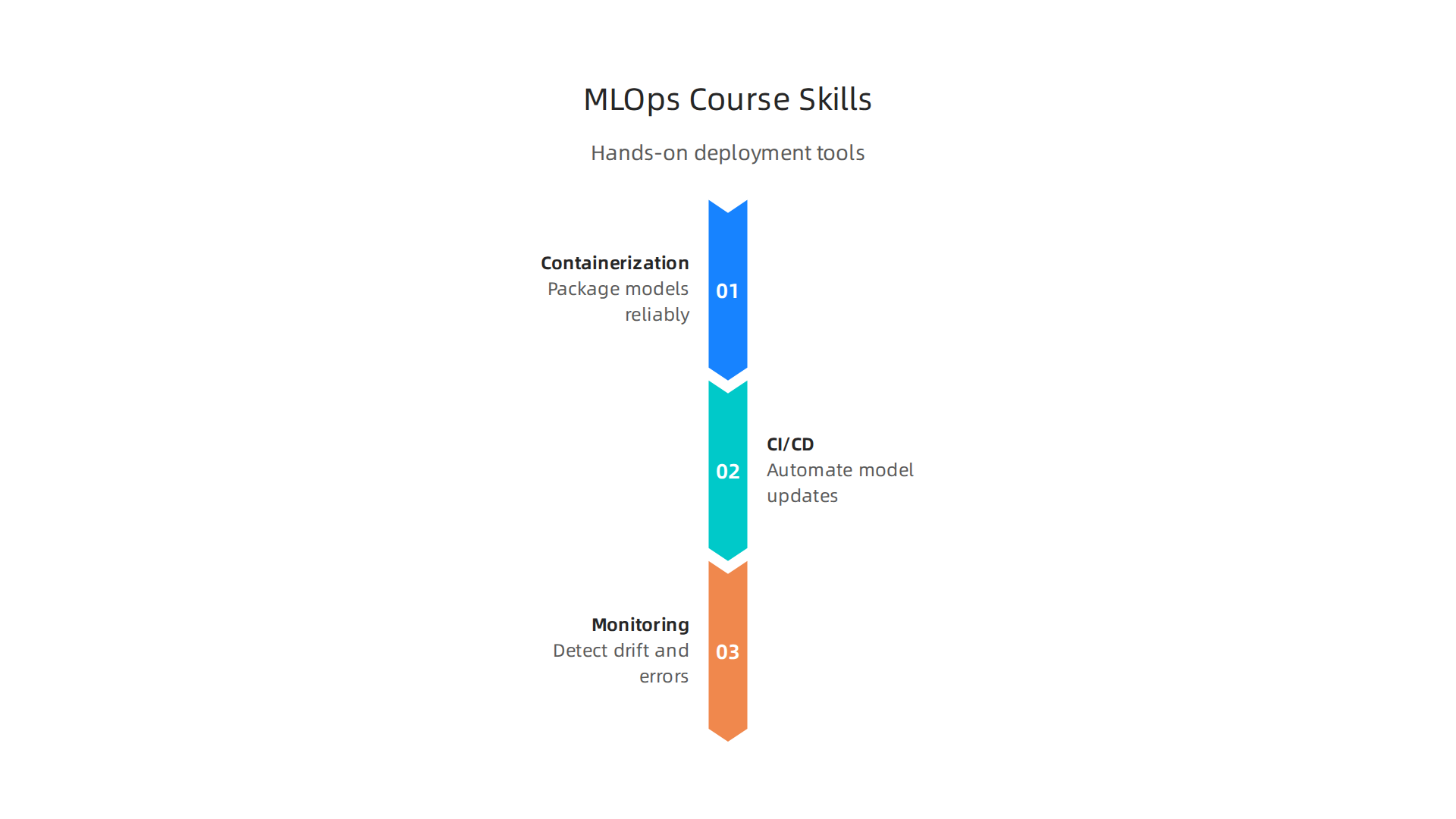
These let you package your model so it runs reliably anywhere. You also need CI/CD pipelines to automate updates. And you must learn monitoring to catch drift and errors after deployment. These are the skills that make an ai engineer course truly valuable.
MLOps is one of the fastest-growing skill areas in job postings right now. Many data science major programs and even an artificial intelligence omscs track now include dedicated MLOps modules. You can also find focused training like the MLOps courses on Coursera that teach deployment and monitoring with real tools.
If you want to go deeper, check out this guide on AI jobs in 2026 to see exactly which MLOps skills employers are looking for. Building models is one thing. Shipping them to production is where the real value lives.
8. Earn AI Certifications: AWS, Google, Microsoft, and More
Knowing how to deploy models is one piece of the puzzle. But employers also want proof that you can work with the tools they use every day. That is where cloud certifications come in.
Major cloud providers like AWS, Google Cloud, and Microsoft Azure offer their own AI certification paths. These exams test your ability to build, train, and deploy models on their platforms. When you pass, you get a credential that hiring managers trust. It shows you can handle real production work, not just notebooks.

The best way to prepare is to pick a course for ai that lines up with the exam you want. For example, if you target the AWS Certified Machine Learning Specialty, look for a training program that covers SageMaker, data engineering, and MLOps on AWS. The same goes for Google’s Professional Machine Learning Engineer or Azure’s AI Engineer Associate.
Certifications from cloud vendors are becoming more important in hiring decisions. According to a guide on top data analytics certifications for AI careers, these credentials can help you stand out and earn more. Industry experts agree that cloud certifications from AWS, Azure, and Google Cloud add significant value to your resume.
A good study plan includes practice tests and hands-on labs. Many online ai course platforms now offer exam-specific tracks. Do not just read theory. Build projects that match the exam scenarios. That builds real confidence.
Staying current is hard because certifications change fast. If you want a daily dose of what matters in AI and cloud, get clear daily AI updates from The Deep View Newsletter. It helps you keep pace with new tools and certs so you never fall behind.
9. Learn AI for Business and Strategy
Not everyone needs to write code to work with AI. If you lead a team, manage a product, or shape company strategy, you need a different kind of knowledge.

You need to understand what AI can do for your business, where the risks lie, and how to decide which projects are worth the investment. That is where business-focused AI courses come in.
These programs skip the math and focus on practical decision-making. They cover AI strategy, innovation management, and methods for evaluating AI investments. Many include real case studies from companies that have successfully transformed their operations with AI. You learn how to spot opportunities, avoid common pitfalls, and communicate effectively with technical teams.
A great starting point is the AI for Everyone course by Andrew Ng, which requires no technical background and takes only about 7 hours. For deeper business strategy, programs from top schools like MIT Sloan offer executive-level training that blends core AI principles with governance and implementation. You can explore offerings like the AI executive courses from MIT Sloan to see what fits your role.
If you want more context on how to assess AI tools and use them wisely in a business setting, check out a practical guide to AI for business leaders. It breaks down what works, what doesn’t, and how to make smarter bets with AI.
10. Stay Current: Advanced Research and Continuous Learning
Here is the thing about AI: it never stops changing. The course you finish today might feel outdated in six months. That is not a reason to skip learning. It is a reason to build a habit of staying current.
Once you have a solid foundation, the next step is to follow where the field is heading. That means reading research papers, keeping an eye on top conferences, and exploring specialized programs that dig deeper.
A good starting point for ongoing learners is to check out The Best AI Courses to Take in 2026. It maps out options for different skill levels so you can keep leveling up without guessing which programs are worth your time.
You should also get comfortable with platforms like arXiv, where researchers publish new findings almost daily. Follow blogs from labs like DeepMind, OpenAI, and Hugging Face. And bookmark a few reliable newsletters that summarize breakthroughs so you do not have to read everything yourself.
If you want more direction on which courses actually help you build skills employers need, take a look at these online AI courses for real jobs. They focus on practical outcomes, not just theory.
One of the easiest ways to keep learning without effort is subscribing to a daily update. The AI Newsletter Worth Reading delivers clear, short summaries of what matters in AI each day. It is perfect for busy professionals who want to stay sharp without drowning in tabs.
Remember, the best course for AI is the one you keep coming back to. Make continuous learning a regular part of your routine, and you will always stay ahead of the curve.
Summary
This guide helps you pick the right learning path for AI in 2026 by mapping ten practical routes—from foundational machine learning and Python to deep learning, computer vision, NLP, reinforcement learning, MLOps, ethics, and business strategy. It evaluates which online courses and programs actually build job-ready skills, highlights the tools and projects you must practice (PyTorch/TensorFlow, OpenCV, Hugging Face, Docker/Kubernetes), and shows how certifications and portfolios influence hiring. The article explains why foundations and hands-on projects matter more than certificates alone, which specializations pay off, and how to approach continuous learning so your skills don’t become outdated. After reading, you’ll know which courses to prioritize for your goal, what projects and tools to add to your portfolio, and how to combine certifications, ethics training, and MLOps experience to get hired and succeed in real AI roles.