
Why choosing the right AI course matters for busy professionals
In 2026, the world of Artificial Intelligence (AI) is moving faster than ever. New AI tools, ideas, and ways to use them pop up every day. For busy professionals, this can feel like a lot of information to sort through. You might feel overwhelmed trying to keep up, let alone figure out how to best use AI in your job.

Actually, many people struggle to find good, clear information. They often need to know what a proper AI education looks like, which can involve learning about complex algorithms and how to use them in real-world situations, as highlighted by academic programs Vishwakarma Institute of Technology. The biggest challenge is picking the right learn ai course that truly helps you grow your career. There are so many choices out there, from an ai course Singapore to an ai course UK, and even a best ai course in India or a free AI course by Google. How do you know which one is the right fit for your busy schedule and career goals?
That’s where this guide comes in. We understand that your time is valuable. This article will give you a simple, research-backed way to look at different AI courses from all over the world. We’ll help you build a smart learning plan, maybe for the next 6 to 12 months, that will truly make a difference in your professional life. We aim to help you unlock your potential by choosing the right learning AI course for 2026.
Staying informed about all the latest AI developments is crucial. To get clear daily AI updates that cut through the noise, consider subscribing to The AI Newsletter Worth Reading.
A decision framework to pick the right AI course for your role
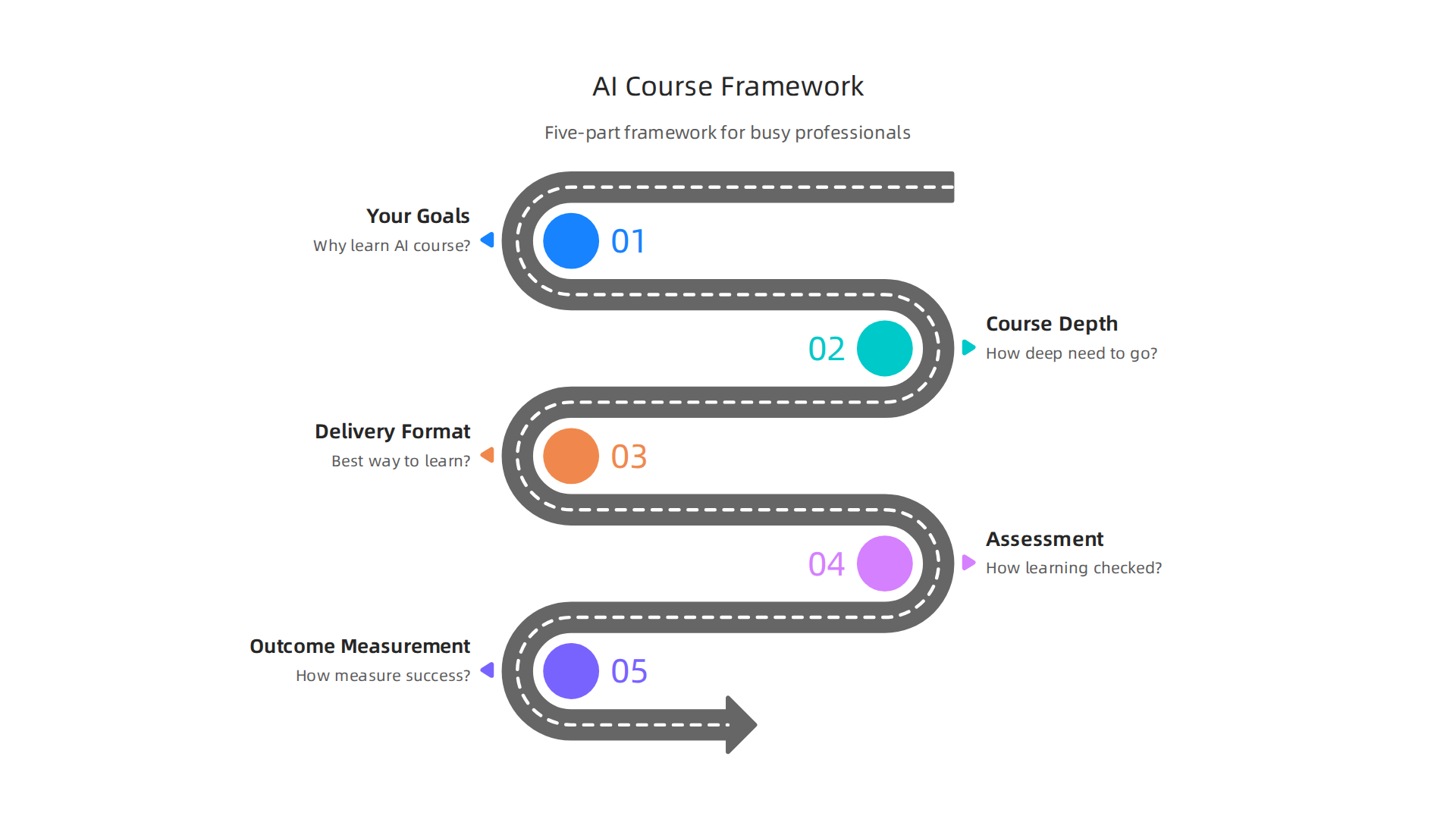
Now that you know how important it is to pick the right AI course, let’s look at a simple way to make that choice. This framework helps you break down the decision into smaller, easier steps. It has five main parts: your goals, how deep the course goes, how it’s taught, how you’re tested, and what you get out of it.
Thinking about each part will help you find the best learn ai course for your unique path in 2026.

1. What are your goals?
Before you even look at a course, ask yourself: "Why do I want to learn ai course?"
- Are you a founder wanting to add AI to your business? Your goal might be to understand how AI can create new products or make things work better.
- Are you a product leader? You might want to learn how to guide teams in building AI features.
- Are you a researcher? You’ll likely need to dive deep into new AI ideas and methods, like those covered in academic programs that focus on acquiring in-depth knowledge of Artificial Intelligence and Machine Learning to pursue research COEP Technological University.
Your goals will point you towards different types of learning.
2. How deep do you need to go?
AI courses can be very basic or very advanced.
- A beginner might start with a
free AI course by Googleor a similar introduction that explains what AI is and how it’s used every day, focusing on fundamentals like Python programming B.Tech curriculum. - Someone with more experience might need to learn about complex AI models or how to build special AI systems. For example, some programs teach how to apply regression and classification models to real-world problems and implement machine learning algorithms using Python Savitribai Phule Pune University. The right depth depends on your job and what you already know.
3. What’s the best way to learn? (Delivery Format)
Think about your busy schedule.
- Do you need a flexible
ai course UKorai course Singaporethat lets you learn at your own pace? - Would you do better with live online classes or in-person workshops?
- Some courses offer a mix, allowing you to watch videos whenever you can and join live sessions for questions.
The best format helps you stick with the course and finish it.
4. How will your learning be checked? (Assessment)
How will you show that you’ve learned the skills?
- Some courses have quizzes or exams.
- Others focus on projects where you build AI tools.
- Many professional courses offer certificates that prove you finished the program.
Consider how these checks help you grow and what kind of proof you need for your career. If you’re looking for certifications that matter, check out how to find the best online AI courses 2026 that actually prepare you for real jobs.
5. How will you measure success? (Outcome Measurement)
This step looks at the real-world results of your learning.
- Did the
best ai course in Indiahelp you get a new job or promotion? - Can you now build AI solutions for your company?
- Are you able to use your new skills to solve problems you couldn’t before?
For roles like an ML Engineer, a roadmap might include key skills, tools, and even suggested projects to go from beginner to job-ready, clearly defining success ML Engineer Roadmap 2026. Knowing these outcomes upfront helps you pick a course that truly changes your professional life.
Different roles put different weights on these steps. A founder might care most about goals and outcomes. A researcher might focus on depth and assessment. A product leader needs to balance depth with practical outcomes. Knowing how to choose the right learning path is key to your career success in 2026. This framework helps you compare options and choose an ai course that’s a perfect fit. If you’re interested in more general guidance, you can also explore how to choose the best data science and AI online course for 2026.
After you know how to pick an AI course that fits your needs, the next big step is to understand what important things every professional should learn. It’s like building a house; you need a strong base. For AI, this means knowing the key ideas and skills that help you use AI well in your job.
Here are some essential topics you should master when you decide to learn AI:
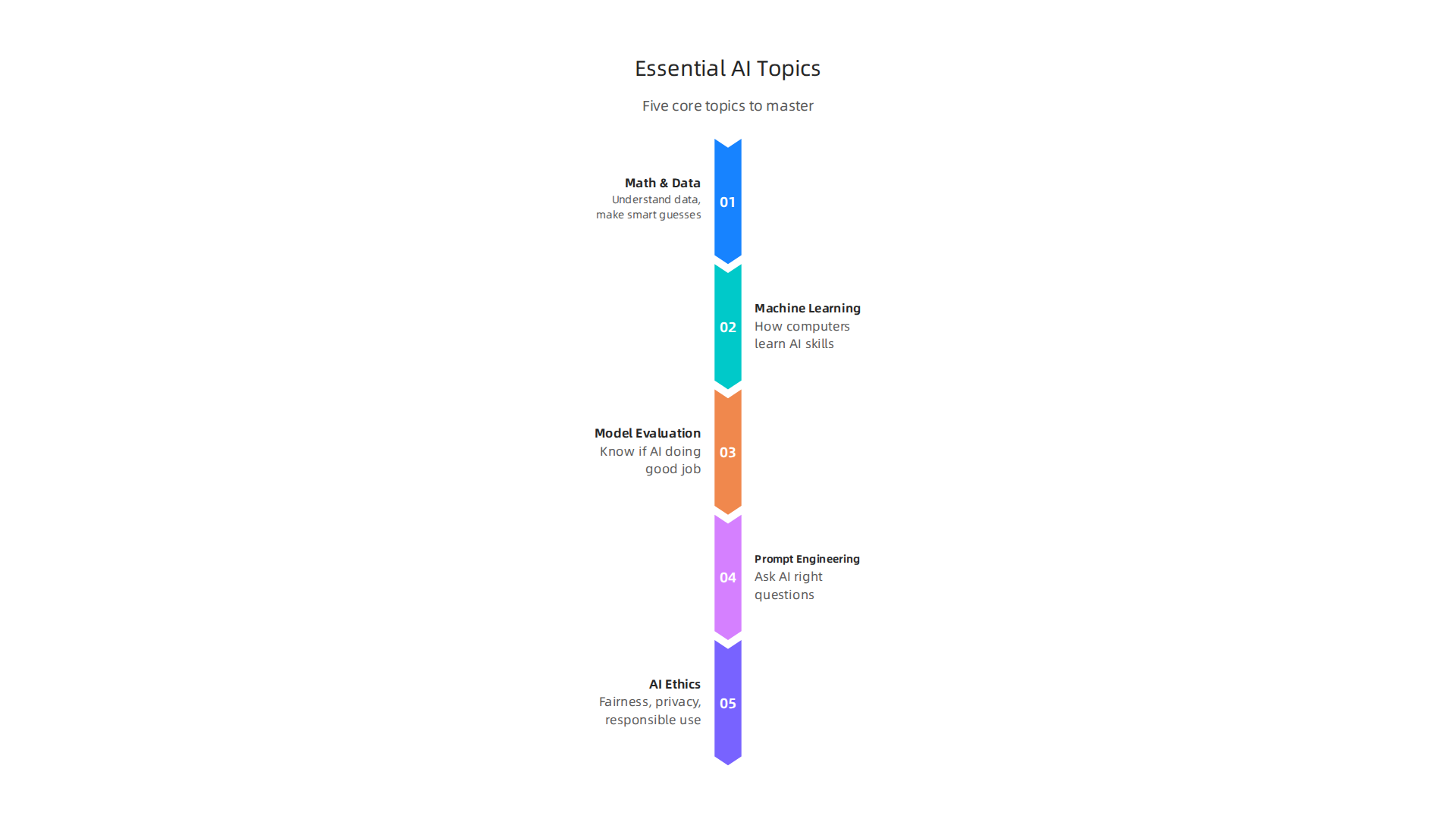
1. The Basics of Math and Data
- Probability and Statistics: These are like the grammar of AI. They help you understand data and make smart guesses. You don’t need to be a math genius, but knowing the main ideas helps you see how AI makes decisions. For example, many AI programs aim to help students understand foundational concepts and algorithms in machine learning, which relies on these math principles ACADEMIC CURRICULA.
- Data Foundations: You need to know how to work with data. This includes getting data, cleaning it up, and showing it clearly. Good data is the fuel for any AI system. You can explore more about this through a course on mastering data foundations and data literacy for AI leadership.
2. Machine Learning Fundamentals
Machine learning is a big part of AI.
- What it is: Learn what machine learning is and how it lets computers
learn ai courseskills without being told every single step. - Types of Learning: Understand basic types like supervised learning (where AI learns from examples) and unsupervised learning (where AI finds patterns on its own). Many courses teach how to use these concepts to solve real-world problems Vishwakarma Institute of Technology.
- Simple Models: Get to know simple models like regression (for predicting numbers) and classification (for sorting things into groups).
3. How to Check AI’s Work (Model Evaluation)
It’s not enough to build an AI; you need to know if it’s doing a good job.
- Measuring Success: Learn ways to tell if an AI model is accurate or fair. This helps you trust the AI and fix it if it’s wrong.
- Fixing Problems: Understand common issues like overfitting, where an AI learns too much from its training data and can’t work well on new data. Learning how to prevent issues like overfitting data in AI systems is key for building reliable solutions.
4. Talking to AI (Prompt Engineering)
With new AI tools, knowing how to ask the right questions is a skill.
- Basic Prompting: This means learning how to write clear instructions or questions for AI models to get the best answers or results.
- Using AI Tools: Whether you take an
AI course UKor afree AI course by Google, basic prompt engineering is a practical skill you’ll use every day. If you want to dive deeper, you can also learn about how to choose the best AI prompt engineering course for 2026.
5. Being Fair and Safe with AI (Ethics and Governance)
AI can do amazing things, but we need to use it wisely.
- Fairness and Bias: Understand that AI can sometimes be unfair if its training data is biased. Learn how to spot and avoid this.
- Privacy: Know how to handle data responsibly and protect people’s information.
- Responsible Use: Think about the bigger picture and how AI impacts society. Many courses focus on how to design and deliver AI solutions that are human-centered and address societal needs Vishwakarma Institute of Technology.
For most professionals not doing deep research, it’s better to learn a little bit about all these topics first. This gives you a wide understanding. Later, if your job needs it, you can pick one area to learn more deeply. For instance, if you’re aiming for a specialized role, a best AI course in India might offer a deeper dive into certain areas. This broad foundation helps you speak the language of AI and work with AI experts more effectively in 2026.
Ready to stay ahead of the AI curve?
Get clear daily AI updates from The AI Newsletter Worth Reading.
After learning the main ideas, the next step is to truly build skills. It’s like learning to ride a bike. You can watch videos about it all day, but you only truly learn when you get on the bike and start pedaling. The same goes for AI. To effectively learn ai course material and apply it, you need to get your hands dirty with real-world practice.
Hands‑on learning: labs, projects, and toolchains that build real skills
Watching videos or reading books about AI is a good start. But these are like looking at a map; they tell you where to go, but they don’t help you travel. To build real skills, you need hands-on learning. This means working on labs and projects.

These activities show you how AI works in real life, not just in theory. Many courses, like those for professionals looking to get ahead, offer hands-on AI labs and capstone projects to ensure practical skill development in 2026 AI Masters Program for Working Professionals: What to Expect in 2026.
Why is this important? Because employers want to see what you can do, not just what you know. Labs and projects give you that experience. They help you turn knowledge into actual ability. For example, some programs are built to help you create a project portfolio from the start, showing off your hands-on AI solutions Build Your AI Skills for 2026: General Assembly Launches Four New ….
When you are looking for an AI course, here’s a checklist for strong hands-on parts:
- Access to Real Data: Can you work with real information, like numbers, pictures, or words? This helps you understand how messy real data can be.
- Cloud Credits: Does the course offer free access to powerful computers in the cloud? AI tasks often need a lot of computing power, and these credits let you run your projects without extra cost.
- Reproducible Notebooks: These are like digital lab reports that combine code, notes, and results. They help you follow steps, try things out, and share your work easily. They also help you understand why your results make sense Teach Python for Science and Engineering with ….
- Mentor Feedback: Can you get advice from an expert on your projects? Someone who can guide you and help you fix mistakes is super valuable.
- Capstone Projects: Look for courses that end with a big project where you build a full AI solution from start to finish. These "capstone" projects are great for your learning and for showing off your skills to others. Some capstone projects focus on solving real-world problems and creating something tangible to demonstrate Capstone Project Briefs | AI Engineer 2026.
Choosing an AI course that focuses on hands-on practice means you’re not just learning about AI; you’re learning how to do AI. This practical experience is what truly makes a difference in 2026. If you want to dive deeper into selecting a course that truly unlocks your potential, consider exploring how to Unlock Your AI Potential: Choosing the Right Learning AI Course for 2026.
After you learn the basics of AI and get some hands-on practice, the next big step is to pick a special area to focus on. It’s like deciding if you want to be a heart doctor or a brain doctor. Both are doctors, but they do very different things. AI is the same way; there are many paths you can take. Choosing your path helps you pick the right learn ai course and build the skills that matter most for your goals in 2026.
Choosing a specialization: MLOps, ML engineering, research, or prompt engineering?
The world of AI is growing super fast, and with that growth come many different kinds of jobs. Each job needs a special set of skills. Let’s look at some popular specializations and what they are all about.
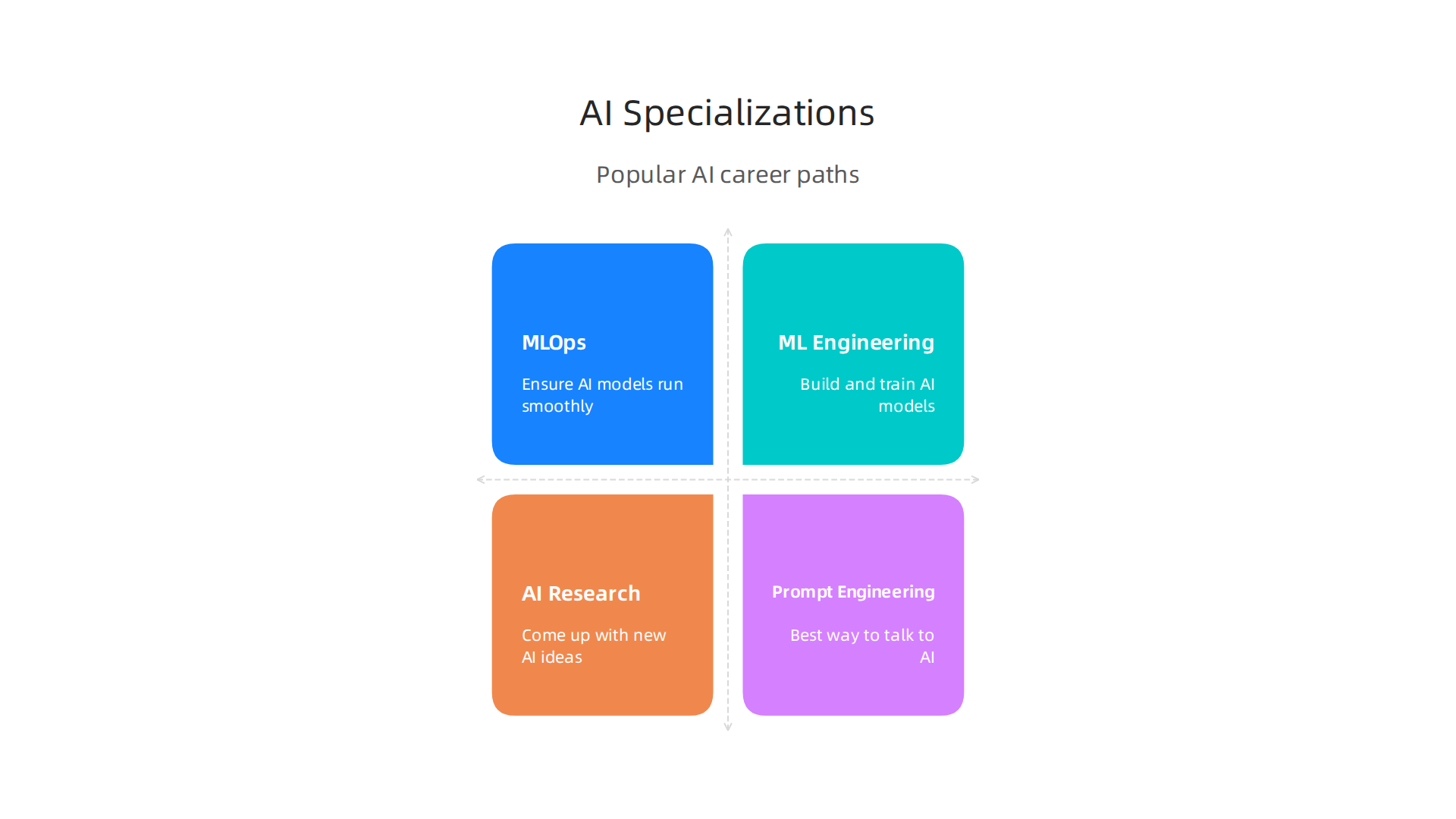
MLOps (Machine Learning Operations)
Imagine you’ve built a cool AI program, but now you need it to run smoothly all the time for many people. That’s where MLOps comes in. People who work in MLOps make sure AI models are put into action correctly, kept working well, and updated when needed. They are like the engineers who build and maintain the roads for AI.
- Daily Skills: You’ll work with tools to deploy AI models, keep an eye on them (monitoring), and set up automated pipelines that help models get trained and updated over and over. This also includes things like version control for code and data, and making sure everything can be reproduced MLOps Roadmap [2026]: A Complete MLOps Career Guide.
- Tools: Common tools include Docker and Kubernetes for managing how AI programs run, and MLflow for tracking experiments.
- Career Path: This role is great for those who like to build systems and keep things running efficiently. MLOps skills are highly sought after in 2026 to ensure AI projects move from testing to real-world use MLOps Skills That Matter in 2026 | AI Pulse.
ML Engineering (Machine Learning Engineering)
ML engineers are the builders of AI models. They take the ideas from AI researchers and turn them into working programs. They also help make these programs faster and more efficient.
- Daily Skills: You’ll spend time building and training machine learning models, making them better (optimization), and working closely with MLOps teams to get models ready for use. A big part of this in 2026 is being able to deploy and maintain models in real systems, not just train them in a lab Machine Learning Engineering Interview Guide (MLOps & AI 2026).
- Tools: Popular programming languages like Python and frameworks like PyTorch and TensorFlow are key.
- Career Path: This is a good choice if you enjoy coding, problem-solving, and seeing your AI creations used in practice. Many
ai course singaporeandbest ai course in indiaoptions focus heavily on these engineering skills. You can find out more about the different types of AI jobs and how to get them in 2026 through resources like the AI Engineer Roadmap 2026: Skills, Tools, and Career Path.
AI Research
AI researchers are the explorers of the AI world. They come up with new ideas, new ways for AI to learn, and push the boundaries of what AI can do.
- Daily Skills: This involves a lot of reading academic papers, designing experiments, writing complex algorithms, and testing new theories. It’s often about asking "what if?" and finding new answers.
- Tools: Advanced math, statistics, and programming skills are crucial.
- Career Path: If you love discovering new things, solving very hard problems, and working at the forefront of technology, research might be for you.
Prompt Engineering
With the rise of large AI models (like ChatGPT), prompt engineering has become a hot new field. It’s all about figuring out the best way to "talk" to these AI models to get the exact answer or output you want.
- Daily Skills: You’ll write, test, and improve the instructions (called "prompts") given to AI models. The goal is to make the AI perform its best for different tasks MLOps Learning Road: Step by Step Guide (2026). You might also work on fine-tuning these models or building systems to retrieve information for them (RAG).
- Tools: You’ll mostly work with different AI model APIs and related tools.
- Career Path: This path is great for those who enjoy language, clear communication, and finding clever ways to make AI useful. To dive deeper into this specific area, consider exploring how to choose the best AI prompt engineering course for 2026.
Hybrid Roles and Choosing a Program
Sometimes, jobs might mix skills from a few of these areas. For example, an AI engineer might also need good prompt engineering skills. When looking for an ai course uk or even a free ai course by google, think about what blend of skills you want to learn.
When you look at different learn ai course options, see if they offer a good mix of theory and hands-on practice in the specializations you’re interested in. Do they teach you the tools used in that specific field? Do they have projects that let you practice those particular skills? A good program will help you gain skills across these areas, preparing you for different job roles in 2026.
Staying updated with all the new AI specializations and tools can be hard.
Get clear daily AI updates from The AI Newsletter Worth Reading.
After you pick a special area in AI, like MLOps or prompt engineering, the next natural question is: how do you show others you have these skills? This is where certifications and other papers come in. While hands-on experience from a good learn ai course is super important, having a piece of paper to prove your skills can really help.
Certifications, credentials, and employer recognition: what actually matters
Not all papers or certificates are the same. It’s helpful to know the differences when you think about your career path in AI in 2026.
Different Kinds of Credentials
- Vendor Certificates: These come from big tech companies like Google, Amazon (AWS), or Microsoft. They show you know how to use their specific AI tools and platforms. For example, a Google Professional Machine Learning Engineer certificate shows you can work with Google’s AI technologies. Many hiring managers look for these, with one report in 2026 showing that over 60% recognize the Google certificate specifically when making hiring choices for tech roles and operations AI Skills for Jobs: Which Certifications Hiring Managers ….
- University Credentials: These are diplomas or special program certificates from colleges and universities. They usually mean you’ve studied deeply and broadly in AI, often covering theory and many different ideas.
- Industry-Backed Certifications: These come from groups that represent many companies in an industry. They show you have skills that are widely accepted and needed across different businesses. These kinds of credentials can sometimes lead to higher pay and better job chances The impact of manufacturing credentials on earnings and the ….
What Employers Look For
In 2026, many companies want to see that you can actually do the job. So, a certificate that proves real-world skills is often valued. Studies show that having these kinds of extra papers can make it more likely for you to get hired or even earn more money. Some people who get non-traditional certificates are 6% more likely to find new jobs within a year that are related to what they learned The value of non-traditional credentials in the labor market.
When a company sees you have a recognized certificate, it tells them you’re serious and ready to work. It’s like a shortcut to show them your skills. This is why when you look for the best ai course in india or an ai course uk, you should check if it offers certifications that are known and respected by employers.
To truly stand out, it helps to have both practical skills and papers that prove those skills. Think about if an is the google advanced data analytics certificate worth it in 2026 for your career goals. Knowing which ones are most recognized can help you plan your learning journey. You can also explore how different types of papers fit into the bigger picture of finding AI Jobs 2026: The Skills, Certifications, and Portfolio That Get You Hired.
After thinking about what types of papers help your career, you might wonder where to get the best education. There are many places where you can learn AI, and each one works a little differently. In 2026, you can choose from universities, special training programs called bootcamps, and online courses known as MOOCs. Knowing the main differences can help you pick the best way to learn AI.
Global providers compared: universities, bootcamps, and MOOCs
When you want to take a learn AI course, it’s good to look at a few things. These include how deep the learning goes, if it’s officially recognized, how they teach, how much it costs, and how much time you need to put in.
Here is a simple way to look at the main types of places to learn AI:
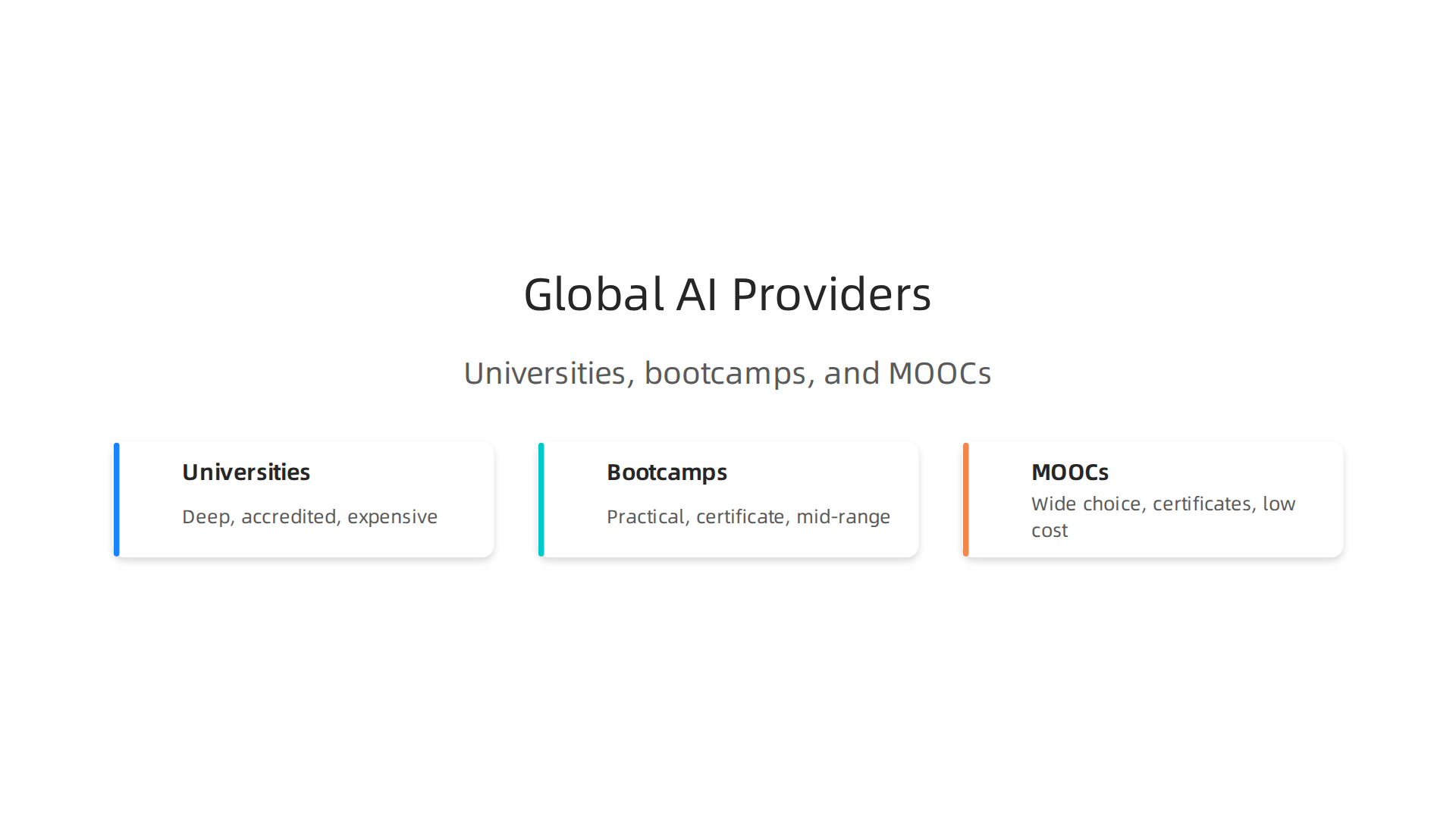
| Feature | Universities | Bootcamps | MOOCs (Massive Open Online Courses) |
|---|---|---|---|
| Depth of Learning | Very deep, lots of theory and big ideas. | Focused on practical skills, less theory. | Can be wide or focused, depends on the course. |
| Accreditation | Official degrees (Bachelor’s, Master’s). | Certificates of completion, sometimes industry-backed. | Certificates of completion, not always official degrees. |
| Teaching Style | Lectures, seminars, longer projects. | Fast-paced, hands-on projects, group work. | Videos, quizzes, self-study, online forums. |
| Cost | Very expensive, many thousands of dollars a year. | Mid-range, often a few thousand dollars total. | Can be free (to listen), or low cost for a certificate. |
| Time Needed | Many years (2 to 4+ years). | Short and intense (a few weeks to several months). | Flexible, can take weeks or months, often at your own pace. |
For example, if you’re looking for a deep dive into the science of AI, a university course might be best. But if you want to quickly get hands-on skills for a job, an AI bootcamp could be a better fit. Some of the best AI bootcamps in 2026 can cost anywhere from $1,200 to over $21,000, depending on their length and focus Best Artificial Intelligence Bootcamps [2026 Update].
MOOCs are very popular because they offer a lot of choice. Platforms like Coursera and edX have many courses from top universities. You can even find a free AI course by Google or other providers. These courses are often quite affordable if you want a certificate, sometimes around $59 a month for a platform subscription AI Online Learning Platforms 2026 Complete Guide.
How Location and Flexibility Affect Your Learning
Where you live can also change your choices. If you’re looking for an AI course UK or an AI course Singapore, you’ll find many online options. Most MOOCs and many bootcamps offer "asynchronous" learning. This means you don’t have to be online at a certain time. You can learn when it works best for you. This is great for people with busy schedules or those in different time zones.
However, learning completely online and at your own pace can sometimes make it harder to meet other students and build a network. In-person classes or live online sessions, like those offered by some of the best AI course in India options or local bootcamps, give you more chances to connect with teachers and classmates. Building these connections can be super helpful for your career.
No matter which path you choose, staying informed about the latest AI trends is key.
Get clear daily AI updates from The AI Newsletter Worth Reading.
Learning AI is a great goal, and you can definitely do it even with a busy work schedule. It’s all about making a smart plan and sticking to it.

Instead of just "staying informed" about AI, let’s look at how you can actively build your skills over the next 6 to 12 months.
Building a 6–12 month learning plan while working full‑time
When you want to learn AI while working, the trick is to be very organized. Think about it like building a house, brick by brick. You need a clear plan, small steps, and ways to check your progress. Many working professionals choose to learn AI through flexible programs designed for them, which often include hands-on labs and projects AI Masters Program for Working Professionals: What to Expect in 2026.
Set Aside Weekly Time
First, decide how much time you can truly give each week. Even a few hours can add up.
- Weekends: Maybe 3-4 hours on Saturday and 3-4 hours on Sunday. That’s up to 8 hours.
- Weekdays: Can you spare 1-2 hours after work, a few days a week? That’s another 2-4 hours.
Adding these up, you could aim for 10-12 hours per week. This might seem like a lot, but it’s broken down into smaller, doable chunks. Use these times for watching lectures, reading, and practicing coding.
Focus on Milestone Projects
Learning AI isn’t just about reading books or watching videos. You need to actually build things. Milestone projects are like mini-goals that show you understand what you’re learning. For example, some AI programs suggest focusing on topics like machine learning with Python or deep learning with tools like Keras and TensorFlow, and then moving on to larger projects IBM AI Engineering Professional Certificate: Ultimate 2026 Guide.
- Small Projects (Weeks 1-4): Start with basic coding exercises. Build a simple program that can tell apples from oranges based on their size and color.
- Medium Projects (Months 2-6): Work on slightly bigger challenges. Maybe a project that suggests movies based on what you’ve watched before. These are often called "capstone projects" and help you build a portfolio of your skills.
- Big Project (Months 7-12): Aim for a more complex project that solves a real problem. This could be something for your current job, which leads to our next point.
Check Your Progress Regularly
It’s important to know if you’re truly learning.
- Quizzes: Most online courses have short quizzes. Don’t skip them. They help you remember what you’ve learned.
- Feedback: If your learn AI course offers feedback on projects, take it. This helps you get better.
- Show and Tell: Share your small projects with friends or colleagues. Explaining what you did can help you understand it better yourself.
Get Your Employer on Board
This is a smart move. If your company can benefit from your new AI skills, they might even help you pay for your learn AI course or give you time to study.
- Show the Value: Explain how AI can make your job or company better. Maybe you can automate a task or find new insights from data. For example, if you learn how to use AI to boost business growth, it’s a win-win. You can find out more about how to drive 2026 business growth with smart technologies.
- Start Small: Offer to work on a small AI project for your team. Show them what you can do.
- Talk About It: Discuss your learning journey with your manager. Let them know you’re eager to bring new skills to the company.
By breaking down your learning into manageable parts and showing how it can help your job, you can make real progress in your AI journey. If you’re looking for a structured pathway, consider checking out options that highlight why a structured learning path matters.
Summary
This article helps busy professionals pick the right AI course in 2026 by offering a clear, practical framework and an actionable learning plan. It explains a five-part decision framework—goals, depth, delivery format, assessment, and outcomes—and outlines the core topics you should master (math and data, machine learning, model evaluation, prompt engineering, and ethics). The guide stresses hands‑on practice through labs, capstone projects, cloud credits, and mentor feedback, and compares specializations like MLOps, ML engineering, research, and prompt engineering so you can match training to your role. It also explains which certifications carry weight with employers and contrasts universities, bootcamps, and MOOCs on depth, cost, and time. Finally, the article gives a realistic 6–12 month study plan for working professionals and tips for getting employer support so you can turn learning into measurable career impact.