Introduction
You see new AI company names every week. Galaxy AI, Cluely AI, Trickle AI, Seeing AI. Each one tries to solve a different problem. But one name keeps popping up in serious conversations about the future: Anthropic AI.
Anthropic AI has become a major player in the artificial intelligence world. What makes it different? The company was founded in 2021 with a clear mission: build AI systems that are safe, controllable, and trustworthy. Siblings Daniela and Dario Amodei started Anthropic along with five other former OpenAI researchers. They left OpenAI because they believed the industry needed to focus more on AI safety and alignment.
Daniela Amodei, the president of Anthropic, has shared that the company’s core goal is to create AI that people can actually understand and rely on. You can hear her talk about this mission in her conversation at the Sixth Street podcast. Her brother Dario, a respected AI researcher and CEO, guides the technical side. Together they have built a team that puts safety first, right from the start.
Anthropic’s approach has already produced the Claude family of models. These models are designed to be helpful, harmless, and honest. That’s a big deal in a field where many companies rush to release powerful tools without enough safety checks.
As we move through 2026, understanding Anthropic AI matters more than ever.
The choices this company makes will shape how AI evolves. And with so many people worried about risks, it helps to know there is a company actively working on answers. Curious about the bigger picture? Read our article on the real risks of AI and what experts say to see how Anthropic fits into the safety conversation.
Let’s look at where Anthropic came from, how its technology works, and why it might be the most important AI company you need to know about.
Founding Story and Mission
The story of Anthropic AI starts with a disagreement about safety. Back in 2021, Dario and Daniela Amodei were working at OpenAI. They saw the race to build more powerful AI models, but they worried about one big thing. Nobody was asking how to keep those models safe. That fear pushed them and five other researchers to leave and start something new.
Dario Amodei, a respected AI researcher born in 1983, brought deep technical knowledge. His sister Daniela brought leadership and a clear vision for responsible AI. Together they founded Anthropic in 2021 with a mission that still drives the company today: build AI systems that are controllable, understandable, and trustworthy.
The founders shared a simple but powerful belief. They thought the AI industry needed to slow down and focus on safety before things went wrong. As Daniela explained in a conversation at the Future of Life Institute, their approach was to build AI that people could actually rely on. Not just fast, flashy models. Models you can trust.
Building with purpose
The company’s mission comes down to three words: interpretable, steerable, and reliable.
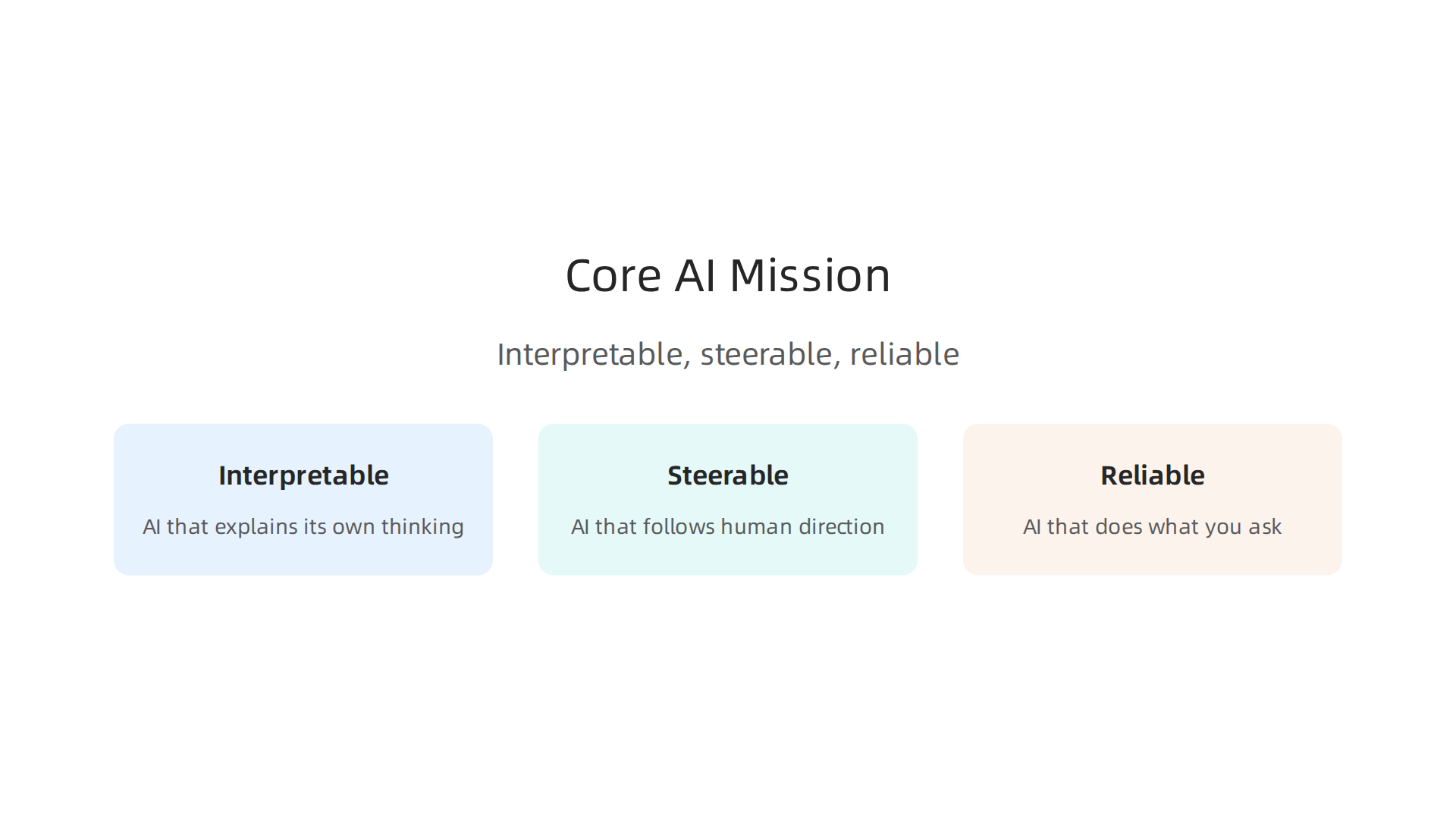
Anthropic wants to create AI that explains its own thinking. AI that follows human direction. AI that does what you ask without surprises. This focus on alignment sets Anthropic apart from companies that prioritize scale over safety.
Early on, big names in tech saw the potential. Google and Spark Capital both invested in Anthropic. That funding gave the company room to focus on research without rushing products to market.
As we look at the AI landscape in 2026, it helps to understand where each company comes from. Anthropic’s founding story explains a lot about their choices today. Want to dive deeper into how AI companies are reshaping different industries? Check out our article on AI breakthroughs that are changing gaming, 3D, and fashion in 2026.
The Core Team Behind Anthropic
Dario Amodei serves as CEO of Anthropic. Before starting the company, he led safety and alignment research at OpenAI. His background in making AI systems more predictable and controllable shapes every decision at Anthropic. As Wikipedia notes, Dario is a respected AI researcher who brings deep technical knowledge to the team. His work focuses on building models that don’t just perform well but also behave the way people expect.
Daniela Amodei is the President of Anthropic. She handles policy, operations, and the big picture strategy. Before co-founding Anthropic, Daniela worked at Stripe and OpenAI. She brings a business mindset to the safety conversation. The KITRUM article highlights how Daniela and Dario share the same belief: AI should be controllable, understandable, and trustworthy. That shared vision keeps the company moving in one direction.
The research brain trust
Anthropic didn’t stop with two founders. They brought in some of the brightest minds in AI research. Jared Kaplan and Sam McCandlish are key scientists who help drive the technical work. These researchers focus on alignment, which is the science of making AI do what humans actually want.
The team also includes Chris Olah, who works on interpretability (understanding how AI models think), and Tom Brown, who helped build some of the most advanced language models. Jack Clark handles communications and policy. Together, this group forms one of the strongest research teams in the AI world.

When you look at other AI tools like Galaxy AI or Seeing AI, you see different approaches to building with AI. But Anthropic stands out because their team was built around safety from day one. Every hire, every project, every model comes back to that original mission.
If you want to understand the real risks and benefits of this approach, check out our breakdown of what experts say about AI risks in 2026.
Constitutional AI: The Technological Core
Now that you know the people behind Anthropic, let’s talk about what makes their technology truly different. It’s called Constitutional AI, or CAI for short. This training method is the secret sauce that helps Claude, Anthropic’s AI model, behave in a safe and helpful way.
Here’s the basic idea. Most AI models are trained using something called RLHF (reinforcement learning from human feedback). That means humans spend thousands of hours rating model outputs to teach it right from wrong. It works, but it’s slow and expensive. Constitutional AI flips that approach on its head.
Instead of relying on endless human ratings, Anthropic gives the AI a set of written rules. Think of it like a real constitution for the country. This document lays out clear principles for how the model should behave. As Anthropic explains on their constitution page, this document plays a crucial role in training. The model learns to critique its own responses against these rules. It uses self-supervised learning to improve without needing a human to check every single answer.
So what does this actually do for you? Fewer harmful outputs. The AI knows, for example, not to generate hateful speech or give dangerous advice. The constitution guides its behavior at every step. Anthropic even published their research in peer-reviewed venues, adding real credibility to the approach. A study on the arXiv analyzed how CAI models trained with different constitutions performed, showing the method works in practice.
In early 2026, Anthropic released a new version of Claude’s constitution. As SiliconANGLE reported, this updated document refines how the model processes information. The BISI report notes that this constitution introduces a reason-based approach to AI alignment, with a clear ethics hierarchy. This is a big deal because it moves beyond simple rule-following into deeper value understanding.
You might be wondering how this compares to other methods. A BlueDot Impact blog highlights that Anthropic found CAI delivered real improvements over standard RLHF. The models were not only safer but also more helpful. Anthropic’s own Transparency Hub confirms they used Constitutional AI to align Claude with human values during reinforcement learning.
The beauty of this system is that it reduces the need for massive human feedback teams. The model essentially trains itself against a clear set of values. That doesn’t mean humans are out of the loop entirely. But it makes the process faster and more scalable.
If you want to see how AI breakthroughs like this are reshaping entire industries, check out our article on the AI breakthroughs in 2026 that are reshaping gaming, 3D, and fashion. It shows how safe, aligned AI can unlock new creative possibilities.
The Claude Model Family
You already know Constitutional AI is the engine. But what about the cars it powers? Let’s look at the Claude model family. It started with Claude 1 in 2023. By 2026, we are on Claude 4, with a few sub-versions like Claude 4.5 in between. Each step brought real upgrades.
Early Claude models were good but limited. They could handle short conversations and basic reasoning. Then Anthropic kept improving. The key gains came in three areas: reasoning depth, response length, and safety. The company’s own research, shared on the BlueDot Impact blog, showed that Constitutional AI made models safer and more helpful. The technique scaled better than relying only on human feedback.
Claude 4 is the biggest leap so far. It introduced tool use, meaning the model can call external functions and APIs. Hallucinations dropped significantly. The context window expanded a lot, letting you feed entire documents or codebases. And like other seeing AI tools, Claude can now analyze images. If you want to understand how image AI works, that linked article breaks it all down.
On performance, Claude 4 competes head-to-head with GPT-4 in coding, math, and creative writing. Independent tests show it matches or beats the best models. The updated constitution from early 2026 refined Claude’s ethical reasoning even further. This is not a small update. It means the model follows a clearer decision-making hierarchy, as BISI noted in their report.
The Claude family shows how fast AI is moving. In just three years, we went from a useful chatbot to a multimodal system that can code, reason, and see.
Business Strategy and Funding Landscape
So you have seen how Claude models evolved. Now let’s talk about how Anthropic turns that technology into a real business. And the numbers are huge.
Anthropic has raised a massive amount of money. In February 2026, the company closed a $30 billion Series G round led by GIC and Coatue, pushing its valuation to $380 billion. Just a few months earlier, in September 2025, they had raised $13 billion in Series F funding at a $183 billion valuation. All together, Anthropic has brought in over $40 billion from investors like Google, Spark Capital, and Salesforce. The official Anthropic announcement confirms this round was one of the largest in tech history.
But raising money is only half the story. How does Anthropic actually make money? Two main ways: API access and enterprise subscriptions. Companies pay to use Claude through the API for their own apps and workflows. Larger organizations sign enterprise deals for dedicated support, custom models, and higher security. This dual approach, as Intellizence reported, gives Anthropic recurring revenue and a strong business foundation.
Anthropic has also signed strategic partnerships with major platforms. Zoom and Notion both integrate Claude directly. That means millions of users already interact with Anthropic AI without even knowing it. This is a smart move. While some AI tools like Galaxy AI or Cluely AI focus on narrow consumer features, and trickle AI handles small automated tasks, Anthropic aims for deep enterprise integration. Claude’s seeing AI abilities, which we covered in how image artificial intelligence works, are a big part of that appeal for business customers.
The funding and strategy show that Anthropic is betting big on safe, powerful AI for the professional market.

In 2026, the competition is fierce. But with this cash and these partnerships, Anthropic is well positioned to keep growing.
Key Investment Rounds and Valuations
You might wonder how that cash pile grew so fast. Here is the timeline of the key rounds that got Anthropic to where it is today.
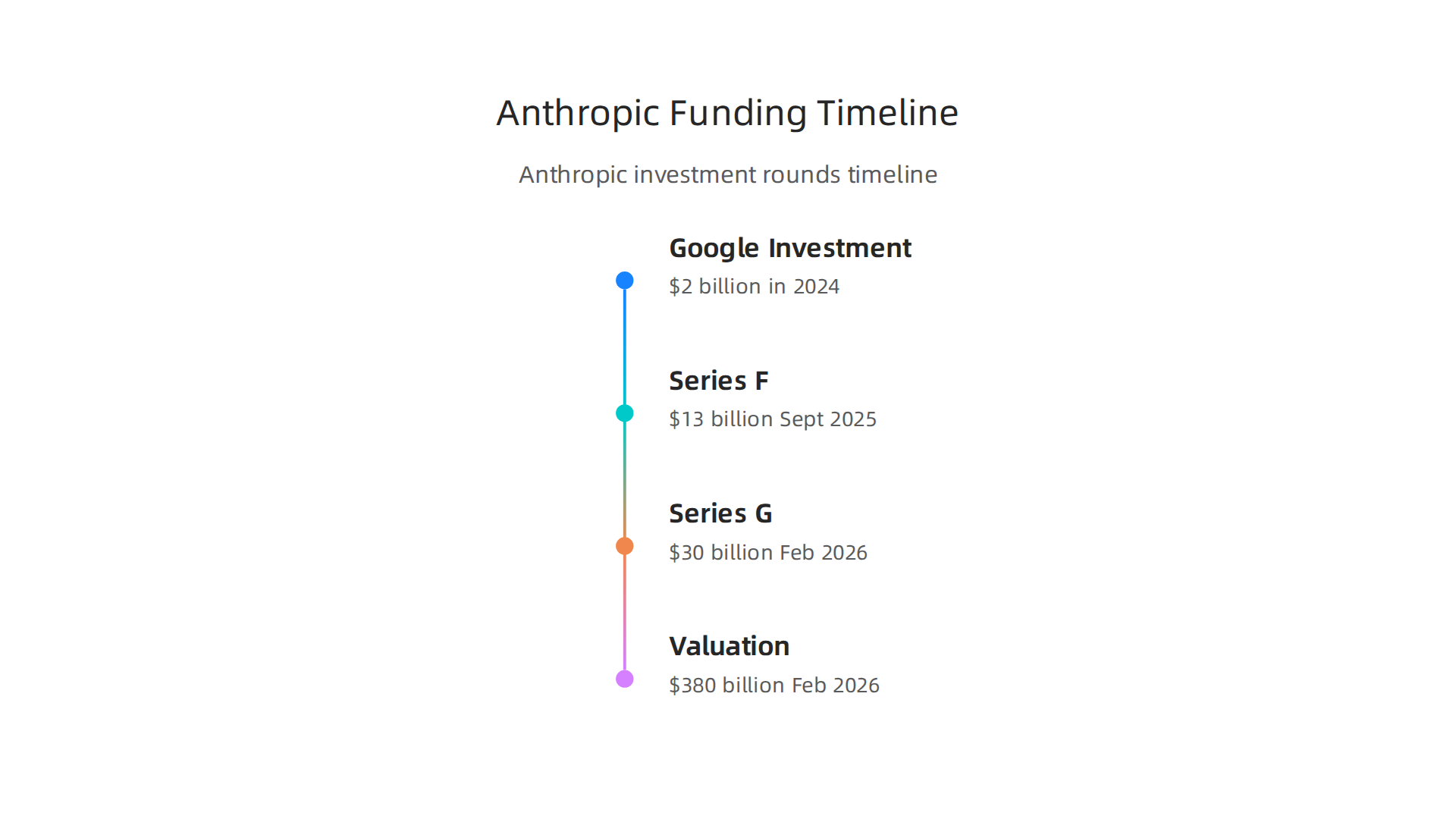
Anthropic’s valuation jumped from around $5 billion in 2024 to $380 billion in 2026. Google’s $2 billion investment in 2024 was a key moment. Insider Finance reported how this move showed huge confidence in Anthropic’s strategy.
Next came a $13 billion Series F in September 2025. It was led by ICONIQ and valued the company at $183 billion. Anthropic shared this news in their official release.
Then in February 2026, Anthropic raised another $30 billion. This Series G was led by GIC and Coatue. It pushed the company’s valuation to $380 billion, as stated in the official announcement.
These investment rounds show that anthropic ai has strong support from top global investors. Part of this excitement comes from Claude’s advanced vision abilities. The seeing ai features of the model make it very useful for enterprise customers. We cover this topic in our article on artificial intelligence imaging in 2026.
Safety and Ethical Framework
With all that funding flowing in, you might wonder: How does anthropic ai actually make sure its models are safe? That’s a fair question, especially when powerful systems like Claude can see, read, and reason at superhuman levels.
Anthropic’s answer is a multi-layered safety framework. It includes three main parts: red-teaming, interpretability research, and a responsible deployment policy.
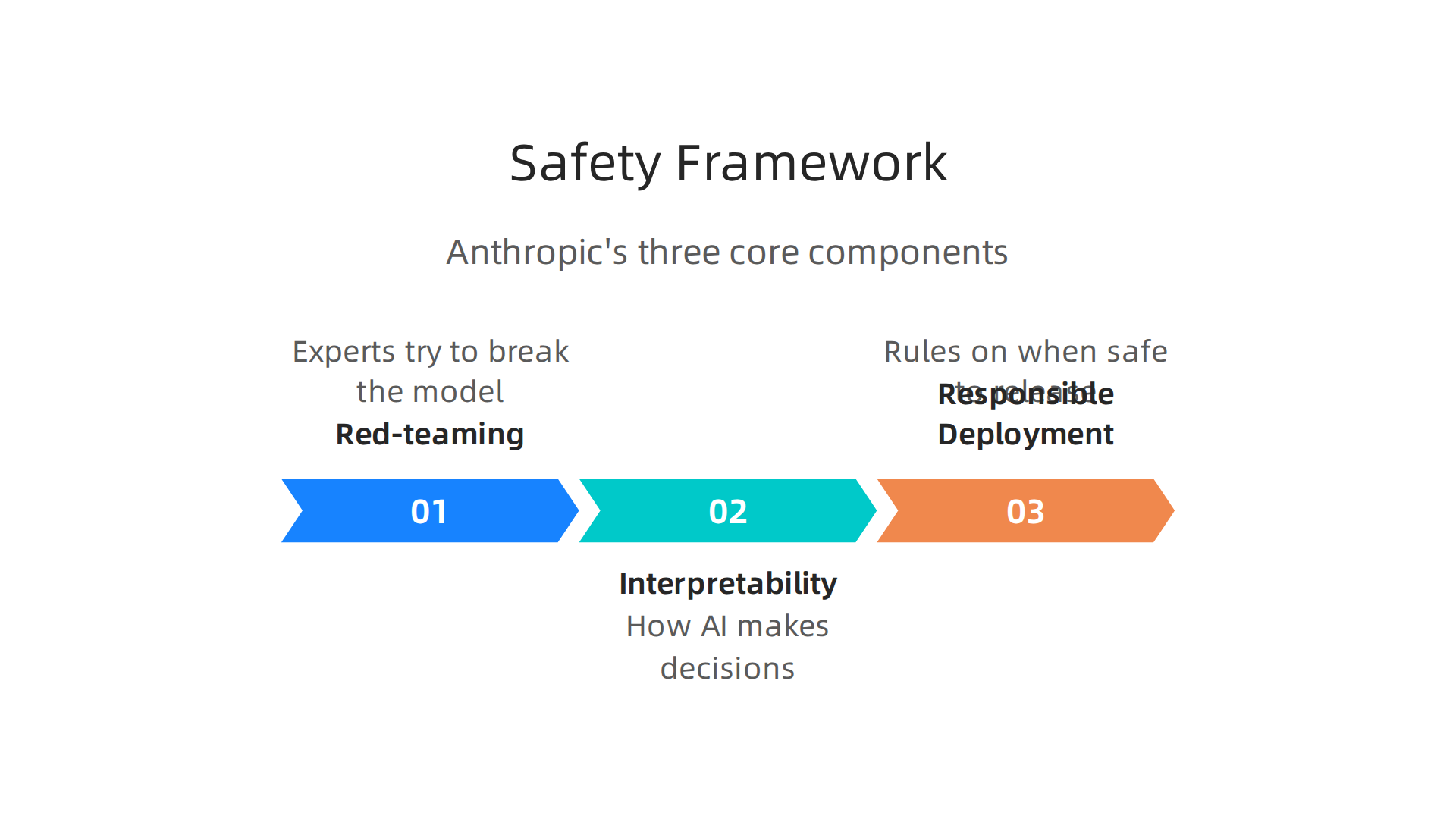
Red-teaming means hiring experts to try to break the model. They look for biases, dangerous outputs, or loopholes. Interpretability research digs into how the AI makes decisions. Think of it as looking under the hood of a car to understand every part. And the responsible deployment policy sets clear rules on when a model is safe enough to release.
In early 2026, Anthropic released version 3.0 of its Responsible Scaling Policy. This voluntary framework sets safety thresholds for increasingly capable AI. The company also updates its Frontier Safety Roadmap to track progress against concrete goals.
Transparency is a big part of the approach. Anthropic publishes system cards, model documentation, and a Transparency Hub that lays out voluntary commitments. These documents help developers and regulators understand what the model can and cannot do.
Not everyone is convinced. A 2025 analysis from The Midas Project argues that Anthropic’s framework needs more clarity and stronger precautionary thresholds. It’s a healthy reminder that safety is a moving target. As AI grows more capable, the rules must keep pace.
These efforts matter beyond one company. When galaxy ai, cluely ai, or trickle ai build products on top of Claude, they inherit this safety culture. Features like seeing ai vision tools become more trustworthy when backed by rigorous testing.
If you want to understand the broader risks of advanced AI, check out our guide on what experts say about the real risks in 2026.
Competitive Landscape: Anthropic vs. Peers
So where does anthropic ai actually stand against the giants? You’ve seen the safety work and the massive funding. But the real test is how Claude stacks up against OpenAI, Google DeepMind, and Meta.
Here’s the short version. The race is tight, and it’s changing fast.
OpenAI still leads in mindshare with GPT-4o and o1. But Claude is catching up faster than most people realize. According to a May 2026 analysis from Claude AI Stats, Anthropic closed a $30 billion Series G at a $380 billion valuation in February. That is not a small bet.
Where the numbers stand
Data from early 2026 tells a clear story about enterprise adoption. The Ramp AI Index update from March 2026 shows that Anthropic now wins about 70% of head-to-head matchups against OpenAI among businesses actually buying AI services. That is a huge swing.
And it gets more interesting. A MindStudio report from May 2026 found that for the first time, Anthropic surpassed OpenAI in business adoption at 34.4% versus 32.3%. This shift happened because Claude differentiates on safety, large context windows you can actually use, and deep enterprise trust.
OpenAI is not standing still. Their numbers from July 2025 showed them ahead at 36.5% business adoption versus Anthropic at 12.1%, according to OpenAI vs Anthropic statistics. But the gap is closing dramatically. Meta’s Llama and Google’s Gemini are also in the mix, though neither has matched Claude’s enterprise momentum.
Why this matters for builders
If you are building tools with galaxy ai, cluely ai, or trickle ai, the choice of underlying model matters a lot. Claude’s edge in safety and reliability means fewer surprises when your product scales. Features built on seeing ai vision tools become more trustworthy when the model behind them has rigorous testing.
The competition is healthy. It pushes everyone to improve. But the data in 2026 is clear. Anthropic is no longer the underdog. It is a real contender.
If you want to understand how these tools can help your career, check out our practical guide on how to succeed as a data analyst in 2026.
Real-World Adoption and Use Cases
The numbers we just looked at tell you where Anthropic is winning. But they do not tell you why. The real story of anthropic ai in 2026 is about specific jobs that get done better with Claude.
Think about the sectors that cannot afford mistakes. Healthcare, finance, and legal.

These are not areas where you want a black box that might hallucinate a wrong answer.
In healthcare, hospitals use Claude to read through patient records and clinical trial documents. The model can spot patterns in data that humans miss. And because Anthropic built Claude with safety first, the outputs are more reliable for sensitive health information.
Finance firms use Claude for compliance work. Think about reading thousands of pages of new regulations. Claude can summarize those documents and flag risks. A report from Anthropic’s own Economic Index study found that coding and technical writing tasks make up the largest share of Claude usage, but document analysis is growing fast.
Legal teams use Claude for contract review and due diligence. They need a model that cites sources and explains its reasoning. That is where Claude shines compared to more opaque models.
For developers, Claude’s API is a workhorse. Teams are building conversational agents and coding assistants on top of it. Tools like galaxy ai, cluely ai, and trickle ai can all tap into Claude’s strengths. And seeing ai vision tools become more trustworthy when the vision model behind them is well tested.
A Ramp AI Index update from March 2026 shows that businesses buying AI services now prefer Claude over OpenAI about 70% of the time. Why? Because Claude delivers measurable productivity gains without the risk.
If you want to see how AI imaging is changing other industries, check out our guide on artificial intelligence imaging breakthroughs in 2026.
Future Roadmap and Open Questions
The adoption numbers and real world use cases we just covered make one thing clear. Anthropic AI is already a major force in the industry. But the really exciting question is what comes next. Where is this technology heading in 2026?
Anthropic has hinted strongly at what is coming. We will likely see Claude 5 with full multimodal capabilities and much deeper reasoning. That means Claude will not just read text. It will look at images, listen to audio, and understand video. It will connect ideas across different formats in a way that feels more human. A look at Anthropic’s model history shows each version has made a big leap in capability. Claude 5 could be the biggest yet.
The company is also investing heavily in mechanistic interpretability. That is a fancy term for making a model’s internal thinking transparent. Right now, even the engineers who build AI often cannot fully explain why a model gives a specific answer. Anthropic wants to change that completely. They want to open the black box. Their new Anthropic Institute agenda shows they are serious about studying real world impacts and publishing everything they learn.
Of course, the road ahead has real challenges. Scaling safety research gets harder as models become smarter. And governments around the world are racing to write new AI rules. Anthropic will need to navigate increasingly complex regulations while keeping its competitive edge.
Here is the bigger picture. As Claude improves, every tool built on top of it improves too. Platforms like galaxy ai, cluely ai, and trickle ai will gain better reasoning abilities. Vision tools like seeing ai will become more trustworthy. The future of anthropic ai shapes the future of AI for everyone.
If you want to understand how AI vision is advancing alongside these language models, read our guide on AI imaging breakthroughs in 2026.
Lessons for the AI Industry
What can other AI companies learn from Anthropic’s rapid rise? Plenty. The company’s story offers three big takeaways for anyone building or investing in AI right now.
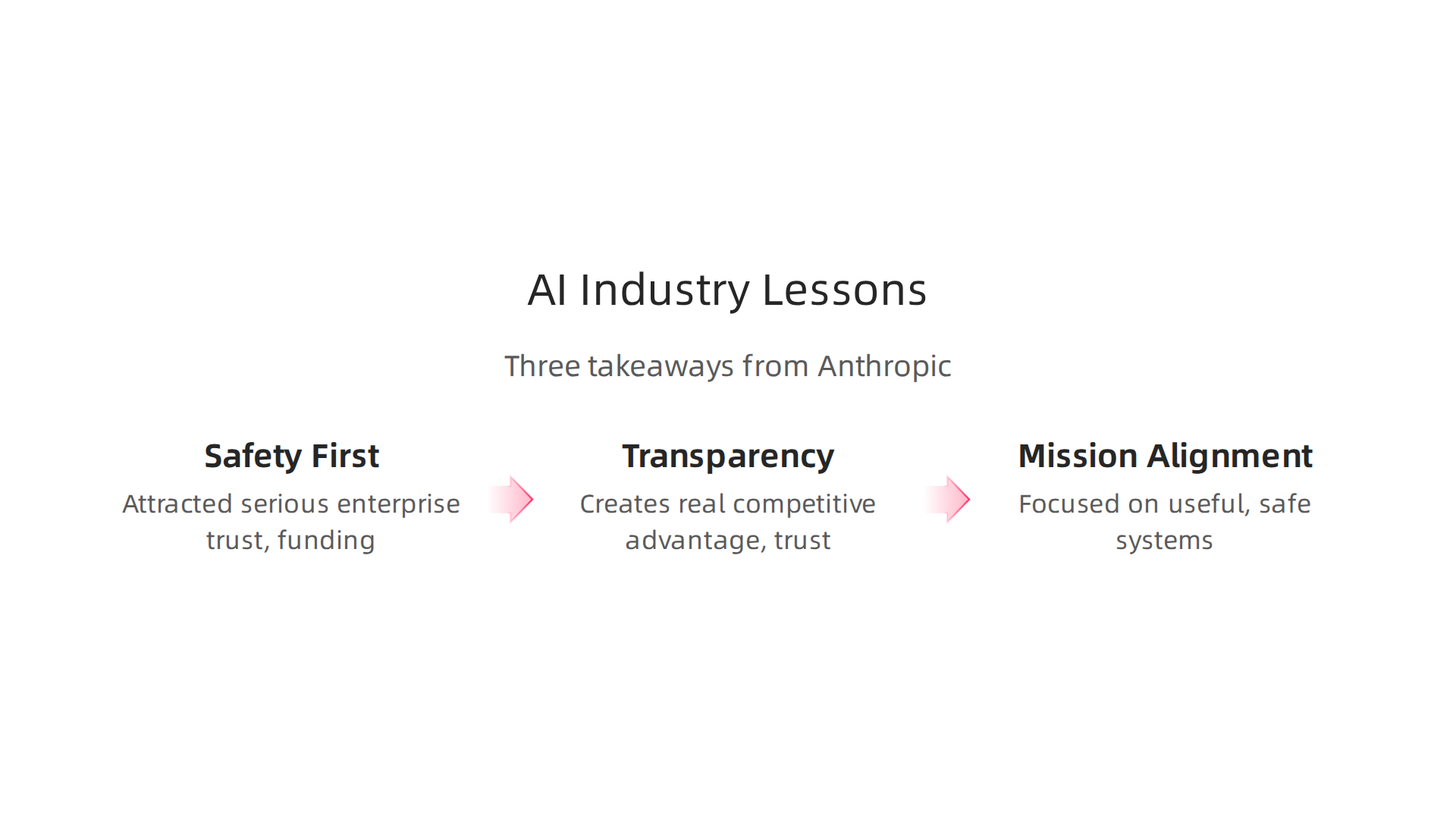
First, a safety first brand actually works. For years, many tech insiders thought talking about safety would scare off customers and investors. Anthropic proved the opposite. By openly prioritizing reliability and interpretability, the company attracted serious enterprise trust and massive funding. Their history of disciplined model releases shows that safety did not slow them down. It sped them up.
Second, transparency creates real competitive advantage. Anthropic publishes its research openly, including detailed economic impact reports that track how people actually use Claude. This openness builds trust with regulators, researchers, and customers. While other labs keep their data hidden, Anthropic shares lessons that help the whole field move forward. That makes them the team everyone wants to work with.
Third, mission alignment matters more than hype. Anthropic stayed focused on building useful, safe systems instead of chasing every trend. They scaled carefully and kept their team aligned around a clear purpose. The result is a $380 billion valuation and a product that businesses actually rely on every day.
For founders and investors watching the space, these lessons are gold. If you want to understand how AI is reshaping specific roles, check out our guide on how to succeed as a data analyst in 2026. The tools are changing fast, but the principles that drive real success stay the same.
Summary
Anthropic AI is a safety-first AI lab founded in 2021 by Dario and Daniela Amodei and former OpenAI researchers, focused on building interpretable, steerable, and reliable models. The company’s signature innovation, Constitutional AI (CAI), trains models to critique and follow a written set of principles, reducing reliance on massive human feedback while improving safety and helpfulness. Anthropic’s Claude family has evolved quickly — now multimodal with tool use, long context windows, and stronger reasoning — and competes closely with top models in enterprise settings. Massive funding rounds and strategic partnerships have pushed adoption into healthcare, finance, legal, and developer tools where reliability matters most. The article explains Anthropic’s research team, funding history, safety framework, real-world deployments, and how its approach shapes the wider AI ecosystem. Readers will come away understanding CAI, Claude’s practical strengths, business implications, and what to watch next as the company scales and navigates regulation and technical risk.