
Why AI ethics + future predictions matter now
In 2026, artificial intelligence is changing our world faster than ever. New AI tools and breakthroughs appear almost every day. This rapid growth can make it hard for leaders and businesses to keep up. It’s easy to feel overwhelmed by all the choices and new information.

When things move this quickly, it becomes super important to have clear rules to guide us. These rules help make sure AI is used in a good way, helping people rather than causing problems.
This is where understanding AI ethics comes in. Ethical rules act like a map for how we build and use AI. One very important guide that many people in tech look at is the AI Principles – Google AI. These are a set of ideas that Google shared to explain how they think about making AI. They talk about things like making AI helpful for society and avoiding unfairness, which is really important for any future generation computer systems. These google ai principles help everyone, from big companies to small teams, think about the right way to develop AI.
This article will help you understand these big ideas clearly. We will look at what the google ai principles mean for you and your work. You will get practical tips and ideas to help you lead in this fast-changing world of AI. We will also look ahead, exploring future predictions for AI and how ethical thinking can help prevent issues like an "ai singularity" that some worry about. This will give tech leaders a forward-looking set of takeaways, especially in fields like education and information technologies, to navigate the future with confidence.
Want to stay informed about the latest AI news and insights?
The AI Newsletter Worth Reading
What the ‘Google AI Principles’ actually say — a concise breakdown
So, what exactly do the google ai principles mean for people making and using AI? They are a set of ideas Google put forth in 2018 to guide how they create and use AI. Think of them as a compass for keeping AI on a good path. These principles help make sure that AI works for everyone, not just a few.
The main ideas in the AI Principles – Google AI can be put into two groups: things to aim for and things to avoid.
Things to Aim For (Objectives)
These are the goals Google sets for its AI creations. They want AI to be:
- Good for Society: This is about making AI helpful. It should improve people’s lives and solve big problems, not just small ones. For example, AI could help in areas like healthcare or understanding climate change.
- Fair: AI should treat everyone fairly. It should not make things worse for certain groups of people because of their background, race, or gender. This means checking that AI systems do not have hidden biases. Ensuring fairness is a big part of creating responsible AI.
- Safe and Secure: AI systems must be built to be safe. They should not cause unintended harm or create risks. This involves careful testing and design to make sure the AI does what it’s supposed to, without bad surprises.
- Accountable: People need to be in charge of AI, not the other way around. If something goes wrong with an AI system, humans should be able to understand why and fix it. This means making AI systems that can be explained.
- Transparent: It should be clear when you are interacting with an AI system. People should know if they are talking to a human or a computer program.
- Built for Privacy: AI often uses a lot of data. It’s really important to protect people’s private information. This means designing AI systems that keep personal data safe and private.
- Scientifically Strong: Google wants to make sure its AI is built on good science and engineering. They want to push the boundaries of what AI can do in a thoughtful way.
Things to Avoid (Prohibited Applications)
Just as important as what to aim for, are the things Google says its AI will not do. They won’t make AI for:
- Weapons that can harm people or fight wars on their own.
- Ways to watch people that go against human rights.
- Tools that try to make things unfair for people, like predicting who might be arrested.
- Technology that causes harm on a wide scale.
These rules show that the company wants to be careful with powerful future generation computer systems. While these principles are a strong guide, putting them into practice can sometimes be complex. For example, what one person sees as "socially beneficial," another might see differently. Also, completely avoiding unfair bias can be hard because the data AI learns from can sometimes have old biases built into it. However, having these clear guidelines is a critical step for tech leaders, especially in fields like education and information technologies, as they work to make AI truly helpful and trustworthy in 2026 and beyond.
We just looked at the Google AI Principles. But Google is not the only group thinking about how to make AI good and safe. Many other groups, companies, and governments have made their own sets of rules. These different sets of rules are called AI ethics frameworks. They all want AI to be used for good, but they try to get there in different ways.
There are a few main kinds of these rules. Knowing them helps us see how different groups are trying to guide AI.

Types of AI Ethics Frameworks
- Principle-Based Frameworks: These are like the google ai principles. They give big ideas or goals for AI. They talk about things like fairness, being safe, and protecting privacy. They are broad guides, not strict laws. Many organizations, like the OECD, use principles to suggest how AI should be built and used.
- Rights-Based Frameworks: These frameworks focus on human rights. They make sure AI does not take away people’s basic rights, like privacy or freedom. They want AI to serve people, not hurt them. The IEEE is one group that talks about human rights in its AI rules, as noted in a study comparing AI ethics guidelines AI Ethics and Transparency.
- Risk-Based Frameworks: These rules look at how much danger an AI system might cause. If an AI system could cause a lot of harm, it gets stricter rules. If it causes very little harm, the rules are lighter. The European Union’s AI Act is a good example of this kind of framework, putting rules on AI based on its risk level.
- Standards-Based Frameworks: These give clear, step-by-step instructions or checklists. They help people who are building AI know exactly what to do to make it safe, fair, and reliable. Groups like NIST offer these kinds of guidelines.
How Different Frameworks Compare
It can be helpful to see how these types of rules stack up against each other. Here is a simple table to compare them.
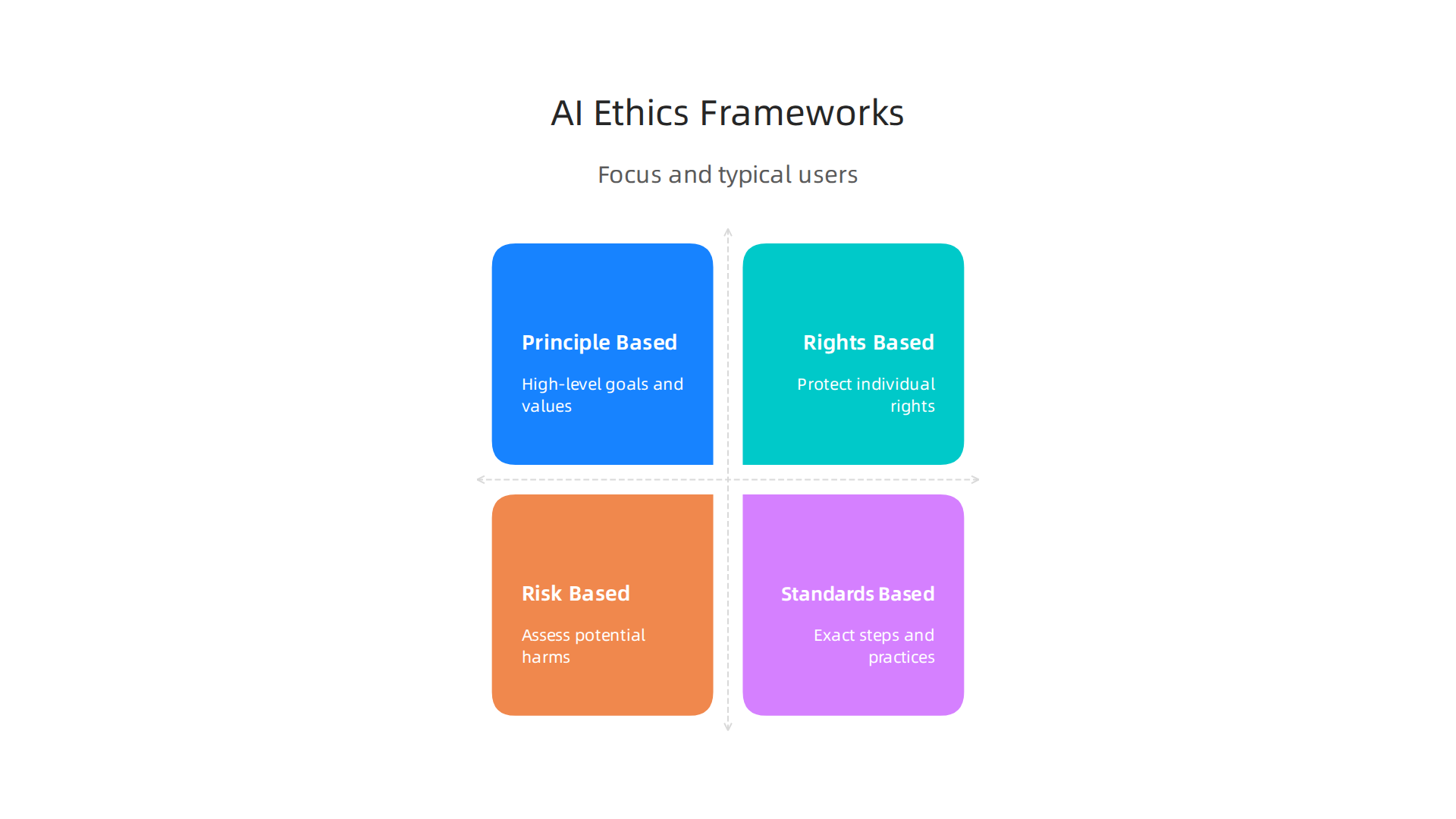
Many frameworks have been compared to help us understand their focus and limitations in 2026, as discussed in Ethical AI Frameworks Compared (2026).
| Type of Framework | What it focuses on | Who usually uses it |
|---|---|---|
| Principle-Based | Big ideas, general goals for AI | Companies, international groups |
| Rights-Based | Protecting people’s basic rights | Human rights groups, governments |
| Risk-Based | How much harm AI might cause | Governments, law makers |
| Standards-Based | Exact steps, best ways to build AI | Engineers, companies building AI |
Choosing the Right Rules
For teams and companies, picking the right framework is a big decision. It depends on what they want to achieve and what kind of AI they are building.
- If you need a law to make sure AI is safe, a risk-based framework might be the best. It sets clear rules for high-risk AI.
- If you need a guide for your engineers to follow every day, standards-based frameworks are very helpful. They provide practical steps.
- Principle-based rules offer more freedom but might not be strict enough for certain uses.
The main challenge is finding a balance. You want rules that protect people but also let new AI ideas grow. A team needs to think about their project, the people who will use the AI, and the laws in their country. Getting this right is key to strategic tech exchange for enterprise AI adoption and making sure AI serves everyone well. Understanding how these frameworks work helps leaders create a strong plan for AI. For more guidance on choosing the right model, you can explore an AI Governance Frameworks Overview: Which Model Is Right?. It’s like having a good roadmap for AI governance in 2026.
Every set of rules has its good parts and its not-so-good parts. The google ai principles are a great example of this. They set a high bar for how AI should be built, but they also have some challenges.
Where the principles succeed
First, let’s look at what the Google AI Principles do well.
- Clear Goals: These principles make it very clear what Google wants to achieve with AI. They talk about making AI helpful, safe, and fair. For example, they say AI should be socially good and not create unfair bias. This gives everyone a good idea of the main goals for AI.
- Big Influence: When a large company like Google shares its AI principles, other companies and groups often follow suit. These principles have helped shape how the whole industry thinks about ethical AI. They encourage others to also think carefully about the kind of AI they are making. This helps set basic rules for everyone working on AI.
- Focus on People: The principles really care about how AI affects people. They want AI to help humanity, not hurt it. They push for AI that is built and tested for safety and that respects privacy. This focus helps make sure that the future of AI keeps people’s well-being at its heart.
Where the principles fall short
Even with all these good points, there are some places where the Google AI Principles face challenges.
- Vague Rules: Sometimes, the principles can be a little unclear. They give big ideas, but they don’t always tell people exactly how to make sure AI follows those ideas. It’s like saying "be kind" without saying "here are three ways to be kind today." This can make it hard for engineers and developers to know the exact steps to take in their daily work.
- Hard to Enforce: Since the principles are more like guidelines than strict laws, it can be tough to make sure everyone follows them all the time. What happens if an AI system doesn’t quite meet a principle? Who decides, and what are the consequences? A study found that while Google’s principles show progress, they could still do more to protect human rights, which is a key part of fair AI use.
- Tough Choices: In the real world, building AI often means making hard choices. Sometimes, being super transparent about how AI works might make it less secure, or vice versa. The principles don’t always give clear answers on how to handle these trade-offs. It’s tricky when you have to balance different good things that might conflict with each other. This is a common issue with principle-based frameworks, which prioritize high-level guidance over specific, actionable instructions.
Understanding these strengths and weaknesses helps us see that guiding AI into the future is a complex task. It’s not just about stopping bad things from happening, but also about making sure AI truly serves everyone. To get a deeper look into the rules for AI, you can read more about navigating the future of AI ethical governance and smart enterprise adoption. It’s a journey that requires ongoing thought and changes as AI keeps growing.
The big ideas behind AI rules, like the Google AI Principles, are not just for smart thinkers in labs. They have real effects on how companies work every day. From deciding what new AI tools to build to where to put money, these principles help shape big choices.
For Product Teams: Shaping the AI Roadmap
Product teams are the people who make new AI tools. For them, the Google AI Principles turn into actual steps. When they plan a new product, they must think: "Is this AI fair? Is it safe for everyone?" For example, if they are building an AI that helps decide who gets a loan, they need to check that it doesn’t treat some groups of people unfairly. This is called avoiding bias. Building ethical AI means looking at these principles from the start, as part of the product’s journey. It helps them make sure that their AI products work well and do good in the world. Guidelines often help teams operationalize ethics and identify which principles are most important for their specific AI use cases and context 1.
For Executives: Managing AI Risks
For company leaders and executives, AI principles are about managing risks. They need to turn big ideas like "be accountable" into clear plans. This means figuring out what could go wrong with an AI system and how to stop it. For instance, an executive might need to set up rules for how their company uses AI to avoid problems like privacy breaches or unfair decisions. Experts suggest that a mix of internal rules, working with others, and clear government oversight helps balance new ideas with doing the right thing 2.

It’s also about understanding the bigger picture of AI safety, as covered in reports like the International AI safety report 2026, which highlights how AI can cause real harm if not handled carefully 3. These leaders must also think about how their decisions today affect future generation computer systems and the bigger world of education and information technologies.
For Investors: Due Diligence and Future Value
Investors put money into companies, hoping they will grow. For them, understanding how a company follows AI principles is part of checking if it’s a good investment. If a company ignores ethical rules, it could face big problems later, like lawsuits or losing trust from customers. This can hurt its value. So, investors look for companies that build AI responsibly. They want to see that companies have plans to deal with AI risks. This is part of doing their "due diligence." It shows that a company is thinking long-term and building technology that will last and be trusted.
Organizational Levers: Making Principles Work
To really use AI principles, companies need the right tools and ways of working.
- Processes: This means having clear steps for how AI is designed, tested, and used. Things like checklists and audits help make sure principles are followed. For example, an ethical AI audit checklist helps companies regularly check their AI systems 4.
- Roles: Companies might need special teams or people whose job is to focus on AI ethics. These roles help guide others and make sure the company stays on track.
- Tooling: Special software can help measure if an AI system is fair or if it has problems. These tools help turn fuzzy principles into clear data.
Putting these things in place helps a company build an AI ethics framework and governance model that really works 5.
Strategic Choices for Leaders
Leaders often face tough choices when it comes to AI. They need to decide how much to invest in ethical safeguards versus quickly launching new products. The Google AI Principles push them to always think about people and fairness first. It’s about finding a balance between making amazing new things and making sure those things help everyone. These principles guide big decisions about what kind of AI the world needs and how to get there safely. For more guidance on this, leaders can explore The Leaders Playbook for AI Governance in 2026.
Staying on top of these fast changes in AI is key for anyone involved in technology. Get clear daily AI updates from The AI Newsletter Worth Reading.
Regulatory and Standards Outlook Through 2026 and Beyond
As 2026 unfolds, the world of artificial intelligence is seeing a big push for more rules and clear ways of working. This isn’t just about what companies decide on their own, like the Google AI Principles. It’s also about what governments and industry groups are putting in place. We are moving towards a time where AI governance is a mix of company guidelines, actual laws, and accepted industry standards.
A Patchwork of Global Regulations
In 2026, there isn’t one single law that covers all AI everywhere. Instead, it’s like a patchwork quilt with different rules in different places. Many countries are creating their own AI policies and legal frameworks to deal with concerns about AI safety and how it is managed around the world AI Regulations around the World – 2026. For example, the European Union has its strong AI Act, which is the only big, risk-based AI law right now. It has strict rules that companies must follow or face penalties The 2026 global AI regulation landscape | RAIL. This act sets clear deadlines for companies to follow certain transparency rules for high-risk AI systems by August 2026 2026 Year in Preview: AI Regulatory Developments for Companies ….
Meanwhile, in the United States, there isn’t one big federal AI law. Instead, many states are making their own rules. This means companies often have to deal with a lot of different state laws U.S. Artificial Intelligence Law Update: Navigating the Evolving State …. Even with these different approaches, there’s a global agreement that AI needs to be handled carefully. This complex picture makes staying on top of decoding AI trends 2026 breakthroughs investment and governance a crucial task for businesses and leaders.
How Company Principles Meet the Law
Company policies, like the Google AI Principles, are a company’s promise to build AI responsibly. These principles act as a guide for internal decisions, pushing teams to think about fairness, safety, and accountability from the start. However, these company-specific principles also need to work together with actual laws and industry standards.
For instance, an industry standard like IEEE 2863-2026 – IEEE SA gives practical steps for how organizations should develop and use AI in an ethical way. So, a company might use its own google ai principles to set a high bar, and then use industry standards to meet that bar in practice. When governments create new laws, these laws often build on common ethical ideas that companies like Google have already thought about. This helps everyone, from product teams to those looking at future generation computer systems, to move forward in a safer, more predictable way.
Near-Term Priorities for Product and Policy Teams in 2026
For product and policy teams, keeping an eye on new rules in 2026 is vital. Some key things to watch include:
- Watermarking AI Content: By December 2026, there will be rules about putting special marks on content made by AI. This helps people know if what they are seeing or reading was created by a machine Global AI Regulation in 2026: Key Laws and Policies ….
- Preventing Harmful AI: New rules are coming to stop AI from creating harmful images without consent.
- Managing High-Risk AI: Many regions are focusing on AI systems that have a big impact on people’s lives, like those used in hiring or healthcare. These will have more strict rules.
Experts note that AI regulation in 2026 will not be defined by a single law, but by many different rules around the globe 2026 AI Regulation Guide for Legal and Compliance Leaders. Understanding this mix of global and local rules is key for navigating the future of AI ethical governance and smart enterprise adoption and for leaders in education and information technologies. It helps companies make sure their AI products not only work well but also follow the rules and do good for society.
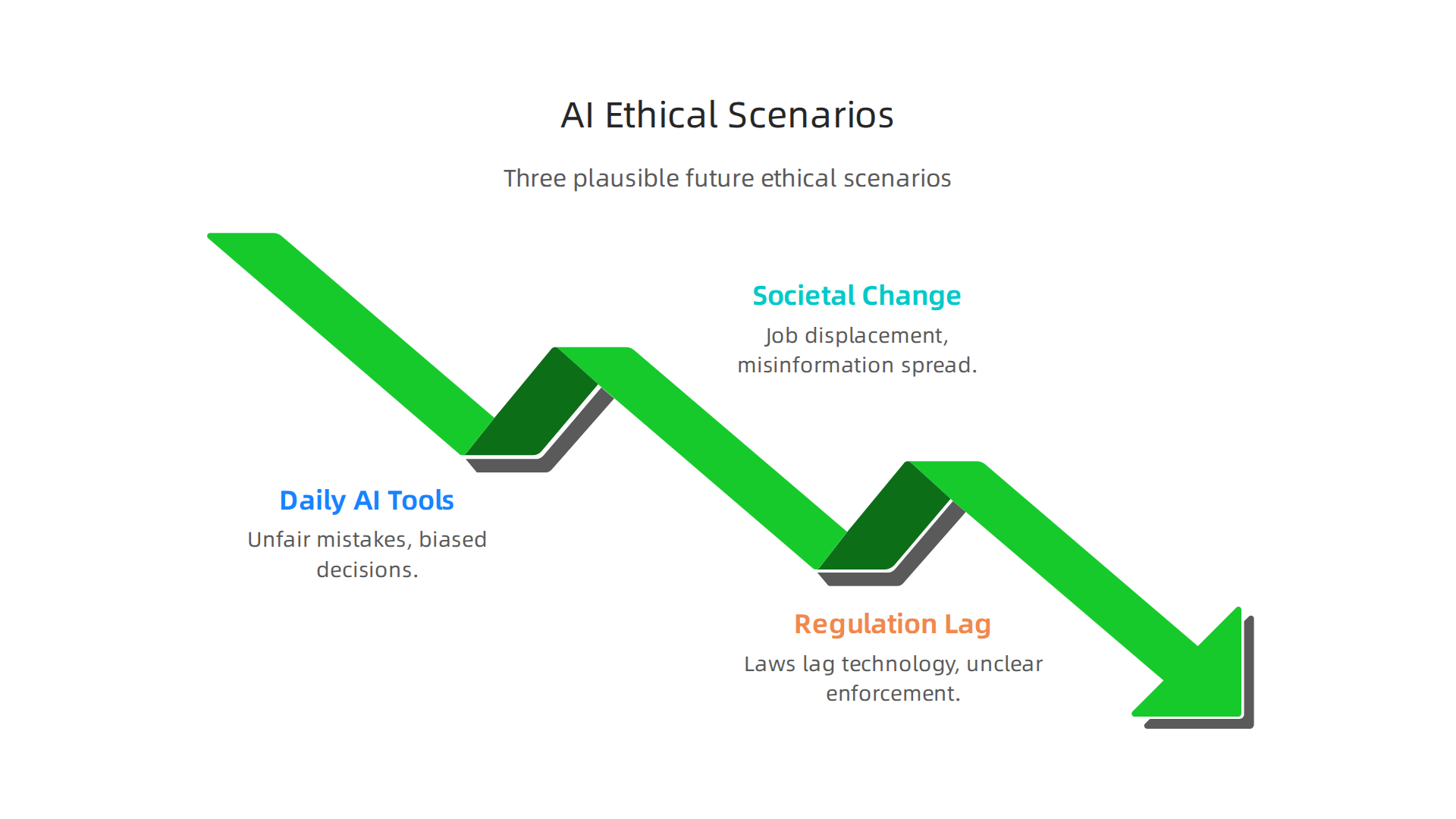
As 2026 continues, even with careful rules and guidelines like the google ai principles that many companies follow, there are still many ethical challenges ahead for artificial intelligence. Thinking about what might happen next helps us be ready for any changes. Here are three possible scenarios where AI could cause ethical problems.
Scenario 1: Daily AI Tools Go Wrong
Imagine the AI systems we use every day, like those that help decide who gets a job interview or a bank loan, start making unfair mistakes. This is called an operational ethical stress.
- What might cause it: These problems can start because the data used to train the AI isn’t balanced, or because the people making the AI didn’t think about all the ways it could be used. Sometimes, the AI systems are just too complex to fully understand why they make certain choices. A closer look at different kinds of AI risks shows how often human decisions are behind these issues, almost as much as the AI systems themselves The AI risk repository: a meta-review, database, and taxonomy of risks from artificial intelligence.
- What could happen: If the AI is biased, it could treat some people unfairly, making it harder for them to get jobs or needed services. This can lead to a loss of trust in AI and serious problems for the companies using it. For example, issues like AI models female bias need to be carefully understood.
- Things to watch for: We might see more public complaints about AI decisions, news reports about unfair outcomes, or audits that show hidden biases in AI tools.
Scenario 2: Big Changes for Society
This scenario looks at how AI might change our whole society. This is a societal ethical stress.
- What might cause it: As AI gets smarter, it could take over many jobs, leading to big changes in the workplace. It could also spread false information very quickly or make it harder for everyone to access new technology fairly, creating a digital divide.
- What could happen: We might see more people out of work in certain areas, and a lot of fake news making it hard to know what’s real. This could cause social problems and put pressure on areas like education and information technologies to adapt quickly. Some even worry about distant ideas like ai singularity, where AI might become much smarter than humans, though that’s still a far-off concern. Experts are already looking at potential AI dangers that could affect national security and the economy Global experts assess risk of AI catastrophes.
- Things to watch for: Keep an eye on how many jobs AI is affecting, how fast misinformation spreads, and if more people are left behind by new technologies.
Scenario 3: Rules Can’t Keep Up
This scenario deals with the challenges of making and enforcing rules for AI. This is a regulatory ethical stress.
- What might cause it: AI technology changes so fast that laws often can’t keep up. Also, different countries have different rules, which can make it confusing for businesses. It’s hard to make sure everyone follows the rules.
- What could happen: Companies might struggle to understand and follow all the different laws, slowing down new AI ideas. There could be conflicts between countries over how AI should be used, and even issues for future generation computer systems as they try to fit into all these rules. This makes AI regulatory compliance in 2026 a tricky area for businesses.
- Things to watch for: Look for new lawsuits about AI, calls for worldwide agreements on AI, and companies saying they find it hard to follow all the rules. Policy experts also see new ethical issues for 2026 in the areas of AI autonomy and the economic impact of AI Top AI ethics and policy issues of 2025 and what to expect in 2026.
These are just some paths AI could take. No one knows for sure what will happen. But by thinking about these possible problems now, and by sticking to strong ethical guides like the google ai principles, we can all work to make sure AI helps society in good ways.
After looking at the possible ethical challenges AI might bring, the next important step is to actually put ethical practices into action. Making sure AI is used fairly and responsibly isn’t just about having good intentions. It needs clear steps and a plan.
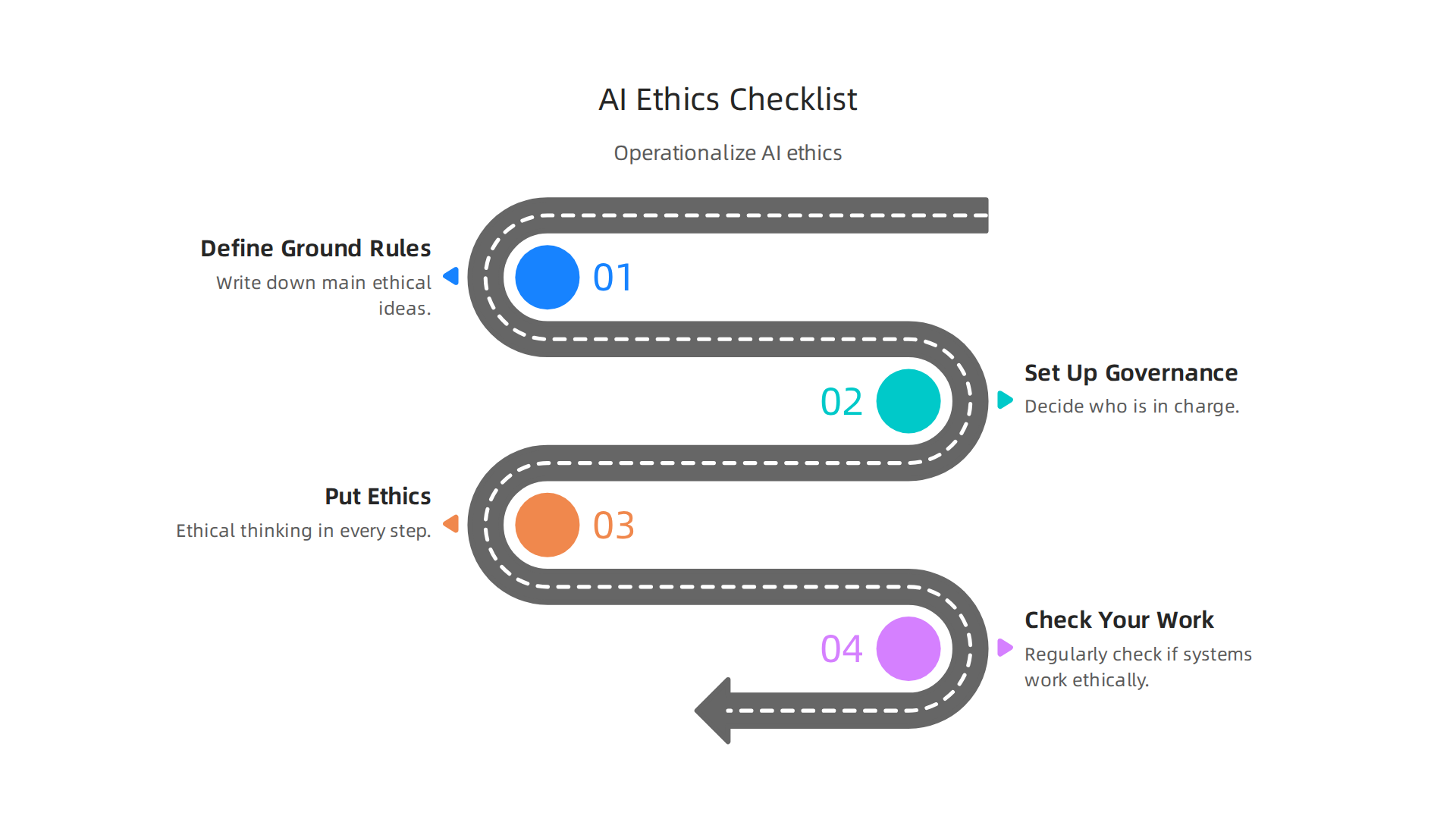
Here’s a simple checklist to help your organization make AI ethics a real part of how you work, building on ideas like the google ai principles.

Practical checklist: operationalizing AI ethics in your organization
1. Define Your Ethical Ground Rules
- What to do: Start by writing down the main ethical ideas that matter most to your company and your AI projects. Think about fairness, transparency, and being accountable. Use guides like the google ai principles as a starting point.
- Quick Win for Small Teams: Have a short meeting to agree on 3-5 core values for your AI use.
- For Larger Organizations: Create a full document of ethical principles, identifying which ones are important for your context and AI tools. This helps set up clear operational ethics guidelines.
2. Set Up How Ethics Will Be Managed (Governance)
- What to do: Decide who is in charge of AI ethics. This might be a special team, a person, or part of an existing group. Create clear rules for how ethical decisions are made. Having strong AI ethics governance helps keep things fair.
- Quick Win for Small Teams: Appoint one person to be the "ethics champion" for each AI project.
- For Larger Organizations: Develop a full AI governance framework. This includes internal controls and ways to involve different groups of people, balancing new ideas with ethical safety. This helps leaders manage AI risks, as described in a Director’s Guide to AI Governance. You can find more detailed guidance in The Leaders Playbook for AI Governance in 2026.
3. Put Ethics Into Your Daily Work
- What to do: Make sure ethical thinking is part of every step of building and using AI. From the very first idea to the finished product, think about how AI might affect people. This means including ethical checks during design, development, and when you put AI into action.
- Quick Win for Small Teams: Add a simple "ethics check" question to your weekly project meetings.
- For Larger Organizations: Embed ethics into your standard development process. This includes looking at ethical concerns for AI compliance and building an AI ethics framework and governance model that includes risk assessment.
4. Check Your Work and Make Changes
- What to do: You need to regularly check if your AI systems are actually working ethically. This involves looking at data, asking for feedback, and doing special "ethics audits." This way, you can find problems and fix them. It’s about making ethics measurable.
- Quick Win for Small Teams: Set up a way for users to easily report problems or concerns about the AI.
- For Larger Organizations: Use specific measures to check if your AI meets ethical standards. Do regular ethical AI audits to make sure everything is working as it should. This helps to make AI ethics real and allows for measurement and assessment. For more on this, check out Ops technology for AI professionals pilot and measure success.
By following these steps, companies can not only avoid problems but also build AI that people trust. Keeping up with the newest insights is also key to ethical AI deployment. If you want to stay ahead in the fast-changing world of AI, you should definitely sign up for The AI Newsletter Worth Reading to get daily updates.
Summary
This article explains why AI ethics and future-focused predictions matter for leaders in 2026, using Google’s AI Principles as a practical example. It breaks the principles into objectives (like fairness, safety, transparency and privacy) and prohibited applications, then compares different types of AI ethics frameworks — principle-, rights-, risk-, and standards-based — to help teams choose the right approach. The piece discusses strengths and limits of corporate principles, how they influence product teams, executives, and investors, and outlines organizational levers (processes, roles, tooling) to make ethics real. It also surveys the evolving regulatory landscape and near-term rules to watch, and offers three plausible ethical-stress scenarios that could cause harm. Finally, you get a concise, actionable checklist to operationalize ethics with governance, daily workflows, and audits so your organization can manage risk and build trusted AI responsibly.