
Why ‘realistic AI’ matters now: framing the problem and what this guide delivers
In 2026, it feels like everyone is talking about artificial intelligence, or AI. You hear about amazing new tools that can write, draw, and even make decisions faster than ever before. This excitement is real, and AI truly can change things for the better. But with all this buzz, it’s easy to get lost in the hype. That’s why understanding "realistic AI" is so important right now. We need to look beyond the big promises and see what AI can actually do, how well it works, and what it truly takes to make it useful. For leaders and decision-makers, having a clear, down-to-earth view of AI is key to making smart choices that help their businesses grow.

Many people face big challenges when trying to use AI.
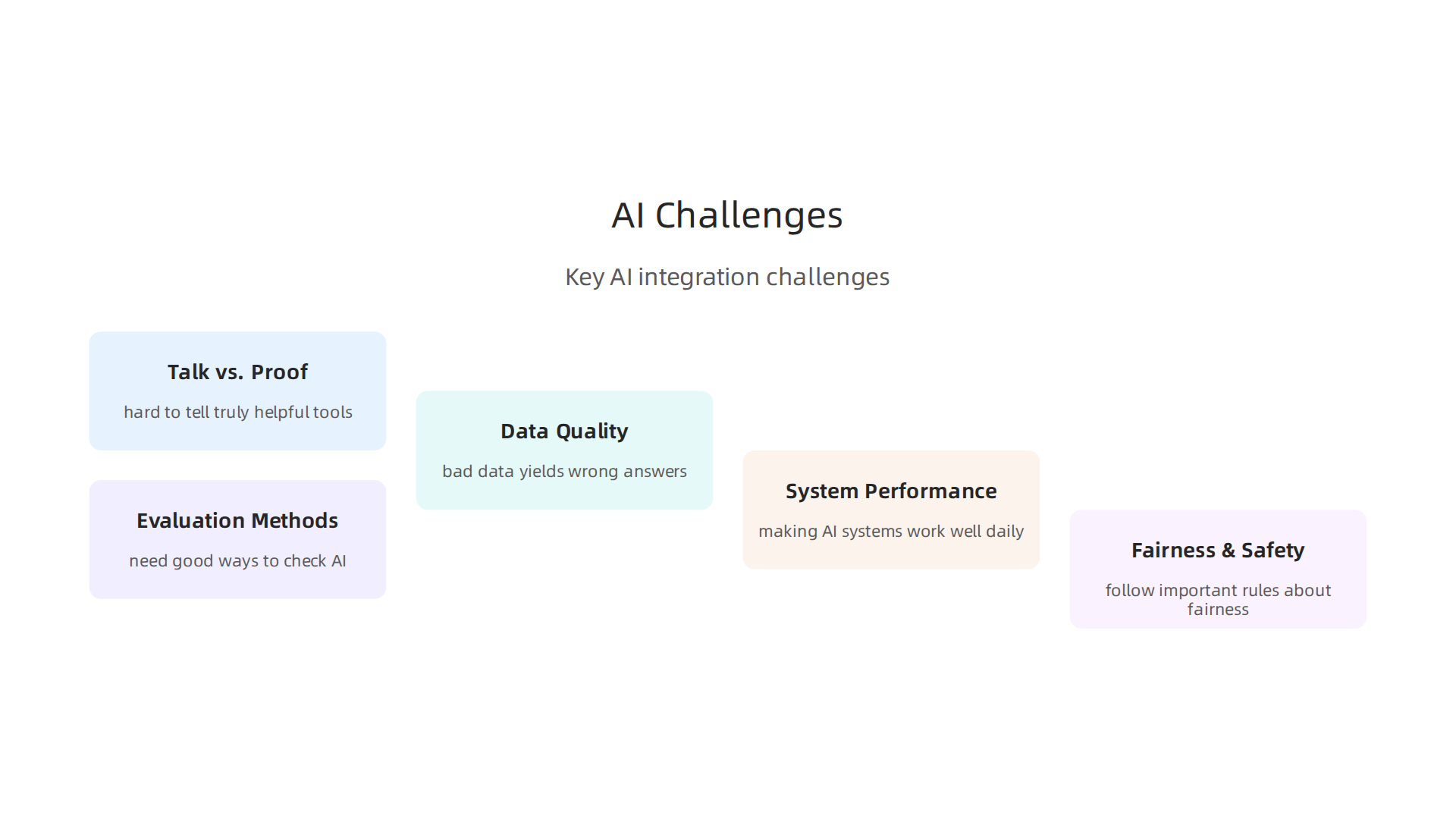
First, there’s a lot of talk versus real proof. It’s hard to tell which AI tools are truly helpful and which are just popular. For instance, you might hear about new tools like amplify AI or solutions like infinity AI, magic AI, or harvey AI, but picking the right one for your specific needs can feel overwhelming. Many AI models also rely heavily on the quality of the information they’re given. If the data is bad, the AI’s answers might be wrong or unfair, as noted in the Artificial Intelligence – Stanford Emerging Technology Review.

Also, making sure AI systems work well day after day and follow important rules about fairness and safety is a real task. It means we need good ways to check how well AI systems perform. In fact, many groups are working on this, like the OECD, which is building new ways to measure AI’s true abilities to help everyone understand it better Constructing a framework to measure AI capabilities – OECD. When thinking about different AI options for your business, it’s helpful to explore guides on the Best AI Tools for Businesses That Deliver a Real Productivity Advantage in 2026.
This guide is here to help you cut through the noise. We will give you a practical, evidence-first look at realistic AI. You’ll learn about different AI platforms, how to check if an AI system is good for your needs, and what real-world ups and downs to expect. Our goal is to give you the knowledge you need to use AI wisely and make it truly work for you.
Want to stay informed about the latest in AI without all the confusion? Get clear daily AI updates from The Deep View Newsletter.
What ‘Realistic AI’ Means Today: Scope, Limits, and Common Misconceptions
Moving beyond the buzz, what does "realistic AI" truly mean in 2026? It’s about seeing AI for what it is: a powerful tool with specific abilities and clear limits. It’s not magic, even if some tools like magic AI or infinity AI seem very advanced. Realistic AI looks at what these systems can actually do right now, how reliable they are, and whether they are safe to use.
The Real Scope of AI Capabilities
When we talk about what AI can do, we’re mostly looking at its functional capabilities. Think of these as the specific tasks AI is good at:
- Understanding and Generating Language: AI can write reports, answer questions, and even have simple conversations. This is why tools like amplify AI are so popular for content creation.
- Seeing and Understanding Images: AI can recognize faces, spot objects in pictures, and even describe what’s happening in a video.
- Simple Reasoning and Problem Solving: AI can help make decisions based on lots of data, find patterns, and automate routine tasks. It can help with things like figuring out the best route for a delivery or sorting customer emails.
However, these abilities are still based on the data they were trained on. While AI is getting better at understanding different languages, as noted in the Global AI Diffusion – Q1 2026 Trends and Insights from Microsoft, its deep understanding is not the same as a human’s. It’s about system-level reliability and safety. An AI system might perform well in a controlled test, but how does it handle the messy, unpredictable real world? This is where understanding realistic AI becomes key. For example, testing how well AI works in real network automation tasks uses frameworks like NETARENA: dynamic benchmarks for AI agents.
Common Misconceptions That Cloud Our View
It’s easy to get confused about AI, especially with so much exciting news.
whirlwind of information, symbolizing the challenge of cutting through AI hype.](https://latestaibreakthroughs.com/wp-content/uploads/2026/06/weblish-inline-42190.jpg)

Here are some common misunderstandings:
- AI is "Smart" Like a Human: Many people think AI can think and feel just like us. Actually, AI follows complex rules and patterns it learned from data. It doesn’t have emotions or true self-awareness. It’s a very advanced tool, not a new kind of mind. The Artificial Intelligence Index Report from Stanford HAI for 2026 gives a detailed look at where AI truly stands in terms of capabilities.

- AI is Always Right: Because AI can process so much information quickly, we might believe its answers are always perfect. But AI can make mistakes, especially if the data it learned from was biased or incomplete. It can also produce "hallucinations" or made-up information.
- AI Works Perfectly Out of the Box: Some might expect AI solutions, like a new harvey AI program, to simply work without any effort. The truth is, AI systems need careful setup, constant monitoring, and sometimes human guidance to perform well over time. This includes making sure they are fair and accessible for everyone, as highlighted in research on AI testing, evaluation, verification and validation for accessibility.
Benchmarks Versus Real-World Utility
We often see news about AI performing amazingly well on certain tests, called benchmarks. These tests show what AI can do under very specific, controlled conditions. They are helpful for developers to see how much progress is being made. However, real-world utility is different. An AI system might ace a test in a lab, but struggle with the everyday problems faced by a business or a person.
For example, an AI tool might be great at recognizing objects in perfect pictures. But in real life, pictures can be blurry, have bad lighting, or show things from odd angles. This is why human experts are still very important in reviewing AI, even with the latest AI Benchmarks 2026: Top Evaluations and Their Limits.
Understanding this difference is important. Just because an AI performs well on a benchmark doesn’t always mean it’s ready to solve all your business problems right away. It means we need better ways to evaluate AI that truly reflect how it will work in the real world. You can learn more about how AI helps transform various fields by checking out articles on topics such as Doctor AI In 2026 How Artificial Intelligence Is Transforming Healthcare Today.
To really understand what realistic AI can do, we need to break it down into its main parts. Think of it like taking a complex machine and looking at each gear and lever. Each part of AI has its own job and its own way of being measured.
Here are the core abilities of AI today:
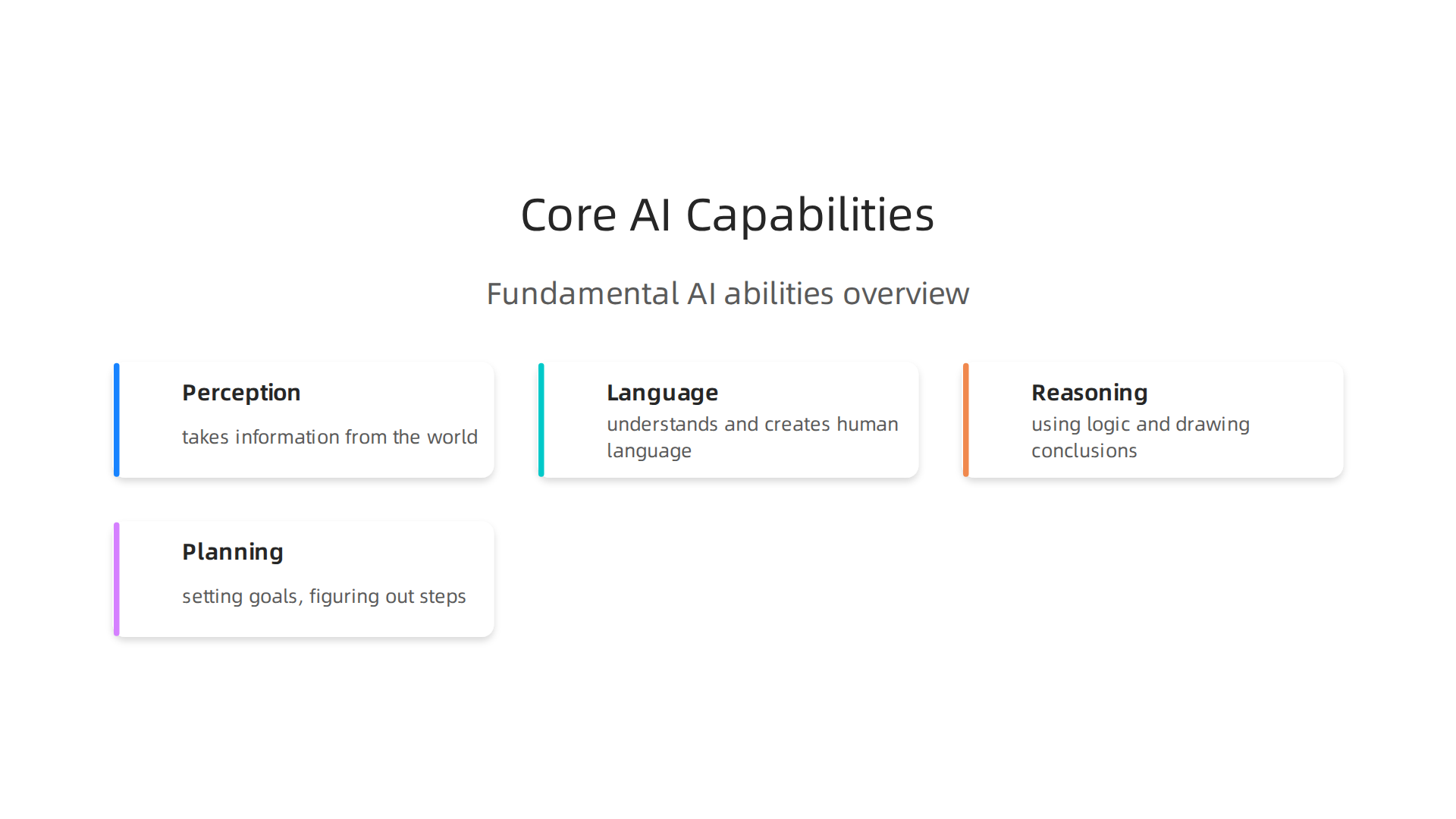
Perception: Seeing and Hearing
Perception is about how AI takes in information from the world around it.
- Vision (Seeing): This is how AI understands images and videos. It includes tasks like:
- Object Recognition: Spotting a cat or a car in a picture.
- Facial Recognition: Identifying a person’s face.
- Scene Understanding: Describing what’s happening in a whole image, like "a child playing with a ball in a park."
We measure this by having AI look at huge sets of labeled images and seeing how accurately it can name or describe what’s there.
- Speech (Hearing and Understanding Sound): This is how AI processes spoken language and other sounds. It includes tasks like:
- Speech-to-Text: Turning spoken words into written text.
- Speaker Recognition: Identifying who is speaking.
- Emotion Detection: Trying to figure out feelings from a person’s voice.
This is measured by how well AI turns speech into text or identifies sounds from large audio databases.
Language: Reading, Writing, and Talking
This capability covers how AI understands and creates human language. Tools like amplify AI use these features a lot.
- Natural Language Understanding (NLU): This is about making sense of what people say or write. It includes:
- Sentiment Analysis: Figuring out if a review is positive or negative.
- Question Answering: Giving correct answers to questions from a text.
- Summarization: Making a long document shorter while keeping the main ideas.
We test NLU by checking how accurately AI can answer questions, summarize articles, or understand the meaning behind sentences.
- Natural Language Generation (NLG): This is about AI creating new text. It includes:
- Text Generation: Writing articles, emails, or creative stories.
- Chatbots: Having conversations that feel natural.
- Translation: Turning text from one language into another.
NLG is often measured by how human-like and correct the generated text is.
Reasoning and Planning: Thinking and Deciding
These are more advanced capabilities, getting closer to what we think of as "thinking."
- Reasoning: This involves using logic and drawing conclusions from information. It includes:
- Problem-Solving: Finding solutions to puzzles or specific challenges.
- Pattern Recognition: Discovering hidden rules or connections in data.
- Decision Making: Choosing the best action based on available facts.
We evaluate reasoning by giving AI logical puzzles, complex data sets, or strategic games, and seeing how well it solves them.
- Planning: This is about setting goals and figuring out the steps to reach them. It includes:
- Task Automation: Breaking down a big job into smaller, manageable steps for
harvey AIor similar tools. - Route Optimization: Finding the most efficient path for deliveries.
- Resource Allocation: Deciding how to best use limited resources.
Planning is tested by how effectively AI can create a sequence of actions to achieve a goal in different environments.
- Task Automation: Breaking down a big job into smaller, manageable steps for
The Bigger Picture: Reliability, Latency, and Cost
When these core capabilities are put together in a real AI system, like magic AI or infinity AI, how well they work is not just about raw power. It’s also about:
- Reliability: Does the AI consistently do what it’s supposed to do, without too many mistakes or "hallucinations"?
- Latency (Speed): How fast does the AI respond? For some tasks, like self-driving cars, even a tiny delay can be a big problem.
- Cost: How much computing power and energy does it take to run the AI? More complex AI models usually cost more to develop and operate.
Understanding these measurable components helps us form a realistic AI view. These benchmarks and tests, while not perfect, are our best tools to check what AI can truly do, as explored in the Exploring possible AI trajectories through 2030 report. Learning how to work with AI, understanding its strengths and limits, is becoming more and more important. To learn more about how humans and AI can team up, check out our guide on Human AI Collaboration How to Partner With Artificial Intelligence In 2026.
Want to stay on top of the fast-changing world of AI and technology? Get clear daily AI updates from The Deep View Newsletter. Subscribe to The AI Newsletter Worth Reading.
Understanding what AI can do is just the first step. The next is figuring out how to actually use it. In 2026, many companies and people use AI through different platforms. Think of these platforms like different ways to get your hands on AI’s power. Some are like a full toolbox, some are like renting just one special tool, and others let you build the whole toolbox yourself.
Different Kinds of AI Platforms
When you want to use AI, you have a few main choices for how to get started. Each choice is best for different needs.
- Full-Stack Platforms: These are like big, all-in-one solutions. They give you everything you need, from managing your data to running AI models and showing the results. Companies like Microsoft Fabric and Databricks offer these kinds of platforms. They are good if you want a complete system that works together smoothly, as highlighted in comparisons of the Best AI Data Platforms in 2026.
- Model-Hosting APIs: API stands for Application Programming Interface. These services let you use specific AI models without having to set up the complex parts yourself. For example, if you only need an AI to turn speech into text, you can use an API for that one task. Tools like
amplify AIorinfinity AImight use these APIs to add smart features to their services. It’s like calling a specialist to do one job for you. - Open-Source Deployment Stacks: For those who like to have full control and are comfortable with more technical work, open-source options let you build and run AI models on your own servers or cloud space. This gives you a lot of freedom to customize, but it also means more work to set up and maintain.
- Managed Services: These are a mix of the above. A company handles most of the hard technical work for you, like making sure the AI runs smoothly and stays updated, but you still get some say in how it works. This can be a good choice for smaller teams or those who want a
realistic aisolution without a huge technical burden.
Making Choices: What Matters Most
When picking an AI platform, you need to think about a few important things. These are the trade-offs:
- Model Choice: Do you need to use a very specific AI model, or are you happy with what the platform offers? Some platforms give you many choices, while others are more limited.
- Latency (Speed): How fast does the AI need to respond? For some tasks, like in self-driving cars or real-time chatbots, even a tiny delay can be a problem. This is a key factor to consider, especially when scaling solutions, which can impact costs significantly, as explored in discussions on comparing costs scaling AI search solutions in 2026.
- Customization: Can you change the AI to fit your exact needs? Open-source options give you the most freedom here.
- Observability: Can you see how the AI is working, spot problems, and understand its decisions? This is important for making sure the AI is fair and accurate.
- Cost Predictability: How much will it cost to run the AI? Some platforms have clear pricing, while others might have hidden costs for computing power or data storage. Understanding these costs is crucial for business planning, as noted in many 2026 AI tools guides.
Choosing the right platform is important for getting the most out of your AI efforts.

It helps ensure you have a truly realistic ai setup that meets your goals. If you’re looking for more guidance on specific tools, you might find our guide on Best AI Tools for Businesses That Deliver a Real Productivity Advantage in 2026 helpful.
Choosing the right AI platform is a big step, but then comes an even bigger question: How do you know if the AI actually works well? In 2026, it’s not enough for an AI to just look smart. We need to evaluate its claims using clear rules, or what we call benchmarks and metrics. This helps us see if an AI is truly a realistic ai solution.
How We Measure if AI is Good
When we talk about how good an AI is, we usually look at a few main things:
- Accuracy: This is about how often the AI gets things right. For example, if an AI is supposed to tell the difference between pictures of cats and dogs, its accuracy is the percentage of times it correctly labels them.
- Latency (Speed): This measures how fast the AI responds. For things like self-driving cars or important health tools, a super fast answer is critical. A slow AI might miss something important.
- Calibration: This shows how confident the AI is in its answers. If an AI says it’s 90% sure about something, is it actually right 90% of the time? Good calibration means the AI knows what it knows and what it doesn’t.
- Robustness: A robust AI can handle different kinds of situations and still work well. It won’t get confused by small changes or unexpected inputs. For example, if an
infinity aisystem can still recognize speech even with background noise, it’s robust.
These measures help us understand an AI’s basic performance.
Why Standard Tests Aren’t Always Enough
While these metrics are helpful, the real world is tricky. Many popular AI tests, called benchmarks, are often based on data that’s clean and predictable. But when AI goes into real use, things can change. The data might be different from what the AI learned from, or someone might try to trick the AI with special "adversarial" inputs.
Actually, in 2026, many experts point out that while AI benchmarks look impressive, real-world failures can still happen because these tests don’t cover everything. This means that AI Benchmarks 2026: Top Evaluations and Their Limits might not always match up with how an AI performs in your actual business or daily life. Things like "model drift," where an AI’s performance slowly gets worse over time because the real-world data it sees changes, are hard to spot with simple benchmarks. For example, an amplify ai tool that once worked perfectly might need ongoing checks to stay sharp.
Your Checklist for Picking AI
To truly know if an AI is right for you, especially for important tasks like in healthcare or finance, you need to look beyond just the scores. Here’s a simple checklist:
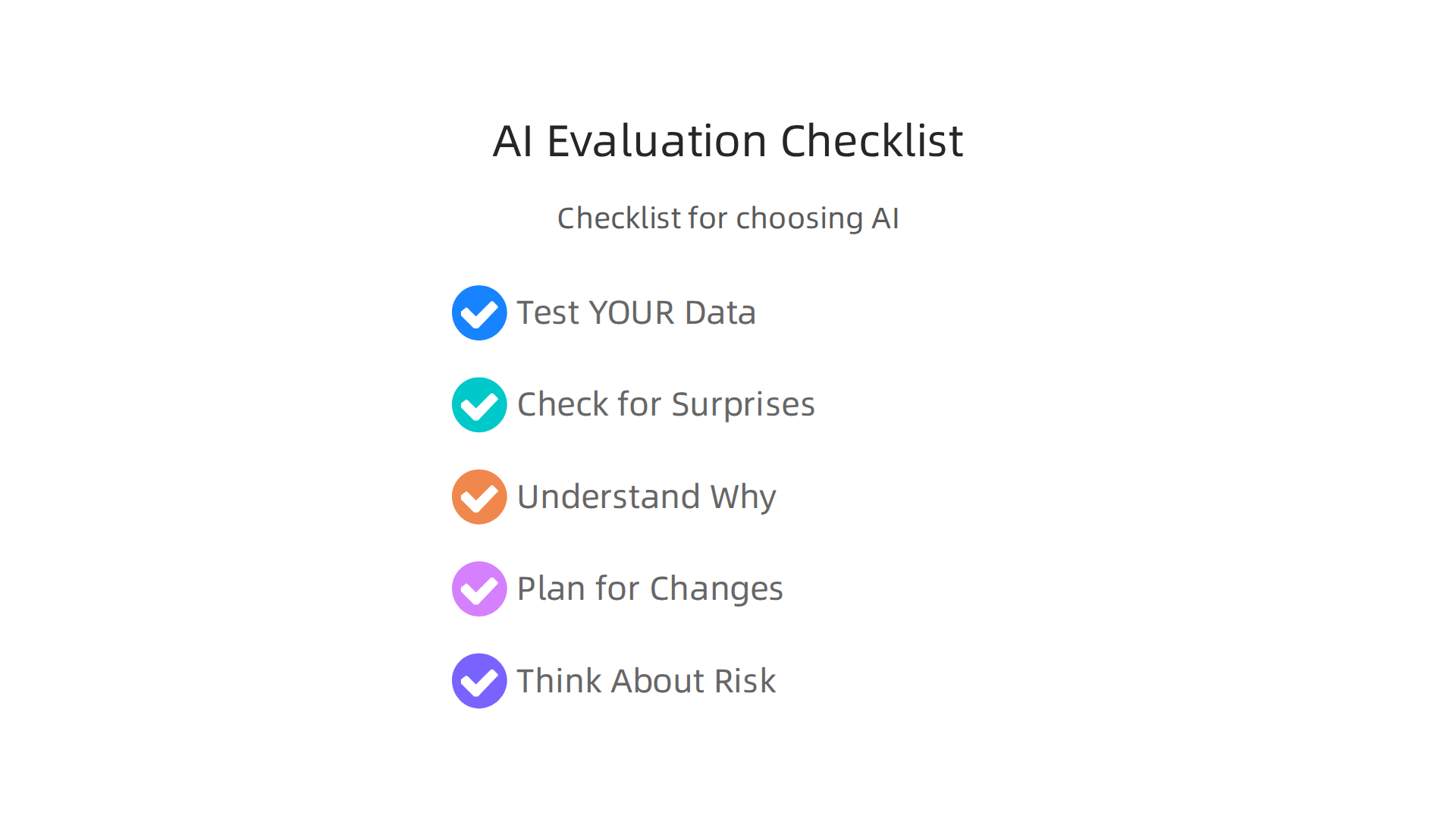
- Test with YOUR Data: Does the AI work well with the specific information and situations your company deals with, not just the general test data?
- Check for Surprises: How does the AI react to unexpected or slightly changed information? Can it handle things it hasn’t seen before?
- Understand Its "Why": Can the AI explain why it made a certain decision? This is super important for fairness and trust, especially if you’re using something like
harvey aiormagic aifor critical choices. - Plan for Changes: What happens if the world changes or your data changes? Can the AI adapt, or will it need to be retrained often?
- Think About Risk: How much risk are you willing to take if the AI makes a mistake? For some tasks, a small error is no big deal. For others, it could be very serious.
Being smart about how you check an AI system helps ensure you get a truly realistic ai solution that is reliable and safe. Without careful evaluation, you might be taking on bigger risks than you realize. Understanding these challenges can help you make better decisions about AI, and for more insights into the potential dangers, you might want to learn about the real risks in 2026.
To stay on top of all the latest changes and expert opinions in the fast-moving world of AI, there’s a great resource. Get clear daily AI updates from The AI Newsletter Worth Reading.
Putting AI to the test is one thing, but making it work day in and day out is another big challenge. In 2026, many companies find that actually using AI in their daily operations brings up new kinds of problems. These are about how the AI fits into existing systems, how it’s watched, and how rules are kept. This is where a truly realistic ai strategy becomes important.
Getting AI to Work: Data, Monitoring, and Rules
Bringing AI into your business isn’t just about picking a smart tool. It’s like building a new road. You need to make sure the materials are good, the road is always watched, and everyone follows the traffic laws.
Data Hurdles for AI
For AI to work, it needs good data. Think of data as the food for your AI. If the food isn’t right, the AI won’t perform well. Here are some data challenges:
- Data Pipelines: This means getting data from where it’s created to where the AI needs it. It’s like setting up pipes to deliver water. These pipes need to be reliable so the AI always has fresh information.
- Data Labeling: Sometimes, humans need to "label" data for the AI to learn. For example, telling an
amplify aisystem which part of an image is a car. This can take a lot of time and effort to do correctly. - Data Versioning: Data changes over time. You need a way to keep track of what data was used when, especially if you need to go back and check why an AI made a certain choice.
- Model Drift: This is when an AI model’s performance slowly gets worse because the real world changes. The data it was trained on no longer matches the new data it sees. For example, if an
infinity aisystem learned about fashion trends from 2023, it might not understand 2026 styles. Because of this, staying on top of Why is AI Model Drift Monitoring Vital for 2026 Strategy? is key to keeping your AI useful.
Keeping an Eye on AI: Monitoring and Observability
Once an AI is running, you can’t just set it and forget it. You need to watch it closely.
- Monitoring AI Performance: This involves always checking if the AI is still working as expected. Is it giving accurate answers? Is it fast enough? If an
amplify aitool is helping customers, you want to know it’s always giving good advice. - Service Level Objectives (SLOs): These are clear goals for how well the AI should perform. For instance, an AI might need to answer 99% of questions correctly within 2 seconds. If it doesn’t meet these goals, you know there’s a problem.
- Incident Response: Sometimes, AI makes mistakes. Having a plan for what to do when an AI fails is very important. This helps fix problems quickly and learn from them.
Rules for AI: Governance
Just like people need rules, AI needs rules too. This area is called AI governance.
- Compliance: AI systems must follow laws and rules, especially when dealing with personal or sensitive information. For example, an
harvey aitool in finance must follow strict data protection laws. - Privacy: Protecting people’s private information is super important. AI needs to be set up so it doesn’t accidentally share or misuse data.
- Explainability: Can the AI tell you why it made a decision? This is crucial for building trust, especially in areas like healthcare or legal advice. People need to understand the "why" behind the AI’s answers.
- Vendor Lock-in: When you choose an AI platform, sometimes you can get stuck with that one provider. It’s hard to switch to another. Thinking about this trade-off is important before committing to a system. Understanding these challenges helps make sure your AI choices are sound, and you can learn more about Data Governance for AI: 2026 Challenges, Solutions & Best Practices.
Managing all these moving parts makes sure you have a truly realistic ai system that works well for a long time. These considerations are vital for any business looking for Best AI Tools for Businesses That Deliver a Real Productivity Advantage in 2026.
For companies to truly gain from artificial intelligence, they need to focus on where a realistic ai approach can bring real benefits. It’s not enough to just have AI tools; you need to know how they make a difference in your business. This means picking the right tasks for AI, figuring out how to measure its success, and testing your ideas before going all in.
Smart Ways to Use AI for Business
Thinking about where AI can help the most is key. Instead of trying to use AI everywhere, smart businesses look for specific areas where AI can reliably add value today. These are often places where AI can make work faster, help people make better choices, or make customers happier.
- Making Customer Service Better: AI chatbots, for instance, can answer many customer questions quickly, letting human helpers focus on harder problems. An
amplify aisystem could help customer service teams give faster, more accurate answers by pulling up information instantly. - Speeding Up Daily Tasks: Many simple, repeated tasks can be done by AI. This frees up your team to do more important work. For example, an
infinity aitool might sort emails or fill out forms much faster than a person can. - Creating Personal Experiences: AI can learn what different customers like. This helps businesses offer products or services that feel just right for each person, making them more likely to buy.
- Helping Make Big Choices: AI can look at lots of data and find patterns that humans might miss. This can help leaders make smarter choices about things like new products or how to spend money. For example, a
magic aisystem could analyze market trends to suggest the best time to launch a new service.
Knowing If AI Is Working: KPIs and ROI
After picking a use case, you need to know how to measure if your AI is actually helping. This is where Key Performance Indicators (KPIs) and Return on Investment (ROI) come in.
- KPIs (Key Performance Indicators): These are simple ways to track if your AI is doing its job.
- If your AI is answering customer questions, you might track how many questions it solves without needing human help.
- If AI is speeding up tasks, you could measure how much time it saves your team each week.
- For sales, you might look at how much extra money was made because the AI offered better recommendations.
- ROI (Return on Investment): This tells you if the money you spent on AI is coming back to you. Many companies are seeing real financial benefits from AI. Experts agree that 2026 is the year AI moves past just experiments into real solutions with clear ROI expectations AI Predictions for 2026. In fact, AI leaders are much more likely to have a good plan for their AI strategy, which helps them see better returns PwC AI performance study: Want ROI from AI? Go for growth.
Trying Things Out First: Experiments and Tests
Before putting an AI system into your whole company, it’s smart to test it out on a small scale. This helps you check if your ideas are correct without spending too much money or time.
- Small Tests: Start with a pilot project or a small group of users. This way, you can see how the AI works in the real world and fix problems early.
- A/B Testing: This means comparing how things work with the AI versus how they work without it. You might have one group of customers use the AI-powered customer service and another group use the old way. Then, you see which group has a better experience.
- Gathering Feedback: Always ask people who use the AI what they think. Their feedback is super valuable for making the AI better. By paying attention to how people and AI work together, you can create even more effective systems. Learning about human AI collaboration how to partner with artificial intelligence in 2026 can help ensure your tests are successful.
By carefully choosing where to use AI, tracking its success, and testing your ideas, businesses can make sure their realistic ai efforts truly pay off.

Want to keep up with the fast-moving world of AI? Stay informed with clear, daily updates.
The AI Newsletter Worth Reading
Summary
This guide explains why a down-to-earth view of AI—what we call "realistic AI"—matters in 2026 and how leaders can separate hype from practical value. It breaks AI into measurable capabilities (perception, language, reasoning), then shows how to pick platforms, run meaningful tests, and measure reliability, latency and cost. The article warns that benchmark results often overstate real-world readiness and offers a simple checklist for evaluating models with your own data, monitoring for model drift, and planning governance and compliance. It also outlines deployment challenges—data pipelines, observability, incident response—and practical business use cases where AI delivers clear ROI. After reading, you’ll know how to choose the right platform, design small pilots, and set KPIs so AI systems actually improve operations without creating hidden risks.