
Introduction
Remember when a new tech skill meant you could coast for years? That era is gone. Generative AI is rewriting the rules of work faster than almost anything we have seen before.
Every week brings news of another company restructuring, another role shifting, another skill becoming suddenly relevant or suddenly outdated. It is easy to feel lost in the noise. You might wonder if your current path is safe, or if you should pivot entirely.
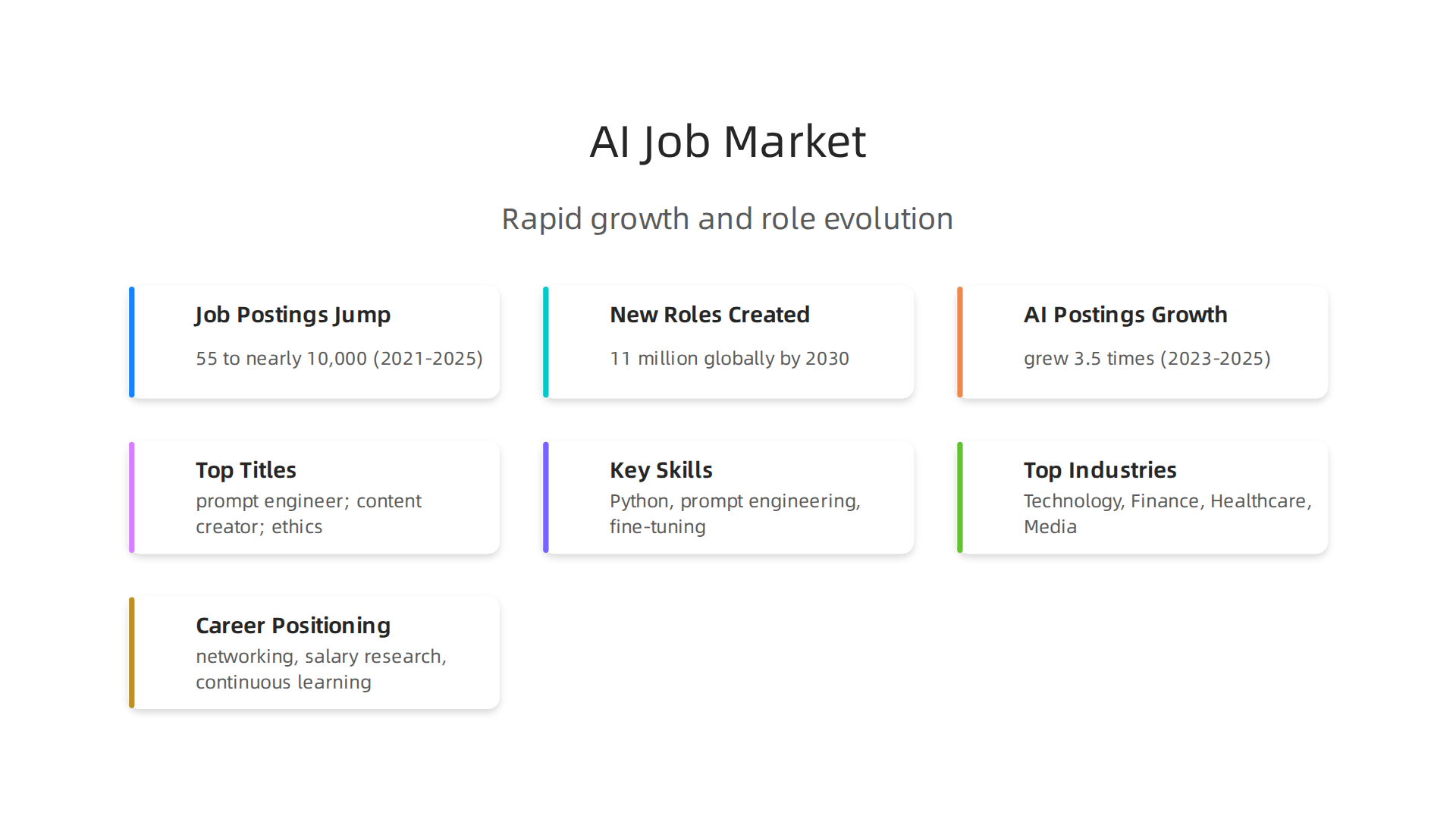
Here is the real picture. Between January 2021 and May 2025, unique job postings requiring generative AI skills jumped from just 55 to nearly 10,000 (The Generative AI Job Market: 2025 Data Insights).
That is not a niche trend. It is a flood. And by 2026, that acceleration has only continued.
But here is the part that does not make headlines. While some jobs are shrinking, AI and data processing are expected to create 11 million new roles globally by 2030 (88 AI Job Creation Statistics and Trends for 2026). The net effect is positive, but the path is uneven. Some industries are adding jobs fast. Others are cutting them.
That is why this article exists. We are cutting through the hype and the fear to give you data-driven insights and actionable strategies. You will learn what generative AI jobs actually look like in 2026, which skills matter most, and how to position yourself for the roles that are growing right now.
If you want to start building a practical skill set today, check out our guide to the best online AI courses for 2026 that actually prepare you for real jobs. It is a solid first step.
The landscape is shifting fast. But with the right information and a smart plan, you can navigate it with confidence.

For a daily dose of clear, trustworthy AI updates that help you stay ahead, subscribe to the AI newsletter worth reading and make informed decisions every day.
The Expanding Landscape of Generative AI Jobs
The numbers are big, but what do they actually look like on the ground? In short, the range of generative AI jobs has exploded since 2023. Companies are not just hiring AI engineers anymore. They need people who can build, manage, and guide AI tools across nearly every part of a business.
According to the 2026 AI Job Disruption Report, AI-related job postings grew 3.5 times between 2023 and 2025. The fastest growing title is AI/Machine Learning Engineer, with 41.8% year-over-year growth. AI Content Creator roles jumped 134.5% in the same period. But these are just a few of the many emerging roles.
Job titles now include prompt engineers, AI ethics specialists, AI interaction designers, and AI content creators.
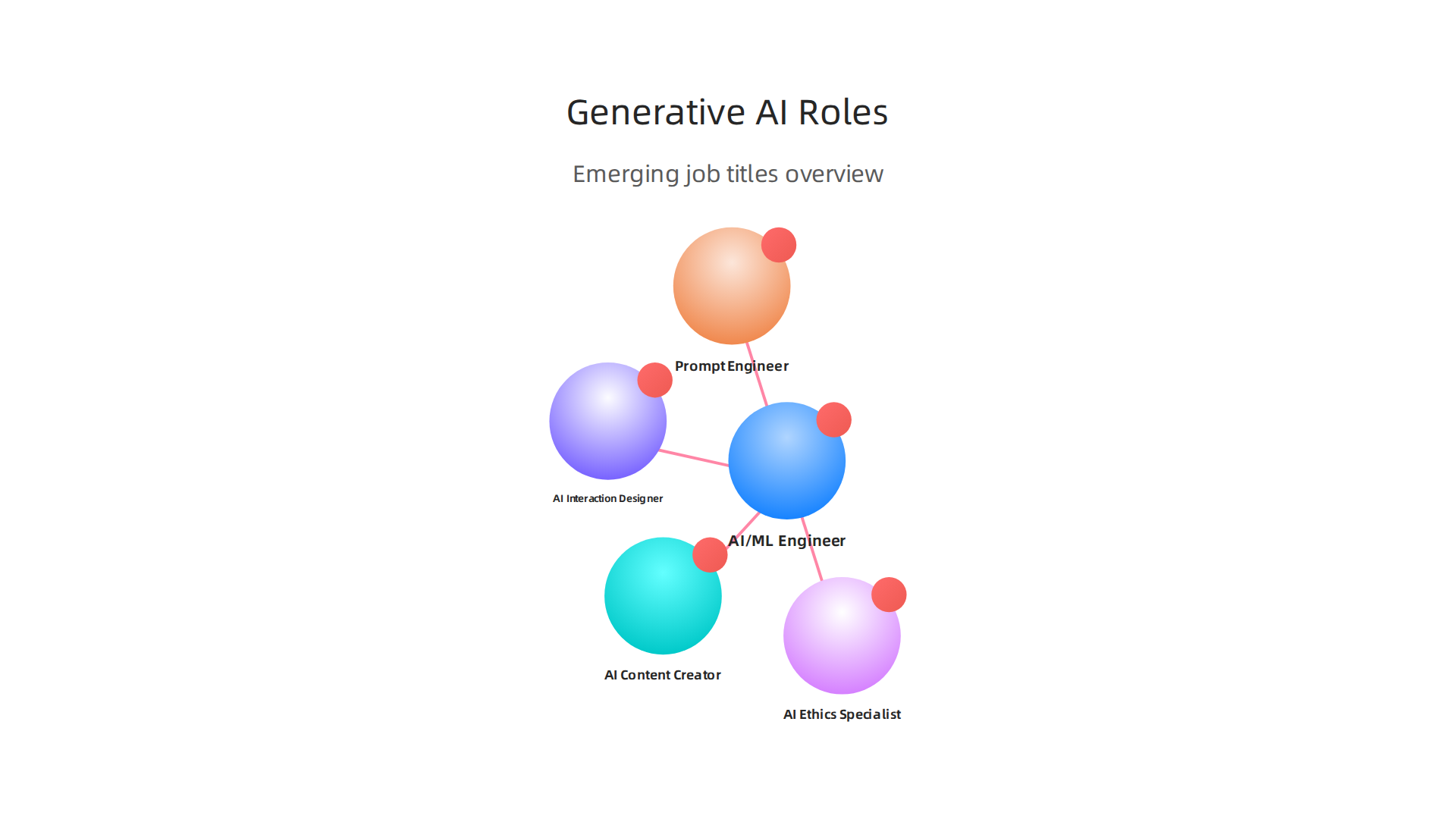
Each of these roles needs a different mix of skills. For example, a prompt engineer focuses on writing and testing inputs to get the best output from a model. An AI ethics specialist thinks about fairness, bias, and regulation. A data scientist might use generative AI to speed up analysis, while a product manager might oversee AI features.
The intersection of AI and jobs is not limited to tech. Nearly 45% of data and analytics job postings now include AI-related terms, according to the January 2026 US Labor Market Update from Indeed. That means data science jobs are being reshaped by AI right now. Financial services, healthcare, and consulting firms are all hiring for these roles.
Rather than asking what jobs will AI replace by 2030, it is more useful to look at which roles are being created today. Understanding this landscape helps you see where your own skills might fit. If you are curious about what hiring managers are looking for in 2026, check out our detailed guide on the skills, certifications, and portfolio that get you hired in AI jobs. It breaks down exactly what to focus on.
The market is wide open, but it moves fast. Knowing the roles that exist today is the first step to landing one.
Key Skills for Thriving in a Generative AI Career
So you understand the roles that exist. The next question is practical: what do you actually need to learn to land one of these generative ai jobs? The answer is a mix of hands-on technical abilities and softer human skills that help you stand out.
Let’s start with the technical side. Python is the foundation. Nearly every AI role expects you to know it.
Beyond that, prompt engineering has become one of the fastest-growing skills. Companies need people who can write effective prompts, test different inputs, and get reliable results from models like GPT-4 and Claude. Model fine-tuning is another key skill. That means taking a pre-trained model and adjusting it for a specific task, like customer support or medical analysis. If you are aiming for a more technical path, you will also want to understand MLOps — the process of deploying and monitoring models in real production environments. According to a 2026 career guide on the top AI skills to learn in 2026, these skills are what recruiters look for most.
But technical skills alone won’t get you hired. Soft skills are becoming a major differentiator. Critical thinking helps you decide when to trust an AI output and when to question it. Communication lets you explain complex AI concepts to non-technical teams. Adaptability matters because the tools and models change every few months. One report from Computerworld notes that the most valuable AI skill in 2026 isn’t coding, it’s building trust by showing you can use AI to solve real problems. Employers want candidates who can demonstrate adaptability and a willingness to learn.
There is another skill that separates average candidates from great ones: domain expertise. Technical people who also understand a specific industry — healthcare, finance, logistics — can design solutions that actually work in that context. A data scientist who knows medical records is worth more than one who only knows Python. That is why many data science jobs now require both AI skills and industry knowledge. This blend of ai and jobs from different fields is the sweet spot.
For anyone wondering what jobs will ai replace by 2030, the answer often depends on who develops these skills. People who build domain expertise plus AI literacy are harder to replace. They become the ones shaping how AI is used.
If you are ready to start building these skills, our guide on mastering practical machine learning for data science in 2026 walks you through the exact steps to go from beginner to job-ready. It covers Python, model training, and real-world projects.
The field moves fast. The best way to keep up is to stay informed every day. That is why we recommend subscribing to The AI Newsletter Worth Reading.

It delivers clear daily updates on what matters most in AI, from new skills to emerging roles.
Top Industries Hiring for Generative AI Roles
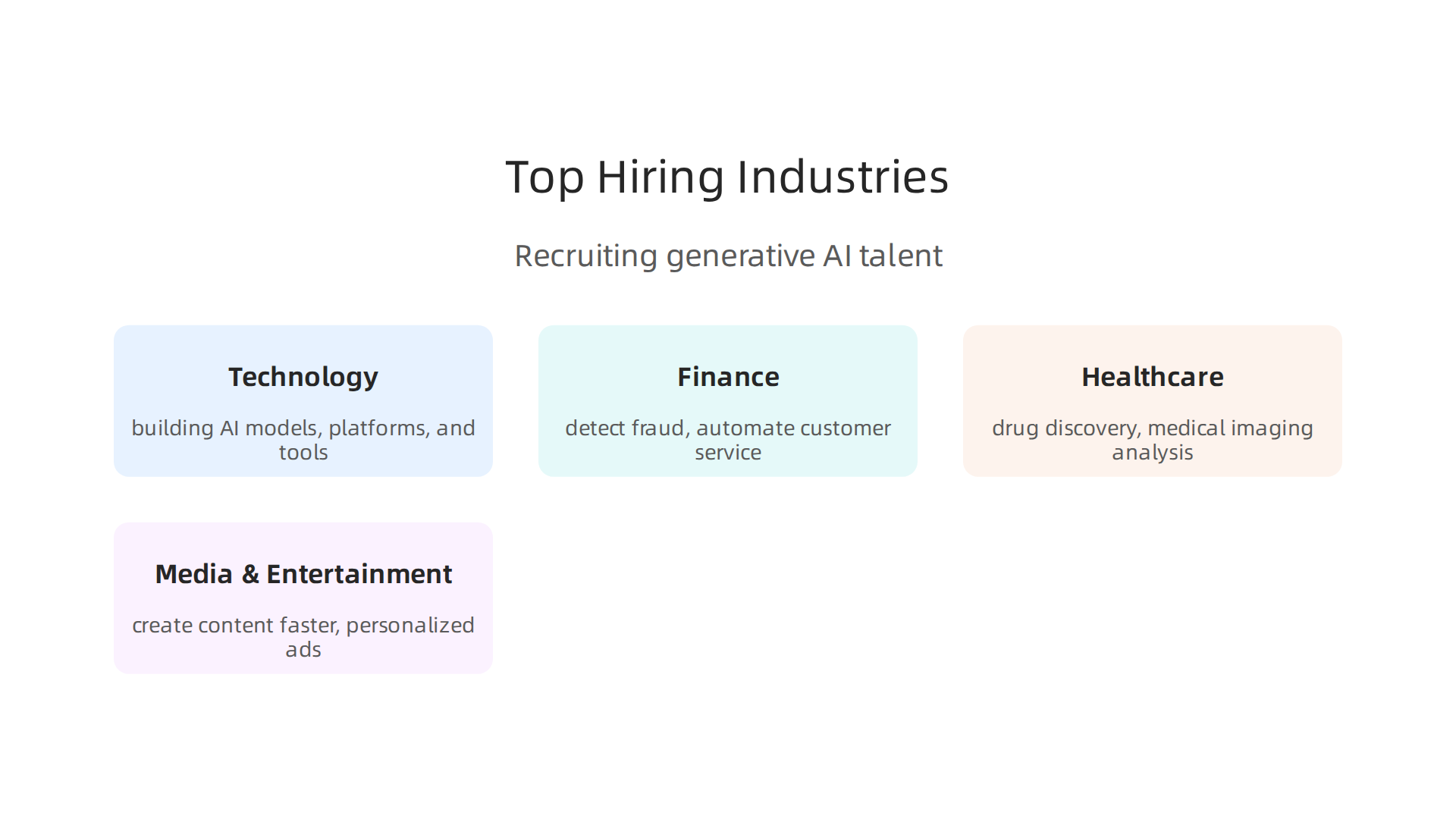
You have the skills. Now where do you use them? The generative ai jobs market is not limited to one corner of the economy. Companies across many industries are racing to hire people who can build and manage generative AI systems.
Knowing which industries are hiring the most can help you focus your learning and target your job search.
Let’s look at the top four.
Technology
Tech is the obvious leader. Companies building AI models, platforms, and tools need the most talent. Think of companies like OpenAI, Anthropic, Google, and Microsoft. They hire for roles like machine learning engineer, AI researcher, and prompt engineer.
According to the Forbes 2026 AI 50 List, top AI companies have raised over $34 billion in funding combined, and they are aggressively expanding their teams. If you want to work directly on cutting-edge models, this is the place to be.
Finance
Banks and insurance companies are also major adopters. They use generative AI to detect fraud, automate customer service, analyze financial reports, and even generate investment insights. A report from BCG notes that corporations plan to double their AI spending in 2026, with financial institutions spending about 2% of their revenues on AI. That means more data science jobs and AI roles in banking, insurance, and fintech. Industry-specific knowledge of finance can give you a strong edge.
Healthcare
Healthcare is one of the fastest-growing sectors for generative AI. Applications include drug discovery, medical imaging analysis, personalized treatment plans, and clinical documentation. The NVIDIA State of AI Report 2026 shows that generative AI is now the top AI workload in healthcare and life sciences, surpassing traditional data analytics. If you have a background in biology or medicine plus AI skills, you become extremely valuable. For a deeper look, check out our article on doctor AI in 2026 how artificial intelligence is transforming healthcare.
Media and Entertainment
Media companies use generative AI to create content faster. This includes writing news articles, generating video and music, designing graphics, and producing personalized ads. Studios and publishing houses are hiring AI specialists who understand storytelling and production. The demand is real.
Other Industries
Manufacturing, retail, and telecommunications are not far behind. The ai and jobs landscape is broadening every quarter. The key takeaway? Pick an industry that interests you and learn its specific needs. The people who understand both AI and a domain are the hardest to replace. That is how you future-proof your career.
How to Position Yourself for the Best Opportunities
You now know which industries are hungry for generative ai jobs. But knowing the market is only half the battle. The real question is: how do you make sure employers pick you?
The candidates who land the best roles don’t just have skills on paper. They prove their value in concrete ways. Here are three strategies that will set you apart in 2026.
Build a Portfolio That Shows What You Can Do
A resume with bullet points is fine. A portfolio with real projects is unforgettable. Hiring managers want to see that you can actually build, tune, or apply generative AI models. So create case studies.
Pick a problem, use a model like GPT or Stable Diffusion, and show your process. What data did you use? How did you evaluate results? What would you do differently? That kind of thinking is hard to fake.
The best portfolios include 3 to 5 short case studies that demonstrate how you handle complex challenges. This is what some career experts call a "Problem-Solver Portfolio." It moves beyond a static resume and shows your real thinking. For more examples and a deeper walkthrough, check out this guide on the AI jobs 2026 skills and portfolio guide.
Network Like Your Career Depends On It (Because It Does)
Here is a number that might surprise you. Up to 80% of senior and specialist roles are never posted publicly. They are filled through referrals and recruiter pipelines. That means ai and jobs in the hidden market are invisible unless you know the right people.
So your job search strategy needs to include real human connections. Spend as much time networking as you do applying. Reach out to former coworkers, attend industry events, and ask for virtual coffee chats with people at your target companies.

Use AI tools to research companies and prepare for those conversations, but when it comes to making the actual connection, be human. Send a personal message. Share something genuine. As one career guide notes in the 10 Best Job Search Tips for 2026, focusing on internal referrals and building relationships is far more effective than blasting out generic applications.
Tailor Your Resume for Both Humans and Bots
In 2026, your resume has two readers: a human hiring manager and an applicant tracking system (ATS). You need to satisfy both.
Start by making a master resume with every meaningful achievement you have ever had. Then, for each job you apply to, customize it. Use AI tools to compare your resume against the job description and find missing keywords. Add those keywords to a skills section at the top. Rewrite your bullet points using the "Accomplished [X] as measured by [Y] by doing [Z]" formula.
But here is the important part. Do not let AI write your resume from scratch. Use it as a drafting tool, then rewrite every sentence in your own voice. Authenticity is your biggest advantage in a world full of generic AI-generated applications. Tools like ChatGPT can help you practice interview questions too. You can turn it into your own personal interview coach.
Stay Ahead of the Curve
The generative ai jobs market changes fast. New tools, new models, and new roles appear every quarter. The people who stay informed are the ones who stay hired.
If you want clear, daily updates on the biggest AI developments without the noise, consider subscribing to The AI Newsletter Worth Reading. It delivers the news you actually need to know straight to your inbox.
Understanding Compensation and Career Progression
So you have networked, built your portfolio, and landed interviews. But what happens once you get the offer? And where can you go from there? Understanding how pay and career growth work in generative ai jobs helps you make smart moves for the long haul.
What You Can Expect to Earn
Salaries in this field vary a lot, and three big factors drive the numbers: experience, location, and company size. According to the Annual AI Index 2026 report, AI skills now appear in 2.5% of all US job postings, a jump of 55% from last year. That kind of demand pushes pay upward.
Here is a rough picture for 2026:
- Entry-level (0–2 years): Machine learning engineers and AI junior roles often start between $100,000 and $140,000.
- Mid-level (3–5 years): AI specialists and applied scientists typically earn $140,000 to $200,000.
- Senior (6+ years): Senior AI engineers and architects can command $200,000 to $350,000, especially at Big Tech companies.
- Leadership (director and above): Head of AI or VP of AI roles often exceed $400,000 when you include stock and bonuses.
Location matters too. Silicon Valley, New York, and Seattle pay the highest. Remote roles may adjust based on your city. Startups often offer lower base pay but more equity, while large firms provide more stability and bonus potential.
Where Your Career Can Go
The typical path for ai and jobs in generative AI moves from doing the work to leading the work.

You might start as an AI specialist focusing on a single area like natural language processing. From there you become an AI architect who designs systems across teams. Next comes director of AI, where you manage budgets, people, and strategy. Some people skip management and become principal or staff engineers, which pays just as well.
The key is to keep learning. The models change fast. The what jobs will ai replace by 2030 question keeps shifting, but one thing is steady: people who understand both the technology and how to apply it will always be in demand. For a deeper look at the skills and certifications that help you climb, read this guide on AI jobs 2026 skills and portfolio.
Negotiate the Whole Package
Total compensation matters more than base salary. Always look at the full picture: base pay, annual bonus, stock or restricted stock units (RSUs), sign-on bonus, and benefits like education stipends.
Here are a few negotiation tips that work in 2026:
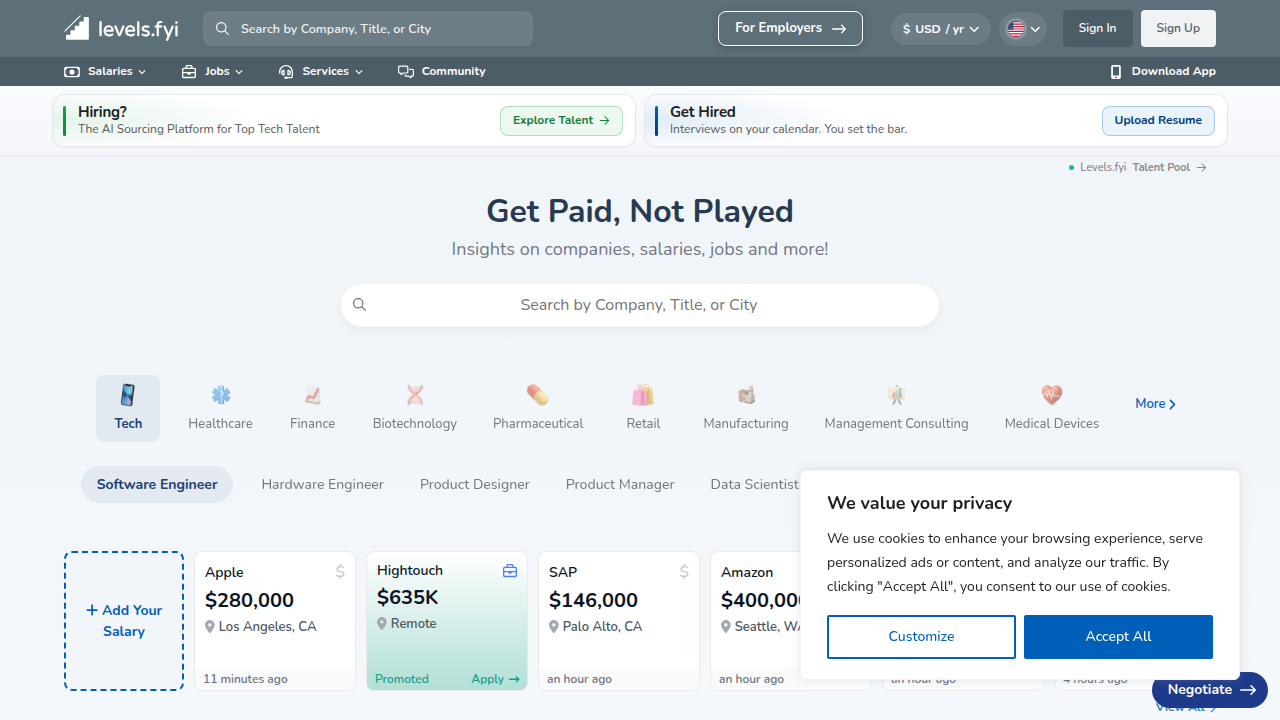
- Know your market value before you talk numbers. Use salary data from sites like Levels.fyi or Glassdoor.
- Ask about the company’s AI budget. If they are investing heavily (and many are, with 86% of organizations planning budget increases according to industry reports), they likely have room to improve your offer.
- Focus on total first-year value. A lower base with a giant signing bonus and equity might beat a higher base with no extras.
- Be ready to walk away. The market is hot for skilled people, and the best roles come with compensation that reflects your worth.
Understanding compensation and career progression helps you not just land a job, but build a career that grows with the industry.
The Role of Continuous Learning and Certifications
Landing a role in generative ai jobs is a big win. But staying valuable in this field means you never stop learning. The tools, models, and best practices change every few months. What works today might be outdated by next year. That is why continuous learning and certifications are not optional. They are the engine that keeps your career moving forward.
Why Formal Learning Still Matters
Some people think you can learn everything on the job. In AI, that is risky. Employers want proof that you know the latest techniques. Certificates from respected platforms tell hiring managers that you invested time to build real skills. Top platforms like Coursera, edX, and Udacity offer programs designed with universities and tech companies. For example, a certificate in deep learning or MLOps can open doors to higher-level roles.
The most in-demand skills for 2026 include prompt engineering, retrieval-augmented generation (RAG), and MLOps. According to the AI Skills in Demand 2026 article, skills like deep learning with PyTorch and natural language processing lead the hiring lists. Getting certified in these areas shows you understand what companies need right now.
Combine Courses with Hands-On Work
Certificates alone are not enough. The best way to prove you know your stuff is to build things. Employers want to see projects, not just course completions. After you finish a certification, apply what you learned to a real problem. Build a chatbot, fine-tune a language model, or create a data pipeline. Put your work on GitHub. Share it on LinkedIn.
Hackathons and open-source contributions are also powerful. They force you to solve problems under time pressure and work with tools you might not use at your day job. Many hiring managers look for candidates who participate in these events because they show adaptability and teamwork.
For a curated list of programs that actually prepare you for real roles, check out this guide on best online AI courses 2026. It breaks down which certificates are worth your time and money.
Stay Updated Without Burning Out
The AI field moves fast. You cannot learn everything. Focus on the skills that match your career path. If you want to build models, focus on Python, PyTorch, and MLOps. If you want to apply AI in business, focus on prompt engineering and AI governance. Keep a learning routine. Spend 30 minutes a day reading, taking a short course, or experimenting with a new tool.
One easy way to stay informed without overwhelm is to subscribe to a daily AI newsletter. The The AI Newsletter Worth Reading delivers clear daily updates so you spend less time hunting for news and more time building skills.
Continuous learning is not a chore. It is your competitive edge in a field that rewards people who keep growing. Make it part of your weekly habit, and your career in generative AI will keep moving forward.
Ethical Considerations and Long-Term Outlook
Building skills and landing generative ai jobs is exciting. But the fast growth of AI comes with real responsibility. Ethical practices are no longer just a nice bonus. They are becoming a central part of company strategy and job requirements.
Companies that deploy AI without thinking about fairness, bias, or transparency face serious risks. Regulators are watching closely. Customers expect responsible use. That is why roles like AI ethics officers and governance specialists are growing fast. According to the AI’s Impact on Jobs in 2026 report, demand for certified AI compliance professionals is outpacing supply in finance, healthcare, and technology.
This matters for your career too. Hiring managers want people who understand the bigger picture. If you can show you care about responsible AI, you stand out from candidates who only focus on the technical side.
What Jobs Will AI Replace by 2030?
This question worries a lot of people. And the honest answer is that some roles will change or disappear. Research from BCG shows that 50% to 55% of jobs in the US will be reshaped by AI. Between 10% and 15% of roles are vulnerable to elimination.
But here is the part that does not get enough attention. AI is also creating huge numbers of new jobs. The AI job creation statistics for 2026 show that 170 million new roles could be created globally by 2030, compared to 92 million displaced. That is a net gain of 78 million jobs. Many of these roles did not exist a few years ago. Prompt engineers, AI workflow designers, and human-AI collaboration managers are now real career paths.
So instead of asking what jobs will disappear, ask yourself this: how can I position myself for the new opportunities AI creates?
Stay Informed and Stay Responsible
Keeping up with regulations is part of being a smart professional. Governments around the world are introducing new rules for AI. The European Union’s AI Act is one example. Knowing how these rules affect your work shows employers that you are forward-thinking.
For a deeper look at how companies are balancing innovation with safety and control, check out this guide on AI without restrictions in 2026.
The long-term outlook for generative AI jobs is bright. But it depends on people like you who care about building technology the right way. Stay curious. Stay ethical. And keep learning.
One easy way to stay on top of all these changes without getting overwhelmed is to get clear daily updates. The AI Newsletter Worth Reading delivers the most important news straight to your inbox so you never miss a shift in policy, ethics, or opportunity.
Summary
Generative AI is reshaping the job market rapidly, creating thousands of new roles while changing many existing ones. This article maps the 2026 landscape: which jobs are growing (from prompt engineers to AI ethics specialists), the technical and human skills employers demand, and the industries hiring most aggressively. It explains practical steps you can take—build a portfolio of real projects, network for referrals, tailor resumes for both people and ATS, and choose certifications that pair with hands-on work. Compensation ranges and career pathways are outlined so you can plan growth, and the piece stresses continuous learning and responsible AI practices to future-proof your career. By reading this guide you’ll know where to focus your learning, how to demonstrate value to hiring managers, and how to navigate offers and ethical expectations in a fast-moving market.