
Why a Structured AI Learning Path Matters in 2026
Let’s be honest. Searching for the best ai course in 2026 feels like drinking from a fire hose.

Thousands of programs promise to turn you into an expert overnight. Some cost nothing. Others cost thousands. And many leave you with a certificate but no real skills.
Here is the good news. The AI job market is growing faster than ever. LinkedIn data shows that the global economy has added 1.3 million new AI-related jobs in just two years. Employers are hungry for people who can actually build, deploy, and manage AI systems. But here is the catch. Most courses teach theory without practice. They give you slides instead of projects.
So how do you find a path that works? A path that moves you from fundamentals to production-ready skills? A path that actually leads to a job?
That is exactly what we are going to cover here. This article breaks down the top programs by cost, depth, and real-world applicability. We looked at enrollment numbers, graduate outcomes, and expert reviews. We compared options like the Google AI Essentials course, the MIT Micromasters data science track, and the best AI online course free offerings.
But first, let’s talk about what makes a course worth your time. Because in 2026, you cannot afford to waste months on a program that does not deliver.
If you want to stay ahead of every new development, consider subscribing to a daily update that cuts through the noise. The AI Newsletter Worth Reading delivers clear updates straight to your inbox.
Many busy professionals use it to spot trends before they go mainstream. It is a smart way to keep your learning on track between courses.
Now let’s dive into the specific programs that actually prepare you for real work in 2026.
1. Andrew Ng’s Machine Learning Specialization (Coursera) – Best for Beginners
If you are new to AI and want a trusted starting point, this is it. Andrew Ng’s Machine Learning Specialization has become the most popular best ai course for beginners, and for good reason.
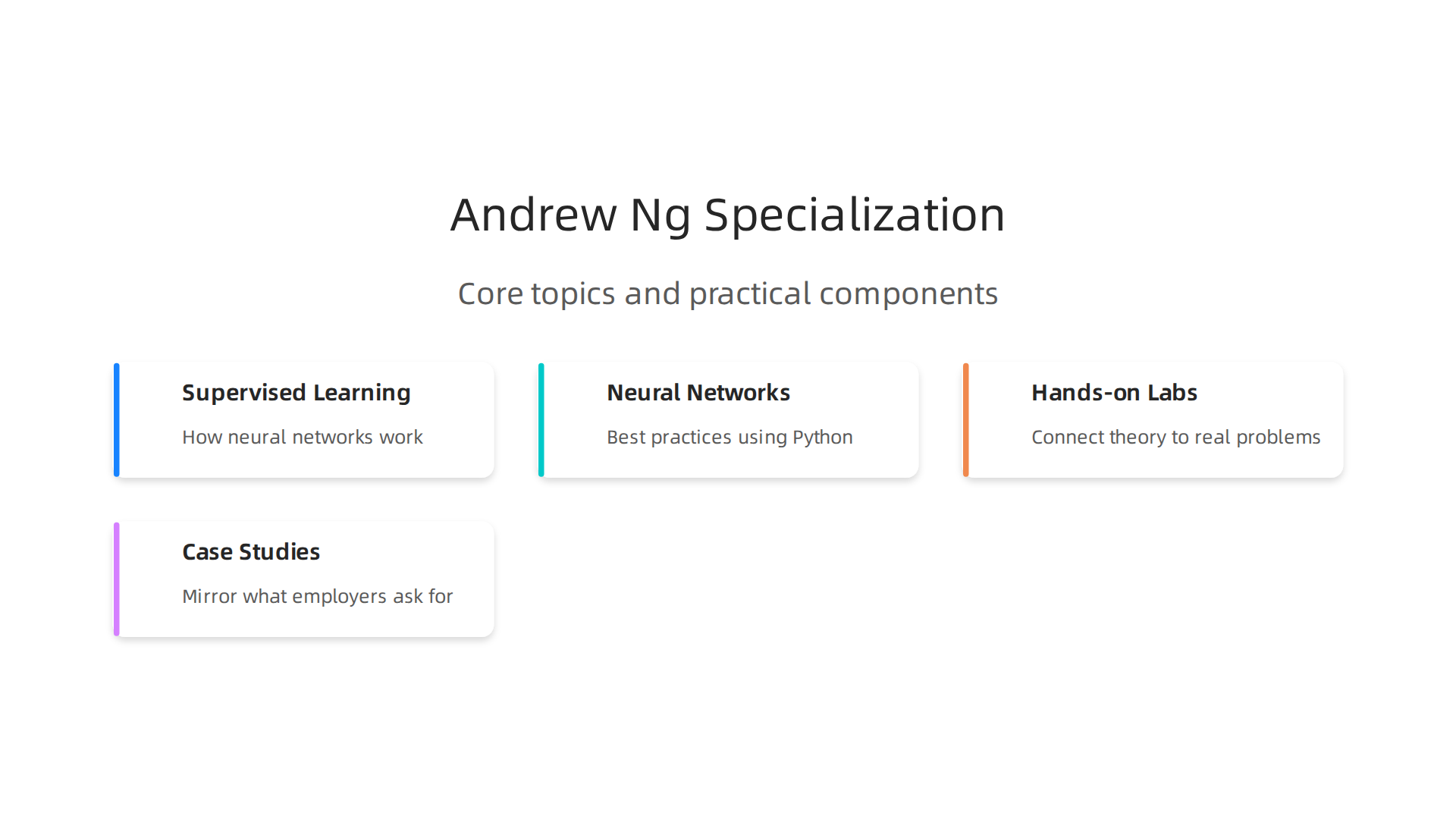
The program covers the fundamentals you actually need. You will learn supervised learning, how neural networks work, and best practices using Python and scikit-learn. The three-course track takes about two months to finish. Each course includes hands-on labs and case studies that connect theory directly to real problems.
More than 4.8 million learners have enrolled, and the program holds a 4.9 out of 5 rating. That kind of trust is rare in online education.
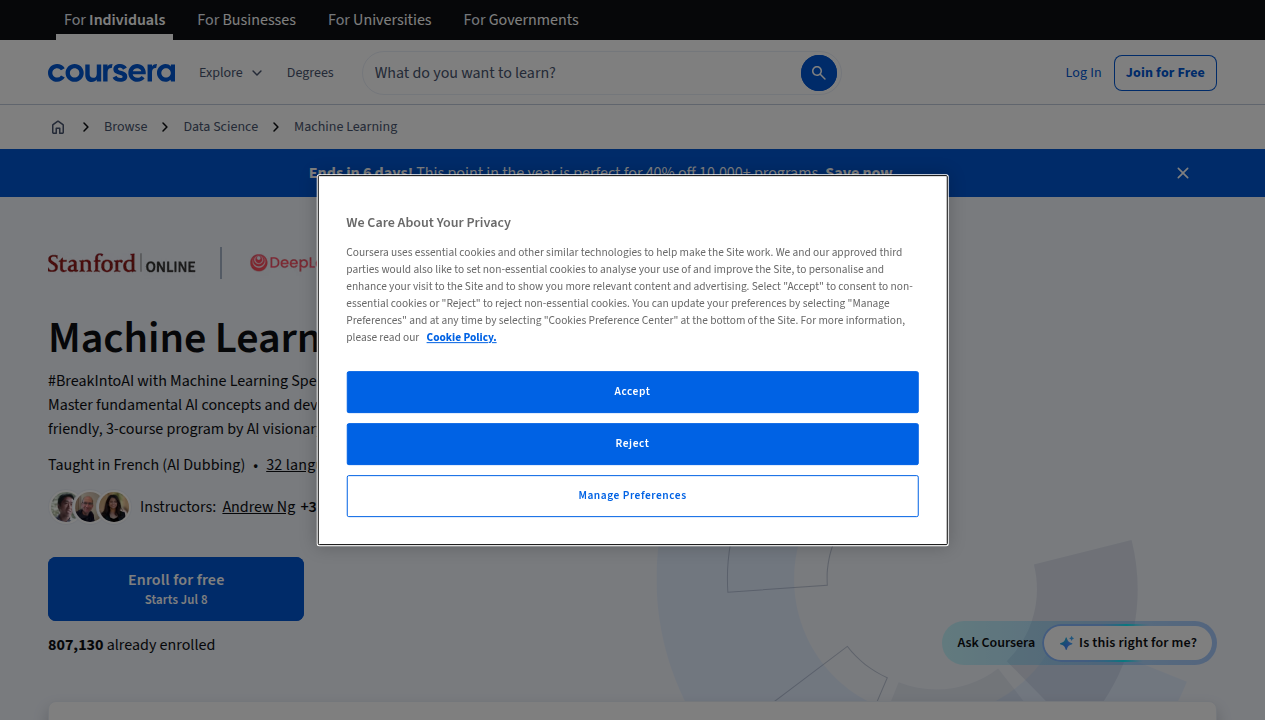
According to a detailed Coursera Machine Learning Specialization Review (2026), the course remains one of the most respected credentials in AI. The content comes from DeepLearning.AI and Stanford Online, and it gets updated regularly. In 2026, the curriculum still reflects current tools and workflows, not outdated examples.
But here is what really matters. This course does not just teach you theory. You build real models. You work through exercises that mirror what employers ask for in entry-level roles. The hands-on approach is why so many people call this the best ai course for breaking into the field.
Many learners pair this program with a practical framework for choosing what to study next. If you want a clear method for evaluating programs based on your goals, check out our guide on how to identify the best course on AI in 2026. It helps you compare options without getting overwhelmed.
2. DeepLearning.AI TensorFlow Developer Certificate – Hands-On Deep Learning
If Andrew Ng’s specialization gives you the foundation, this program pushes you into real deep learning projects. The DeepLearning.AI TensorFlow Developer Certificate focuses on one thing: building and deploying models that solve actual problems.
You work through four courses covering computer vision, natural language processing, and time series forecasting. Each module teaches you to build, train, and optimize models using TensorFlow. The curriculum also includes best practices for model optimization and deployment, which is exactly what employers want to see.
One thing to know: as of early 2024, Google paused the official TensorFlow Certificate exam for updates. But the DeepLearning.AI program on Coursera still teaches the same practical skills. According to a detailed TensorFlow Developer Certification Guide: How to Pass in 2026, the material remains valuable even as the certification landscape shifts.
The certificate holds weight because it comes from DeepLearning.AI, the same team behind Andrew Ng’s courses. Employers recognize the credential, especially for roles involving building AI-powered applications. This is why many learners still call it a top best ai course for getting hands-on fast.
This program works best if you already know basic Python and want to go deeper. It pairs naturally with strategies for landing actual AI roles.

If you are mapping out your career path, our guide on AI jobs 2026 skills certifications shows how certifications fit into a broader job search strategy.
And if you want to stay current on AI as the field keeps evolving, Get clear daily AI updates from The Deep View Newsletter. It helps you track new models and tools without drowning in noise.
3. Harvard’s CS50’s Introduction to Artificial Intelligence with Python – Free & Rigorous
If you want a university-level AI education without the tuition bill, this course is hard to beat. It is part of Harvard’s famous CS50 series, the same program that has taught millions of students around the world.
The class covers the core ideas behind modern AI. You learn about search algorithms, how to handle knowledge and uncertainty, and the basics of machine learning.
Each topic is taught with Python, so you build actual projects as you go. The official Harvard page for CS50’s Artificial Intelligence course outlines the full syllabus.
The best part? It is completely free. You can watch all the lectures, do the assignments, and learn at your own pace. If you want a verified certificate, you can pay a fee, but it is optional. This makes it one of the best ai online course free options available in 2026.
That said, this course assumes you already know basic programming. If you are new to coding, you might want to take CS50’s Introduction to Computer Science first. But if you have some Python experience, dive right in.
For many learners, this course represents a true best ai course because it gives you Harvard-quality learning at zero cost. The rigor is real, and the projects prepare you for more advanced work.
If you are still deciding between programs, our guide on how to identify the best course on AI in 2026 can help you match courses to your own goals.
4. Fast.ai Practical Deep Learning for Coders – Free, Top-Down Approach
Most AI courses teach theory for weeks before you ever touch a real model. Fast.ai does the opposite. You start by building complete, working deep learning models on day one. The theory comes after you have already seen what the code does.
That top-down approach works surprisingly well. You feel the satisfaction of training a real model right away. And that momentum carries you through the harder math later.
The course is completely free and built around PyTorch and the fastai library. You tackle projects like image classifiers and language models from the start. The community around Fast.ai is also one of the most active and helpful you will find in 2026.
The 2026 edition covers the latest techniques including 1-bit LLMs and efficient fine-tuning methods. If you want a practical best ai course that skips the fluff, this is your pick.
The course expects you to know basic Python and have some coding experience. But it assumes no prior deep learning knowledge. That makes it a strong ai online course free option for programmers ready to jump into building.
One reason this course stands out is its framework choice. While some courses still teach TensorFlow, PyTorch now dominates both research and industry. A recent honest TensorFlow certificate review for 2026 confirms this shift. Fast.ai teaches you the framework that actually matters.
Once you finish Fast.ai and want to go deeper, our guide on mastering practical machine learning for data science shows you the next logical steps.
And if you want to stay ahead of every new technique that comes out in 2026, The AI Newsletter Worth Reading delivers clear daily updates so you never miss a breakthrough.
5. Stanford’s CS229 Machine Learning (YouTube) – Theoretical Foundation
Fast.ai gets you building models on day one. Stanford’s CS229 takes the opposite route. You sit with the math first. And for many learners, that is exactly the right place to start.
This is the actual machine learning course Andrew Ng teaches at Stanford. The full lectures are posted for free on YouTube. You also get the same problem sets and lecture notes that Stanford students use. The only thing missing is the credit and the tuition bill.
So what do you actually learn? You dive into probability theory, linear algebra, and statistical learning theory at a deep level. You derive gradient descent from scratch. You prove why certain algorithms converge and others do not. You build a mental model of machine learning that stays accurate even as new techniques emerge years later.
The trade-off is honest. CS229 does not teach you to deploy models. It does not cover modern frameworks or cloud APIs. What it does give you is a foundation that makes every other course easier. Once you understand the theory, practical tools feel like straightforward applications of principles you already mastered.
This is the best ai course for anyone who values deep understanding over quick results. If you need to know why something works before you use it, CS229 will reward your patience.

Many professionals pair CS229 with a hands-on option like Fast.ai. That combination delivers both theoretical depth and practical skill. If you are still deciding which learning path fits you best, our guide on how to identify the best course on AI in 2026 breaks down the decision process.
And if certifications matter for your career goals, the latest list of the best AI certifications in 2026 shows you which credentials employers actually value today.
6. MIT’s Introduction to Deep Learning (MIT 6.S191) – Free Live Lectures
Now let’s look at a course that updates every single year. MIT 6.S191 is the university’s flagship deep learning course, and the full lectures and labs are available online at no cost.
This course covers the full modern stack. You learn about convolutional neural networks (CNNs), recurrent neural networks (RNNs), transformers, and generative models. And here is the important part: the content changes each year to reflect what is actually happening in the field. The 2026 edition includes hands-on work with diffusion models and foundation model fine-tuning. That is cutting-edge material, not old textbook theory.
The format keeps you engaged. Live lectures are paired with software labs where you implement what you just learned. You are not just watching someone explain attention mechanisms. You are coding them yourself.
AI moves fast. The 2026 AI Index Report shows just how quickly benchmarks and capabilities keep rising. A course that stays static for two or three years becomes outdated fast. MIT 6.S191 solves that by rebuilding its curriculum every January.
If you want to pair this course with hands-on practice, our guide on mastering practical machine learning for data science in 2026 shows you exactly how to apply these deep learning skills on real problems.
And to keep up with where AI is heading next, The AI Newsletter Worth Reading delivers clear daily updates that help you connect what you learn in this course to the latest industry developments.
7. Google’s Machine Learning Crash Course – Free, Practical
If the MIT course feels like drinking from a fire hose, Google’s Machine Learning Crash Course is the perfect chaser. It’s free, it’s practical, and it gets you applying ML fast.
This course is built for people who want to skip the heavy math and start building. You work through interactive exercises with real-world case studies pulled straight from Google’s own products. You learn core concepts like feature engineering, model evaluation, and fairness in a hands-on way. No endless theory lectures here.
The course is ideal for developers who want to quickly apply machine learning without drowning in deep theory. Google designed it to be completed in about 15 hours, and you get immediate feedback as you code. By the end, you will know how to build, tune, and evaluate actual ML models.
There are many standout machine learning courses available today. For example, Andrew Ng’s Machine Learning Specialization has reached over 4.8 million learners, proving just how much demand exists for practical ML education. Google’s course sits right alongside those options as a completely free entry point.
If you want a full overview of the best learning paths available this year, our guide on the best online AI courses for 2026 covers all the top picks and how they compare.
8. Full Stack Deep Learning – Learn to Deploy AI
After getting your hands dirty with Google’s free course, you might wonder: how do I actually get this model into the real world? That is where Full Stack Deep Learning steps in.
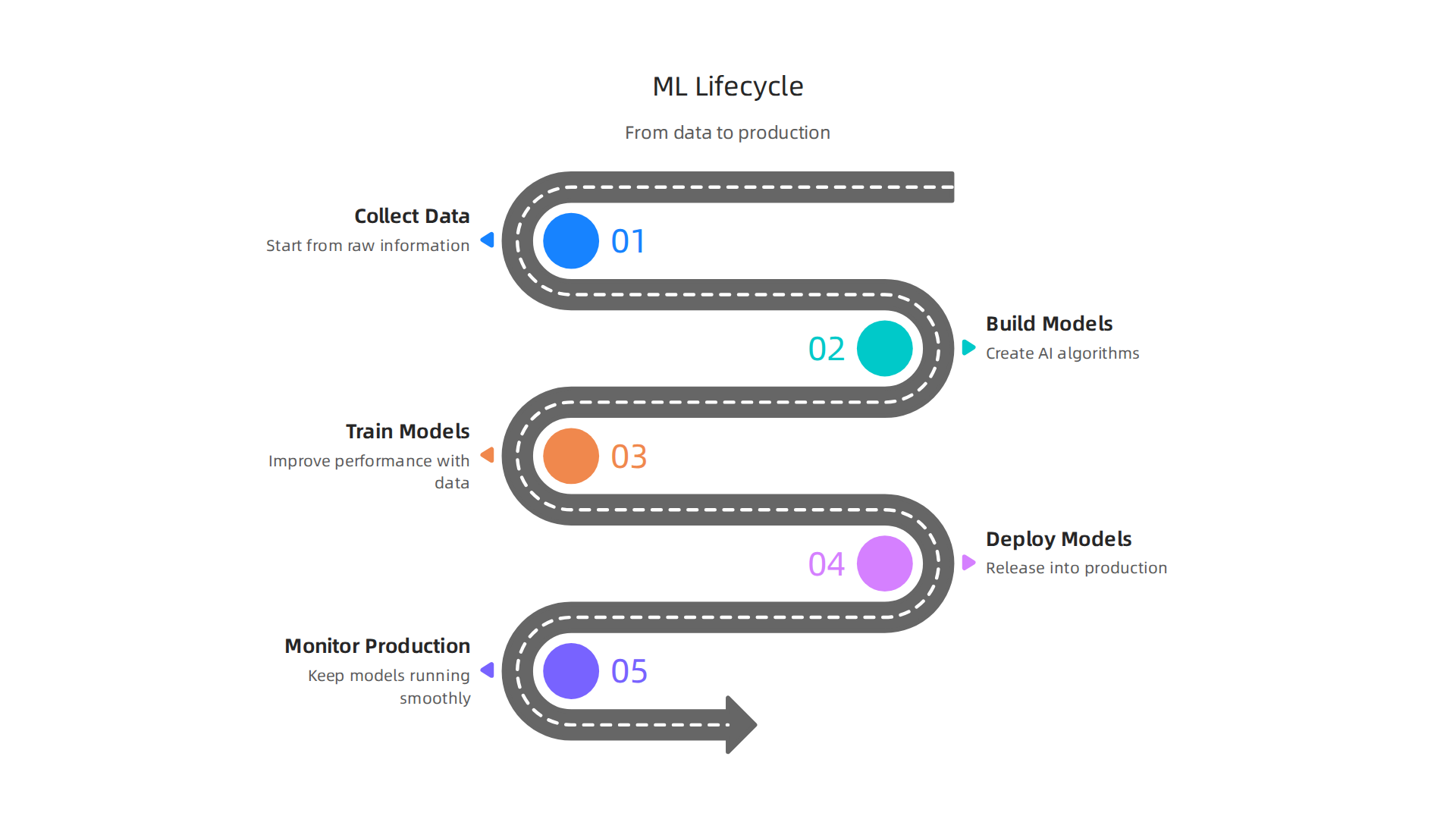
This course covers the entire machine learning lifecycle. You start from collecting and cleaning data, then move to building and training models, and finally deploy and monitor them in production.
It is taught by industry experts from UC Berkeley and experienced startup founders who have shipped real AI products. You get hands-on with cloud platforms like AWS and GCP and learn MLOps tools that keep models running smoothly after launch.
The best AI course for deployment skills? Full Stack Deep Learning is a strong candidate. It fills the gap between knowing theory and shipping software. You work on projects that simulate real industry workflows. So you are not just learning concepts. You are learning what it actually takes to maintain a live AI system.
If you want to explore more learning paths, check out our guide on the best AI courses for 2026 that covers all top options. For example, the TensorFlow Developer Professional Certificate also prepares you to build scalable AI applications, which ties into full stack deployment skills. But Full Stack Deep Learning gives you the bigger picture.
Rather not miss any AI updates? Get clear daily AI news from The AI Newsletter Worth Reading. It helps you stay on top of tools and trends.
9. AI for Everyone (Coursera) – Business & Strategy Focus
Not everyone needs to build models to benefit from AI. If you are a manager, product leader, or executive, your main job is asking the right questions and steering AI investments in the right direction.

That is exactly the gap AI for Everyone fills.
Created by Andrew Ng, this non-technical course covers AI terminology, project scoping, and ethical considerations. You learn how to identify which problems AI can solve and which ones it cannot. No math. No coding. Just clear strategic thinking.
Here is the thing. Many AI projects fail not because the technology is bad but because the planning is weak. Leaders who do not understand basic AI concepts struggle to set realistic goals. This course helps you avoid that trap. You learn how to talk to data scientists, evaluate project proposals, and lead AI initiatives with confidence.
For anyone in a leadership role, finding the right training matters. That is why the best AI course for business leaders often combines strategy with real examples. AI for Everyone does this well. It helps you move from feeling lost around AI to making informed, practical decisions.
Understanding AI at a strategic level also opens up career opportunities. As the AWS Certification Salary Report 2026 shows, skills in AI and cloud technologies can lead to significant salary growth. Even non-technical leaders who understand AI stand out in the job market.
If you want to take the next step and lead AI projects with clarity, start here. Then check out our practical guide on understanding realistic AI for business leaders to go deeper.
Ready to stay ahead of the fast-moving AI landscape? Get clear daily updates from The AI Newsletter Worth Reading. It keeps you informed without the hype.
10. Top AI Certifications from AWS, Google, Microsoft – For Career Boost
Strategic understanding is powerful, but earning a recognized credential can supercharge your career even more. If you are looking for the best AI course to validate your skills in a way employers trust, certifications from the big cloud providers are the answer.
Three stand out in 2026. The AWS Machine Learning Specialty has been a gold standard, though it is being phased out. The Google Professional ML Engineer exam tests deep knowledge of building and deploying models on Google Cloud. The Microsoft Azure AI Engineer Associate certification focuses on using Azure’s AI services to build intelligent solutions.
Here is what makes these valuable. They are not theory exams. They require hands-on experience with real tools. Employers recognize them as proof that you can actually do the work.
Salary impact is real. According to the latest data on top AWS certifications worth your investment, professionals with these credentials see significant pay bumps. Cloud certifications in general can boost earnings by 25% or more.
So which one should you pick? If your company uses AWS, start there. If you work with Google tools, go for the ML Engineer path. And if you are in a Microsoft-heavy environment, the Azure AI Engineer cert is your best bet.
Each of these carries more weight than a typical online course. They are the best AI course option for proving your expertise to hiring managers. Pair one of these with relevant projects, and you will stand out in any job search.
For a full list of credentials that open doors, check out our guide on top data analytics certifications in 2026. It covers which ones pair best with AI roles.
Summary
This article explains why following a structured AI learning path is essential in 2026 and compares the courses that actually prepare you for work. It evaluates beginner options like Andrew Ng’s Machine Learning Specialization, hands‑on programs such as Fast.ai and DeepLearning.AI’s TensorFlow track, free university courses from Harvard and MIT, and deployment-focused tracks like Full Stack Deep Learning. The piece highlights how to balance theory and practice, when certifications matter, and which programs are best for specific goals—coding, research, leadership, or shipping models to production. Readers will learn how to pick courses based on cost, time, and real-world applicability and how to combine programs and projects into a job-ready portfolio. The article also points to resources for ongoing updates so learners can keep skills current as tools and employer expectations evolve.