
Introduction
Have you ever read a piece of text and wondered, "Did a human or a machine write this?" In 2026, that question matters more than ever.

Generative AI tools like ChatGPT and Claude can now produce essays, emails, and reports that sound almost human. This has created a big challenge for teachers, publishers, and businesses. They need a reliable way to tell the difference between human writing and machine writing. That is where an artificial intelligence detector comes in.
You might think these tools simply look for obvious clues, like robotic phrases. But the truth is more interesting. Modern AI detectors work by analyzing subtle linguistic signals. They do not just match patterns. Instead, they study how text is put together. Things like sentence variety, word choice, and flow. The goal is to spot the fingerprints that large language models (or LLMs in AI) leave behind.
For example, a tool like Copyleaks helps educators see which assignments were likely written by AI. Trinka AI explains that detectors examine writing style and sentence structure to find patterns common in machine text. This is a data driven approach. It is not about looking for one single error. It is about measuring things like data meaning through metrics called perplexity and burstiness.
One common question people ask is, "is artificial intelligence capitalized?" That is a grammar detail. But the real focus of detection is much deeper. It is about how the text behaves as a whole.
In this article, we will break down the core linguistic principles behind artificial intelligence detectors. You will learn what signals they look for, how they work, and where they can get things wrong. Understanding this will help you use these tools smarter and spot their limits. And if you want to stay ahead of AI trends, consider partnering with artificial intelligence in 2026 with better awareness.
Ready to see what the machines are hiding? Keep reading.
Get clear daily AI updates from The Deep View Newsletter
What Is an AI Detector?
An artificial intelligence detector is a system that decides whether a piece of text was written by a human or generated by a machine. Think of it as a digital gatekeeper. You feed in a paragraph, and the tool gives you a score or a label like "likely AI" or "likely human." These tools are not the same as plagiarism checkers. Plagiarism tools look for exact matches to existing content. AI detectors look for hidden patterns in how the text is built.
So how do they actually work? Most detectors use statistical and linguistic feature analysis. That means they study things like sentence length, word choice, and the rhythm of the writing. A tool like Copyleaks explains that in 2026, educators rely on these signals to spot AI in student work. Trinka AI adds that detectors examine writing style and sentence structure to find patterns common in machine-generated text.
Two key metrics come up again and again: perplexity and burstiness. Perplexity measures how predictable the text is. AI writing tends to be more predictable. Burstiness looks at how varied the sentence lengths are. Humans naturally mix short and long sentences. AI often sticks to a more uniform rhythm. Thesify describes these signals as core to modern detection in 2026.
Detection technology has evolved fast since 2022. Early tools were simple and often wrong. Today’s best detectors use transformer-based classifiers. These are the same kind of deep learning models that power tools like ChatGPT. A transformer can scan a piece of text and compare it to millions of examples of both human and machine writing. It learns what "normal" human writing looks like at a deep level. One challenge is that these tools can have bias against ESL students, flagging formal writing as AI because it lacks casual variation.
Understanding what an AI detector is helps you use it better. You will know not to treat its verdict as absolute truth. And you will see why the technology keeps improving. If you want to stay informed about the latest developments in AI detection and other breakthroughs, getting a daily dose of curated news can help. Subscribe to The Deep View Newsletter for clear AI updates every day.
For more context on how AI is reshaping our world, check out our guide on whether AI will take over the world.
The Linguistic Toolkit: How AI Detectors Analyze Text
Now that you know what an artificial intelligence detector is, let us look under the hood at how these tools actually read your text. They do not guess randomly. They look for specific linguistic signals that separate human writing from machine writing.
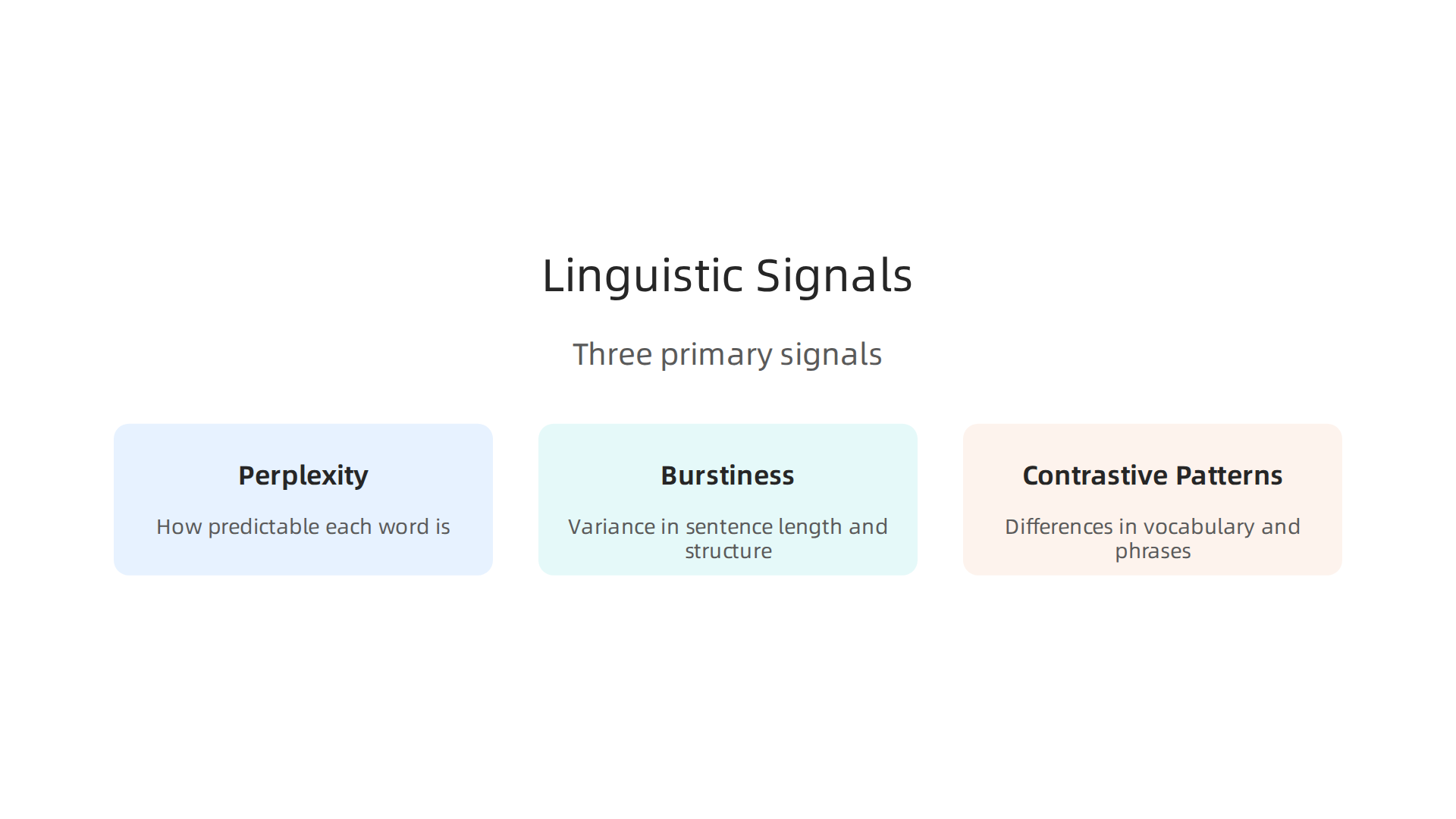
Detectors focus on three primary signals: perplexity, burstiness, and contrastive patterns.
The first two are the most important.
Perplexity is a measure of how predictable each word is. Think of it as a surprise meter. When you read a sentence, some words are easy to guess. Others are surprising. Human writing tends to have higher perplexity because we make unexpected word choices. AI text often has lower perplexity because the model picks the most likely word at every step. Tools like GPTZero use this metric heavily. As Eyesift explains in their 2026 guide, perplexity measures how predictable each word is, and AI text usually scores lower.
Burstiness looks at how much sentence length and structure vary throughout a piece of writing. Humans naturally mix long, complex sentences with short, punchy ones. AI models tend to produce sentences with more uniform length. This uniformity is a telltale sign. The [Gonzaga University faculty guide](https://researchguides.gonzaga.edu/GenerativeAIforFaculty/AI Detectors) notes that burstiness captures variance in sentence length, which is often lower in AI text.
These two metrics work together. An artificial intelligence detector calculates a perplexity score for every sentence and then measures how those scores change across the document. Low average perplexity plus low burstiness? That is a strong flag for machine generation.
Contrastive patterns go a bit deeper. Some detectors also check for contrast between different parts of the text. For example, a human might shift tone between an introduction and a conclusion. AI often keeps the same style throughout. This third signal adds another layer of accuracy.
Are these metrics foolproof? Not at all. As Pangram Labs points out, perplexity and burstiness can fail when human writers use very predictable language or when AI text is deliberately made more varied. That is why modern detectors combine these signals with other techniques like deep learning models.
Understanding these tools is a data driven skill. It helps you see why an artificial intelligence detector makes the call it does. And if you want to get better at analyzing text yourself, you might enjoy our guide on how to succeed as a data analyst in 2026. The same thinking applies.
Detection technology keeps evolving. To stay on top of the latest breakthroughs and best practices, a daily dose of curated news can help. Subscribe to The Deep View Newsletter for clear AI updates every morning.
Perplexity Scores and Token Probability
Let’s zoom in on perplexity. This is the core metric in any artificial intelligence detector. Think of it as a confidence score for each word.
Here’s how it works. A language model, the same kind of tech behind an LLM in AI, looks at your text one word at a time. For every word, it asks: "How likely was this word to come next?" If the model would have picked the same word very often, the perplexity is low. If the model would have picked a different word instead, the perplexity is high.
Human writing has higher perplexity. Why? Because we make surprising choices. We use slang, metaphors, and odd phrasing. AI text tends to be more predictable. The GPTZero team explains that you can interpret the perplexity per sentence as a measure of how likely an AI model would have chosen the exact same words.
Detectors set a specific perplexity threshold. If your text scores below that line, you get flagged as AI generated. But thresholds vary by tool. Some are strict. Others are loose. This threshold approach is a data driven process. It requires understanding the data meaning behind each score.
If you want to sharpen your skills in analyzing data like this, check out our guide on how to succeed as a data analyst in 2026. The same logical thinking applies.
And since detection tools keep changing their thresholds, staying informed is key. Subscribe to The Deep View Newsletter for clear daily AI updates.
Burstiness: The Rhythm of Human Writing
Perplexity tells us how predictable each word is. But there is another metric that rounds out the picture. It is called burstiness.
Think of burstiness as the rhythm of your writing. It measures how much your sentence lengths and structures vary. Humans almost never write the same way twice in a row. We throw in a short, punchy sentence. Then we follow it with a longer, flowing one full of clauses and details. This natural variation creates a unique fingerprint.
On the other hand, an LLM in AI tends to produce text that is more uniform. Sentence after sentence, the structure feels even. The length stays in a narrow range. That smoothness is a clue for an artificial intelligence detector.
Detectors combine burstiness with perplexity for much higher accuracy. Low perplexity plus low burstiness is a strong signal for AI generated text. High perplexity plus high burstiness looks human. The data meaning of burstiness is all about the flow.
How do tools actually measure this? It is a data driven process. They scan your entire document and compare the variation against what a language model would likely produce. If the rhythm is too flat, you may get flagged.
Whether you write "artificial intelligence" or capitalize it, burstiness looks past the words to the patterns. Understanding these patterns helps you see how your own style compares to machine output. It also matters for fields like human AI collaboration, where blending human and AI voices requires knowing the difference.
Detection tools keep evolving. To stay on top of the latest methods, subscribe to The Deep View Newsletter and get daily updates straight to your inbox.
Contrastive Language Patterns
Burstiness looks at the rhythm of your sentences. But there is another layer that makes an artificial intelligence detector even sharper. It compares the specific words and phrases you choose.
Think of contrastive language patterns as a fingerprint of your vocabulary. An AI detector scans your text for the tiny word habits that humans and machines use differently. For example, an LLM in AI tends to reach for formal transition words like "furthermore," "additionally," and "consequently" way more often than a person would. Humans throw in contractions like "don’t" and "can’t" without thinking. AI models often skip them.
These patterns are not random. Detectors capture them using something called n-gram frequency distributions. An n-gram is just a group of words that often appear together. The tool counts how often certain phrases pop up and compares them to what a human would likely write. According to research from GPTZero, this comparison helps flag text that feels too uniform or too formal.
The data meaning behind all of this is simple. Your writing carries a signature. An artificial intelligence detector picks up on that signature by looking at the small stuff. How often do you use "is artificial intelligence capitalized" or "data driven"? Those choices matter.
If you are curious about how these patterns affect real world collaboration between people and machines, check out our guide on human AI collaboration. Understanding the differences helps you blend the best of both worlds.
Training Data and Model Biases
The last section showed how an artificial intelligence detector studies your word choices. But here’s the thing. The detector itself has a big weakness. Its performance depends on the data it learned from. And that data is far from perfect.
Think of it like training a dog. If you only teach it to fetch a red ball, it won’t know what to do with a blue one. Same goes for AI detection tools. Most artificial intelligence detectors are trained on a narrow set of writing examples. According to a 2026 study on AI detection in academics, these tools struggle to tell apart human and AI text when the writing comes from different backgrounds or styles.
The problem starts with the training data. A shocking statistic from 2026 shows that 73% of AI systems have problems with biased training datasets. These datasets often leave out large groups of people. For example, as the International AI Safety Report 2026 points out, AI systems underperform in languages that are less common in their training data. This means an artificial intelligence detector might wrongly flag a non-native English speaker’s writing as AI generated.

The tool just has not seen enough examples of that style.
But it gets worse. Many commercial detectors in 2026 are trained mostly on older models like GPT-3. They have not learned the patterns of newer LLMs. So if someone uses a modern model to write a paper, the detector might miss it completely. Or it might flag text that sounds slightly formal, even though a human wrote it. This leads to a high false positive rate for certain writers.
These biases are not just technical problems. They affect real people. Students get accused of cheating. Job applicants get rejected. Researchers get their work doubted. As Stanford’s 2026 AI Index Report shows, the field is still working on making these tools fairer and more inclusive.
So what can you do? First, understand that no artificial intelligence detector is perfect. Always double check flagged results. Second, if you are writing and want to avoid false flags, mix up your sentence structure and use natural contractions. And third, stay informed about how these tools evolve.
The landscape changes fast. New bias statistics and research come out every year. If you want to keep up with the latest breakthroughs and understand how AI affects your work, subscribing to a trusted source helps.
Get clear daily AI updates from The Deep View Newsletter. It keeps you in the loop without the hype.
If you want to dig deeper into how bias shapes the risks of AI, check out our guide on whether AI will take over the world. It covers the bigger picture of trust and fairness.
Evaluating Detector Accuracy
So how good are these tools really? Let’s talk numbers. When researchers evaluate an artificial intelligence detector, they look at a few key metrics.

You do not need to be a data scientist to understand them.
Precision tells you how many of the flagged texts are actually AI generated. If a detector has high precision, you can trust its warnings. Recall (also called sensitivity) measures how many AI written texts it actually catches. A tool with low recall misses a lot. F1 score is the balance between precision and recall. And area under the ROC curve gives an overall picture of how well the detector separates human text from machine text.
Here is the real issue. False positive rates are a huge concern. A false positive happens when the detector says a human written essay is AI generated. In education, that can destroy a student’s reputation. A 2026 guide on how professors detect AI writing shows that these false flags happen more often with non-native speakers and formal writing styles. The tool simply has not seen enough variety in its training examples.
No current artificial intelligence detector achieves perfect accuracy. Performance changes based on text length, topic, and which LLM in AI was used to create the text. A short email is harder to judge than a long research paper. Academic writing with structured language triggers more false alarms than casual blog posts. The academic study on AI detection in 2026 confirms that even the best tools struggle with certain domains.
The takeaway? Do not trust a single score. Use a data driven approach. If a tool flags your work, compare multiple detectors. Look at the raw scores, not just the label. And be aware that the data meaning behind these scores depends on the training set quality. As the International AI Safety Report 2026 notes, systems still underperform in less common languages and contexts.
To get better at spotting these weaknesses, it helps to understand how humans and AI can work together. Learning about human AI collaboration can give you a clearer view of what machines can and cannot do.
In the end, think of an artificial intelligence detector as a helpful assistant, not a judge. Always double check before making big decisions based on its output.
Key Benchmarks and Leaderboards
But how do you pick the right artificial intelligence detector for your needs? That is where benchmarks and leaderboards come in. They give you a standard way to compare tools side by side.
Researchers use datasets like HC3 and M4 to test detectors. These open source collections include both human written and AI generated text. They cover different lengths, topics, and writing styles. Some even add adversarial examples, which are tricky texts designed to fool the tool. The goal is to see which detectors stay accurate and which ones break down.
Leaderboards rank detectors based on key metrics. You will see numbers for accuracy, F1 score, and robustness to paraphrasing. For instance, one 2026 review of AI detectors found that real-world accuracy ranges from about 65% to 90%, depending on the tool and the text length. Another study on benchmark accuracy warns that high scores can hide serious failures in everyday use.
Still, a benchmark score is not a guarantee. The tool that wins on paper might still flag your human written essay as AI generated. That is why it helps to understand the real risks of AI in 2026 before relying on any single test.
Want to keep learning? The Deep View Newsletter delivers clear AI updates to your inbox every day. It is a great way to stay informed about tools like artificial intelligence detectors and the latest benchmarks.
The Problem of False Positives
Benchmark scores look good on paper. But in real life, artificial intelligence detectors make a scary mistake: they flag human writing as AI generated. That is called a false positive. And it can have serious consequences.
Imagine a student who writes their own essay. They turn it in. A tool says it is AI written. The student gets accused of cheating. This happens more often than you might think.
Research from 2026 shows false positive rates can be very high. One study found a mean false positive rate of 61.3 percent for certain essays. Other tools show rates from 2 to 15 percent for native English speakers. But for non-native speakers, the rate can jump to 61 percent. That is a big problem.
Why do false positives happen? Artificial intelligence detectors look for patterns. They compare your writing to data from large language models (LLM in AI). Human writing that is clear and structured can look like LLM output to these tools. So a writer who uses simple, direct sentences might get flagged.
How do we fix this? Some tools now use ensemble methods. That means they combine several detectors to make a final call. Others use confidence thresholds. They only flag text when the score is very high.
Still, no single test is perfect. If you rely on one artificial intelligence detector alone, you risk accusing someone unfairly. The data driven truth is that these tools need improvement.
The best way to stay safe is to know the limits of AI detection. Want to keep learning without the hype? The Deep View Newsletter delivers clear daily AI updates straight to your inbox. It helps you separate real breakthroughs from false alarms.
Real-World Use Cases for AI Detection
False positives are a real worry. But that does not mean artificial intelligence detectors are useless. In fact, they play a big role in three key areas: schools, newsrooms, and online platforms.

The market for these tools is growing fast. It was worth about $2.2 billion in 2026 and could reach $8.6 billion by 2033, according to one market report. Here is where you see them in action.
Academic Integrity
Universities use artificial intelligence detectors to catch AI-generated assignments and theses. Since generative AI exploded, schools have had to rewrite their honesty policies. Many now require students to submit essays through detection software. The goal is to keep grades fair. But as we covered earlier, false positives can hurt honest students. That is why colleges are careful. They use detectors as one piece of the puzzle, not the final word. If you want to understand the bigger risks of AI in education and beyond, our article on whether AI will take over the world gives you a balanced view.
Journalism and Content Verification
Newsrooms are also adopting artificial intelligence detectors. Reporters and editors use them to check if a submitted story or press release was written by a human or by an llm in ai. This helps maintain trust. When a source sends a guest post, a quick scan can reveal if it is fake news or real reporting. Publishers also use detectors to verify content from freelance writers. The data driven approach here is simple: catch machine-written text before it reaches readers.
Content Moderation
Social media platforms and review sites face a flood of automated spam and fake reviews. Artificial intelligence detectors help filter this noise. They flag posts that look like they came from a chatbot rather than a real person. For example, a fake product review that uses robotic language gets caught early. Moderation teams then decide what to remove. This is a tough job because the tools are not perfect, as the limits of automated content moderation show. Still, they help platforms stay cleaner than they would without detection.
The field is moving fast. To keep up with the latest on AI detection and other breakthroughs, get clear daily updates with The Deep View Newsletter.
Detecting AI in Academic Work
Universities have jumped headfirst into using artificial intelligence detectors to catch AI written essays and assignments. Tools like Turnitin and GPTZero are now common in many schools. The goal is simple: keep academic integrity strong in an age where generative AI is everywhere. In 2026, the academic standard for AI detection involves scanning submitted work and flagging anything that looks machine made, according to one guide for colleges.
But here is the tough part. False accusations are a real fear. A student might write an original essay, but the detector says it was AI generated. That mistake can damage trust and cause real harm. That is why most schools now have a rule: no penalty comes from a detection score alone. A human must review the flagged work before any action is taken. This helps protect honest students and makes the system more fair.
The best approach combines tools with common sense. Schools pair an artificial intelligence detector with metadata analysis and follow up oral exams. For example, if a paper scores high on the AI scale, the teacher asks the student to explain a few sentences face to face. This data driven method works better than relying on software alone. If you want to see how educators can partner with AI more effectively, check out our guide on human AI collaboration.
The tools keep improving, but the human check stays essential. To stay up to date on how detection tech is changing education, get clear daily updates from The Deep View Newsletter.
Adversarial Evasion and the Future of Detection
Here is the thing. Even as artificial intelligence detectors get better, students and others looking to cheat are finding clever ways to slip past them. This creates a constant back and forth, like a game of cat and mouse.
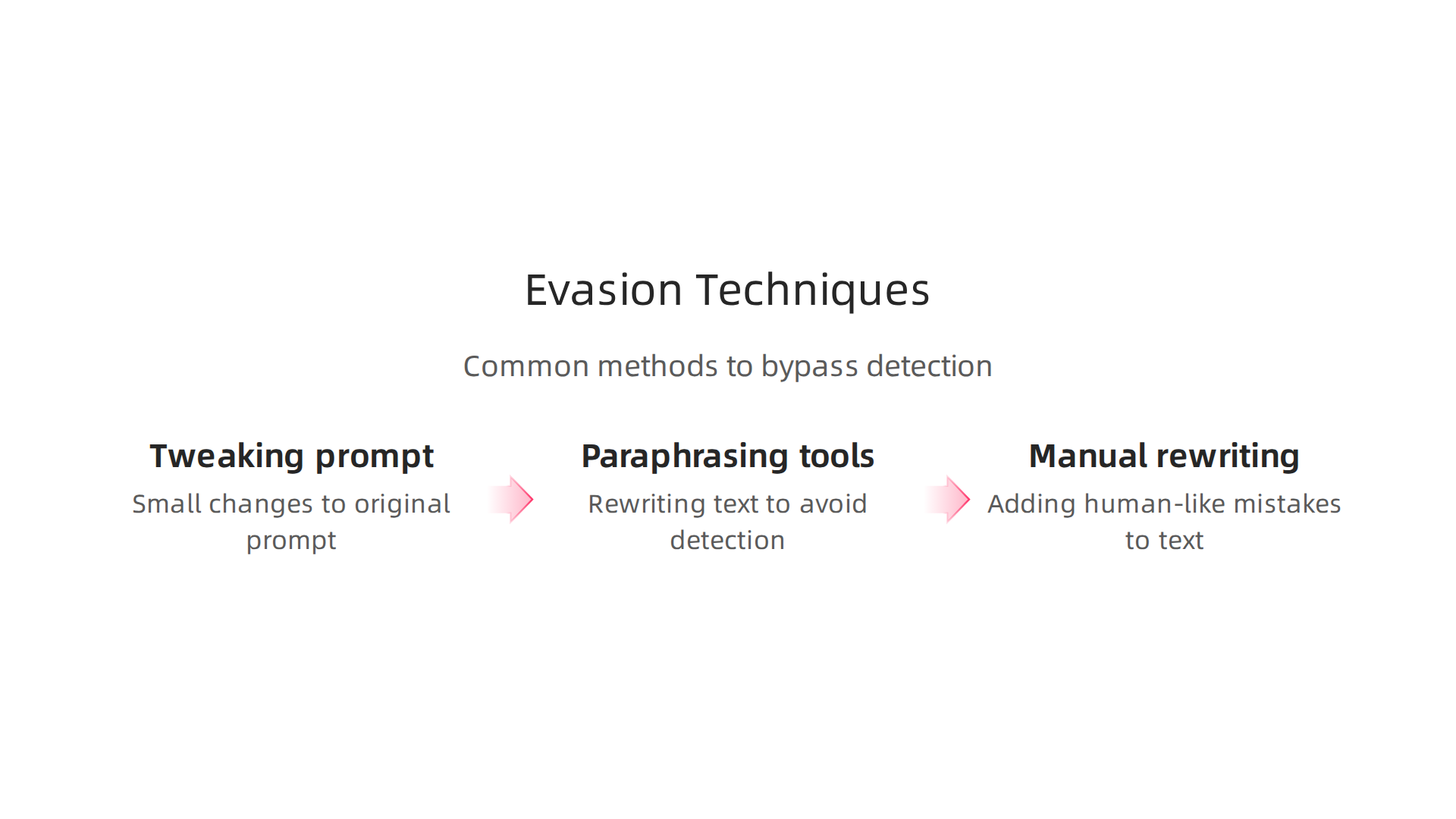
One big trick is called adversarial evasion. It works by making small changes to AI written text so that a detector no longer flags it. Common methods include tweaking the original prompt, using paraphrasing tools, or manually rewriting sentences to add human like mistakes.
A research paper from 2024 showed that adding a little "external noise" to text can effectively hide its machine origins, according to a study shared on arXiv. Another study from 2025 found that even simple attacks, like changing a PDF file in a specific way, can completely bypass detection without needing to modify a single word. This is a serious challenge for anyone relying on an artificial intelligence detector alone.
So what is the next step? Many experts believe that proactive protection is the key. Instead of just reacting to AI written work, we can build detection directly into the output. This is called watermarking. The idea is simple: when an AI model creates text, it embeds a hidden signal that only a special scanner can read. You cannot see it, but a machine can. If a student tries to pass off AI generated content as their own, the watermark will give them away. Watermarking is a promising long term solution because it prevents the cat and mouse game before it even starts.
Still, no single method will win forever. The arms race between people who create AI text and those who detect it will likely continue for years. The future of detection probably involves a mix of tools. We will see more multi modal forensic approaches that combine text analysis with metadata, style checks, and even image or code analysis. Detection systems will become smarter at spotting adversarial attacks.
To stay ahead of these fast moving changes in AI detection and generation, you need to keep learning. Get clear daily updates from The Deep View Newsletter to track the latest breakthroughs and understand what they mean for you. It is a smart way to stay informed without the noise.
Summary
This article explains how artificial intelligence detectors decide whether text was written by a human or a machine by analyzing linguistic signals rather than simple phrase matching. It covers the core metrics—perplexity (how predictable words are) and burstiness (variation in sentence rhythm)—and shows how detectors combine these with contrastive pattern analysis and transformer-based classifiers. The piece also highlights real limits: biased training data, high false positive rates for some writers, and the arms race of adversarial evasion. You will learn how detectors work under the hood, when to trust their scores, common accuracy metrics to check, and practical steps institutions use to reduce errors. Ultimately the article helps readers use AI detection tools more wisely, understand their risks in education and publishing, and prepare for future defenses like watermarking.