
The AI landscape is moving fast. By 2026, the global market for artificial intelligence in education is projected to grow past $136 billion, according to the latest AI in Education Market Size report. That kind of growth means one thing: the number of AI courses has exploded.
But here’s the problem. Not all courses are created equal. Some are packed with fluff. Others claim to make you an expert in a weekend. The reality is, picking the wrong course can waste your time and money. More importantly, it can set your career back.
Choosing the right ai course is a strategic decision. The best course on ai for your neighbor might be a total miss for you. Your career goals, your current skill level, and your learning style all matter. The right ai and ml course can fast-track your skills and boost your professional credibility.

The wrong one leaves you stuck.
That’s exactly why this guide exists. We use a research-backed, experience-informed method to help you find the best course for ai that fits your needs. You’ll learn how to spot quality content, avoid marketing traps, and build a learning plan that actually works.
If you’re serious about staying ahead, you need trusted sources for daily updates. Get clear, curated AI insights delivered to your inbox with The AI Newsletter Worth Reading.
And for a head start, check out our hand-picked list of best online AI courses 2026 that actually prepare you for real jobs.
Why Structured AI Learning Matters in 2026
You might be tempted to learn AI by jumping from one YouTube tutorial to another. Maybe you pick up tips from Twitter threads or random blog posts. But here’s the thing: that approach leaves gaps in your knowledge. And in 2026, those gaps can hurt your career.
The field is moving so fast that 82% of students already think knowing how to use AI properly is important for their future, according to the latest AI in Education Statistics. But knowing a few tricks isn’t the same as real understanding.
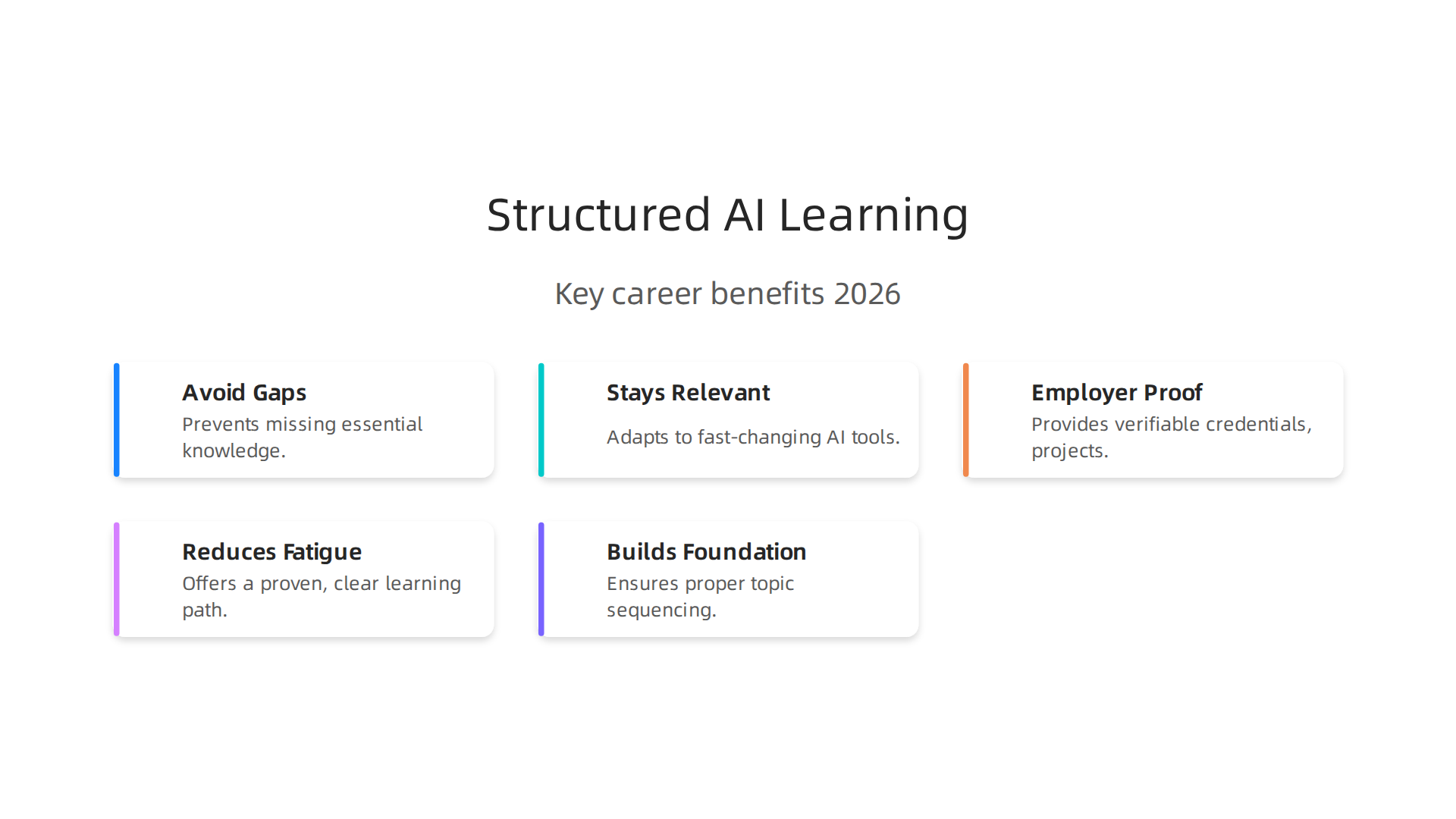
Structured learning keeps you from getting lost
When you follow a well-designed ai course, you learn topics in the right order. You start with the basics, build on them, and then move to advanced ideas.

Without that structure, you might spend weeks on something that assumes knowledge you don’t have yet. That’s frustrating and wastes time.
A good ai and ml course also teaches you the theory behind the tools. That matters because AI changes fast. If you only know how to use today’s version of a tool, you will be behind when the next version arrives. But if you understand the core concepts, you can adapt.
Employers want proof, not stories
In 2026, companies are getting smarter about hiring. They do not just want to hear that you "know AI." They want to see credentials. A certificate from a respected best course on ai tells them you put in the work and learned from experts.
Self-taught experience is valuable, but it is hard for employers to verify. A structured course gives you a clear way to show what you know. Plus, many courses now include projects that become part of your portfolio. This hands-on work proves you can apply what you learned.
Reduce decision fatigue
Trying to figure out what to learn next on your own is exhausting. There are thousands of tutorials, papers, and tools. A structured path removes that stress. You follow a proven sequence and trust that you are covering the essential topics. That is a huge relief when you are already busy with work or school.
Real-world example
Think about building a house. You would not start with the roof. You need a solid foundation first. Learning AI works the same way. Jumping straight to advanced topics like deep learning without understanding basic machine learning leads to confusion.
If you are ready to find a structured path that works, check out our guide on top data analytics certifications in 2026 for AI careers. It is a great starting point for building knowledge in the right order.
Evaluating the Top AI Course Platforms: What to Look For
Not all platforms are built the same. Picking the right one for your ai course can make or break your learning experience. You want a place that gives you real skills, not just flashy marketing.
So what should you actually look for? Let’s break it down.
Curriculum freshness matters more than you think
AI changes every few months. A course made two years ago might already be outdated. The best platforms update their content regularly. Check if the syllabus includes recent topics like large language models, prompt engineering, and AI agents. Top platforms such as Coursera, edX, Udacity, and DeepLearning.AI all refresh their courses often. But some do it better than others.
The latest best course on ai rankings from a 2026 review of platforms show that DeepLearning.AI and Coursera are top choices with high student ratings. The best AI courses online for 2026 list highlights the Deep Learning Specialization with a 4.9 rating and reasonable pricing. That kind of feedback tells you the content is solid.
Instructor quality separates good from great
Who teaches the course matters a lot. Top instructors like Andrew Ng from DeepLearning.AI bring years of real-world experience. They explain complex ideas in simple ways. Other platforms use industry professionals who work on cutting-edge projects. Look for instructors with proven backgrounds, not just impressive titles.
If you want a deeper look at which courses actually prepare you for real work, check out our guide on best online AI courses in 2026 that prepare you for real jobs. It breaks down what each platform offers.
Hands-on projects and certification value
A good ai and ml course gives you projects you can show off. Employers want proof you can apply what you learned, not just recite facts. Udacity is known for extensive projects, while DeepLearning.AI offers shorter but focused hands-on work. Both can build your portfolio.
Certification also matters. A certificate from a respected platform signals you completed a real course. But make sure the certificate is recognized in your industry. Some platforms offer free audits, while others are paid only.
Community and support can save you time
Learning AI can get lonely and hard. Platforms with active forums or mentorship help you get unstuck faster. Udacity includes mentorship and career help, which is why it costs more. Coursera and DeepLearning.AI have large student communities where you can ask questions and share progress.
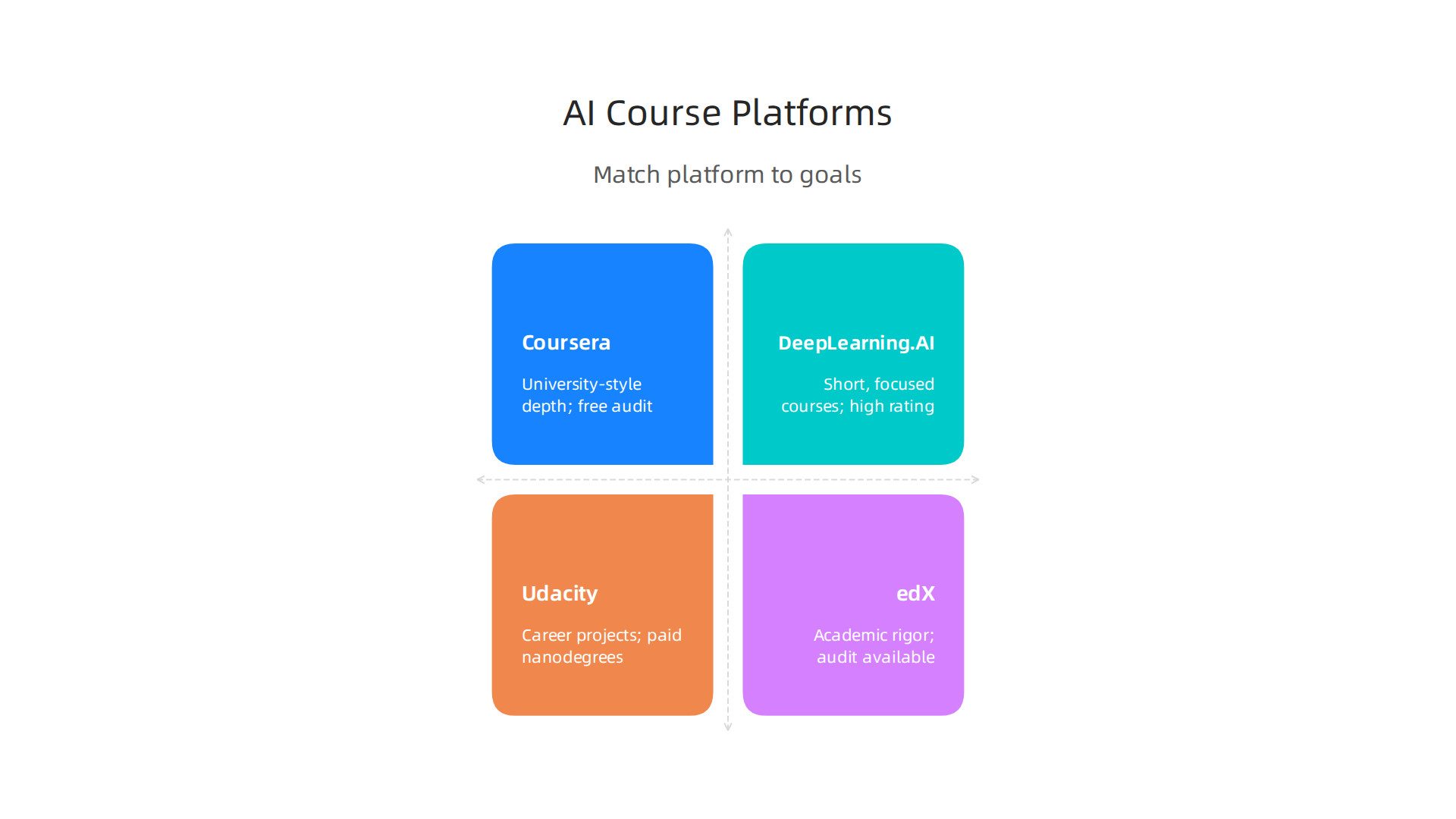
A quick comparison of popular platforms
| Platform | Best For | Typical Cost | Rating (out of 5) |
|---|---|---|---|
| Coursera | University-style depth | Free to audit, ~$49/month | 4.7+ |
| DeepLearning.AI | Short, focused courses | Free to audit, ~$49/month | 4.9 |
| Udacity | Career-focused projects | $399–$999 per nanodegree | 4.5+ |
| edX | Academic rigor | Free to audit, varies | 4.6+ |
Each platform has trade-offs. The key is matching the platform to your learning style and goals.
Final tip for choosing
Do not just pick the most popular option. Read reviews, check the syllabus, and look at sample videos. Your time is valuable. Spend it on an ai best course that actually fits your current skill level.
And once you start learning, staying updated on the field is just as important. For clear daily updates on AI trends and breakthroughs, check out The AI Newsletter Worth Reading. It helps you stay ahead without drowning in noise.
Foundational AI Courses vs. Specialized Tracks: Choosing Your Path
Once you have picked your platform, the next big question is what type of course to take. Do you start with a broad foundation or jump straight into a niche area? The answer depends on where you are in your career and what role you want.
Foundational courses give you the big picture
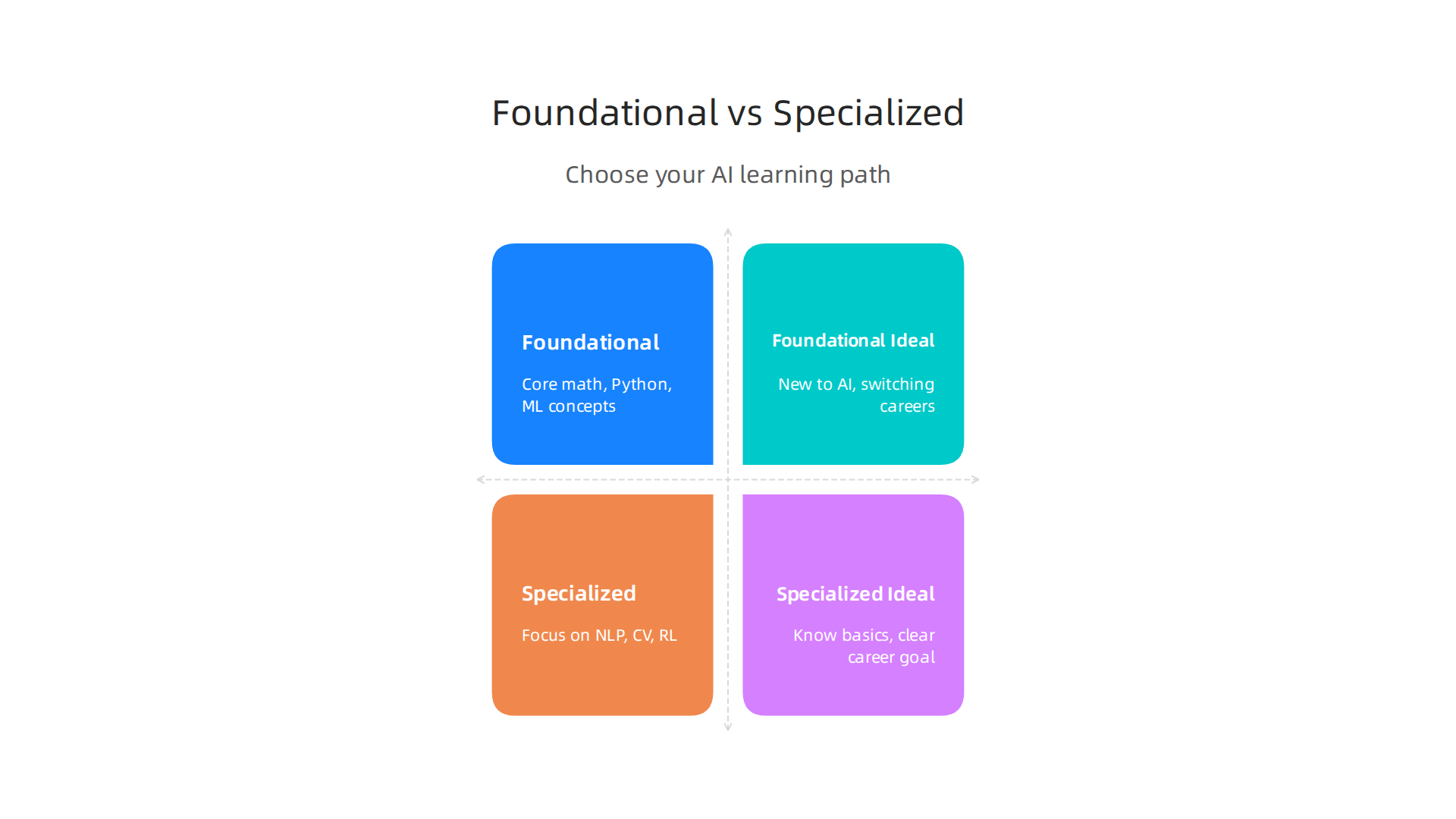
Foundational courses cover the core building blocks. You will learn basic math like linear algebra and statistics. You will get comfortable with Python programming. And you will understand machine learning concepts like supervised and unsupervised learning.
These courses are ideal if you are new to AI or switching careers. They take longer to complete, but they give you a solid base. With a strong foundation, you can later pick up any specialization more quickly. Many experts agree that foundational knowledge helps you see how different parts of AI connect. That kind of big-picture understanding matters when you need to solve real problems.
Specialized tracks get you job-ready faster
Specialized courses focus on one area. You might choose natural language processing, computer vision, or reinforcement learning. These tracks teach you the specific tools and techniques used in that field.
For example, if you want to build chatbots, a specialization in NLP makes more sense than a general machine learning course. Looking at the top AI skills to master in 2026, employers are asking for deep expertise in areas like prompt engineering and LLM fine-tuning. Specialized courses help you develop that depth quickly.
Specialized tracks are great if you already know the basics or if you have a clear career goal. They can get you job-ready in a shorter time. But jumping into a specialization without any foundation can leave you confused when concepts get advanced.
How to decide what is right for you
Think about your current skill level and your target role. If you want to be a data scientist, you might need a strong foundation first. If you want to be an ML engineer focused on computer vision, a specialized track could work if you already know Python and basic ML.
Start by being honest about what you already know. If your math and programming skills are rusty, a foundational course is the safer choice. If you already have experience and just need to fill a specific gap, go for a specialization.
For a deeper look at how different roles break down, check out our guide on AI jobs in 2026 and the skills you need to get hired. It maps specific courses to career paths.
The bottom line
There is no single right answer. The best course for AI depends on your personal situation. Foundational courses build long-term flexibility. Specialized tracks build short-term expertise.
Pick the one that moves you closer to your goal.
Free vs. Paid AI Courses: Balancing Cost and Quality
Once you have picked your direction and decided between foundational and specialized learning, the next big question is whether to spend money. Free and paid AI courses both have their place. Knowing the difference can save you time and cash.
Free courses are a great starting point
Free courses like Stanford CS229 on YouTube or Fast.ai offer world-class content. Major companies like Google, IBM, and Microsoft also publish free modules that are rigorous and employer-recognized. The content quality is often excellent.
But free courses usually lack certification, graded assignments, and personal support. They give you awareness but may not push you to apply what you learn. According to a 2026 analysis on Free vs. Paid AI Courses in 2026: An Honest Answer, free resources are great for building foundational knowledge but often stop at awareness. If you are completely new to AI, start with free courses first.
Paid courses add structure and credentials
Paid courses offer structured depth. They include graded assignments, active forums, career services, and verifiable certificates. Your completion rate also tends to be higher when you have money on the line.
Costs vary. Platform subscriptions run $30 to $100 per month. Professional certificates cost $300 to $2,000. University programs can go up to $25,000. But the payoff can be real. A guide on the Best AI Learning Course in 2026 points out that AI professionals earn premium salaries. A $10,000 course that leads to a $30,000 raise pays for itself in four months.
Paid courses are best when you have a clear career target and need proof of your skills.
The smartest strategy: blend both
You do not have to pick just one. A blended approach works well for most people. Start free. Use free courses to explore different areas and build your base. Once you are sure of your direction, invest in a paid course for depth and a verifiable credential.
This way you spend money only when it matters most. If you want to see a curated list of high-quality options, check out our roundup of best online AI courses in 2026 that actually prepare you for real jobs.
Stay informed as you learn
The AI field moves fast. Even the best course can feel outdated in months. To keep up with new tools and trends, The AI Newsletter Worth Reading delivers clear daily updates straight to your inbox. It is one simple way to stay ahead while you build your skills.
Building a Practical AI Learning Roadmap
Now that you know how to choose between free and paid courses, the next step is putting everything into a clear plan. A practical roadmap turns scattered learning into steady progress.

The right sequence matters
Most beginners make the same mistake. They jump straight into advanced topics without building a foundation. An effective roadmap follows a logical order: start with fundamentals, then move to tools, then build projects, create a portfolio, and finally prepare for jobs.
The first phase covers core concepts. You need a basic understanding of what AI is, how machine learning works, and the ethics around it. You also need practical Python skills and comfort with data libraries like pandas. A solid resource like the AI Learning Roadmap 2026: The Best Resources for Beginners from DataCamp lays out this exact sequence. It suggests spending months 1 through 3 on foundations before moving into core machine learning.
Once you have the basics, you shift to tools and frameworks. Scikit-learn for classical ML. PyTorch for deep learning. Hugging Face for large language models. Each tool builds on the last.
Projects are where real learning happens
Here is the truth. Watching videos and reading tutorials only gets you so far. The moment you start building, everything changes. Hands-on projects force you to debug, make decisions, and think like an engineer.
Aim to complete at least three real projects during your learning journey. Use real-world datasets. Collaborate with others when you can. Each project should push you slightly beyond your comfort zone. If you want to build a foundation in working with data first, check out this guide on practical machine learning for data science for a deeper look at the tools and techniques you will use.
Certifications can help but choose wisely
Not all certifications carry the same weight. Some are widely recognized by employers while others are just completion badges. Before you pay for a certificate, research which ones your target industry values. A certification from a respected platform can help your resume stand out. But it should never replace actual project experience.
A good rule is to use certifications as proof of your skills, not as a substitute for building them. Employers in 2026 want to see what you can do. A strong portfolio backed by a relevant certification is a powerful combination.
With a clear roadmap in hand, you are ready to start learning with purpose. The next step is choosing your first project and getting your hands dirty.
The Role of Certifications in AI Career Advancement
So you built a solid learning roadmap and started working on projects. Now comes the question that trips up many learners: are certifications worth it in 2026? The answer depends on how you use them.
How certifications help you stand out
Here is the truth about the job market right now. Half of all tech job postings require AI skills. That is a baseline, not a bonus. A certification from a trusted name like DeepLearning.AI, Google, or Microsoft can help you show employers you have that baseline. It signals that you completed a structured program and passed a real assessment.
The demand for AI talent is huge. According to a recent report, 50% of tech jobs now require AI skills, up from 47% just a month before. That means having a recognized certification on your resume can make the difference between getting an interview and getting ignored.
The portfolio vs. certification debate
Some employers treat certifications as valid proof of competence. Others care mainly about what you have built. The smart approach is to use both. A certification shows you understand the theory. A portfolio proves you can apply it.
Think of it this way. A certification is like a driver’s license. It says you passed the test. But a portfolio is like a video of you driving through city traffic, parallel parking, and handling a highway merge. Employers want to see both.
Avoid the stacking trap
One danger is stacking multiple certifications without doing real work. You might earn five certificates in six months but never build a single project. That does not help. In fact, it can hurt. Recruiters may see you as someone who collects badges but cannot deliver.
Instead, pick one or two relevant certifications and pair them with hands-on experience. For example, earn a certificate from a top AI course, then build a project that uses those skills. If you want to explore which credentials carry the most weight right now, check out this guide on top data analytics certifications in 2026 for AI careers. It breaks down which ones employers actually value.
Use certifications as proof, not a shortcut
The best way to think about certifications is as proof of your skills, not a replacement for building them. A strong portfolio backed by a relevant certification is a powerful combination. It shows you know the theory and can execute.
The AI field moves fast. Staying informed about new tools, trends, and opportunities is just as important as any certificate. If you want to keep up without the noise, consider subscribing to The AI Newsletter Worth Reading. It delivers clear daily updates so you always know what matters for your career.
How to Identify High‑Quality AI Courses Amid the Hype
Everywhere you look in 2026, someone is pushing an AI course. Some are excellent. Others are a waste of time. How do you tell the difference before you spend your money?
Here is a simple checklist to separate the real deals from the noise.
Red flags that scream "skip this course"
Keep your eyes open for these warning signs:
- Outdated content. AI moves fast. If a course still focuses on techniques from 2023 without updates, it is probably behind.
- Vague prerequisites. A good course tells you exactly what you need to know before starting. If it says "basic Python" but throws calculus at you in week one, that is a problem.
- No instructor credentials. Who is teaching you? If you cannot find their name, background, or reputation, walk away.
- Poor or fake reviews. Check the platforms carefully. A 4.9 rating is great, but read the actual feedback. Look for specific praise or criticism. Reviews that mention "life changing" without any detail are often paid.
Green flags that point to a winner
When a course has these signs, it is worth your attention:
- Active community. A forum, Discord, or Slack where students and instructors engage regularly means you will get help when you get stuck.
- Regular updates. The best courses refresh content every few months. Look for a "last updated" date within 2025 or 2026.
- Real‑world projects. The course should ask you to build something useful, not just memorize terms. Projects show you can apply what you learn.
- Transparent success metrics. Do they share how many students completed the course or what jobs they landed? Honest numbers are gold.
You can see these green flags in action on highly rated programs. For example, one of the best AI courses online in 2026 for real jobs combines a strong instructor, hands‑on projects, and an engaged community.
Use a structured checklist before you buy
Before you click "enroll", run through this short list:
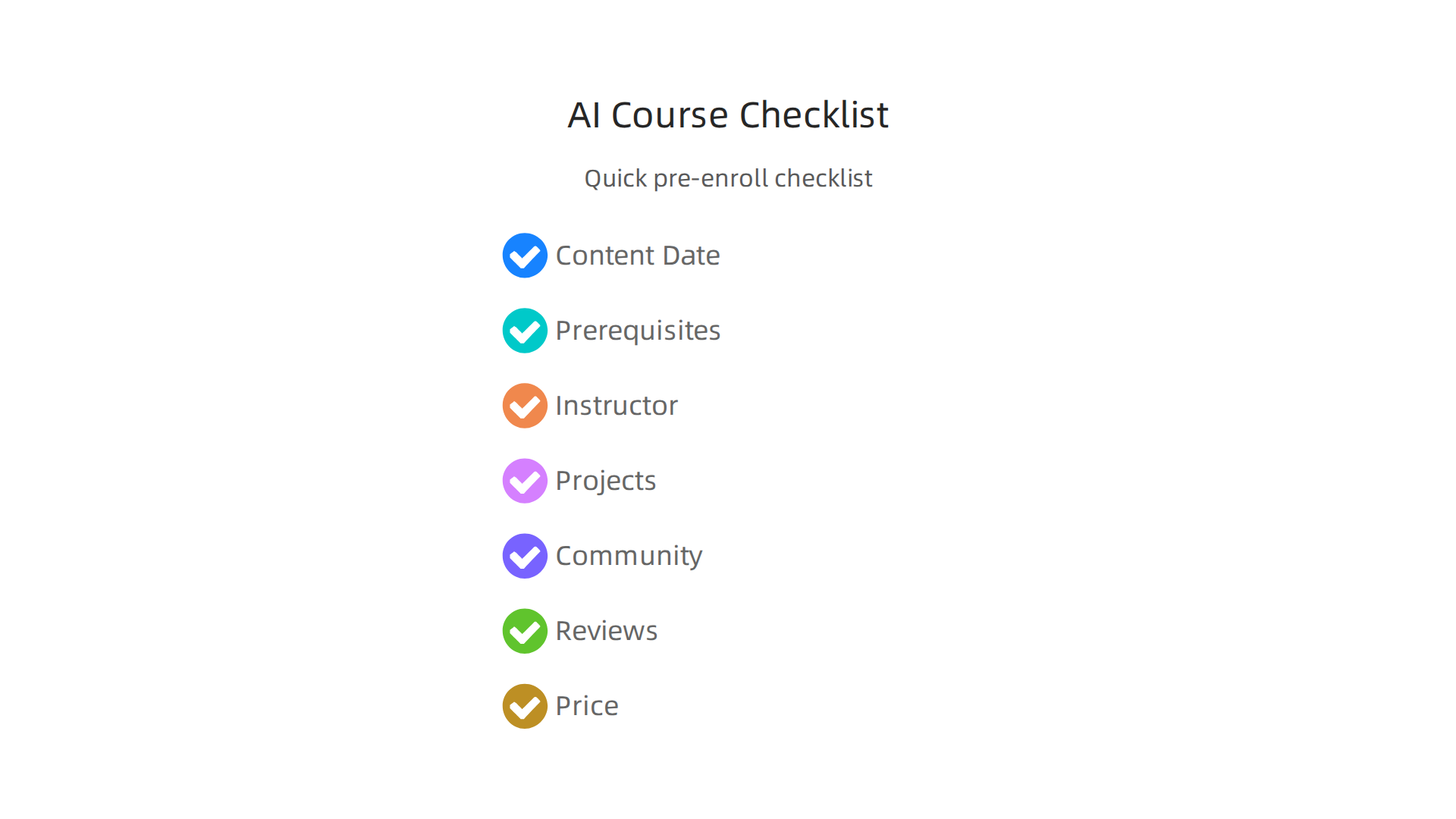
- Is the content from 2025 or later?
- Are the prerequisites clear and fair?
- Does the instructor have a proven track record?
- Are there real projects, not just quizzes?
- Do students actively discuss the material?
- Can you find honest reviews from people who finished it?
- Is the price reasonable for what you get?
If a course passes all seven, it is a safe bet. If it fails three or more, move on.
Stay ahead of the hype
The AI education space changes fast. What is a top course today might be irrelevant next month. To keep finding high‑quality options without the guesswork, get clear daily updates from The AI Newsletter Worth Reading. It helps you spot the real breakthroughs and avoid the noise.
Staying Ahead: Continuous Learning Strategies for AI Professionals
Finishing a great AI course is a big step, but it is not the end. AI changes fast. What you learned in your best course on ai last year might already have new approaches. In 2026, the professionals who stay relevant are the ones who keep learning every day.

So how do you keep growing without burning out? Here are three strategies that work.
1. Follow research papers and attend conferences
The real breakthroughs happen in research labs first. Reading original papers helps you understand why new methods work. But you do not need to read every page. Start with blog summaries or implementation notebooks.
Major conferences like NeurIPS, ICML, and CVPR publish the most important papers each year. Following their proceedings keeps you ahead of the curve. A good machine learning roadmap for 2026 recommends building a habit of reading papers practically, starting with blog summaries before diving into dense research.
Also consider attending virtual or in‑person conferences. Even one talk per month can expose you to ideas you would never find on your own.
2. Set recurring learning goals and cut the noise
It is easy to feel overwhelmed by the flood of new tools, models, and tutorials. The trick is to set small, repeatable goals.
- Spend 15 minutes each morning skimming a curated feed of AI news.
- Listen to a podcast during your commute.
- Dedicate one weekend afternoon per month to building a small project using a new technique.
This structure replaces panic with routine. You stay informed without the stress of trying to follow everything. A great way to start is to check out the AI breakthroughs in 2026 that actually matter for a focused view on what is worth your attention.
3. Build a personal learning network
You learn faster when you learn with others. Join AI communities on Discord, Slack, or Reddit. Engage in open‑source projects on GitHub. Ask questions and share what you discover.
When you explain a concept to someone else, you understand it better yourself. And when you get stuck, a community can unblock you in minutes instead of days.
keep the momentum going
No single ai and ml course can teach you everything. The real skill is staying curious and having a system that makes learning a habit. Pick one of these strategies, try it for a month, and see how much more confident you feel.
The professionals who thrive in 2026 are not the ones who took the best course. They are the ones who never stopped learning.
Summary
The AI course market has exploded, but quality varies wildly, so choosing the right program is a strategic decision that affects your time, money, and career. This guide explains why structured learning matters in 2026, how to evaluate platforms (curriculum freshness, instructor quality, projects, community), and how to decide between foundational and specialized tracks. It compares free and paid options, shows how to build a practical roadmap with hands‑on projects and sensible certification use, and offers a clear checklist to spot red flags and green flags before you enroll. Finally, it covers how to keep learning after a course finishes so your skills stay current and relevant to employers.