
Introduction: The New Collaborative Era
Have you ever wondered whether you are competing with AI or working alongside it? That question is more important than ever in 2026. Just a few years ago, we saw AI as a simple tool. You asked it a question, it gave you an answer. But today, something has shifted. AI models in vogue right now can hold conversations, write code, create art, and even help scientists make discoveries. The relationship between humans and machines has changed fast.
Think about the experts shaping this change. In 2026, leaders like Andrew Ng, Fei-Fei Li, and Demis Hassabis are building a bridge between human values and machine intelligence. These are not just tech executives. They are thinkers who ask hard questions about safety, fairness, and what we actually want from AI. You can follow these voices to understand where things are heading.
Here is the tension at the heart of it all. On one side, we have human potential. Our creativity, empathy, and ability to make judgment calls are unmatched. On the other side, AI capability keeps growing. Some people worry about artificial superintelligence, a future where machines are smarter than us. Others focus on the more immediate problem of undetected ai, content that looks human but is not. Both sides matter. But the real opportunity lies in synergy, not fear.

In this article, we will walk through the structured, evidence-based overview of the human-AI frontier. We will look at what works, what does not, and how you can make smart choices in a world where the line between human and machine keeps blurring.
The first thing to understand is that the landscape has changed. As we explore the latest AI breakthroughs in 2026, you will see how industries from healthcare to gaming are already partnering with AI in ways that were science fiction just a few years ago.
If you want to stay ahead of these changes, get clear daily AI updates from The Deep View Newsletter.
It is one of the best ways to keep your finger on the pulse of the AI world without getting lost in the noise.
Defining the Human-AI Frontier: From Tool to Partner
For a long time, we thought of AI as a tool. You put data in, you got an answer out. Simple. But in 2026, that view is outdated. The shift from automation to true partnership is the real story.
Here is the big change. Instead of AI replacing people, we are seeing an augmentation model take hold. AI now works alongside you, amplifying your skills rather than pushing you out. As one expert put it, AI is shifting from a replacement model to an augmentation model, empowering employees rather than displacing them. That is a massive difference. You are not competing with the machine anymore. You are collaborating with it.
But what does collaboration actually look like? Researchers have broken it down into three main models for how humans and AI work together.
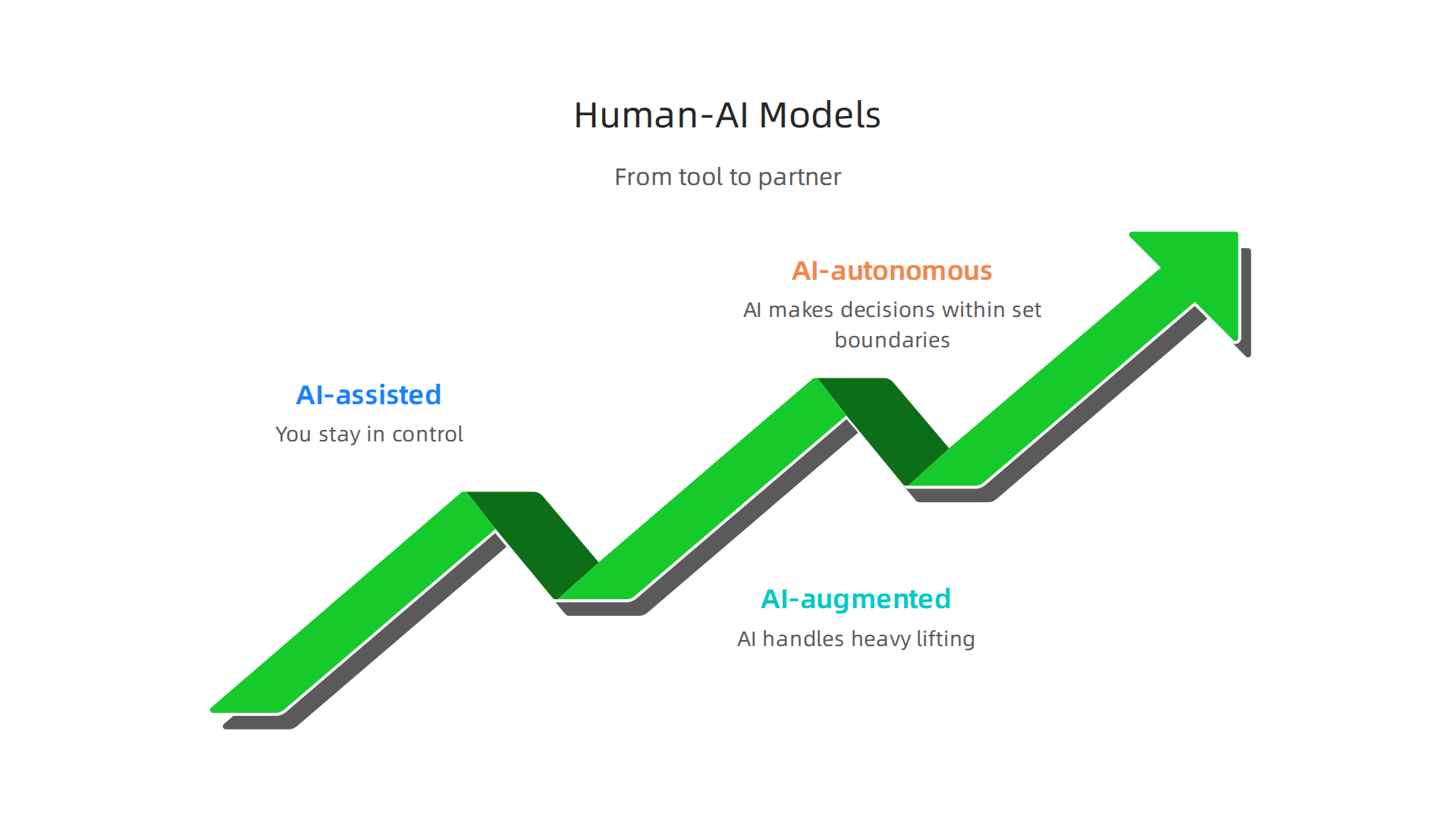
A recent paper from SSRN describes them as AI-assisted, AI-augmented, and AI-autonomous decision-making. Let me explain each one.
AI-assisted means you stay in control. The AI suggests options, but you make the final call. Think of a doctor looking at a patient scan. The AI flags a possible issue, but the doctor decides the next step. This is called human-in-the-loop. You are still driving.
AI-augmented goes a step further. Here the AI does more of the heavy lifting, analyzing huge datasets or running simulations, while you focus on strategy and creativity. You are still involved, but the AI handles the boring stuff. This is sometimes called human-on-the-loop. You supervise rather than steer directly.
AI-autonomous is where the AI makes decisions on its own within set boundaries. For example, a self-driving car navigating a highway. It handles routine choices without your input. But you set the rules and can step in if needed. These are autonomous decision boundaries, and they require careful design.
Frameworks like IBM’s three waves of AI help make sense of this evolution. The first wave was rules-based automation. The second wave is machine learning and pattern recognition, which we see today. The third wave, still emerging, is about contextual understanding and true collaboration. Gartner’s hype cycle also reminds us that many AI promises go through a trough of disappointment before becoming useful. Keeping that in mind helps you separate real progress from hype.
Worried about undetected ai or the risks of artificial superintelligence? That is fair. Even stephen hawking artificial intelligence warnings remind us to stay cautious. But the best path forward is not to avoid AI. It is to learn how to collaborate wisely.
If you are curious about how safety-focused companies approach this partnership, check out this article on Anthropic AI and Constitutional AI.
It explains one of the most thoughtful frameworks for keeping AI aligned with human values.
The bottom line is simple. AI models in vogue today are not just smarter. They are designed to work with you. Understanding these collaboration models helps you choose when to trust the machine and when to trust your own gut.
Want to stay ahead of these changes without drowning in noise? Get clear daily AI updates from The Deep View Newsletter. It cuts through the hype and gives you the signals that matter.
Key Milestones in Human-AI Collaboration
So how did we get here? It helps to look at a few key moments when AI went from a standalone tool to a real partner.
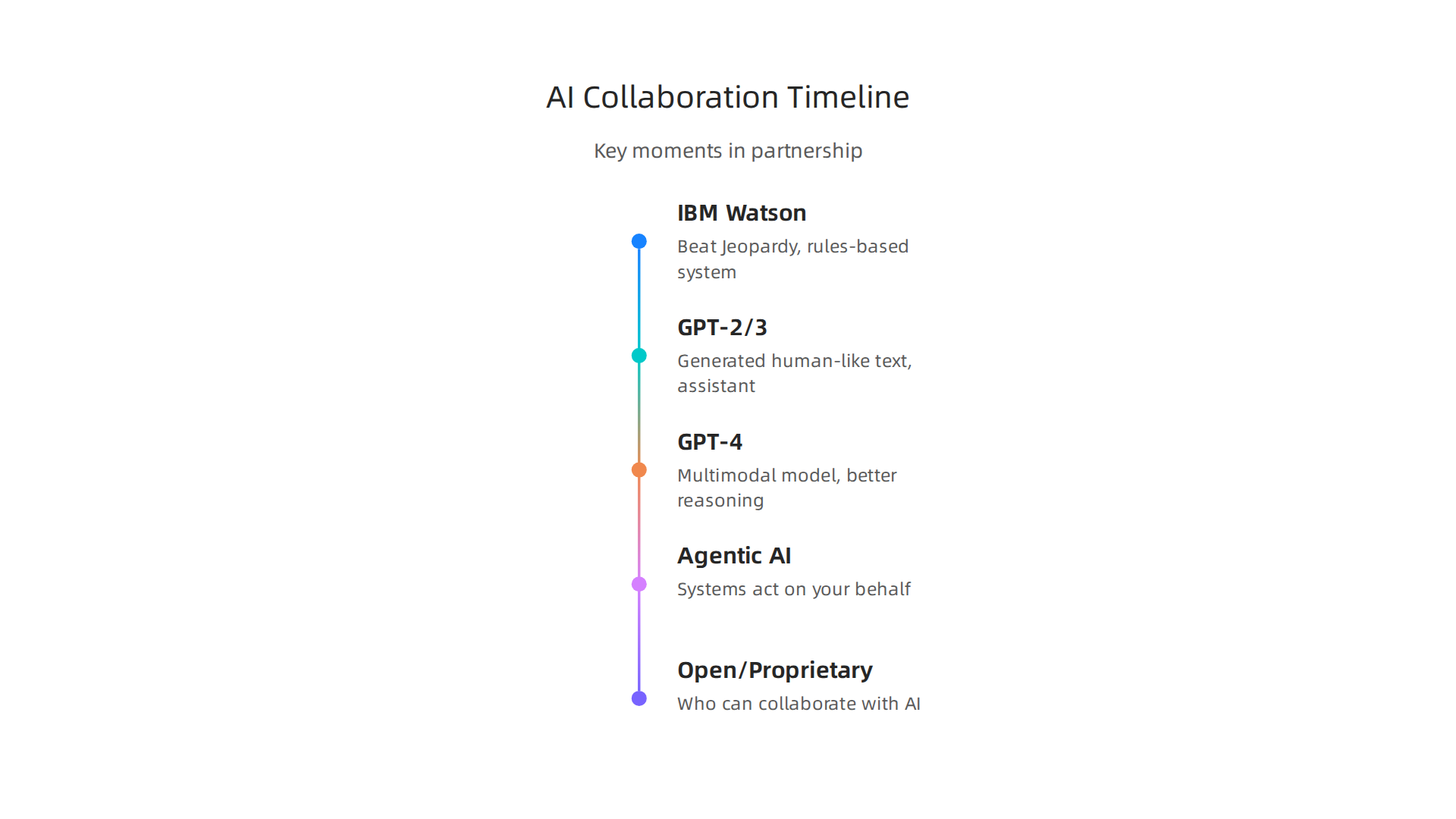
The journey started with IBM Watson in 2011. Watson beat human champions at Jeopardy by processing huge amounts of text. But it was still a rules-based system. You asked a question, it searched a database. There was no real collaboration.
Then came GPT-2 in 2019 and GPT-3 in 2020. These models could generate human-like text, and for the first time, people started using AI as a writing assistant or a brainstorming buddy. GPT-3 showed that AI could help you think, not just answer.
The real turning point was GPT-4 in 2023. It could see images, understand code, and reason better than earlier models. Multimodal models like GPT-4 and later Gemini made collaboration feel natural. You could show AI a graph and ask for insights. That is a huge leap from typing a query into a search bar.
In 2024 and 2025, agentic AI took over. These systems don’t just respond. They take action on your behalf, like scheduling meetings or writing code. Research from 2026 shows how agentic AI is driving growth by handling routine tasks while you focus on strategy.
Now, the debate between open-source and proprietary models matters a lot. Open-source models like Meta’s Llama and Mistral let anyone build and customize AI for free. Proprietary models like GPT-4 and Claude are powerful but locked down. This choice affects who can actually collaborate with AI. Open-source levels the playing field.
Curious about how safety fits into this? Check out our piece on will AI take over the world. It separates real risks from fear.
The bottom line: each milestone made AI more useful as a partner. The ai models in vogue today are built for teamwork.
Want to keep up with every breakthrough without overload? Get clear daily updates from The Deep View Newsletter. It helps you spot the moments that actually matter.
Augmented Decision-Making: How AI Enhances Human Judgment
You know that feeling when you have to make a big decision, but your gut is telling you one thing and the data says another? Or when you realize later that you overlooked something obvious? That is your brain’s cognitive bias at work. We all have them. Confirmation bias, anchoring, availability bias, they cloud our judgment every day. But here is the good news: artificial intelligence can help.
How AI Calibrates Human Decisions
Think of AI as a second set of eyes that never gets tired, never panics, and never falls for a quick emotional trigger. When you pair a human decision maker with an AI, the results are often better than either could achieve alone. A 2025 MIT Sloan study made this crystal clear. Humans alone hit 81% accuracy on a classification task. AI alone got 73%. But when humans and AI worked together? The team scored 90% accuracy. That is a huge jump.
So what is happening? The AI catches patterns the human misses. The human steps in when the AI is not sure or when context matters. This is the core idea behind the human-in-the-loop paradigm. You stay in control, but you let the AI point out blind spots. It is not about replacing you. It is about making you sharper.
Real-World Cases
Medical Diagnosis
In 2025, AI algorithms reached a 96.3% accuracy rate in detecting diabetic retinopathy from eye scans. That outperforms many human specialists. But doctors are not being fired. Instead, the AI flags potential issues, and the radiologist makes the final call. This partnership saves time and catches more cases. Research also shows AI is being integrated into healthcare, criminal justice, and hiring decisions. You can see how artificial intelligence imaging is changing the game for early detection.
Financial Risk Assessment
Banks and investment firms now use AI to analyze massive transaction data for fraud detection and risk scoring. A 2026 study on human-AI collaboration in financial decision-making highlights how these systems help analysts spot suspicious activity faster. But again, a human reviews the AI’s alerts before blocking a transaction. That prevents false positives and ensures fairness.
Supply Chain Optimization
Logistics companies rely on AI to predict demand, reroute shipments during disruptions, and manage inventory. The human managers then override or adjust based on local knowledge. The combination reduces waste and speeds delivery. This kind of teaming, where AI handles computation and humans handle nuance, is spreading across industries.
The Tradeoff: Speed vs. Oversight
There is a catch. The more you involve a human in the loop, the slower the decision. Sometimes you need split-second AI actions, like stopping a fraudulent payment. Other times you want careful human review, like approving a high-risk loan. Researchers are now building metrics to measure "team readiness", figuring out when to let AI act alone and when to pause for human input.
The goal is not to make AI replace humans. It is to build a partnership where ai or human each do what they do best. Even Stephen Hawking, who warned about artificial superintelligence, agreed that careful design could make AI a powerful tool for good. The key is keeping the human involved, so the AI never becomes undetected or unchecked.
Want to stay ahead of every new breakthrough in human AI collaboration? The landscape moves fast. The Deep View Newsletter delivers clear daily updates on exactly these kinds of developments. It helps you separate real progress from hype.
Real-World Applications in Healthcare and Finance
The partnership between humans and AI is not just a nice idea. It is already saving lives and money. Let us look at two industries where this teaming works best.
Healthcare: Catching What the Eye Misses
In radiology and pathology, AI models can scan thousands of images in minutes. They flag tiny abnormalities that a tired human might overlook. A 2025 study found that AI algorithms detected diabetic retinopathy with 96.3% accuracy, beating many human specialists. Yet doctors are not being replaced. Instead, the AI acts as a triage tool. It highlights suspicious spots. The radiologist makes the final diagnosis. This cuts reading time by half and reduces false negatives. The result? Faster treatment and better outcomes. For a deeper look at how this technology is evolving, check out our guide on artificial intelligence imaging breakthroughs.
Beyond diagnostics, AI helps plan treatments. It analyzes patient history, genetic data, and drug interactions to suggest personalized plans. Doctors then adjust based on the human factors the AI cannot see, like a patient’s lifestyle or fears. This human-in-the-loop approach is now used in oncology, cardiology, and neurology.
Finance: Stopping Fraud Without Stopping Customers
Banks and investment firms process millions of transactions every second. AI models spot fraud patterns instantly, detecting anomalies that human analysts would never catch. A 2026 paper on human-AI collaboration in financial decision-making shows that these systems reduce false positives while catching more real fraud. Here is how it works:
- The AI flags a suspicious transaction.
- A human analyst reviews the case.
- The analyst approves or blocks it, using context the AI lacks.
For algorithmic trading, AI executes trades at lightning speed based on market data. Human traders oversee the strategy and step in during unusual events. This balance prevents costly mistakes while keeping markets efficient.
Credit scoring is another area. AI analyzes vast data to assess risk more accurately than old models. But humans set the rules to avoid bias. Studies show that combining AI with human oversight leads to fairer lending.
The numbers speak for themselves. In healthcare, error rates drop by 30% or more when AI assists diagnosis. In finance, fraud detection rates improve by 40% while saving thousands of analyst hours. This is not about asking ai or human who is better. It is about building teams where both shine.
Want to stay current on these real world use cases? The Deep View Newsletter delivers daily updates on the latest AI applications in medicine, banking, and beyond.
Co-Creativity: AI as a Collaborator in Art, Science, and Innovation
You have seen how AI teams with humans in healthcare and finance. But the partnership goes further. It is now changing how we create art, discover new science, and solve big problems. This is not about machines taking over. It is about humans doing better work with AI as a partner.

Creating Art Together
Think of the last movie you watched or song you heard. There is a good chance AI helped shape it. Generative AI tools now help writers brainstorm plots, musicians compose melodies, and designers create stunning visuals. In film, AI assists with storyboarding and even generating realistic backgrounds. A 2026 study from the University of Chicago shows that AI tools are expanding what individuals can do on their own, but they also warn that this might narrow the range of ideas we explore. Still, the power to create is in your hands.
You do not need to be a programmer. Tools like image generators let you type a sentence and get a custom picture. For businesses, this speeds up ad creation and product design. Want to learn more about how these tools work? Check out our guide on how image artificial intelligence works for practical tips.
Speeding Up Scientific Discovery
AI is also a research partner. In biology, it has predicted the shape of millions of proteins, a task that would take humans years. In materials science, it designs new compounds for batteries and solar panels. A 2026 article from Stanford HAI explains how AI can simulate 1,000 years of climate in a single day, while keeping humans at the center of decisions.
Drug discovery is another big win. AI analyzes millions of chemical interactions to suggest new medicines. Humans then test and refine those ideas. This cuts years off the timeline. But there is a catch. A 2026 paper in Nature found that while AI helps individual scientists do more, it may also shrink the number of unique research paths they explore. This is the undetected ai effect, where we rely too much on what the tool suggests.
The Authorship Debate
All of this raises a big question: Who gets credit for the work? If AI writes a paragraph or generates a design, is it original or just a remix of existing work? Some artists worry their style will be copied without permission. Others argue that AI is just a new tool, like a camera or a paintbrush.
Experts like Stephen Hawking artificial intelligence warnings remind us that we need to think carefully about control. The goal is not to create artificial superintelligence that replaces us, but to build tools that amplify human creativity.
Your Next Step
The debate will continue. But one thing is clear: AI is now a creative partner in art, science, and innovation. The best results come when humans stay in charge.
Stay informed on the latest breakthroughs and collaborations. The Deep View Newsletter delivers daily updates on AI in creativity and science, straight to your inbox.
Generative AI in Scientific Discovery
You have seen how AI helps create art and speed up drug research. But there is a deeper partnership happening in labs around the world. Scientists are now using generative AI to come up with new ideas and design experiments on their own. This is not about handing over control. It is about using AI as a co-scientist.
Take protein folding. DeepMind’s AlphaFold changed biology by predicting the shape of millions of proteins. That work would have taken human researchers decades. Now, AI helps scientists find new antibiotics by scanning millions of molecules for ones that kill bacteria in fresh ways. It has also discovered better materials for batteries and solar panels. A 2026 article from Stanford HAI shows how AI can simulate 1,000 years of climate data in a single day. But humans still guide the questions and check the results.
Here is how the co-scientist model works. A researcher types a prompt: "Find a molecule that might stop this enzyme." The AI generates hundreds of suggestions. The researcher picks the best ones, runs real experiments, and sends results back. This back-and-forth speeds up discovery without losing human judgment.
There is a risk, though. A 2026 study from the University of Chicago found that AI tools can expand what individuals can do, but they may also narrow the range of ideas researchers explore. This is the undetected AI effect, where we lean too heavily on what the tool suggests. To avoid this, scientists must stay curious and question AI’s output.
If you want to see how this works in practice, check out our article on how image artificial intelligence works in biomedical research.
Interested in the latest breakthroughs? The Deep View Newsletter delivers daily updates on AI in science, straight to your inbox.
Ethical Governance: Ensuring Trust and Transparency
So AI works as a powerful co-scientist. That speed and creativity is exciting. But it also brings serious questions we cannot ignore. Every time we ask an AI to make a decision, we face a choice: who is responsible if it gets things wrong?
The core ethical risks are real and growing.
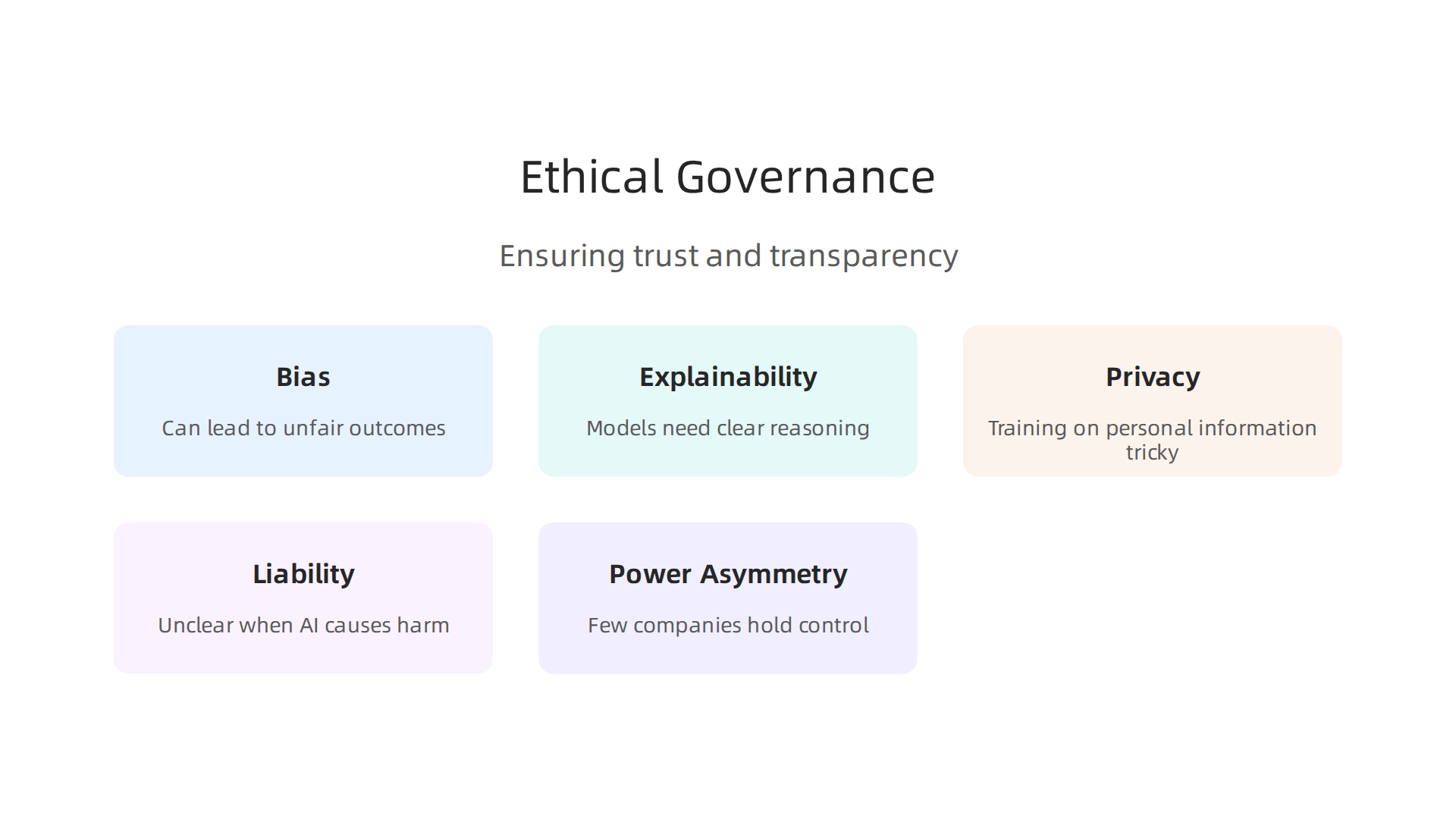
Bias in training data can lead to unfair outcomes. Explainability matters when an AI recommends a medical treatment or a loan denial. Privacy gets tricky when models train on personal information. Liability is unclear when an AI system causes harm. And power asymmetry means a few big companies hold a lot of control.
We have all heard the warnings. Stephen Hawking famously warned about artificial superintelligence. But even today’s AI models in vogue carry hidden flaws. A 2026 study from the University of Chicago highlighted the undetected AI effect. That is when we trust AI’s output without questioning it. It is a human problem, not just a technical one.
Because of these risks, governments are finally stepping up with rules. The big one is the EU AI Act.
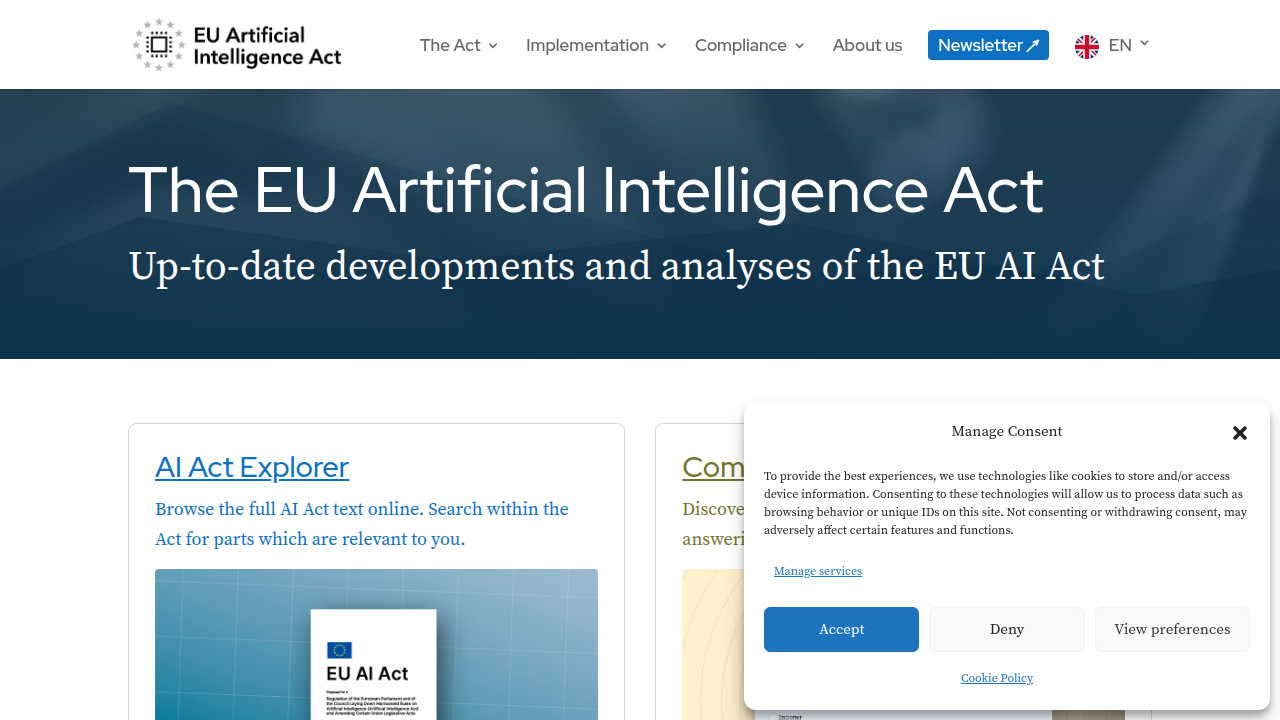
It entered force in 2024 and becomes mostly applicable on August 2, 2026. This law sets a high bar for high-risk AI systems. Companies must follow strict rules on transparency, risk management, and human oversight. The August 2026 deadline activates the main compliance framework, including Articles 8 through 15.
But it is not perfect. The EU just overhauled the AI Act before the key deadline. It delayed watermarking obligations on AI content until December 2, 2026. That shows how fast this field moves. Other countries are acting too. The United States has its Executive Order on AI. China has its own strict algorithmic regulations. The global picture is a patchwork of rules, but the direction is clear: accountability is mandatory.
What does this mean for you? Whether you are a developer, a business leader, or a curious reader, human oversight is nonnegotiable. You need to know what your AI models are doing. You need to check for bias. You need to maintain the ability to override AI decisions. If you want to dig deeper into the risks, our article on will AI take over the world? covers what experts really say.
Staying on top of all these regulations and ethical shifts is hard. But you do not have to do it alone. The Deep View Newsletter delivers clear daily updates on AI governance, breakthroughs, and risks straight to your inbox. It helps you stay ahead of the curve.
Regulatory Frameworks and Industry Standards
So where do we draw the line between ai or human accountability? The answer is starting to take shape through new laws and industry standards. You do not have to guess anymore. Governments and global bodies are finally giving us clear rules.
The EU AI Act is the biggest example. It sorts AI systems into four risk groups: unacceptable, high-risk, limited, and minimal. Unacceptable risk systems are banned outright. High-risk systems get the most attention. If you build or use a high-risk AI system, you must follow strict rules on data quality, transparency, and human oversight. The main compliance deadline is August 2, 2026. That is when Articles 8 through 15 kick in. And each EU country must set up at least one AI regulatory sandbox by that same date, so companies can test their systems safely.
But here is the thing. The rules keep changing. Just before the August deadline, the EU overhauled the AI Act and delayed watermarking rules for AI content until December 2, 2026. That shows how fast regulators have to move. The official EU AI Act page has the full timeline.
Beyond the EU, other frameworks matter too. The NIST AI Risk Management Framework gives US companies a playbook for managing AI risks. It covers governance, mapping, measuring, and managing. ISO and IEC are working on standards like ISO/IEC 42001 for AI management systems. These help companies show they take compliance seriously.
And companies are not waiting for laws to force them. Many are setting their own rules. OpenAI has safety commitments like red-teaming and external audits. Google follows its own AI Principles that ban weapons and surveillance. These self-regulation efforts help build trust, but they are not a replacement for law. A 2026 study on the undetected ai effect showed that even careful teams miss biases in their models. That is why you need both internal checks and external oversight.
For a deeper look at how these rules connect to real-world risks, read our article on will AI take over the world? It covers what experts really say about the danger of unchecked artificial superintelligence and the ai models in vogue today.
Keeping up with all these frameworks and deadlines is a full-time job. But you do not have to do it alone. The Deep View Newsletter delivers clear daily updates on AI regulation, safety standards, and industry news straight to your inbox. It helps you stay ahead of the curve without the overwhelm.
The Future of Work: Reskilling and New Human-AI Roles
Here is the big question everyone is asking: Will AI take my job? The short answer is, it depends. But the longer answer is more hopeful than you might think.
Let us look at the numbers. According to the World Economic Forum, employers expect 39% of workers’ core skills to change by 2030. That is a massive shift. Another survey of over 10,000 executives found that about 54% expect AI to displace some existing jobs. But here is the important part: 24% expect AI to create entirely new roles.
So yes, some jobs will disappear. But many more will change. And brand new jobs are being born right now.
The key debate is displacement versus augmentation. Are we replacing humans, or are we giving humans superpowers? PwC’s 2025 Global AI Jobs Barometer shows that AI can actually make people more valuable, even in jobs that are highly automatable. That means the future is not about ai or human. It is about ai AND human working together.
Emerging Roles You Need to Know About
New job titles are popping up that did not exist five years ago.
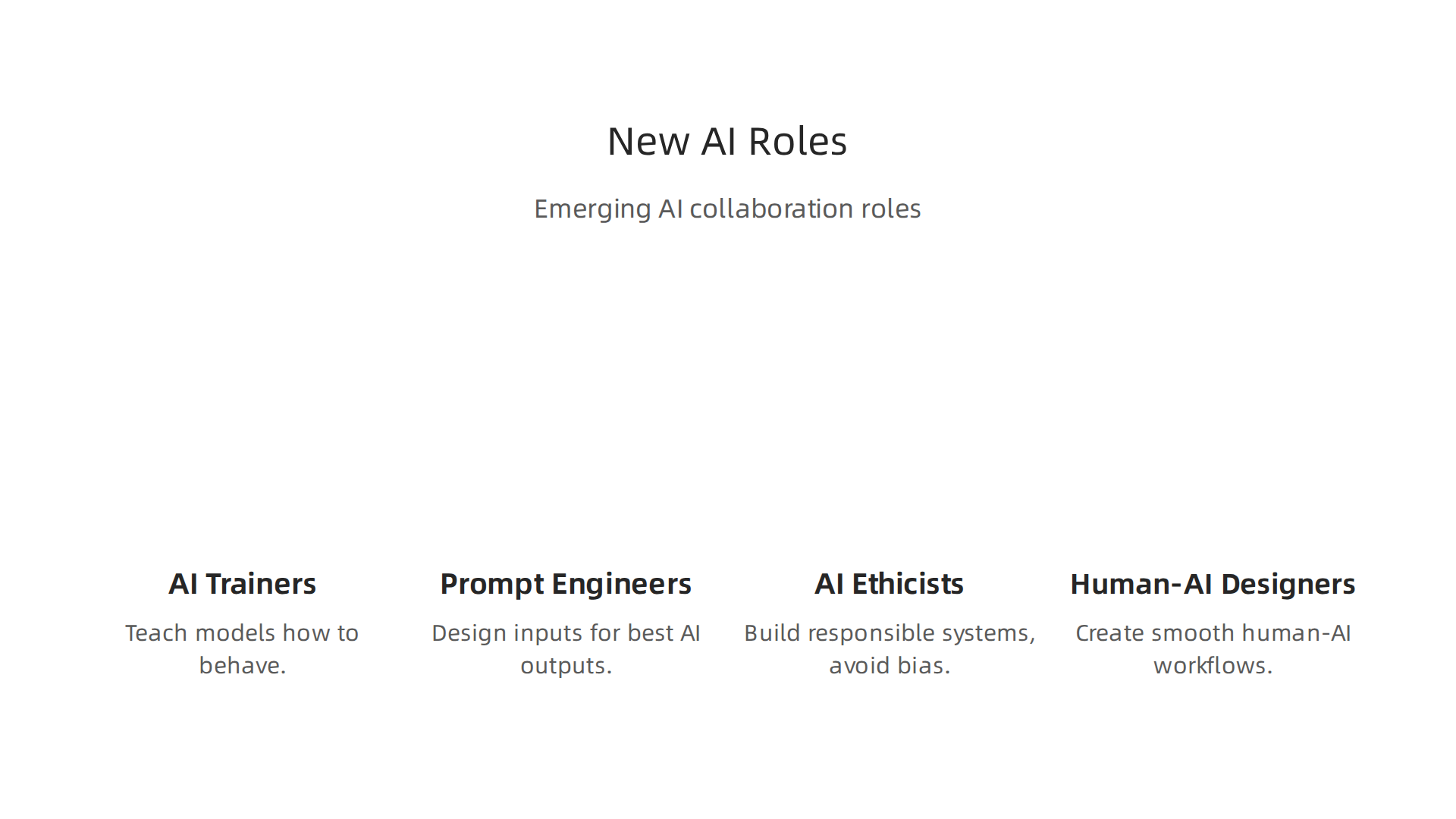
Here are the big ones:
- AI Trainers teach models how to behave, correct mistakes, and improve accuracy. They are the human backbone behind better AI.
- Prompt Engineers design the inputs that get the best outputs from AI systems. This is a fast-growing skill.
- AI Ethicists help companies build responsible systems and avoid bias. With rules like the EU AI Act getting stricter, this role matters more every day.
- Human-AI Interaction Designers create workflows where humans and AI work together smoothly. Think of them as architects of collaboration.
These roles did not exist in 2020. Now they are career paths with real demand.
How Organizations Can Prepare
If you run a team or a company, the smartest move is reskilling. Do not wait for the disruption to hit. Start now.
The World Economic Forum’s Future of Jobs Report 2025 shows that AI and big data top the list of fastest-growing skill needs.
Companies that invest in training their people on these skills will come out ahead.
Some industries are changing faster than others. Certain jobs are being replaced at different speeds depending on how repetitive and data-heavy the work is. But the common thread is this: humans who learn to work with AI will thrive.
If you are looking to future-proof your own career, consider learning how to use AI tools in your field. For example, understanding data analytics is a great start. Check out our guide on how to succeed as a data analyst in 2026 for practical steps.
The Bottom Line
The ai or human debate is outdated. The real question is how we combine human judgment with machine speed. The undetected ai problem shows us that AI still makes mistakes humans catch. The stephen hawking artificial intelligence warnings remind us that unchecked power is dangerous. And the ai models in vogue today prove that innovation is moving fast.
You do not have to navigate this alone. The Deep View Newsletter gives you clear daily updates on AI trends, workforce shifts, and career advice. It helps you stay informed without the information overload.
Building an AI-Ready Workforce
So you know the skills gap is coming. The World Economic Forum says 39% of workers’ core skills will change by 2030. That is a big number. But where do you start if you are leading a team or company?
The smartest move is to build a clear plan for AI fluency.

You do not need everyone to become a coder. But you do need everyone to understand how AI helps their work.
Start with training curriculums that are short and practical. Think micro-credentials and hands-on workshops, not long courses. Focus on how to use AI tools for daily tasks. For example, teach your marketing team how to use AI for content planning. Teach your data team how to spot model errors. PwC’s AI Jobs Barometer shows that workers who learn AI skills become more valuable, even in jobs that could be automated.
Next, create internal AI champions and centers of excellence. Pick a few people who are curious about AI. Give them time to experiment and share what they learn. They become your go-to experts. They help others avoid mistakes and find the best workflows. This is way more effective than forcing training on everyone at once.
Here is a simple roadmap for leaders:
- Assess readiness. Survey your team. Ask what tools they already use and where they feel stuck. Look for skills gaps in areas like data analysis.
- Close the gaps. Offer short training sessions. Use free resources like our guide on how to succeed as a data analyst in 2026 to build basic skills.
- Keep learning. AI models change fast. Set up monthly internal talks or lunch-and-learns.
- Measure progress. Track how many people complete training and how often AI is used in real projects.
The ai or human debate is over. The real work is about building a workforce that uses AI as a partner. If you want to stay ahead of the curve without the noise, the Deep View Newsletter gives you daily updates on AI trends and workforce strategies. It helps you make smart decisions for your team.
Summary
This article maps the modern human-AI frontier and explains how AI has shifted from a simple tool to an active partner across industries. It defines three collaboration models—AI-assisted, AI-augmented, and AI-autonomous—then traces key milestones from Watson through GPT and agentic systems to show how teamwork with AI became possible. You’ll read concrete examples in healthcare, finance, science, and creative work that illustrate accuracy gains and time savings, plus the tradeoffs of speed versus oversight. The piece also tackles governance and ethics, highlighting rules like the EU AI Act and the need for transparency, bias checks, and human control. Finally, it outlines workforce implications and practical steps for leaders to reskill teams and build AI-ready roles so people and machines can complement each other effectively.