
Why ‘AI replacing jobs’ is the strategic issue leaders can’t ignore
The talk about artificial intelligence (AI) can often feel like a mix of exciting new tools and worries about the future. One big question on many people’s minds, especially for business leaders and policy makers, is about ai replacing jobs.

It’s not just a passing trend in 2026. Instead, it’s a deep shift that changes how businesses work and how we think about work itself.
This isn’t about AI taking all jobs. It’s more about specific tasks and parts of jobs that AI can do better or faster. For example, some reports show that about one-fifth of jobs in the U.S. today are already at least half automated. This means that AI tools are doing a big part of the work in those roles, even if the whole job hasn’t disappeared yet Automation, AI, and Job Displacement Risk in U.S. Employment. This change means leaders must think carefully about ai policy and how to use responsible ai in their plans.
Understanding which tasks and roles are most likely to change because of AI is super important. It helps companies plan for the future, train their workers for new roles, and make smart decisions about where to invest. For example, some jobs might see a lot of their everyday tasks taken over by AI, while other jobs might just use AI as a helpful assistant. The goal is to see how ai for work can improve what we do, not just replace it.
This article will look closely at these changes, moving past the hype to give you clear facts. We’ll explore what the real studies show about which jobs and tasks are most affected. You’ll find actionable steps to help your business and your team get ready for what’s next. If you want to dive deeper into these changes, you can explore what jobs will AI replace in 2026.
To keep up with the fast pace of AI and get simple daily updates, make sure you don’t miss out.
The AI Newsletter Worth Reading
Current landscape: which jobs and tasks are exposed to AI today
As we learn more about how artificial intelligence (AI) works, we see that it mostly changes specific tasks inside jobs, instead of taking over whole jobs at once. In 2026, research shows that about 20% of jobs for wages or salary in the U.S. have at least half of their work done by automated systems. Also, around 21% of jobs use AI tools for at least half of their tasks SHRM Research Finds AI and Automation Exposure Is Rising, but …. This means that while some jobs might see parts of their daily work shift to AI, the entire job role often still needs human oversight and skills.

The risk of AI replacing jobs is not the same for everyone. Some jobs, like those in financial services and administrative support, are more likely to be affected. This is because many tasks in these areas involve handling lots of data or following set rules, which AI is very good at. For example, financial services and banking have the highest risk score among industries, with 31% of jobs having high exposure to AI Industries Most Affected by AI Automation 2026. On the other hand, jobs that need a lot of human creativity, judgment, or personal interaction are less likely to be fully automated.
It is important to see the difference between quick changes and long-term shifts. In the short term, AI often helps people do their jobs better. It acts like a powerful assistant, freeing up time for more important work. This is how many businesses use AI for work today, making teams more effective. But over a longer time, the way jobs are structured might change a lot. New kinds of jobs could appear, and some old jobs might change quite a bit. To manage these big changes well, leaders need to create smart AI policy and focus on using responsible AI. Understanding these shifts helps companies prepare for the future, making sure their teams have the right skills and tools. If you want to dive deeper into guiding your business through these changes, explore The Leaders Playbook for AI Governance in 2026.
What the evidence says about job losses, job creation, and skill shifts
When we talk about AI and jobs, it is not always a simple story of ai replacing jobs. The truth is more mixed. While some jobs might see parts of their tasks taken over by artificial intelligence, other jobs are growing, and many are simply changing. It is like a big puzzle where pieces are moving around.
On one side, we see some jobs shrinking. For example, reports in 2026 show that about 16,000 net U.S. jobs are eliminated by AI each month. This happens as AI tools become better at handling simple, repeated tasks. Jobs that involve a lot of data entry or basic customer service are sometimes affected the most. These are often the jobs with a high risk of being changed by automation AI Job Displacement Statistics 2026 – AI Exposure.
But that is only part of the story. AI also helps create new jobs and change old ones in helpful ways. New roles appear, like AI trainers or people who manage AI systems. Existing jobs become different. For example, a marketing person might now use AI to write first drafts or to figure out what customers want. This frees them up to do more creative or big-picture work. So, while some jobs might go away, new ones often come up, and many more are transformed. This means workers need to learn new skills to keep up with these changes. It is a time for people to grow their abilities and adapt.

It is tricky to figure out the exact impact of AI on jobs. Researchers face a few challenges when studying this. First, it is hard to know if a job change is truly because of AI or because of other reasons, like new business ideas or changes in the economy. Second, the effects of AI can take time to show. Some changes happen quickly, but big shifts in jobs might take years. Third, it is hard to know what would have happened if AI was not around. Would jobs have changed anyway? These questions make it hard to measure the full picture of ai replacing jobs. Because of these challenges, it is important to look at many different studies and understand that the situation is always moving.
To stay informed about the latest movements and changes in the AI landscape daily, you can get insights from The AI Newsletter Worth Reading.
Sectors and roles most likely to see rapid AI-driven change
The changes we talked about with AI do not happen the same way everywhere. Some jobs and whole parts of our economy are feeling the effects of AI much faster than others. It is like some areas are in the fast lane of change.
Looking at 2026, reports show that some sectors are highly exposed to AI automation. For example, financial services and information technology are often at the top of the list for seeing big changes. These areas deal with a lot of data and many tasks that can be done over and over. This makes them prime spots for AI Disruption Global Overview Report 2026: AI-Driven. Other sectors like administrative support, media, and even parts of manufacturing are also seeing rapid shifts. A deeper look at different areas shows that financial services, for instance, has the highest average risk score when it comes to automation AI Automation by Industry 2026 – AI Exposure.
But here is an important point: even within these sectors, not every job is affected equally. This is called heterogeneity. Imagine a big hospital. A job that involves typing up patient notes might be more likely to see ai replacing jobs or tasks. But a doctor’s job, which needs deep thinking, talking to patients, and making complex choices, is much more resilient.
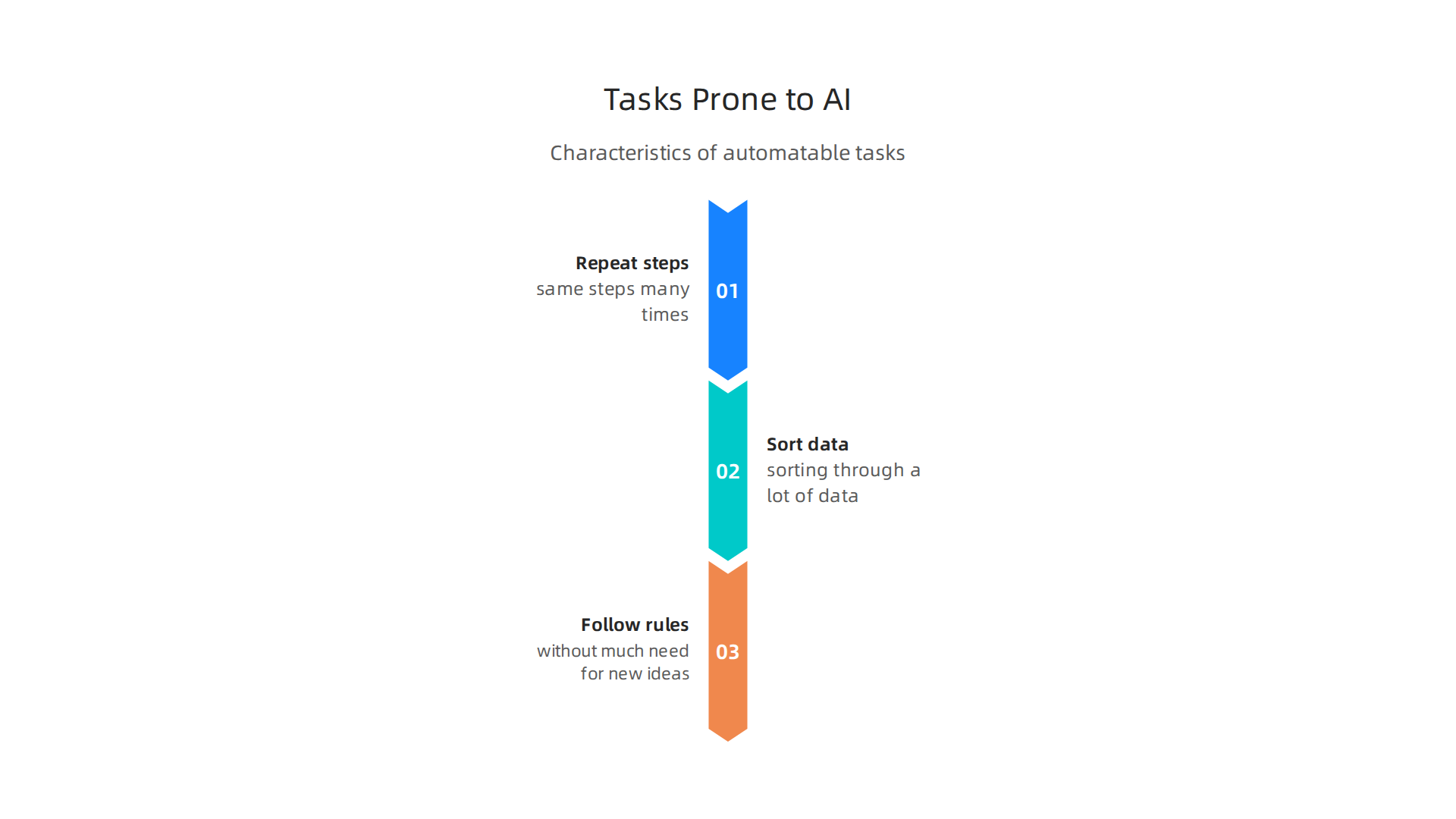
Jobs that are more likely to be changed by AI are often those with tasks that:
- Repeat the same steps many times.
- Involve sorting through a lot of data.
- Follow clear rules without much need for new ideas.
On the other hand, jobs that need human skills like creativity, solving brand-new problems, emotional understanding, or managing people are often safer. These roles use AI as a tool to do their ai for work better, not to be replaced. They can even become more important as humans focus on higher-level tasks.
Understanding these differences is key for people and companies to prepare. It means thinking about what skills are most valuable now and in the future. It also brings up discussions about responsible AI and how AI policy can help guide these changes fairly. People looking to grow their careers should think about what skills will be needed for AI jobs 2026 the skills certifications and portfolio that get you hired in these changing times.
How AI creates new roles and transforms existing jobs
While it is true that AI can change some jobs, making certain tasks automatic, the full story is much bigger. AI also helps create new jobs and makes current jobs better. It is not just about ai replacing jobs; it is also about AI helping people do more and different kinds of work.
One way AI creates jobs is through something called "complementarity." This means AI tools work with people, making human workers more powerful and productive. Think of a smart assistant that helps a customer service agent find answers very fast. The agent can then help more people and solve harder problems, making their job richer. When people become more productive, companies can grow, and that often means needing more workers overall, even if their daily tasks look a little different.
Another way is through overall growth. When businesses use AI to work better and make new things, they often become more successful. This success can lead to more jobs in other parts of the company or even create entirely new businesses. For example, reports from 2026 show that new tasks are being created across many types of jobs because of AI chatbots Early Labor Market Transformation under Generative AI – NBER. These new tasks often need human skills to guide the AI or to handle the more complex parts of the work.
We also see completely new job roles popping up. As AI tools get better, we need people to build, maintain, and improve them. Jobs like AI developers, data trainers, prompt engineers, and ethical AI specialists did not exist in the same way before. These are important roles that require human smarts and judgment. A 2026 report highlights how the rise of new tasks and jobs related to AI can even lead to higher wages for those with the right skills New Jobs Creation in the AI Age (SDN/2026/001).
Many existing jobs are not replaced but are transformed. A marketing specialist might use AI to create many ideas for ads quickly. A doctor might use AI to help look at X-rays, but the doctor still makes the final decision about a patient’s health. In these cases, AI is a powerful tool for work, taking over the boring parts and letting people focus on the creative, human-centered, or strategic parts of their jobs. It is about learning how to partner with artificial intelligence to make work better.
Staying informed about these changes is key for anyone in the workforce.
Get clear daily AI updates from The AI Newsletter Worth Reading.
Staying informed about these changes is key for anyone in the workforce. But it is also important for governments and leaders to think about how they can help people through these changes. This is where thoughtful ai policy comes in.
Policy levers: social safety nets, training, taxation and labor standards
As AI continues to change jobs, governments around the world are looking at different ways to help workers and make sure everyone benefits. These ideas are called "policy levers" because they are tools leaders can use to guide change.
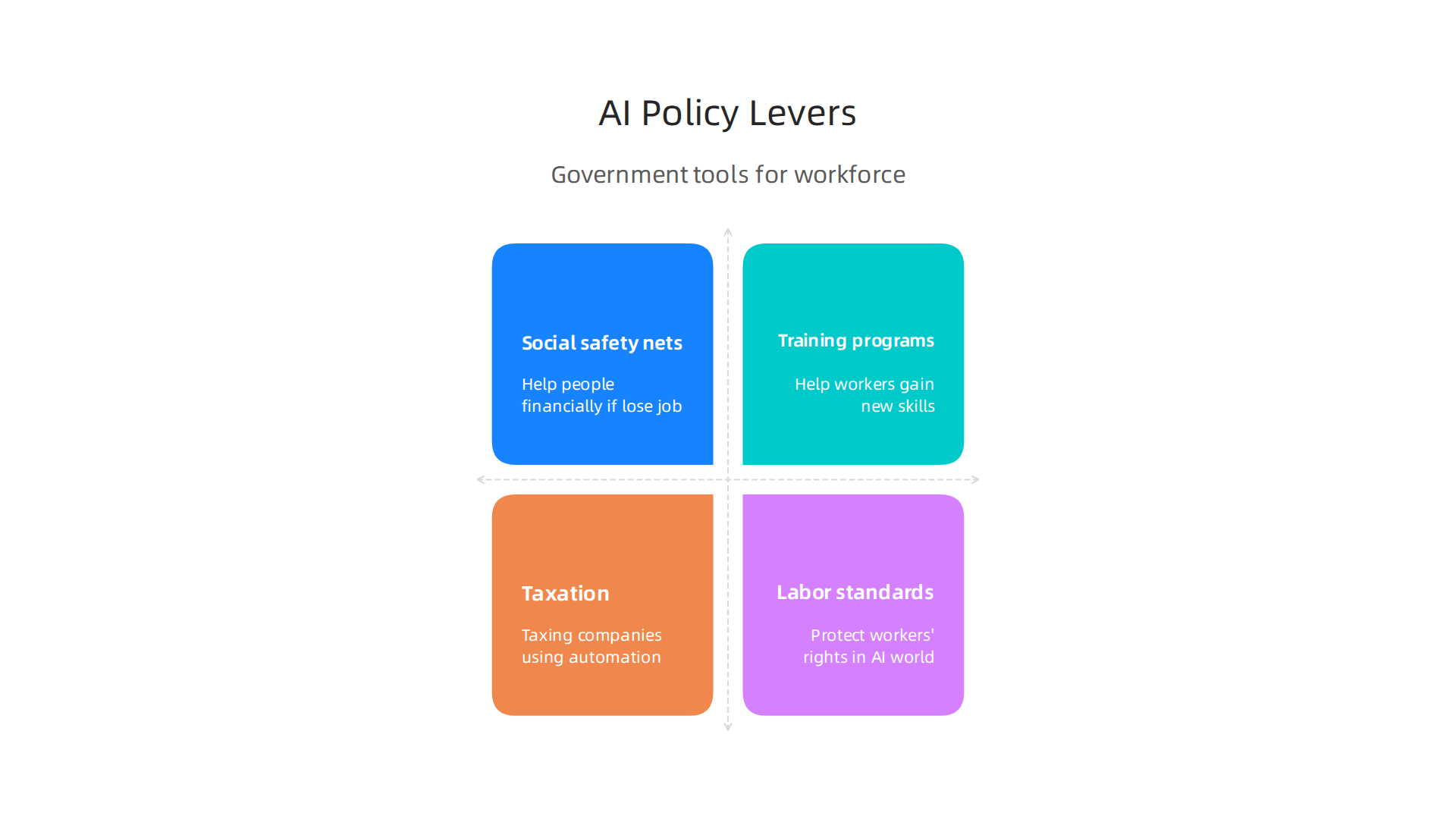
One important tool is social safety nets. These are programs like unemployment benefits or basic income that help people financially if they lose their job or need time to learn new skills. The goal is to make sure no one is left behind when ai replacing jobs happens in some areas. These nets give people a cushion during times of change.
Another big focus is training and retraining programs. Since many jobs are transforming or new ones are being created, workers need help gaining new skills. Experts agree that investing in education and training is key for an AI-ready workforce. This includes things like:
- Upskilling: Teaching current workers advanced skills they need to use AI in their existing roles.
- Reskilling: Helping workers learn entirely new skills for new jobs, especially if their old job is changing a lot.
- Lifelong Learning: Making sure people can keep learning throughout their careers, as technology keeps moving forward. The European Union, for example, is focusing on lifelong learning to bridge skills gaps in the digital age EU policy update: Digital skills, AI and the digital transition in Europe. This helps people stay ready for new kinds of ai for work.
However, putting these training programs in place is not always easy. Some studies from 2026 show that retraining programs can sometimes have limited success or be very costly Evaluating Retraining Programs in OECD Countries. This means policymakers need to think carefully about how to design programs that actually work and lead to good job outcomes. Other research suggests that training can indeed improve employment prospects, especially for programs focused on specific job skills What training for the unemployed? An impact evaluation for …. The challenge is finding the right balance and approach.
Governments are also looking at taxation and labor standards. Some ideas include:
- AI taxes: Taxing companies that use a lot of automation to help fund retraining programs.
- New labor laws: Making sure workers’ rights are protected in a world where AI plays a bigger role, especially for new types of work like the gig economy. Thinking about responsible ai is part of this.
These policy choices have trade-offs. For example, some taxes could slow down innovation, while not having enough support could leave many workers struggling. Finding the right mix of policies is a big task for leaders in 2026 and beyond.
While governments work on bigger plans, companies also need to act now to get ready for the changes AI brings. It is not just about ai policy from the top down; businesses must make smart choices inside their own walls. This means looking closely at their workforce and planning for the future.
Workforce Planning for the AI Age
Companies in 2026 are thinking about how AI will change the work people do. This is called "workforce planning." It is about making sure they have the right people with the right skills for tomorrow’s jobs. Here are some key ways companies can plan:
- Internal Mobility: Instead of letting people go when ai replacing jobs happens in some areas, companies can help workers move to new roles within the same company. This keeps valuable knowledge inside and shows care for employees.
- Targeted Reskilling: Just like governments, companies can offer training to help employees learn new skills needed for jobs that work with AI. This could mean learning how to use new AI tools or even understanding how to build them. Giving workers the chance to choose the best AI course can be a great way to support this.
- Redesigning Roles: Many jobs won’t disappear completely. Instead, they will change. Companies need to look at each job and figure out how AI can help workers do their tasks better or take on new, more complex parts of the job. For example, AI might handle the boring parts, leaving the creative or problem-solving parts to humans.
Studies show that AI will keep changing how people work. Some tasks might be taken over, but new tasks and jobs will also appear, often requiring different skills. For instance, new research in 2026 points out that AI can create new tasks across many different jobs, leading to new opportunities for workers who adapt with ai for work.
Smart AI Adoption: Risk and Opportunity
Companies should also have a clear plan for how they will use AI. This means looking at both the good things that can come from AI (like making work faster) and the bad things (like job changes or unfair outcomes).
- Aligning HR and Product Strategy: Human Resources (HR) teams need to work closely with the teams that build or use AI products. HR can help make sure that new AI tools are used in ways that support workers and help them grow, not just cut costs. They also make sure the company’s responsible ai goals are met.
- Measuring Success: It is important to measure if AI is truly helping. This means looking beyond simple cost savings to see if workers are more productive, happier, or if new kinds of value are being created. Companies need a framework to measure these things.
- Change Management: When big changes like AI come, people can feel worried. Companies need to manage this change well by talking openly with employees, helping them understand the benefits, and giving them support. Clear communication makes the shift much smoother.
Thinking ahead about AI’s impact on workers is not just good for people; it’s good for business. Companies that plan well for their workforce can gain a real advantage in the changing world of 2026 and beyond.

Stay ahead with daily insights.
The AI Newsletter Worth Reading
Moving from just planning to actually helping workers means looking at how people learn new skills. In 2026, many different ways of learning are being used to help people get ready for jobs that use AI. These methods aim to teach workers the skills they need for new roles, especially as some tasks might be taken over by AI.
Different Ways to Learn New Skills
There are a few main ways people can learn skills for the AI world:
- Employer-Led Programs: Companies can run their own training programs, sometimes called apprenticeships.
Here, workers learn on the job from experienced people. This helps them gain skills that are directly useful to the company. It’s like a company teaching its own team what it needs. These programs can enable thousands of internal moves, helping companies keep valuable knowledge within their workforce, as seen in some successful cases in 2026.
- Microcredentials: These are small, quick courses that give a certificate for a very specific skill. Think of them as tiny badges for new abilities. They are great for busy people who need to learn one new thing fast, without going back to school for a long time. They help workers get targeted skills needed for specific roles with ai for work.
- Public Programs: Governments and public groups also offer training. These programs can be wider, helping many people in a region or country learn general skills that are in demand. Many policymakers are looking to invest in these types of AI education and training programs to support workers through reskilling efforts.
- Digital Learning: Online courses and platforms let people learn at their own speed, from anywhere. There are many options, from free guides to paid university-level courses. Choosing the right learning AI course for busy professionals can make a big difference for those who need flexibility.
These programs are important because they help bridge the gap between old jobs and new ones, especially when ai replacing jobs in certain sectors.
How to Know if Training Programs Work
It is important to check if these training programs actually help people. How do we measure success?
- Job Outcomes: One main way is to see if people who finish a program find a new job or get a better one. Do they get hired? Do they earn more money than before? Some research suggests that retraining can lead to stable or better employment and earnings for workers who complete the programs.
- Skills Used: Are the new skills they learned actually being used in their new roles? A program is more effective if the training directly leads to better performance at work. Companies can track things like how fast tasks are completed or the quality of work output after training to see if employees are more efficient.
- Company Benefits: For companies, success means things like increased worker productivity and happier employees. Studies in 2026 show that companies investing in good training can see a big jump in employee output and even fewer people leaving the company. Measuring things like "internal mobility rate" (how many workers move to new roles inside the company) is also key.
It is clear that making sure these reskilling and education models truly work is vital for everyone. It helps workers stay ready for the future and helps companies keep their teams strong and skilled.
Summary
This article cuts through the hype to explain why