
Why UCSD for Neural Data Science – Who This Guide Is For
In 2026, the world of technology keeps moving super fast, especially in areas like data science and artificial intelligence. One very interesting part of this world is neural data science. This field looks at information from brains and nervous systems, using smart computer tools to understand how they work. People who want to lead in this area need good training. That’s why many are looking for the best programs out there.
Neural data science teaches you how to gather, look at, and make sense of complex brain data. It helps us learn more about how we think, feel, and even how to treat brain diseases. If you’re excited about using data to unlock the secrets of the brain, then a program in neural data science is for you.

Many smart people want to learn about this new field. The University of California San Diego, known as UCSD, is a top school for this kind of learning. If you are looking for a program in neural data science UCSD offers some great choices. For example, a course called Neural Data Science is offered through Cognitive Science at UCSD. It’s a project-based class where students use computer tools to study real brain data.
It can be hard to figure out all the different programs a big school like UCSD offers. You might wonder if you should get a BS in information science, a data science minor, or go for something more advanced. This guide is here to help you. It’s for company leaders, business founders, researchers, and anyone who uses data in their job. We want to help you easily look at what UCSD has to offer in neural data science. This includes details from the main UC San Diego Catalog of Record.
Knowing the basics of data is super important before you dive into advanced topics like neural data science. You can prepare by understanding core data fundamentals for AI professionals. This article will help you find the right path, whether you’re just starting or looking to grow your knowledge in this exciting field. We’ll make it easy to understand the programs and how they can help you reach your goals.
Keeping up with all the new AI information can be tough. If you want daily updates that are easy to understand, check out The AI Newsletter Worth Reading.
Now, let’s look closely at what UCSD offers for students interested in neural data science. You’ll find different kinds of learning paths, from main degrees to special programs and research chances.
The school’s main list of programs, the UC San Diego 2026-27 Catalog of Record, helps us see everything.
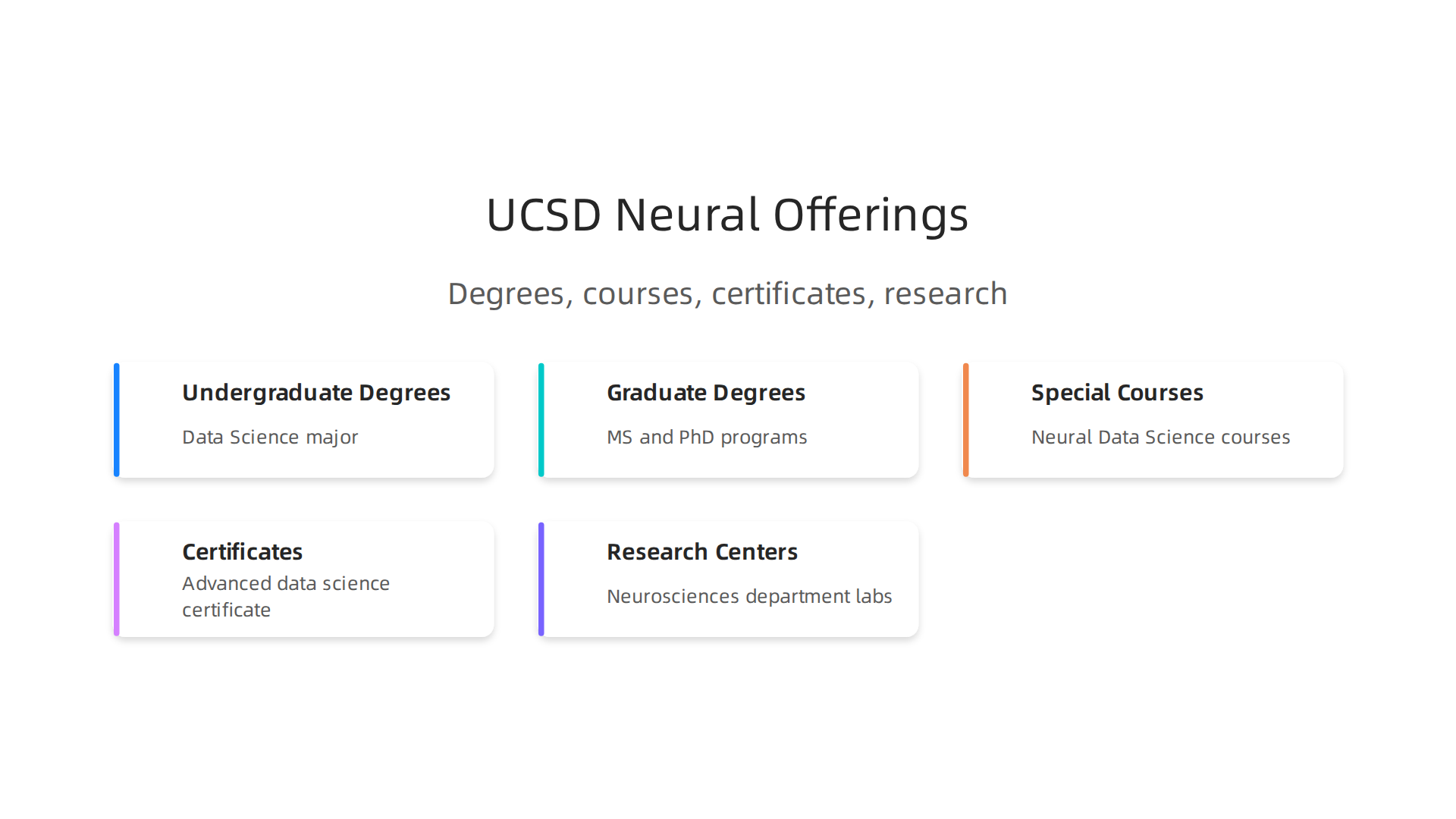
Degrees for Neural Data Science at UCSD
UCSD has many great options if you want to study data science, which is a key part of neural data science.
- Undergraduate Degrees: For students just starting out, there’s a strong Data Science major. This program gives you a deep dive into how data works, from basic ideas to advanced tools. You could also get a BS in information science or add a data science minor to another degree. These paths teach important skills like programming and how to use data for different problems.
- Graduate Degrees: If you’re looking for more advanced study, UCSD offers several graduate degrees. These include Master of Science (MS) and Doctor of Philosophy (PhD) programs in Data Science. There’s even a PhD in Neurosciences and Cognitive Science, which is perfect for focusing on neural data. These programs often include courses on machine learning, which is how computers learn from data, and deep learning, a special kind of machine learning useful for understanding brain data. The university lists these and other Graduate Degrees Offered, 2026–27 in its academic records.
Special Courses and Certificates
Beyond full degrees, UCSD offers specific courses that touch on neural data science UCSD focuses on.
For example, the Cognitive Science department offers a course called Neural Data Science, where students work on real brain data problems. The Biological Sciences department also lists a Neural Data Science course. You can find details about these and other helpful classes in the Course Syllabi for COGS and related course listings.
If you don’t want a full degree right now, UCSD Extended Studies provides valuable certificate programs. The Advanced Certificate in Foundational Data Science is a great example. It helps you gain key skills in programming, statistics, and machine learning. This is very helpful for turning raw information into smart insights, which is a big part of working with neural data. You can learn more about how data science helps in understanding new technologies by checking out artificial intelligence and machine learning explained for 2026.
Research Centers and Labs
UCSD is also home to many research centers and labs that work on brain science and data. These places are where professors and students work together on new discoveries. For instance, the Neurosciences department has strong ties to centers that study how brains work. These labs offer amazing chances for students to:
- Do research: You can help with ongoing projects, getting hands-on experience with brain data.
- Get internships: Some labs offer internships, which are like short-term jobs where you learn a lot.
- Work with experts: You get to learn from top scientists and researchers in the field.
These research opportunities help students apply what they learn in classes to real-world problems. They often involve advanced tools and methods, giving students a head start in their careers. Understanding how these labs work can also give you ideas about what a data scientist does in a research setting.
Overall, whether you’re interested in a full degree, a specialized course, or hands-on research, UCSD has many paths to explore in neural data science.
UCSD offers many paths to learn about neural data science, from full degrees to shorter classes. Let’s compare these options side-by-side to help you find the best fit for your learning journey and career goals.
Degrees for Deep Learning and Research
If you want to dive deep into neural data science, a degree program is usually the way to go. These are for students who can commit to a longer study period.
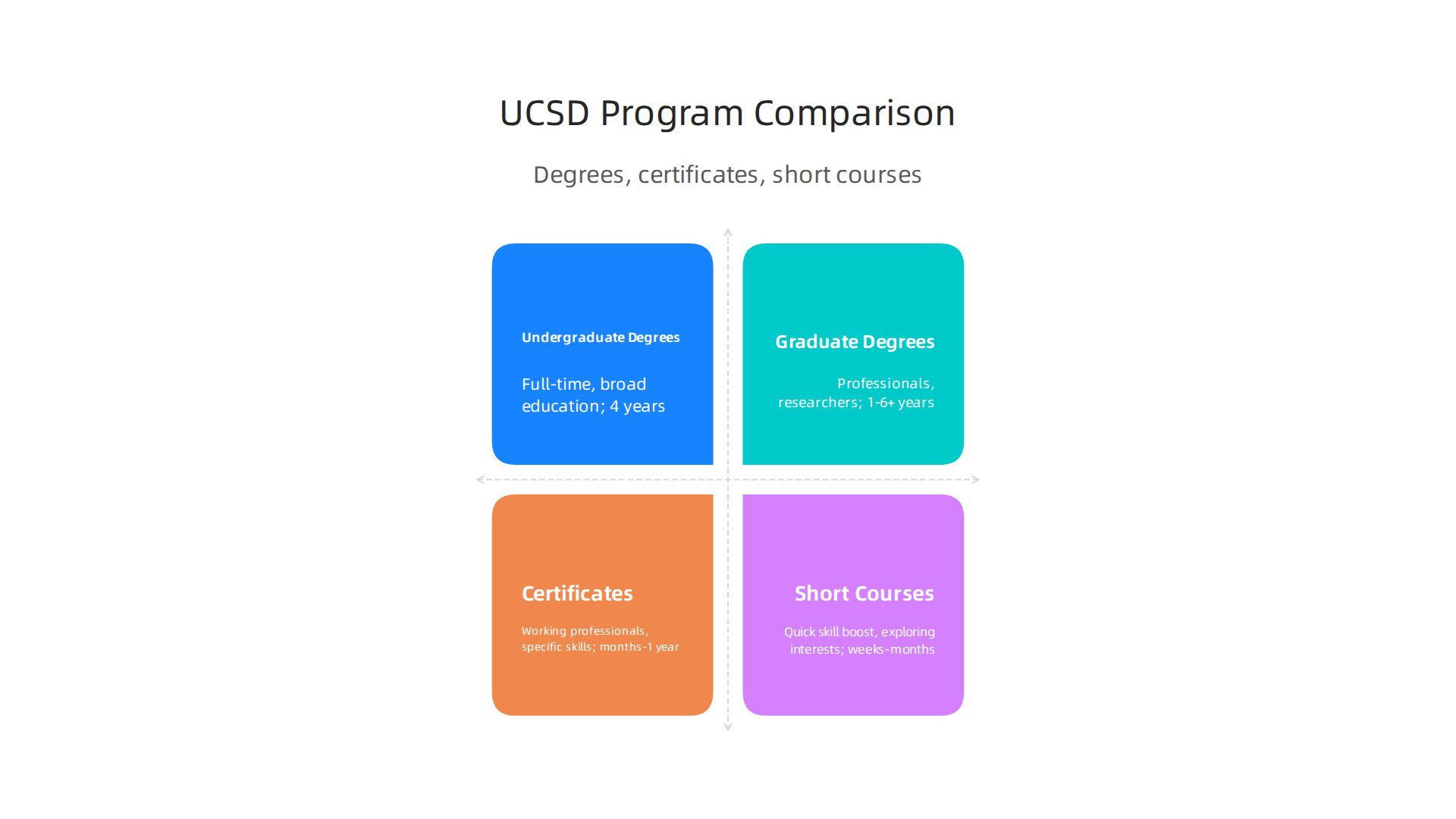
- Undergraduate Degrees (BS/BA): These usually take about four years. They are great for students starting right after high school or those changing careers who want a strong foundation. You can get a Data Science major or a BS in information science, or even add a data science minor to another degree. These programs teach you core skills in programming, math, and how to work with data. Many graduates go on to jobs or further study.
- Student Profile: Full-time students, those seeking a broad and deep education.
- Timeline & Credits: Typically 4 years, full-time credit load (around 120-180 quarter units).
- Graduate Degrees (MS/PhD): These are for students who already have a bachelor’s degree.
- An MS (Master of Science) in Data Science, like the one offered by the Halıcıoğlu Data Science Institute, usually takes 1 to 2 years. It gives you advanced skills for roles in research or specialized data science jobs. You’ll learn about things like machine learning algorithms and how to handle big datasets. The program does not require the GRE exam for admission, making it easier for some to apply. You can find more details about how to apply on the Master of Data Science admissions page.
- A PhD (Doctor of Philosophy) takes even longer, often 4 to 6 years. This path is for those who want to become top researchers or professors. It involves a lot of original research in specific areas, like advanced neural data science.
- Student Profile: Professionals looking to specialize, researchers, those seeking leadership roles.
- Timeline & Credits: MS: 1-2 years, around 40-50 units. PhD: 4-6+ years, heavy research credit load.
Certificates and Short Courses for Targeted Skills
Maybe you don’t need a full degree, or you’re a working professional who wants to update your skills. UCSD has options for you too. These are more flexible and often designed for people who can’t commit to full-time university studies.

- Certificates: Programs like the Machine Learning Methods Certificate are shorter than degrees. They focus on giving you specific skills needed for a job. For example, you might learn advanced machine learning or neural network techniques relevant to neural data science UCSD applies in its research. These are great for adding new skills to your resume or pivoting your career.
- Student Profile: Working professionals, career changers, those needing specific skills quickly.
- Timeline & Credits: Usually several months to a year, fewer units than a degree. Many are modular, meaning you can take courses one at a time.
- Short Courses and Bootcamps: These are the quickest ways to learn. UCSD offers many individual classes through different departments. For example, there are courses on Neural Data Science listed in departments like Biology and Cognitive Science. These courses can help you pick up a new programming language, learn a specific data analysis method, or get a taste of a new field without a big time commitment. They are perfect for gaining practical, hands-on experience.
- Student Profile: Professionals seeking a quick skill boost, students exploring new interests, those with limited time.
- Timeline & Credits: Weeks to a few months, typically 2-4 units per course, or non-credit options. Highly modular.
Many working professionals find these shorter programs very helpful. They can fit studying around their job and quickly apply what they learn. If you’re wondering about joining a shorter program, you might ask is a data science bootcamp worth it for your AI career in 2026? Also, you can explore many other data science careers 2026 that these programs can open up.
No matter which path you choose, staying informed about the latest advancements in AI and data science is key.
Get clear daily AI updates from The AI Newsletter Worth Reading.
The last section talked about different ways to learn at UCSD, from full degrees to short courses. Now, let’s look closer at what you actually learn in these programs. We will explore the main topics, extra classes you can take, and projects that help you use your new skills.
Curriculum Deep Dive: Core Courses, Recommended Electives, and Capstones
At UCSD, a strong focus is placed on teaching students the essential skills for working with complex data, especially in the growing field of neural data science UCSD programs offer. The curriculum is designed to give you a deep understanding of how to analyze brain data and use advanced computer methods.
Core Technical Topics
Whether you’re pursuing a full degree or a specialized certificate, certain core topics are vital.
- Deep Learning and Machine Learning: These are central to understanding and processing large datasets. Courses often cover machine learning basics, including linear algebra, and then move into more advanced topics like deep neural networks. For example, a course like Introduction to Machine Learning or Deep Learning (CSE 151B) introduces how computers can learn from data, which is key for tasks like image recognition in neuroscience. The Halıcıoğlu Data Science Institute also offers graduate-level courses that dive into advanced machine learning algorithms, including deep learning and neural networks.
- Neural Data Analysis and Computational Neuroscience: This is where data science meets brain science. You’ll learn how to work with real brain data. Classes like Neural Data Science, offered in Cognitive Science (COGS 138) or Biology (BIPN 162), teach you how to analyze signals from neurons. This includes understanding how groups of neurons work together and testing ideas using large datasets. The Computational Neuroscience Specialization takes this further, looking into how we can describe neural activity using data analysis tools.
- Statistical Methods: A good understanding of statistics is the backbone of data science. You’ll take classes that teach you how to use statistics to make sense of data and draw reliable conclusions. Programs, including those focused on Machine Learning & Data Science, require courses in Probability and Statistics for Data Science.
Recommended Electives and Capstone Projects
Beyond the core, students can choose elective courses to specialize further. If you’re studying for a Data Science (Undergraduate Catalog) major, you’ll have options to pick classes that fit your interests. For example, you might explore topics in information science or even pursue a data science minor if your main degree is in another area. You can find many individual Course Offerings through the Halıcıoğlu Data Science Institute, including specialized courses in Python for Data Science and Machine Learning Fundamentals.
Many programs also include capstone projects or research opportunities. These projects let you take everything you’ve learned and apply it to a real-world problem.

For instance, a capstone project might involve analyzing neuronal circuits and synapses using deep learning, giving you valuable hands-on experience before you start your career. These projects bridge the gap between classroom learning and practical application, helping you prepare for entry-level data science jobs in 2026. This practical work is very important for showing what you can do.
Understanding the curriculum helps you see how UCSD prepares students for jobs in data science, especially those interested in the brain and nervous system.
After learning about the detailed courses and hands-on projects, let’s look at the smart people and places behind the exciting field of neural data science at UCSD. The University of California San Diego (UCSD) is home to many expert teachers, researchers, and special labs. These groups help push forward our understanding of the brain using data science.
Leading Minds in Neural Data Science
The faculty at UCSD are key to why its neural data science programs are so strong. They bring a lot of knowledge from different fields like physics, biology, and computer science.
- David Kleinfeld: He is a main leader in Computational Neuroscience. His work often involves looking at how brain cells send signals and figuring out patterns in brain data. You can find more about his research and background through the David Kleinfeld Laboratory at UC San Diego.
- Mikio Aoi: Dr. Aoi is a computational neuroscientist at the Halıcıoğlu Data Science Institute. He studies how groups of brain cells work together to do tasks. His lab focuses on using statistics and machine learning to understand neural activity better, as highlighted by the Aoi Lab’s statistical and machine learning approaches.
- Marcus Benna: Dr. Benna explores big questions in computational neuroscience. He uses ideas from physics, math, and data science to study how memories are made and how the brain learns. Learn more about his interests on his Marcus Benna faculty page.
- Virginia de Sa: A professor in Cognitive Science and a leader at the Halıcıoğlu Data Science Institute. She’s also part of the Institute for Neural Computation. Her work looks at how we see and remember things, often using computer science tools. You can find out more about her research at the Virginia de Sa Lab.
- Eran Mukamel: As a Professor of Cognitive Science, Dr. Mukamel leads a lab focused on how neural data moves and changes. His team works on understanding the complex patterns in brain activity. Details about his work are often found through the Mukamel Lab.
These are just a few of the many talented people. The whole list of neuroscience faculty at UCSD shows how deep their expertise runs in this area.
Innovative Labs and Research Centers
Beyond individual professors, UCSD has many labs and centers that focus on applied research in neural data science. These places are where students can get hands-on experience and contribute to real discoveries.
- Institute for Neural Computation (INC): This institute is a big hub for researchers from many fields. They all work together to understand the brain through advanced computing. Members of the INC team come from different departments, bringing fresh ideas to the table.
- Cognitive Science Research Labs: The Cognitive Science department hosts several research labs, including the Computational Neural Data and Dynamics Lab led by Eran Mukamel, and the Neural and Data Analytics Laboratory. These labs are great for students interested in how the brain processes information. You can explore the different Research Labs to see what projects are happening.
- Computational Neuroscience Program: This program helps students understand how to use computer tools to analyze brain data. It focuses on the mathematical methods needed to study how brain cells work together. Find out more about the Computational Neuroscience work at UCSD.
Many of these labs and centers also work with companies or offer open datasets for study. This means students and partners can see how new discoveries can be used in the real world. Staying informed about breakthroughs in this area can be very helpful for those in the industry. For more information on how cutting-edge AI research impacts different fields, consider checking out articles like decoding AI trends 2026. The combination of great teachers and busy research spaces makes UCSD a leading place for anyone wanting to learn about neural data science in 2026.
After learning about the detailed courses and hands-on projects, and meeting the smart people and places behind neural data science at UCSD, you might be wondering how to join them. This section will walk you through the steps and requirements for getting into these exciting programs.
Admissions, Prerequisites, and Who Should Apply
If you want to study neural data science at UCSD, you’ll need to meet some specific requirements. Think of these as the building blocks for your success in such an advanced field.
Typical Admissions Requirements
Most graduate programs, like a Master of Data Science (MSDS) or PhD, will ask for a few key things. Usually, you’ll need a bachelor’s degree from a good university. While any undergraduate major can apply, a background in a quantitative field is often preferred. This means subjects like engineering, computer science, math, statistics, cognitive science, or other science fields are a great start 1.
You’ll also need a strong academic record, often shown by a GPA (Grade Point Average) of at least 3.0 out of 4.0 2. Letters of recommendation are important too. These are notes from your past teachers or bosses who can speak about your skills and why you’d be a good fit for the program 2.
Good news for many applicants: the GRE exam (Graduate Record Examinations) is often not required for data science programs at UCSD, though you can send scores if you have them 3, 4. If you’re an international student, you’ll also need to show you can speak and understand English well 4.
Key Prerequisites for Neural Data Science
Neural data science programs need students who are comfortable with numbers and computers. So, expect to have completed certain college courses before you apply.

These often include:
- Math: Courses in calculus (like Calculus I and II) and linear algebra are usually a must 5. These help you understand the complex math behind data analysis.
- Programming: You’ll need to know at least one programming language like Python, Java, or C/C++ 5. This is because you’ll use computers to handle and study brain data.
- Statistics and Probability: Knowing about these areas helps you make sense of large datasets and predict outcomes. These are core skills for any data science field 6.
These courses provide the foundational knowledge you need. You might also need to show you understand how data is organized and how to use data methods 7. Understanding these basics is key for anyone looking to step into data science careers 2026.
Who Makes a Strong Candidate?
The best applicants for neural data science at UCSD are often curious, good at solving problems, and ready to learn new things. They usually have:
- A strong academic history in quantitative fields.
- Experience with programming and data analysis, even if it’s from a data science minor or personal projects.
- A clear interest in how the brain works and how data can help us understand it.
- Good communication skills, as working in science often means sharing your findings.
Advice for Experienced Professionals
If you’re already working, you might wonder if a full degree is the right path. For deep research roles or leading projects in neural data science, a master’s or PhD is often best. However, if you want to quickly update your skills or move into specific data analysis roles, shorter courses or certificates can be a great option. Programs like the MIT MicroMasters Data Science can offer a taste of advanced learning without the full-time commitment of a long degree.
Choosing the right path depends on your career goals. If you’re aiming for a specialized role, understanding what does a data scientist do in today’s world can help you pick. For those wanting to dive into the latest AI insights and how they relate to data science, staying updated is key.
Stay informed about the fast-moving world of AI and how it impacts data science. Get clear daily AI updates from The AI Newsletter Worth Reading.
After learning about how to get into programs like neural data science at UCSD, it’s natural to think about what happens after you graduate. What kind of jobs can you get? How does the university help you find them? The good news is that studying data science, especially in a specialized field like neural data science, opens many doors in today’s job market.
Outcomes: Careers, industry partnerships, and research-to-product paths
Graduates from data science programs at UCSD often find exciting jobs very quickly. The university keeps track of where its alumni go, with many students reporting they found jobs or continued their education after graduation.

For example, the Halıcıoğlu Data Science Institute (HDSI) tracks many alumni outcomes, showing strong employment rates 1. These students join top technology and innovation companies, including big names like Amazon and Epic Systems 1.
Many students from UCSD’s data science programs, including those focusing on areas related to neural data science, go on to become AI engineers, machine learning researchers, and data scientists 2. These roles are highly valued in 2026. The university’s career services team works hard to connect students with employers through career fairs, which employers rate as very good. Most employers are satisfied with how well students are prepared for these roles, often recruiting for internships and early career positions 3.
Real-World Experience Through Internships and Projects
A big part of why UCSD students do so well is the hands-on experience they gain. Many programs, including those in information science, include internships and capstone projects. These projects connect students with real companies and mentors, allowing them to work on actual problems. For example, hundreds of students are mentored by industry professionals for their capstone projects each year 4.
These partnerships are key. HDSI often works with companies like Prism Data to train students and even create paths for them to get jobs directly 5. This means you might get to help a company turn new research ideas into useful products or services. Some internships are even fully funded, especially for those in programs like the Machine Learning Methods Certificate who work with local San Diego companies 6.
UCSD also offers strong career support. The university has a dedicated career center that helps students find jobs and internships, research companies, and get ready for interviews 7. They also collect data on where graduates go, including their first jobs, industries, and salaries 8. This focus on practical outcomes helps students successfully start their careers in neural data science or other related fields. For those interested in a wider view of data careers, understanding how to succeed as a data analyst in 2026 can also be helpful. Graduates from programs like the BS in information science also benefit from these strong industry connections.
Summary
This guide explains why UC San Diego is a strong choice for studying neural data science and what paths the university offers. It reviews undergraduate majors, graduate degrees (MS and PhD), and shorter options like certificates and bootcamps, and explains the core curriculum areas such as deep learning, computational neuroscience, and statistics. You will also learn about hands-on opportunities through capstones, internships, and research labs like the Institute for Neural Computation, and meet faculty leaders who run those programs. The guide outlines typical admissions requirements and prerequisites—math, programming, and statistics—and notes practical timelines for MS (1–2 years) and PhD (4–6+ years). It highlights career outcomes, employer partnerships, and how UCSD prepares students for roles in AI and neuroscience research. By reading this, you’ll be able to compare degree and non-degree options, decide which path fits your career stage, and identify the next steps to apply or gain targeted skills in neural data science.