

Introduction: Navigating the Enterprise AI Tooling Landscape in 2026
The numbers are hard to ignore. By 2026, roughly 88% of organizations report using AI in at least one business function. Yet according to Deloitte’s 2026 report on enterprise AI trends, only about one-third of companies have moved beyond small experiments to truly scale AI across their operations. That gap between hype and real results is where most decision-makers get stuck.

You probably feel the pressure yourself. Your competitors are moving fast. Your executive team expects results. And the options for building AI capability keep multiplying. Should you build a custom solution in-house? Buy an off-the-shelf platform? Or partner with ai software development companies that specialize in turning ideas into production-ready tools?
Each path comes with trade-offs. Build too much internally and you burn budget on headcount. Buy the wrong platform and you end up with a tool nobody uses. Partner without a clear framework and scope creep eats your timeline.
That is why this article exists. We break down the current landscape of ai solution development, helping you separate signal from noise. You will learn how to evaluate partners, what questions to ask before committing budget, and where the smartest enterprises are placing their bets in 2026.
If staying ahead of rapid AI shifts matters to you, The AI Newsletter Worth Reading delivers clear daily updates straight to your inbox.

And for a deeper look at what realistic AI adoption actually requires, check out this guide for business leaders on realistic AI adoption. Let us start with the biggest question: how do you choose the right approach for your specific needs?
The Landscape of AI Software Development Companies in 2026
Before you choose how to move forward, it helps to understand who is actually out there building AI today. AI software development companies range from global tech giants to small boutique firms. Each type serves a different purpose.
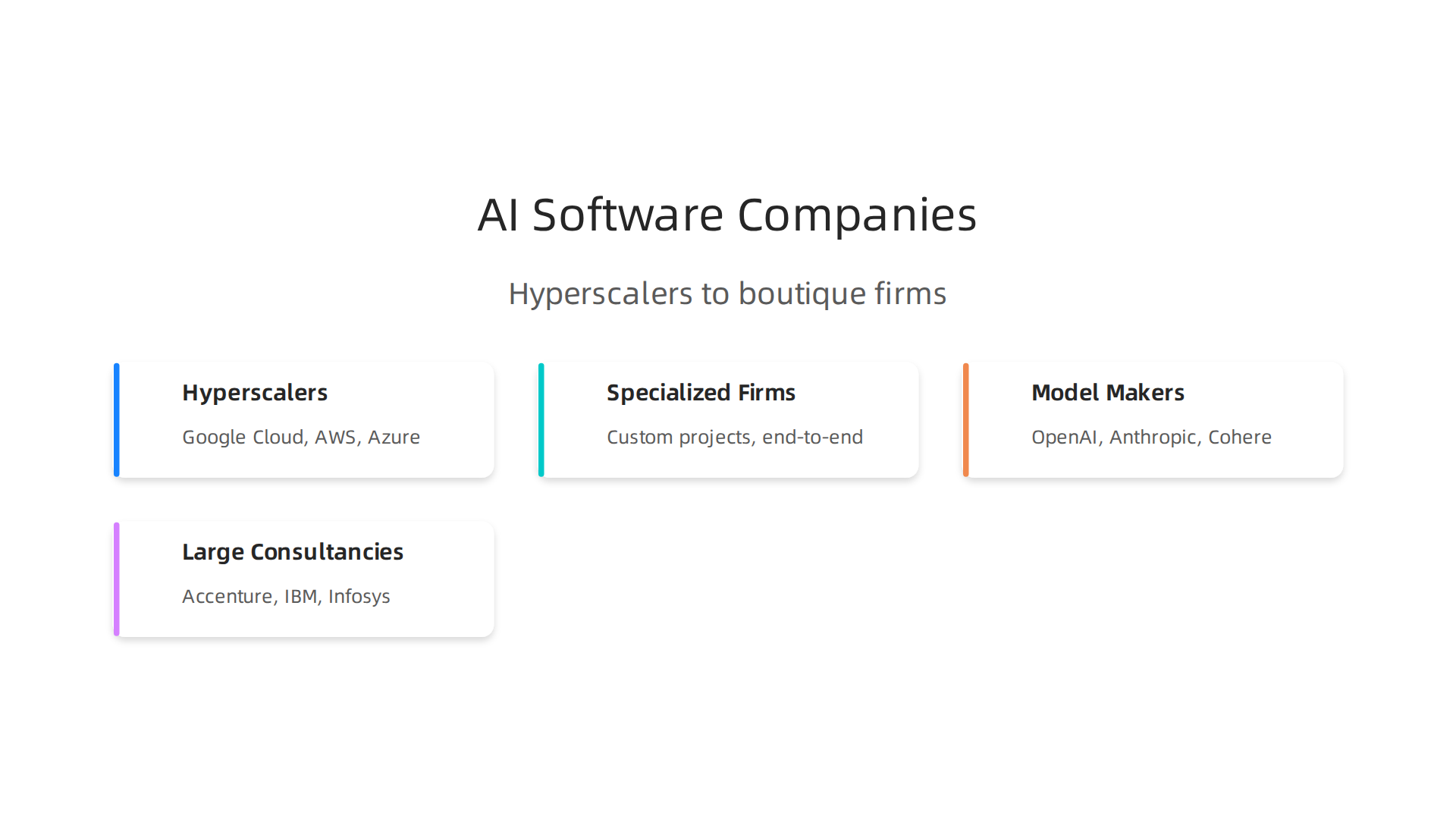
First, the hyperscalers. Providers like Google Cloud AI, Amazon Web Services AI, and Microsoft Azure AI offer powerful platforms and infrastructure. You can build on their tools if you have a strong internal engineering team. They work best for companies that want to own the development process but need ready-made building blocks.
Second, specialized development firms. These companies focus on custom projects from start to finish. According to a list of top enterprise AI development companies, names like LeewayHertz, Master of Code, and Sumatosoft have built strong reputations for delivering tailored solutions. They handle everything from data preparation to model training to deployment. They are a good fit if you need a partner that can build something unique for your business without a huge upfront investment in hiring.
Third, model makers. Companies like OpenAI, Anthropic, and Cohere create the advanced models that power many applications.
If your project needs a powerful language model or computer vision system, you can license their technology or work with them directly. This is often the fastest path to using cutting-edge AI.
Fourth, large consultancies. Firms such as Accenture, IBM Consulting, and Infosys offer end-to-end digital transformation. They are best for big global companies that need help across multiple departments and regions.
The variety can feel dizzying. But having so many options means you can find a partner that matches your specific needs. The trick is knowing which type of player fits your project size, complexity, and budget.
To see which companies are getting the most attention this year, check out our guide to the top AI companies in 2026. It breaks down the key players across all these categories and helps you narrow down your choices.
Core Criteria for Selecting AI Software Development Partners
You now know the different types of AI software development companies out there. But how do you actually choose the right one for your project? Picking a partner based on name recognition alone is a common mistake. A better approach is to evaluate potential partners against a clear set of criteria.
The companies that get the best results use a structured evaluation framework. According to a comprehensive top enterprise AI development companies list, the most successful projects come from teams that score their options on key factors before making a decision. Here are the core criteria you should weigh.
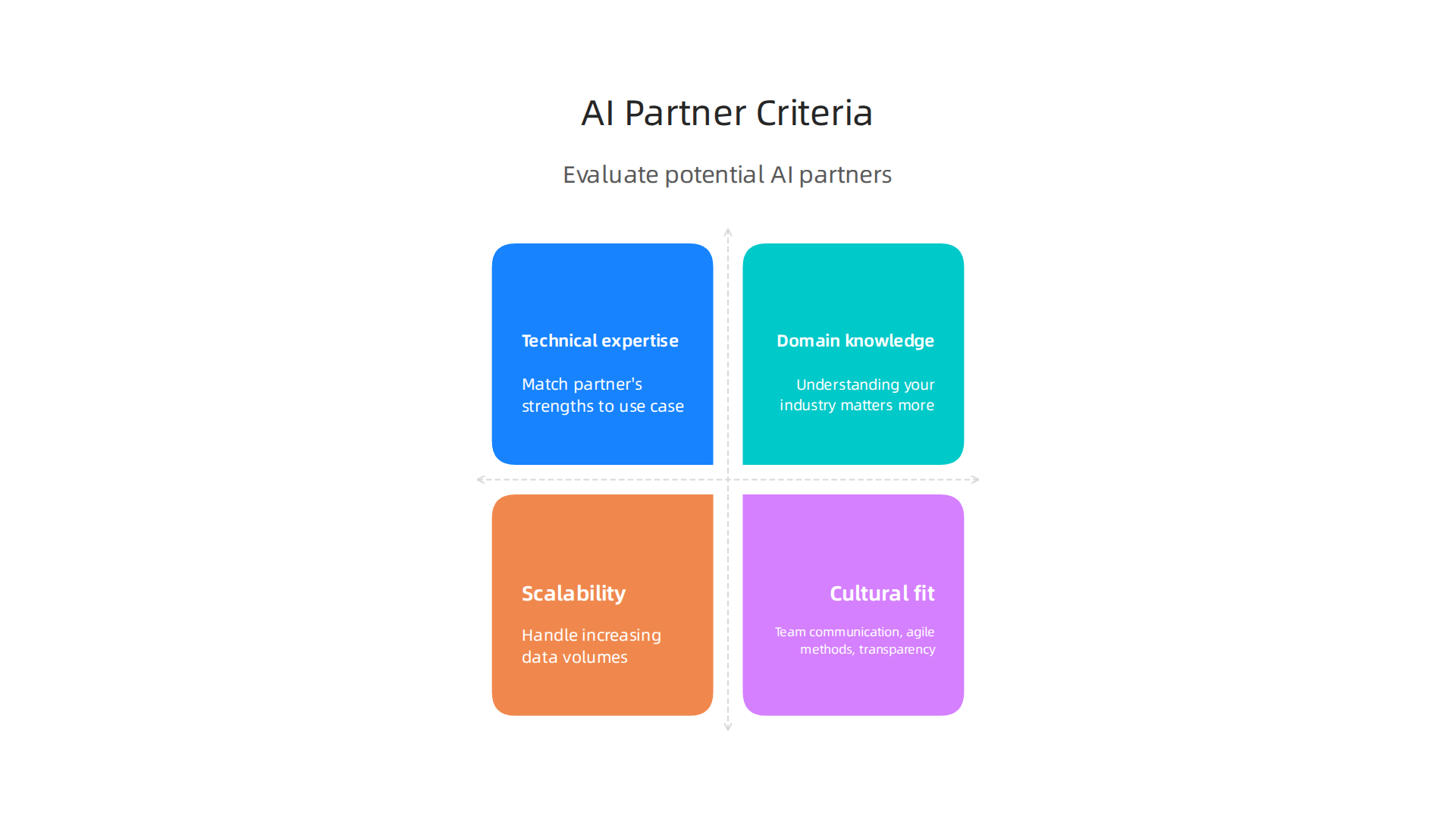
Technical expertise and specialization. Not every AI development company can handle every kind of project. Some excel at computer vision. Others specialize in natural language processing or predictive analytics. You want a partner whose technical strengths match your specific use case. Ask about the frameworks they use, their experience with production deployments, and how they handle model performance at scale.
Domain knowledge. Understanding your industry matters more than you might think. A firm that has built AI solutions for healthcare will understand compliance, data privacy, and clinical workflows. A company focused on finance will know regulatory requirements and fraud detection patterns. Look for past projects in your sector. It is a sign they already understand the unique challenges you face.
Scalability and infrastructure. Your AI solution may start small, but it should grow with you. Evaluate whether the company has experience with cloud architectures, distributed computing, and managing large datasets. They should be able to handle increasing data volumes and user loads without needing a full rebuild.
Cultural fit and collaboration style. This one often gets overlooked, but it matters a lot. How does the team communicate? Do they use agile methods? Are they transparent about progress and setbacks? A partner who shares your working style will save you time and frustration.
Studies show that companies that use a weighted scoring model to rank these factors achieve higher satisfaction with their final product. That means assigning points to each criterion based on your priorities and then comparing partners objectively.
Once you have a shortlist, take time to validate their claims. Look for case studies, ask for client references, and test their communication early. A thorough selection process is the best investment you can make before signing a contract.
If you want a clearer picture of which tools and platforms leading AI developers are using in 2026, check out our guide to the best AI tools for businesses that deliver a real productivity advantage.
And if you want to stay on top of the fast-moving AI industry so you always know which partners and technologies are worth your attention, subscribe to The AI Newsletter Worth Reading for clear daily updates straight to your inbox.
Build vs. Buy vs. Co-Develop: Choosing the Right AI Tooling Strategy
You have your criteria and shortlist of AI software development companies. Now comes the hard question: should you build your AI solution from scratch, buy an off-the-shelf product, or go with a co-development model?
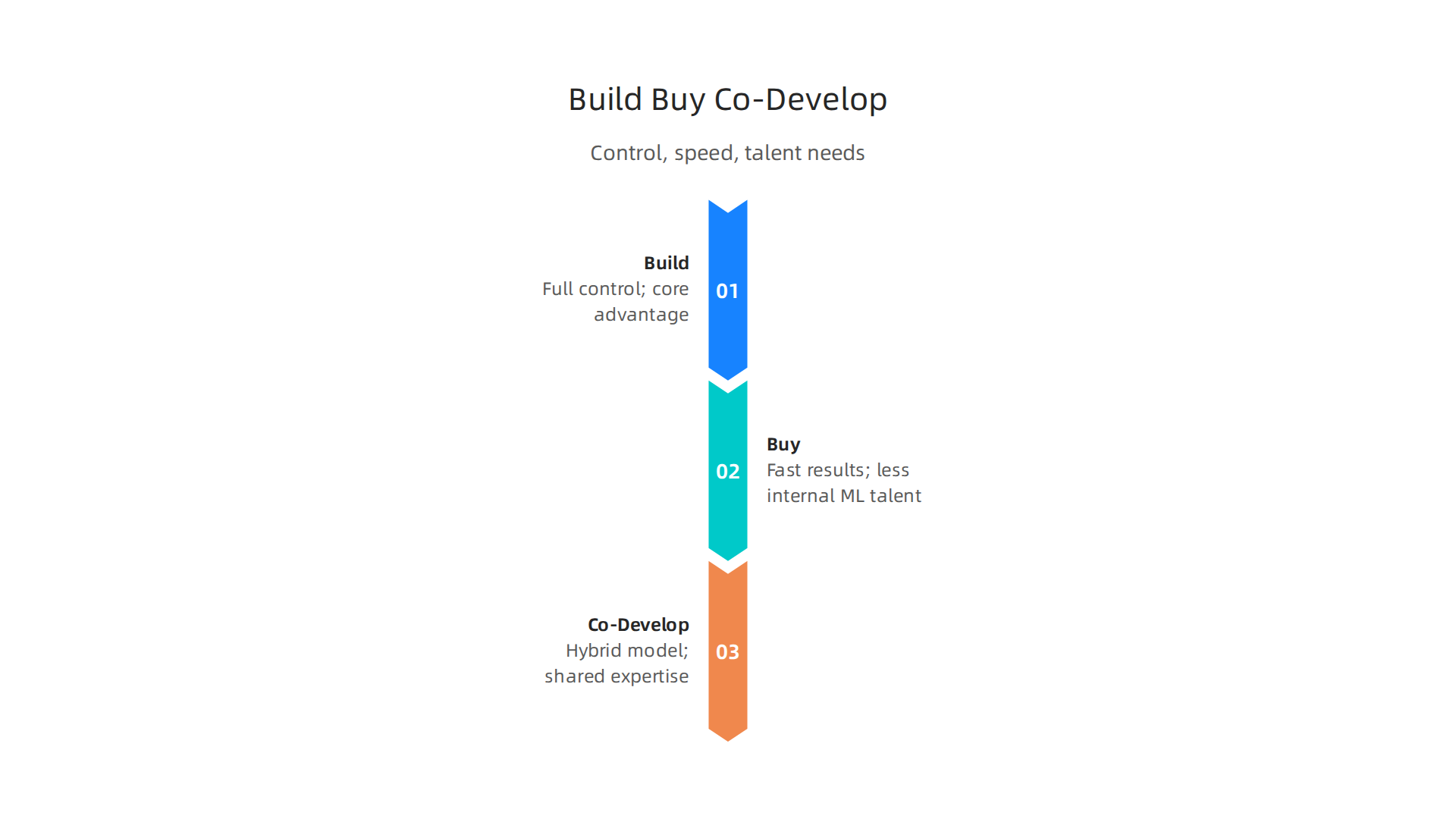
Each path has different trade-offs in cost, speed, control, and talent needs. And the right answer depends on your specific situation.
When building makes sense. Building your own AI system gives you full control. You own the data, the model, and the intellectual property. This works best when AI is core to your competitive advantage and you have a strong internal team. But building is expensive and slow. The enterprise build vs buy decision framework for 2026 breaks down the trade-offs by data, team, and timeline so you can see where your project lands.
When buying is the better move. Buying a ready-made solution is fast. You can get results in one to three months. It works well when AI capabilities are important but not your core differentiator. Buying is also smart if you lack internal ML talent or need to prove value quickly. The downside is vendor lock-in and less flexibility. If your data is standard and you need speed, buying is often the right call.
The rising middle ground: co-development. More companies in 2026 are choosing to co-develop their AI solutions with a partner. This hybrid approach lets you keep control over your unique data and workflows while leaning on an expert team for technical execution. Co-development works well when you have some internal capability but need specialized skills to move faster. In fact, a common framework for deciding between build, buy, and partner suggests that low capability combined with high complexity and high criticality almost always points to partnering as the best path. That is exactly the co-development sweet spot.
How to decide. Ask yourself three questions. Is AI core to your competitive moat? Do you have proprietary data that gives you an edge? Do you have the internal team to build and maintain a complex AI system? If you answered yes to all three, building might be your path. If you answered no to most, buying is safer. If you are somewhere in the middle, co-development is probably your best option.
To put this into practice, start with a small proof of concept. Test your assumptions before committing to a full build. And if you want to understand how to partner effectively with external teams, our practical guide to human AI collaboration covers how to work with partners and make the most of shared expertise.
No matter which path you choose, the goal is the same: get a working solution that solves your real business problem without overextending your resources. The decision is not permanent. You can always shift strategies as your needs change.
Security, Compliance, and Data Governance in Enterprise AI
Choosing between buying, building, or co-developing your AI solution is just the first big decision. The next layer is just as important: security, compliance, and data governance. Get this wrong, and even the smartest AI project can blow up.
AI brings unique risks that most traditional software projects don’t have to worry about. Your AI model can leak sensitive data through its responses. It can produce biased results that harm your customers or your reputation. And it can run afoul of new regulations that didn’t exist a few years ago.
That’s why security and compliance need to be part of your decision from day one. They aren’t things you bolt on at the end.

The regulatory landscape is shifting fast. Frameworks like the NIST AI Risk Management Framework and the EU AI Act are setting new standards for how companies must handle AI. These regulations affect everything from how you train your models to how you explain their decisions. If you work with sensitive customer data or operate in regulated industries like healthcare or finance, these rules directly shape what you can and cannot do.
Before you commit to a path, you need to map your constraints around data sensitivity, residency, and audit requirements. This means asking tough questions upfront: Where will your data live? Who has access to it? How long will you keep it? What happens if your vendor changes their security policies?
Vetting partners is non-negotiable. When you work with ai software development companies, you’re trusting them with your data. You need to verify their security practices thoroughly. This includes how they handle sensitive information during ai solution development, how they protect your data during training, and whether they follow industry standards for data governance. Even seemingly small decisions like who handles your data annotation tech and ai data labeling can introduce risks if the partner doesn’t have strong controls in place.
The best partners will be transparent about their security posture. They should have clear policies on data encryption, access controls, and incident response. They should also be able to show you how they’ve handled compliance in similar projects before.
For a deeper look at the risks that come with uncontrolled AI deployment, check out our guide on AI innovation risks and controls.
The bottom line is this: security and compliance are not optional features. They are foundational requirements that determine whether your AI project can survive in today’s regulatory environment. The frameworks and regulations will keep evolving, so staying informed is critical.
If you want to keep up with the fast-changing regulatory landscape and make smarter AI decisions, you need reliable daily sources. Subscribe to The AI Newsletter Worth Reading for clear daily updates on AI developments that affect your business.
Measuring ROI and Performance of AI Implementations
Once your security and compliance foundations are solid, it is time to ask the real question: Is your AI investment actually paying off? Measuring return on investment (ROI) for AI projects is different from measuring traditional software. You are not just looking at cost savings. You need to track revenue growth, efficiency gains, and even risk reduction.
The best approach starts before you build anything. You have to define what success looks like in clear numbers. Vague goals like "make things faster" are impossible to measure. Instead, pick specific KPIs that match your business objectives. According to a complete guide to measuring AI ROI, the standard formula is (Value Generated minus Total Investment) divided by Total Investment, then multiplied by 100. That gives you your ROI percentage.
Common metrics to track
Not all metrics are financial. You need a balanced set that covers both short-term progress and long-term value. Here are the main categories:
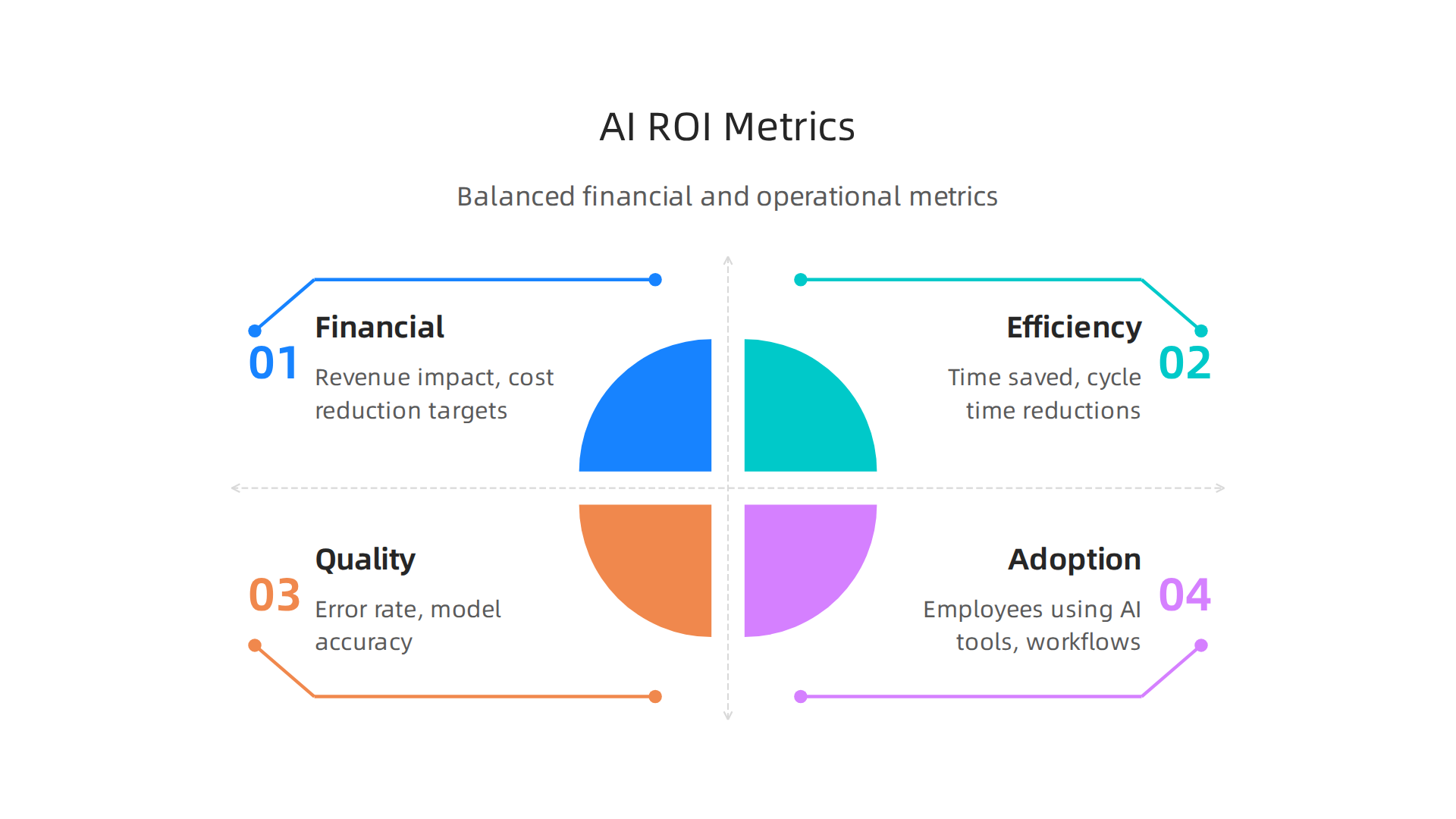
- Financial metrics: Quarterly revenue impact, cost reduction targets
- Efficiency metrics: Time saved per task, cycle time reductions, throughput improvements
- Quality metrics: Error rate reduction, model accuracy, prediction precision
- Adoption metrics: Percentage of employees using AI tools, number of AI workflows in production
Organizations with clear measurement frameworks are 40 to 60 percent more likely to scale AI successfully. They also invest more upfront in governance and training, but they see much higher returns over time.
Tying metrics to business outcomes
A common mistake is tracking only technical metrics like model accuracy. Accuracy matters, but it does not tell you whether your AI is actually growing revenue or cutting costs. You need to connect each metric to a real business impact. For example, if your AI improves customer service, measure the cost savings from automated responses and the increase in customer satisfaction scores.
When you work with ai software development companies, they should help you set these baselines before the project starts. Ask them: What are the current error rates? How long do processes take now? What are the fully loaded costs? Without that baseline, you cannot prove improvement later.
Leading indicators matter too
ROI itself is a lagging indicator. It tells you what already happened. To stay ahead, track leading indicators like adoption rates, user engagement, and system uptime. These signals predict whether your AI project will keep delivering value or start to fail.
For a deeper look at tools that can boost productivity, check out our guide on superhuman AI productivity tools that deliver real results in 2026.
Keep measuring continuously
AI systems evolve. Your data changes, your business needs shift, and new use cases appear. That means ROI measurement is not a one-time event. You should set up regular reviews, like quarterly check-ins, to recalibrate your metrics and make sure your AI investment still makes sense. The most successful companies treat ROI as an ongoing conversation, not a final report card.
Measuring ROI well also helps you decide where to invest next. If one AI project is delivering a 300 percent return while another is barely breaking even, you know where to put your time and money. Clear measurement turns AI spending from a guess into a strategic decision.
Industry Benchmarks and Case Studies of Enterprise AI Success
You hear a lot about AI transforming companies. But what do the actual numbers say? Real benchmarks and case studies help cut through the hype. They show you what is realistic, what works, and what fails.
Let us start with the big picture. According to the 2026 AI ROI benchmarks report, 4 in 5 enterprises now report productivity gains from AI. That sounds great. But here is a warning: ROI drops by 25 percent when companies use six or more different AI tools. That is a huge lesson. Tool sprawl kills returns. It is better to pick a few tools and use them well than to try everything at once.
Benchmarks also vary by business function. Finance and corporate strategy lead the pack. Agentic fraud detection systems in finance can pay back their investment in as little as 8 months. That is fast. Customer service AI also delivers strong returns when you focus on the right metrics like deflection rates and handle time reduction. The key is to match your AI investment to a function that is data ready and has clear baselines.
Now let us look at a real-world success pattern. Large enterprises with over 1,000 developers that invest upfront in governance, training, and measurement infrastructure see ROI between 300 and 600 percent over three years. The top 20 percent of implementations achieve over 500 percent ROI. What sets them apart? They measure before they build. They do not guess. They set baselines for current time, cost, and error rates so they can prove improvement later.
What about failures? The biggest mistake is skipping pre-deployment baselines. Without knowing where you started, you cannot claim any gain. Another common failure is using too many AI tools without integration. That 25 percent ROI drop is real. Also, many companies track only technical scores like model accuracy and miss the business impact entirely. The lesson is to connect every AI project to a specific business outcome like revenue growth or cost reduction.
If you want to see which companies are leading the charge in enterprise AI, take a look at our article on ai companies 2026 the giants and disruptors driving the industry. It covers the players that are actually delivering results.
Keeping up with real AI success stories and benchmarks is tough. Information changes fast. That is why staying informed matters. For a steady stream of clear, daily updates on what actually works in AI, you can subscribe to The AI Newsletter Worth Reading. It helps you separate signal from noise without wasting time.
AI Integration and Scalability: Best Practices for Enterprise IT
The benchmarks and case studies show one thing clearly: getting AI to work at scale is a different ballgame than running a pilot. Many companies hit a wall when they try to connect AI to their existing systems. Let us talk about how to avoid that wall.
Start with your APIs
Your legacy systems were not built for AI. They often use old data formats, rigid structures, and few connection points. The first step is to map out every system you need to connect. Look for existing APIs and figure out where you need new ones. If your systems cannot talk to each other, your AI is useless before it starts.
A common mistake is trying to connect everything at once. Instead, pick one pain point and build a small integration first. Show that it works. Then expand. This approach keeps risk low and gives you early proof. The article on top tips for AI integration challenges from IBM highlights that a phased approach lets you test costs, gauge scalability, and measure ROI before going bigger.
Solve data pipeline problems early
Scalability fails when data pipelines are shaky. AI models need clean, consistent data flowing in from multiple sources. If your data sits in silos across departments, that is a bottleneck. You need to invest in data pipelines that unify everything.
This is where data preparation matters. Tasks like data cleaning, formatting, and labeling are not glamorous, but they are the foundation. You might need to work with ai software development companies that specialize in ai solution development to build robust pipelines. Data annotation tech and ai data labeling services can help you prepare high quality training data. Without that foundation, even the best models will give bad results.
Adopt MLOps for long term success
Once your AI runs in production, the work is not over. Models degrade over time because data changes. Customer behavior shifts. Business rules update. You need a system to manage the full lifecycle of your models.
That is where MLOps comes in. MLOps stands for machine learning operations. It includes automated retraining, monitoring for performance drops, version control for models, and smooth deployment workflows. Companies that adopt MLOps practices see fewer failures and faster updates. As one guide on enterprise AI integration explains, adopting MLOps practices is key to automating tasks and scaling AI initiatives. It keeps your AI reliable over time.
If you want to explore tools that can help with integration and scaling, check out our roundup of best AI tools for businesses. It covers platforms that handle everything from data pipelines to model monitoring.
Keep humans in the loop
Even the most automated AI system still needs human oversight. People catch edge cases that models miss. They interpret results in context. And they make sure the AI stays aligned with business goals. Build workflows where humans review important outputs, especially in the early stages. As you scale, you can reduce manual checks, but never remove them entirely.
To sum up, AI integration is not a one time project. It is an ongoing process of connecting systems, cleaning data, monitoring models, and refining workflows.

The companies that do it well invest in the plumbing before they chase the flashy results.
Future Trends: Preparing Your Enterprise AI Strategy for What’s Next
The AI world moves fast. What felt cutting edge last year is now table stakes. To stay ahead, you need to think about where things are heading and build a strategy that bends with the future instead of breaking.
Three big trends you need to watch
Agentic AI is the first one. Instead of just answering questions, AI agents can take actions on their own. They book meetings, update databases, and handle multi-step workflows. Companies that embrace agentic AI will need to rethink how they connect systems. The reality is that enterprise AI adoption often stalls at data integration because agents need clean access to production data. If your data pipelines are not ready, agents will fail.
Multimodal models are the second trend. These models understand text, images, audio, and video all at once. That means you can build applications that analyze a customer call recording and a support ticket together. It opens up new use cases but also demands more from your infrastructure.
AI driven automation keeps getting smarter. Routine tasks like data entry, report generation, and even code reviews are being automated at a deeper level. The companies that win will be the ones that figure out which tasks to automate and which to leave to humans.
Build for flexibility, not for today
Do not lock yourself into a single model vendor or a rigid architecture. The landscape shifts fast. By 2026, the best AI tools for a given job might come from a company that did not exist three years ago. Instead, build modular systems where you can swap out models and add new capabilities without ripping everything apart.
That applies to your tech stack and your team. Hire people who can adapt. Train your existing staff on new tools. And do not forget governance. As AI gets more powerful, the companies that invest in ethical guidelines, bias checks, and transparent decision making will earn more trust. That trust is a competitive advantage.
To keep up with these fast moving trends, you need a steady stream of clear, reliable information. The daily updates from The AI Newsletter Worth Reading will help you spot the next big shift before your competitors do.
Invest in talent and governance now
The gap between companies that succeed with AI and those that struggle often comes down to people and rules. You need team members who understand both business needs and technical limits. You also need clear policies on data privacy, model explainability, and human oversight. The companies that get serious about these two things today will have a head start tomorrow.
If you want to dig deeper into the biggest developments shaping this year, check out our guide on the AI breakthroughs in 2026 that actually matter. It covers the key releases and research that will influence your enterprise strategy.
The future of AI is not something that happens to you. It is something you prepare for. Start with flexible systems, invest in your people, and keep learning. That is how you build an AI strategy that lasts.
Summary
This article maps the 2026 enterprise AI tooling landscape and gives practical guidance for choosing the right path—build, buy, or co‑develop—based on your goals, data, and team capability. It explains the main categories of AI providers (hyperscalers, specialized firms, model makers, and consultancies) and the core selection criteria you should score, such as technical expertise, domain knowledge, scalability, and cultural fit. You will also learn when each delivery model makes sense, how to vet partners for security and regulatory compliance, and which KPIs to set before you start so you can measure ROI. The piece covers integration best practices—APIs, data pipelines, and MLOps—to avoid pipeline and tool‑sprawl problems, and highlights industry benchmarks, case studies, and emerging trends like agentic and multimodal AI. After reading, you’ll be able to run a structured partner selection process, choose an appropriate tooling strategy, set measurement frameworks, and plan for secure, scalable deployment.