

Why the healthcare data analyst path matters now
Imagine a world where doctors can make choices for patients based on all the best facts. That’s what a healthcare data analyst helps create.

This special job is all about looking at lots of health information and turning it into clear steps that help patients and lower costs.
In 2026, the world of healthcare is changing super fast. We have so much digital information from electronic health records, insurance claims, and even small sensors people wear. All this data is like a huge puzzle, and a healthcare data analyst is the expert who puts the pieces together. They translate complex clinical and daily operational data into simple insights that guide important decisions 1.
The need for people with special data skills in healthcare is growing very quickly. In fact, the market for healthcare analytics is expected to reach about $181.34 billion by 2031 2. This growth is driven by things like artificial intelligence (AI) and the need to make healthcare cheaper and better. Being a healthcare data analyst means you are right at the heart of this change, using numbers to improve lives.
This field isn’t just about crunching numbers. It’s about spotting trends, understanding patient needs, and helping hospitals run smoother. It’s a key role in making sure everyone gets the best care possible. If you are interested in growing your skills, understanding data better can open up many doors.
You might be wondering what kind of skills you need to succeed in this exciting field. If you’re looking for more ways to stay updated on big changes in AI and technology, consider subscribing to The AI Newsletter Worth Reading. It provides clear daily updates that can help you stay ahead. You can also learn more about how to succeed as a data analyst in 2026 in general, which offers helpful tips for data analytics jobs like this one.
Understanding the market: demand, roles, and hiring signals
So, if you’re thinking about becoming a healthcare data analyst, where do these special jobs come from? Actually, many different places in healthcare need these experts. Hospitals, companies that make medicines, insurance groups, and even government health departments are all looking for people to help them understand their data 1. They want to solve big problems like making patient care better, finding ways to save money, and making sure everything runs smoothly.

For example, a healthcare data analyst might help a hospital figure out why some patients stay longer than others. Or, they might look at patient records to see how well a new medicine is working. These data analytics jobs are all about using information to make smarter choices for everyone’s health. The demand for skilled professionals to understand this data is higher than ever in 2026 2.
The job market for a healthcare data analyst is special. While many places need general data analysts, healthcare companies are among the fastest-growing places looking for data experts outside of regular tech companies. Big names like UnitedHealth Group and CVS Health are growing their data teams quickly. This is because looking at clinical and claims data is super important for rules and money 3.
When you look for these jobs, you might see different titles. Besides "healthcare data analyst," you could find roles like "Clinical Data Analyst" or "Health Informatics Analyst." Sometimes, you might even hear terms like "data scout" for someone who searches for useful information. These jobs are different from general data roles because they need you to know about health terms and how health systems work. You’ll use your data skills like understanding databases or making charts, but you also need to understand medical information and patient privacy rules.
What’s really interesting is that there’s a big need for people with these skills. In fact, there’s a huge gap between how many healthcare data science jobs are open and how many skilled people are available to fill them. This means many health places are competing to find the right talent 4. This is good news if you’re just starting out or looking for entry level data science jobs in 2026. The need for smart people who can work with data and understand healthcare is only going to grow. Being a healthcare data analyst puts you in a place where you can really make a difference, especially as new things like Doctor AI in 2026 change how medicine is practiced.
Core technical skills and tools for healthcare data analysts
To become a great healthcare data analyst, you need a special set of skills. It’s not just about crunching numbers; it’s about understanding how health information works and what tools help you make sense of it all.
Knowing these skills helps you build a strong data science resume and succeed in these important data analytics jobs.
Essential skills for understanding health data
First, you’ll need strong skills in getting data ready and understanding it. This is like being a detective for information.
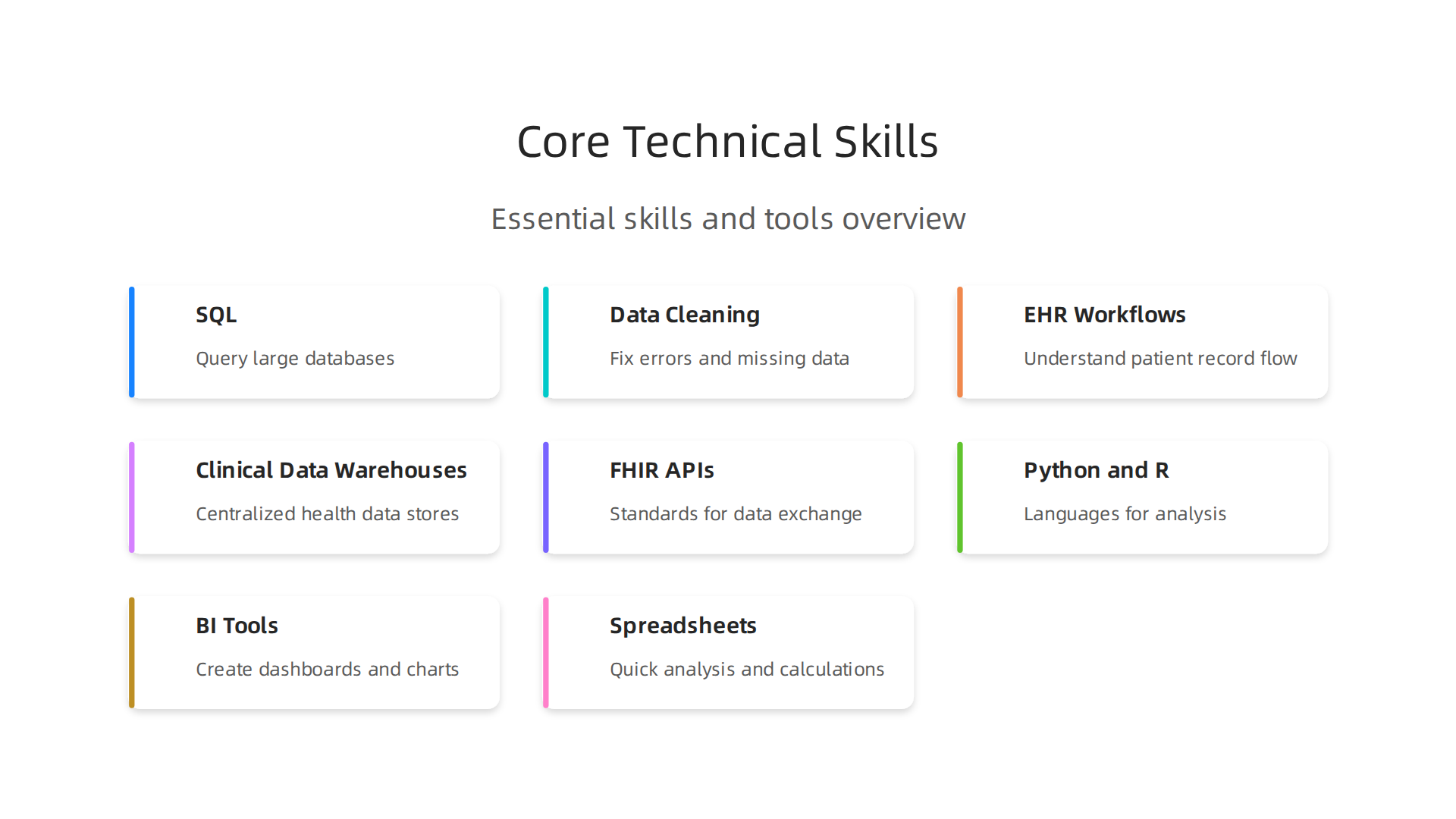
- SQL (Structured Query Language): This is super important. Think of SQL as the main language you use to ask questions to big databases where patient information is stored 1. You’ll use it every day to pull out exactly the data you need from electronic health records, also known as EHRs 2. Many jobs require this as a core skill 3.
- Data Cleaning and Preparation: Health data can be messy! You’ll need to know how to find mistakes, fill in missing pieces, and make sure the data is ready to be analyzed. This is a big part of getting data ready for use.
- Understanding EHR Workflows: This means knowing how patient records move through a hospital or clinic. How is data collected? Where does it go? This special knowledge helps you understand the story behind the numbers. Many healthcare data analyst roles look for this.
Tools and platforms you’ll use
Healthcare data analysts also work with specific tools and platforms. These help them store, share, and show the data.
- Clinical Data Warehouses: These are like huge, organized libraries for health information. All sorts of patient data are kept here, making it easier for you to access and analyze.
- FHIR APIs: FHIR stands for Fast Healthcare Interoperability Resources. These are like special rules that help different computer systems in healthcare talk to each other and share patient information safely 4. Learning how to work with these is a big plus. You can even learn to build FHIR pipelines to move data around.
- Programming Languages:
- Python and R: These are popular languages for deeper data analysis. They help you clean data, do advanced math, and find hidden patterns that might not be obvious at first glance 5. These are key for many data analytics jobs.
- Business Intelligence (BI) Tools: Tools like Tableau and Power BI are used to create easy-to-understand charts, graphs, and dashboards. This helps you tell the story of your data to doctors, managers, or others who need to make decisions 6.
- Spreadsheets: Don’t forget Excel! It’s still a very useful tool for smaller data tasks, quick calculations, and sharing simple reports.
Advanced skills for deeper insights
For some roles, especially those leaning towards data science and artificial intelligence engineering, you might also use more advanced skills:
- Machine Learning (ML): This involves teaching computers to learn from data and make predictions. For example, predicting which patients might be at risk for a certain disease. Knowing about practical machine learning for data science in 2026 can open up new doors.
- Statistical Analysis: This helps you understand if the patterns you see in data are real or just by chance. It’s about using math to prove your findings.
- Time-Series and Survival Analysis: These are fancy ways to look at data over time. For example, understanding how a patient’s health changes each year, or how long a new treatment works for.
Becoming a healthcare data analyst means you get to use many different skills to help make healthcare better for everyone. If you’re looking to dive into the world of data, especially for entry level data science jobs in 2026, building these skills is a fantastic start.
To keep up with the newest changes and tools in AI and technology, which are always impacting data analytics, you’ll want to stay informed.
Get clear daily AI updates from The AI Newsletter Worth Reading.
After building up your technical skills, there’s another very important part of being a great healthcare data analyst: knowing how healthcare actually works. This means understanding clinical workflows, special coding systems, and where all the health data comes from. It’s like being a data scout who also knows the local language and customs.
Why clinical context and care pathways matter
Imagine you’re looking at numbers about how long patients stay in the hospital. If you don’t know why patients move from one ward to another, or what a typical recovery path looks like, your numbers won’t tell the full story. Understanding clinical workflows means knowing the step-by-step journey a patient takes, from seeing a doctor to getting treatment and going home. This knowledge helps a healthcare data analyst see the real meaning behind the data points. It helps you ask better questions and find more helpful answers.
Understanding diagnosis and procedure coding systems
Healthcare uses special "languages" for billing and tracking. These are called coding systems, and two big ones are:
- ICD (International Classification of Diseases): This system gives a unique code to every disease, injury, and cause of death. For example, a cold might have one code, and a broken leg another.
- CPT (Current Procedural Terminology): This system gives codes to medical, surgical, and diagnostic services. So, a doctor’s visit, a blood test, or surgery each have their own CPT code.
As a healthcare data analyst, you’ll work with these codes a lot. They help you group patients, track treatments, and understand patterns across different conditions or procedures. Without knowing what these codes mean, it’s hard to make sense of patient records or billing data.
Key data sources and their special points for analysis
Healthcare data comes from many places, and each source has its own unique features:
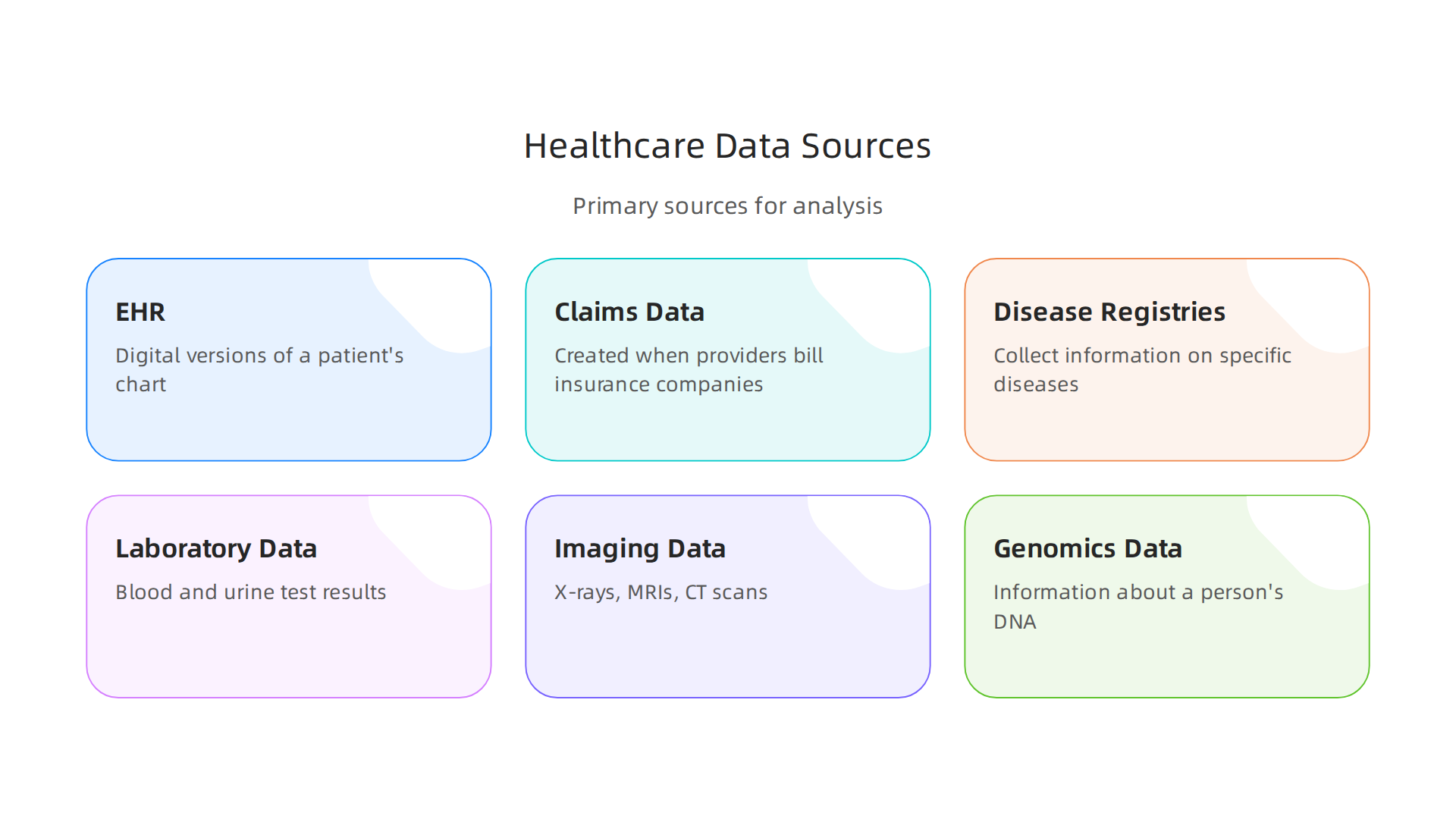
- Electronic Health Records (EHR): These are digital versions of a patient’s chart. They include everything from doctor’s notes, test results, and medications, to allergies and past surgeries. EHR data is very detailed, but it can also be messy because different doctors might write things in different ways.
- Claims Data: This is data created when healthcare providers bill insurance companies for services. It tells you about diagnoses, procedures, and the cost of care. Claims data is usually very structured, but it might not have all the rich clinical details found in EHRs.
- Disease Registries: These are special databases that collect information on specific diseases, like cancer or diabetes. They help researchers track how diseases spread and how treatments work over time.
- Laboratory Data: This includes results from blood tests, urine tests, and other lab work. It’s usually numerical and precise, giving clear insights into a patient’s health status.
- Imaging Data: This covers X-rays, MRIs, CT scans, and other medical images. Analyzing this data often needs advanced tools and sometimes even artificial intelligence imaging in 2026 to spot patterns or problems.
- Genomics Data: This is information about a person’s DNA. It’s becoming more important for understanding how genes affect health and disease, allowing for more personalized medicine.
Working with these different types of data means understanding their strengths and weaknesses. Also, because health data is very personal, there are strict rules about how it’s handled. In 2026, privacy laws like HIPAA in the U.S. and GDPR in Europe heavily influence how a healthcare data analyst can access, store, and use this information. Understanding these rules is a key part of the job to ensure patient trust and legal compliance.
Learning about these different data sources and how healthcare works helps you to not just process numbers, but to truly understand what they mean for patients and healthcare systems.
Now that you know what it means to be a healthcare data analyst and how important it is to understand the healthcare world, let’s look at the different career paths you can take. This field offers many ways to grow, both within healthcare analytics and by moving from other areas.
Typical job progression for a healthcare data analyst
Working as a healthcare data analyst usually means starting in one type of role and then moving up to more advanced positions. This path often looks like this:
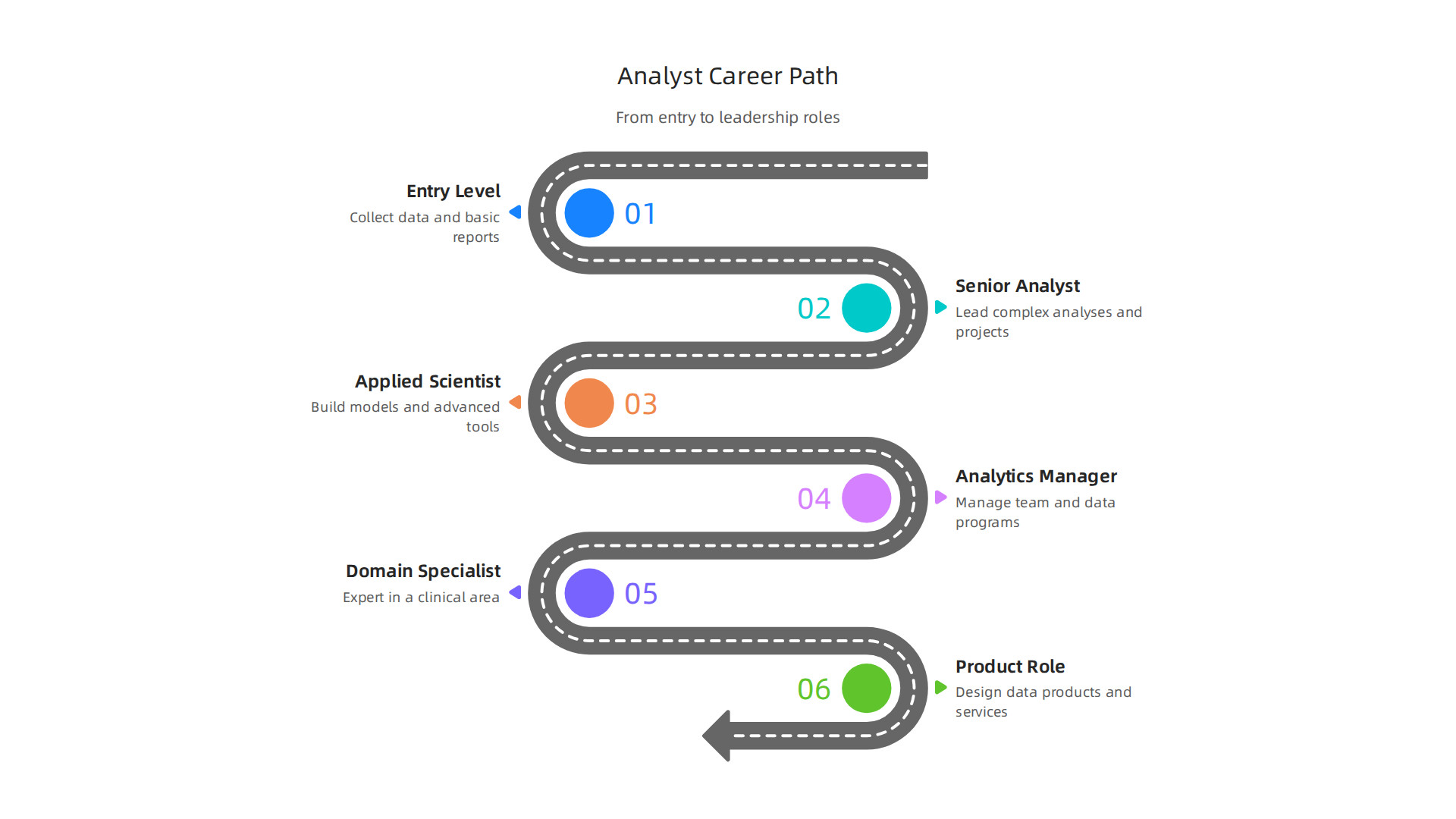
- Entry-Level Analyst: When you’re just starting out, your job might involve collecting data, making simple reports, and helping senior analysts. Common job titles include Data Analyst, Health Informatics Specialist, or Business Intelligence Analyst. Some entry-level roles can also be found as Clinical Data Coordinator or Quality Reporting Analyst, especially in hospitals or health plans, where you might focus on specific regulatory measures or claims data Health Care Data Analyst: Career Guide and How to Become One.
- Senior Data Analyst: After gaining some experience, you can move to a senior role. Here, you’ll work on more complex projects, do advanced statistical analysis, and take on more responsibility Healthcare Data Analyst – Career Path. You might even start leading smaller teams or guiding junior analysts.
- Applied Data Scientist or Analytics Manager: As you gather more skills, you might become an applied data scientist, using more complex tools and models to solve big problems. Or, you could become an analytics manager, where you would lead a team of analysts and oversee bigger data programs Health Data Analyst Career Path, Skills & Advice 2026. This path often involves working with advanced algorithms and larger data sets, moving into the world of mastering practical machine learning for data science in 2026.
- Domain Specialist or Product Role: At the top levels, you might become an expert in a specific area, like cancer data or public health, called a Subject Matter Expert (SME). You could also move into roles that help design new data products or services, becoming an analytics consultant Health Care Analytics Career Guide.
This career progression means you’ll keep learning and growing your skills. To help you along the way, it’s wise to consider top data analytics certifications in 2026 for AI careers that can speed up your climb.
Moving into healthcare analytics from other fields
Not everyone starts their career directly in healthcare data analytics. Many people transition into this field from other areas.
- From General Data Science: If you already work in data science in a different industry, your skills are highly valuable. You’ll just need to learn the specific healthcare context and data types. This is often an easier move because you already know how to work with data.
- From Clinical Research: People who have worked in clinical research often understand patient care and medical studies very well. They can learn the data tools and quickly become great healthcare data analysts.
- From Software Engineering: Software engineers have strong technical skills that are very useful in building and managing data systems. They can learn about healthcare data and apply their engineering knowledge to create solutions.
- From Health Information Management (HIM): If you have experience in HIM operations, like coding or auditing medical records, you already have a strong base in healthcare data. Adding skills in SQL and data visualization can help you become a healthcare data analyst Health Data Analyst Career: Complete Profile.
To succeed as a healthcare data analyst in 2026, it’s important to keep learning and adapting. The field is always changing, with new technologies and data types popping up. Staying curious and building on your skills will open up many opportunities.
Are you looking for more insights into the fast-changing world of AI and its impact on various careers, including data analytics?
Get clear daily AI updates from The Deep View Newsletter.
While gaining new skills opens up many opportunities, being a healthcare data analyst also means understanding a very important part of the job: keeping patient information safe and using it fairly. This field comes with strict rules and ethical duties that everyone must follow in 2026.

Regulatory, privacy, and ethical considerations for practice
A big part of a healthcare data analyst’s work involves handling sensitive patient information. This means you need to know and follow important privacy laws. Two of the most well-known are HIPAA in the United States and GDPR in Europe. These rules make sure that health data is kept private and secure.
For example, the Health Insurance Portability and Accountability Act (HIPAA) sets strong guidelines on who can see, use, and share protected health information (PHI) in the U.S. In 2026, updates to these rules continue to shape how data about things like substance use disorder treatment is handled and protected HIPAA Regulations in 2026: What Healthcare Tech Teams …. This includes clear rules about managing consent, controlling third-party tracking, and how to quickly respond if there’s a data breach The Healthcare Regulatory Landscape in 2026: Key Laws, ….
Similarly, the General Data Protection Regulation (GDPR) in the European Union classifies health data as a special type of sensitive information. It requires clear permission or a good reason related to public health for processing this data 2026 Guide to International Healthcare Data Privacy. For healthcare data analysts, these laws mean that you can only access, link, and share data in very specific ways. You also need to know about Healthcare Data Residency Requirements (2026 Guide) which dictate where health data must be stored and processed. It is important to advance compliance with these rules Advancing Compliance with HIPAA and GDPR in Healthcare.
Beyond these laws, there are important ethical points to consider.
- Bias in Clinical Models: When using data science and artificial intelligence engineering to create tools for diagnosis or treatment, it’s vital to make sure these models are fair and don’t show bias against certain groups of people. Biased data can lead to unfair health outcomes.
- Informed Consent: You must ensure that people have given proper permission for their health data to be used, especially if it’s for something beyond their direct care, like research or new product development.
- Clinical Safety: Any insights or tools a healthcare data analyst develops must be safe and not put patients at risk. This is a huge responsibility.
Understanding these regulatory, privacy, and ethical considerations is a core skill for any healthcare data analyst. It helps ensure that data is used to improve health in a safe and responsible way. Thinking about things like this can also help us understand the the societal implications of AI in a broader sense.
After understanding the important rules for keeping patient information safe and ethical, the next big step for a healthcare data analyst is to show what they can do. This means building a strong portfolio of projects, getting ready for interviews, and connecting with others in the field. These steps are key to landing great data analytics jobs in 2026.
Building a portfolio and landing roles: projects, interviews, and networking
To stand out as a healthcare data analyst, you need to prove your skills with real-world examples. This is where a strong portfolio comes in.
It’s like a showcase of your best work.
Here are some high-impact projects you can include:
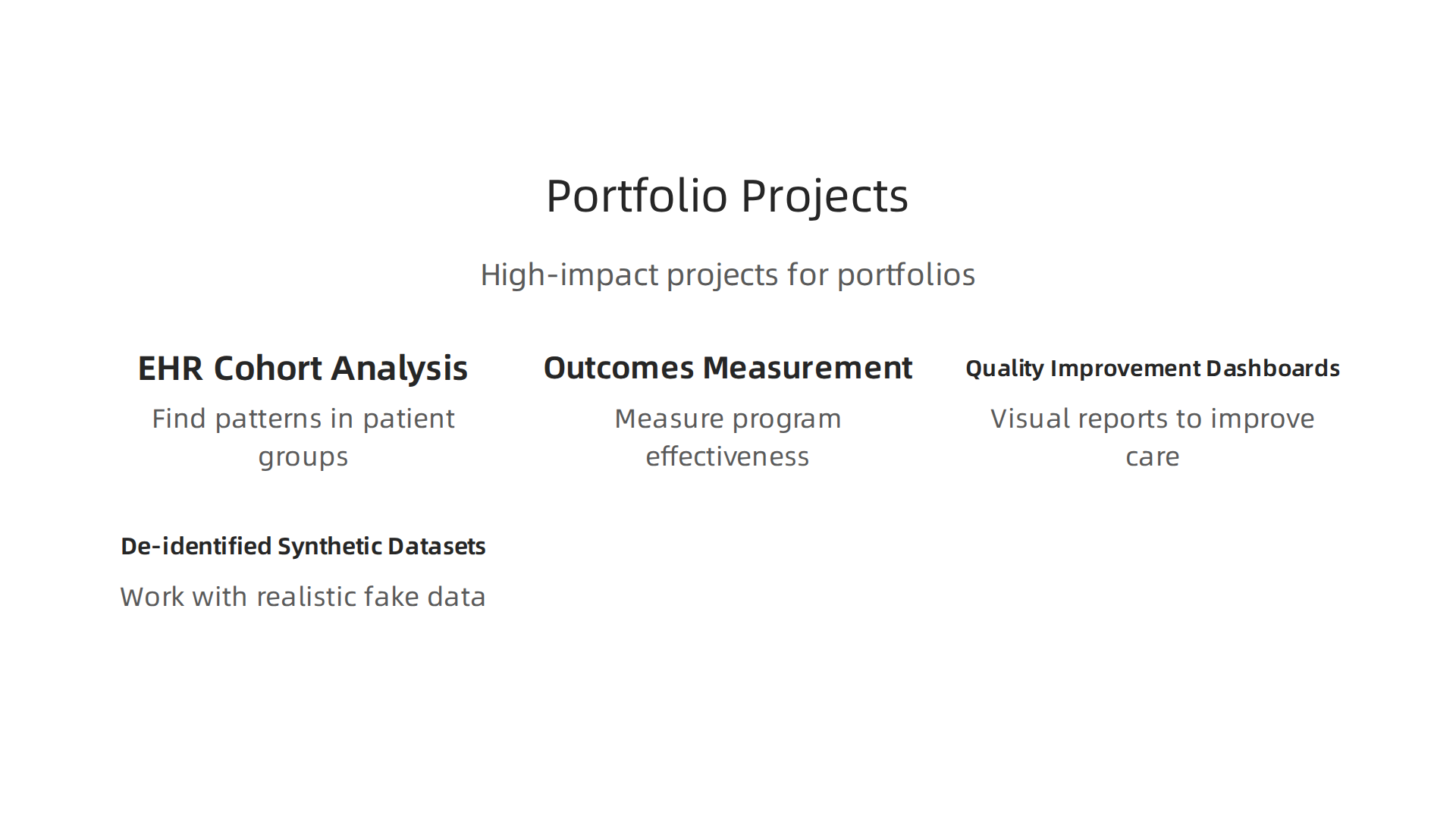
- EHR Cohort Analysis: This means looking at groups of patients from electronic health records (EHRs) to find patterns. For example, you might analyze how a certain group of patients responded to a new treatment. This shows you can work with complex clinical data.
- Outcomes Measurement: You could develop a project that measures how effective a healthcare program or treatment was. This helps hospitals see if their efforts are making a real difference for patients.
- Quality Improvement Dashboards: Imagine creating a visual report (a dashboard) that helps a hospital understand how to improve patient care, like reducing wait times or preventing infections. These dashboards often use tools like Tableau or Power BI.
- De-identified Synthetic Datasets: Since real patient data is very private, showing you can work with fake, but realistic, data that protects privacy is a great skill. This type of project can show your understanding of data provenance and ethical data handling.
For these projects, strong technical skills are a must. Most employers expect a healthcare data analyst to be good at SQL for querying databases, and tools like Python or R for analysis and statistics. Knowing data visualization tools like Tableau or Power BI is also very important for creating reports and dashboards that tell a clear story Healthcare Data Analyst Skills: 2026 Career Guide & Roadmap. When creating your portfolio, consider how to include healthcare-themed projects to make your Healthcare Data Analyst Roadmap clear. You can even learn to build practical data pipelines, like those using FHIR, through online resources Mastering FHIR Pipelines – Data Analysis.
When it’s time for interviews, be ready to talk about your projects in detail. Interviewers often use case studies. You’ll need to:
- Frame your work: Explain the problem you were trying to solve, how you approached it, and what you learned.
- Discuss data provenance and bias: Show that you understand where your data came from and how you made sure it was fair and unbiased. This links back to the ethical points we talked about earlier.
- Translate results for clinical stakeholders: You’ll often need to explain complex data findings to doctors, nurses, or hospital leaders who aren’t data experts. Being able to explain your insights simply and clearly is a very valuable skill.
As you prepare for interviews and work on your data science resume, remember that a mix of technical skills, healthcare knowledge, and good communication will help you succeed. It’s also worth looking into roles that involve data science and artificial intelligence engineering, as these areas are growing quickly in healthcare.
Staying updated with new developments in AI and data is a continuous journey.
Get clear daily AI updates from The AI Newsletter Worth Reading.
Staying updated with new developments in AI and data is a continuous journey. To truly make your mark as a healthcare data analyst, you need to think about the future. This means understanding new trends and always learning more to keep your skills sharp.
Future-proofing your career: trends, continuous learning, and specialized niches
The world of healthcare data analytics is changing fast, mostly because of new kinds of AI and data use. In 2026, the overall market for healthcare analytics is huge and still growing. Experts say it will reach about $181.34 billion by 2031, driven by the need for smarter ways to make decisions and lower costs [Healthcare Analytics Research Report 2026: A $181.34 – GlobeNewswire]. This means many new chances for skilled people.
To future-proof your career, look into these exciting and growing areas:
- Clinical Natural Language Processing (NLP): This is about using computers to understand and work with human language from doctor’s notes or patient records. It helps find important information that might be hidden in text.
- Federated Learning for Multi-Institutional Studies: Imagine many hospitals sharing insights from their patient data without actually sharing the private data itself. Federated learning allows this, making big studies possible while keeping patient information safe.
- Real-World Evidence Pipelines: This involves collecting and analyzing data from everyday clinical practice. It helps us understand how treatments work in the real world, not just in studies.
- Genomics Integration: As we learn more about our genes, healthcare data analysts will help connect genetic information with patient health records to offer more personalized care.
Many of these advanced areas use Artificial Intelligence (AI). AI is becoming a standard part of healthcare, helping with everything from diagnoses to risk checking, and it is changing how care is given Ai Is Accelerating New…. It’s clear that AI is transforming healthcare today, opening many new doors for healthcare data analysts Doctor AI in 2026: How Artificial Intelligence is Transforming Healthcare Today.
Strategies for Staying Current
To keep up and thrive as a healthcare data analyst, you’ll want to:
- Targeted Upskilling: Focus your learning on specific, new skills. This could mean taking courses in clinical NLP or advanced machine learning techniques used in healthcare. The field of data analytics in healthcare has many key trends, including predictive analytics and real-time patient monitoring Top Five Health Care Trends for 2026: How New Technology Is …. Staying on top of these trends will make you a strong candidate 6 Healthcare Data Analytics Trends in 2026. If you’re looking for ways to grow your skills, finding the right learning path can help you Unlock Your AI Potential: Choosing the Right Learning AI Course for 2026.
- Contribute to Reproducible Projects: Working on projects that others can easily check and build upon is a great way to show your skills and understanding of data quality.
- Follow Trusted Signal Sources: Keep an eye on reports from top healthcare groups and tech companies that talk about future trends. This helps you know where the field is going. You can also explore AI Data Analytics 2026 Trends That Deliver Real Results to stay informed.
By actively learning and exploring these new areas, you can ensure your career as a healthcare data analyst remains strong and exciting for many years to come.
Summary
This article explains why the healthcare data analyst role is increasingly critical in 2026, where massive digital health datasets and advancing AI are changing how care is delivered. It walks through who hires these analysts, the different job titles you’ll see, and why demand is growing as organizations seek better outcomes and lower costs. The piece details core technical skills—SQL, data cleaning, Python/R, BI tools—and platform knowledge like EHRs, FHIR, and clinical data warehouses, plus advanced topics such as ML and time-series analysis. It also covers the clinical context you must learn (workflows, ICD/CPT codes), the main data sources (EHR, claims, labs, imaging, genomics), and regulatory requirements like HIPAA and GDPR. The article maps typical career progressions, practical portfolio projects to land roles, and advice for people moving into healthcare analytics from other fields. Finally, it highlights future niches to study (NLP, federated learning, genomics) and recommends continuous learning strategies to keep your skills relevant.