
Why data foundations and data literacy matter for AI leaders
In 2026, artificial intelligence (AI) is changing the world very fast. We see new AI tools and ideas every day. But for AI to work well and be truly helpful, it needs two main things: good information and people who understand that information. This is what we call strong data foundations and data literacy.
Imagine building a tall, strong house. You need good, solid ground to build it on. In the same way, AI needs a strong base of good, clean data to learn from.

Without this, AI can make mistakes or give wrong answers. This means companies and leaders using AI must make sure their data is well-organized, accurate, and easy to find. This idea of managing data properly is known as data governance, and it includes defining who owns data and what quality rules it must follow Data Governance Strategy: 7-Step Framework That Works.
Beyond having good data, people also need to understand it. This is data literacy. It means knowing how to read, work with, and talk about data. If AI leaders and their teams understand where their data comes from and how it’s used, they can make smarter choices.

This is even more important today, as new rules like the EU AI Act require companies to show how their AI systems use data, especially for important tasks Data Governance Frameworks for AI Compliance: What You Need in 2026.
This guide will help AI professionals understand these important parts. We will share easy-to-use plans and ideas for how to set up good data rules (governance priorities) and how to put them into action. We will also look at the very basic building blocks of AI and why understanding them is key for its future Unveiling the primary source of artificial intelligence: AI’s fundamental building blocks. Our goal is to make sure you, as an AI leader, have the tools to build trustworthy and powerful AI systems.
To stay up-to-date with all the big changes in AI, make sure you get clear daily AI updates.
The AI Newsletter Worth Reading
Data literacy: definitions, competencies, and organizational roles
Let’s talk more about data literacy. It’s not just a fancy term. It’s a very important skill in 2026, especially as we use more AI. Data literacy means you can read, work with, and talk about data. It means you can understand what data tells you and use it to make smart choices. Even though there isn’t one official definition everyone uses, we generally agree on what skills are needed to be data literate Data literacy in the labor market: a systematic review.
What data literacy means for everyone
Data literacy is important for both people who work closely with computers and those who don’t.
- For technical people: This group includes those who build AI tools or work with big computer systems. For them, data literacy means they can:
- Find the right data.
- Check if the data is good and clean.
- Use special tools to look at data and find important patterns.
- Build systems that handle data well.
- Understand how data affects the computer science decisions they make.
- For non-technical people: This group might include managers, marketers, or people who use AI tools without writing computer code. For them, data literacy means they can:
- Ask good questions about data.
- Understand reports and charts made from data.
- Know when data is trustworthy or when it might be misleading.
- Use data to help them make better business choices.
- Talk about data clearly with others.
Key skills for data literacy
When we talk about being good with data, we mean having several skills. Experts have pointed out many important areas for data literacy. These include:
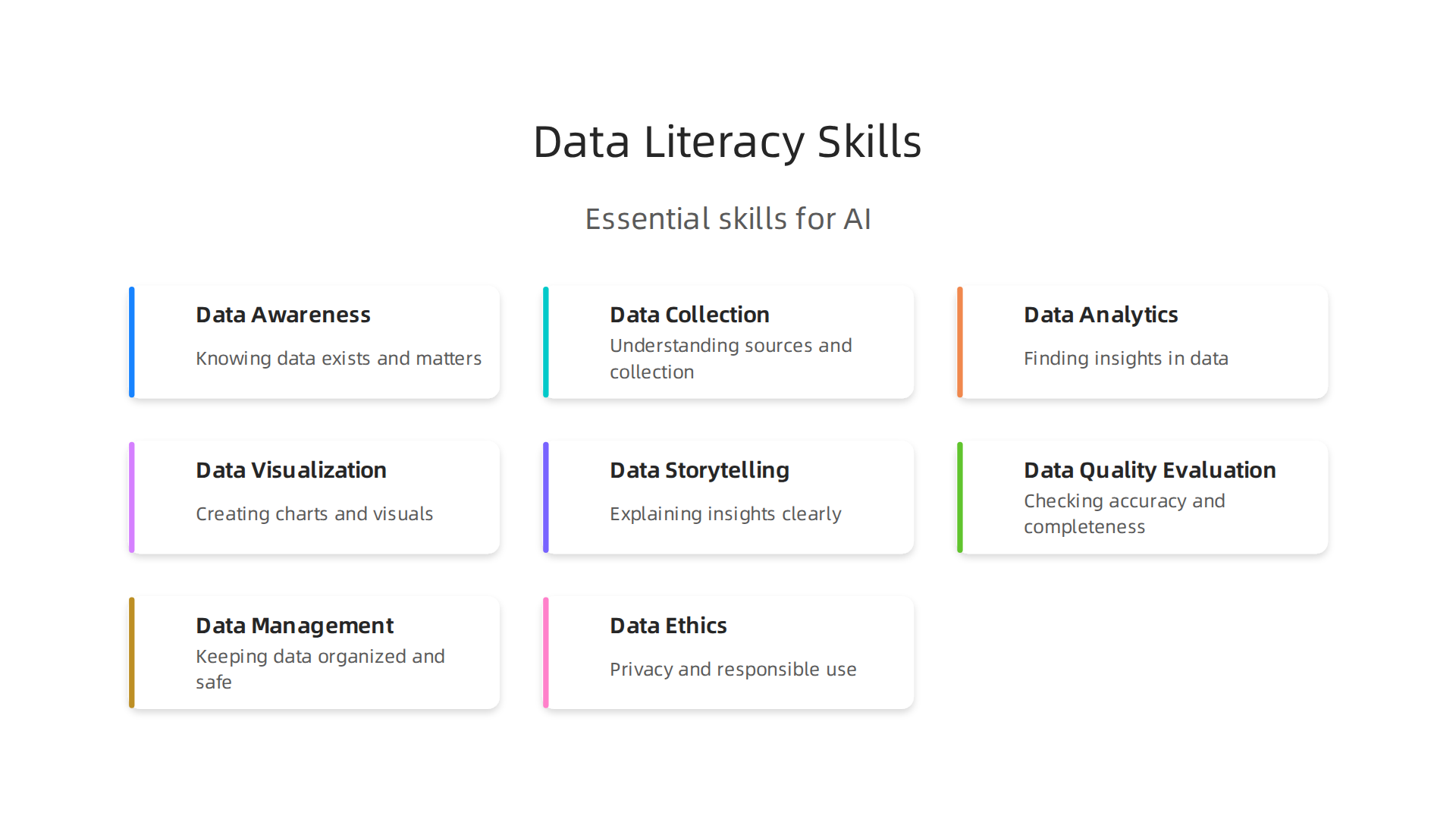
- Data Awareness: Knowing that data exists and why it’s important.
- Data Collection: Understanding where data comes from and how it’s gathered.
- Data Analytics: Being able to look at data to find what’s interesting or useful. If you want to learn more about this, you can check out What is data analytics.
- Data Visualization: Making pictures and charts from data so it’s easy to see and understand.
- Data Storytelling: Explaining what the data means in a clear and interesting way.
- Data Quality Evaluation: Checking if the data is accurate and complete.
- Data Management: Knowing how to keep data safe and organized.
- Data Ethics: Understanding what’s right and wrong when using data, especially about privacy.
These skills help people work with data in a helpful way University students’ self-assessment of data literacy.
Who does what with data in a company?
Different jobs in a company need different levels of data literacy. Here are some examples:
- Data Stewards: These are like the guardians of the data. They make sure data is correct, clean, and follows all the rules. Their data literacy means knowing the rules for data quality and usage.
- Data Engineers: These folks build and take care of the systems that collect, store, and move data. They need to be very good at making sure data flows smoothly and is ready to be used by others.
- Data Analysts: They dig into the data to find answers to questions and discover new insights. They often create reports and dashboards. For them, data literacy is about deep thinking with numbers and patterns. Learning to succeed as a data analyst means mastering these skills.
- Product Owners: They decide what new features or products a company should build. They use data to understand what customers want and how products are performing. Their data literacy helps them make smart choices about what to create next.
Everyone in a company, from the boss to the newest team member, can benefit from being more data literate. It helps teams work together better and make sure AI tools are built on a strong understanding of information.
Data literacy is more than just understanding data; it also means knowing how good that data is and how it’s handled. In 2026, as companies lean more on AI tools, it’s super important to make sure the data feeding these tools is top-notch. Bad data can lead to bad decisions, even with the smartest AI.
Why data quality is so important
Think of data like ingredients for cooking. If your ingredients are old or spoiled, your meal won’t taste good, no matter how good the chef is. The same goes for data and AI. For any AI system to work well, its training data needs to be high quality. This means checking for a few key things:
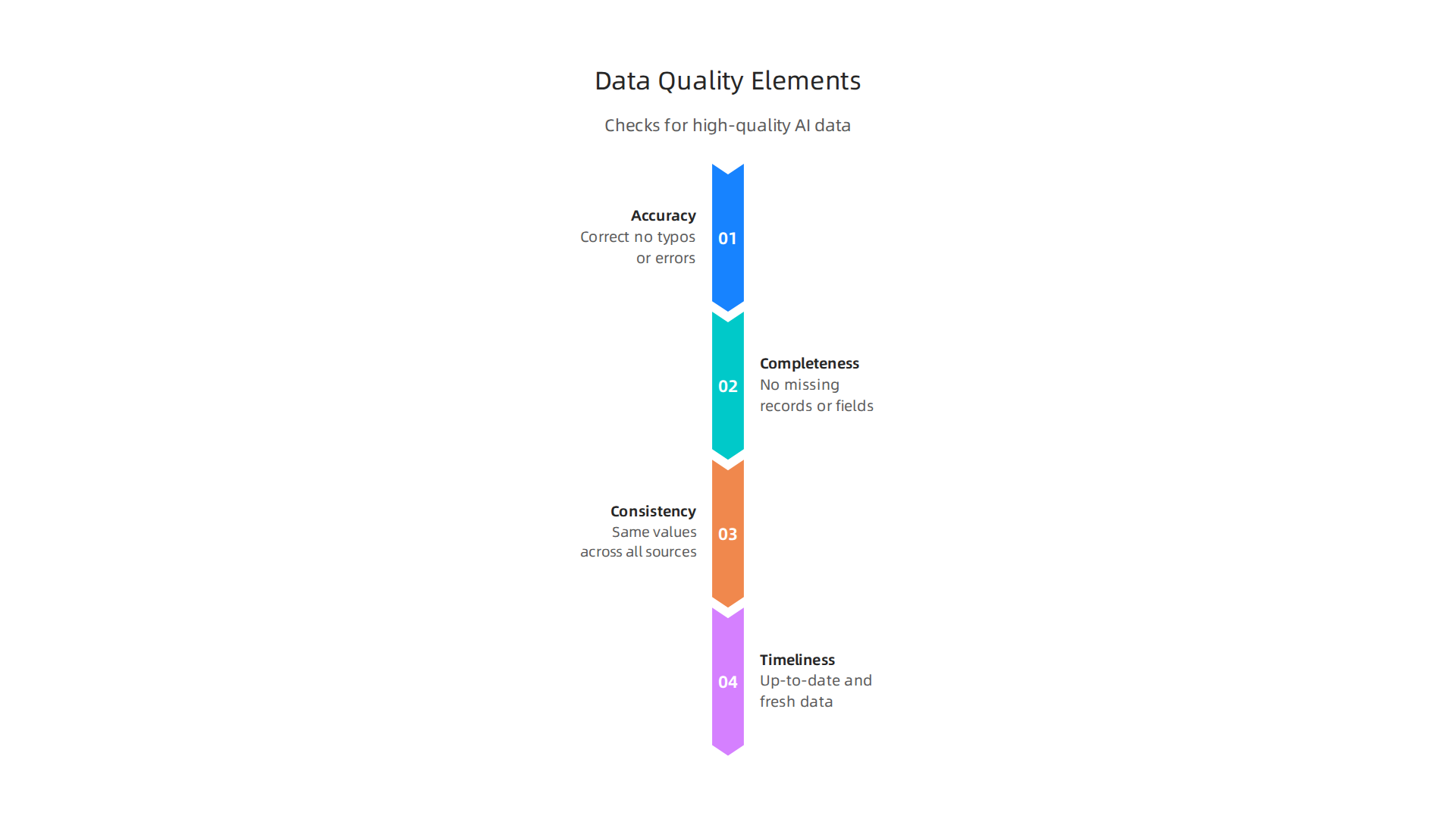
- Accuracy: Is the data correct? Are there typos or wrong numbers?
- Completeness: Is all the data there? Are there missing pieces of information?
- Consistency: Is the data the same everywhere it appears? For example, if a customer’s name is spelled differently in two places, that’s a consistency problem.
- Timeliness: Is the data fresh and up-to-date? Old data might not show what’s happening now.
When data has these qualities, AI models can learn better and give more reliable results. Poor data quality can cause AI to make mistakes, leading to wrong business choices or unfair outcomes.
Data lineage: knowing where your data comes from
Imagine you’re tracing your family tree. Data lineage is a bit like that for data. It’s about knowing where every piece of data started, how it moved through different computer systems, what changes were made to it, and where it ended up being used Data Lineage: The Foundation of Enterprise Data Infrastructure (2026 …).
Why is this important for data literacy?
- Trust: If you can see the full journey of your data, you can trust it more. You know it hasn’t been changed in a bad way.
- Fixing problems: If an AI model makes a mistake, knowing the data’s lineage helps you find out exactly which step in its journey caused the problem.
- Following rules: Many new rules, like the EU AI Act in 2026, require companies to show where their data comes from and how it was processed. Data lineage helps meet these needs.
This tracking helps everyone, from data scientists to regular business users, understand and trust the information they work with.
Data governance: setting the rules for data
Data governance is all about setting up rules and ways of working to manage data well. It makes sure data is secure, private, correct, and useful from when it’s first collected until it’s no longer needed Enterprise Data Governance 2026: A Strategic Priorities Guide for CDOs. It’s like having a clear instruction manual for how data should be used and protected.
Modern data governance is not a one-time thing. It’s a continuous process that works hand-in-hand with how data engineers build and handle data every day What Modern Data Governance Actually Looks Like in 2026. This is especially important in 2026 because of new laws like the EU AI Act, which means companies need to be very careful about the quality and handling of data used for high-risk AI systems EU AI Act Data Governance: 2026 Compliance Guide.
Good data governance means:
- Clear rules: Everyone knows their job when it comes to data. Who owns it? Who can use it?
- Better quality: It helps make sure data stays accurate, complete, and consistent.
- Safety and privacy: It protects sensitive information and makes sure company follows privacy laws.
- Auditing: It makes it easier to check if all the rules are being followed.
By putting these practices in place, companies ensure their data is a valuable asset, not a source of problems. This also boosts overall data literacy, as everyone becomes more aware of how crucial good data management is. If you’re looking to understand how leaders are tackling these challenges, check out The Leaders Playbook for AI Governance in 2026.
Staying informed about these topics is key for anyone involved with AI and data. For more clear daily AI updates and to keep up with the fast-moving world of artificial intelligence, get The AI Newsletter Worth Reading.
Making sure data is good is one step, but actually setting up the systems to handle that data is another big part of data literacy. For AI to really shine, you need strong data pipelines.

These are like the highways and processing plants for your data, making sure it gets to the AI models correctly and quickly. In 2026, building these systems right is more important than ever.
How Data Moves: Key AI Pipeline Patterns
Think about how data flows through a company that uses AI. It’s not just stored in one place. Instead, it moves through different steps, each with a special job.
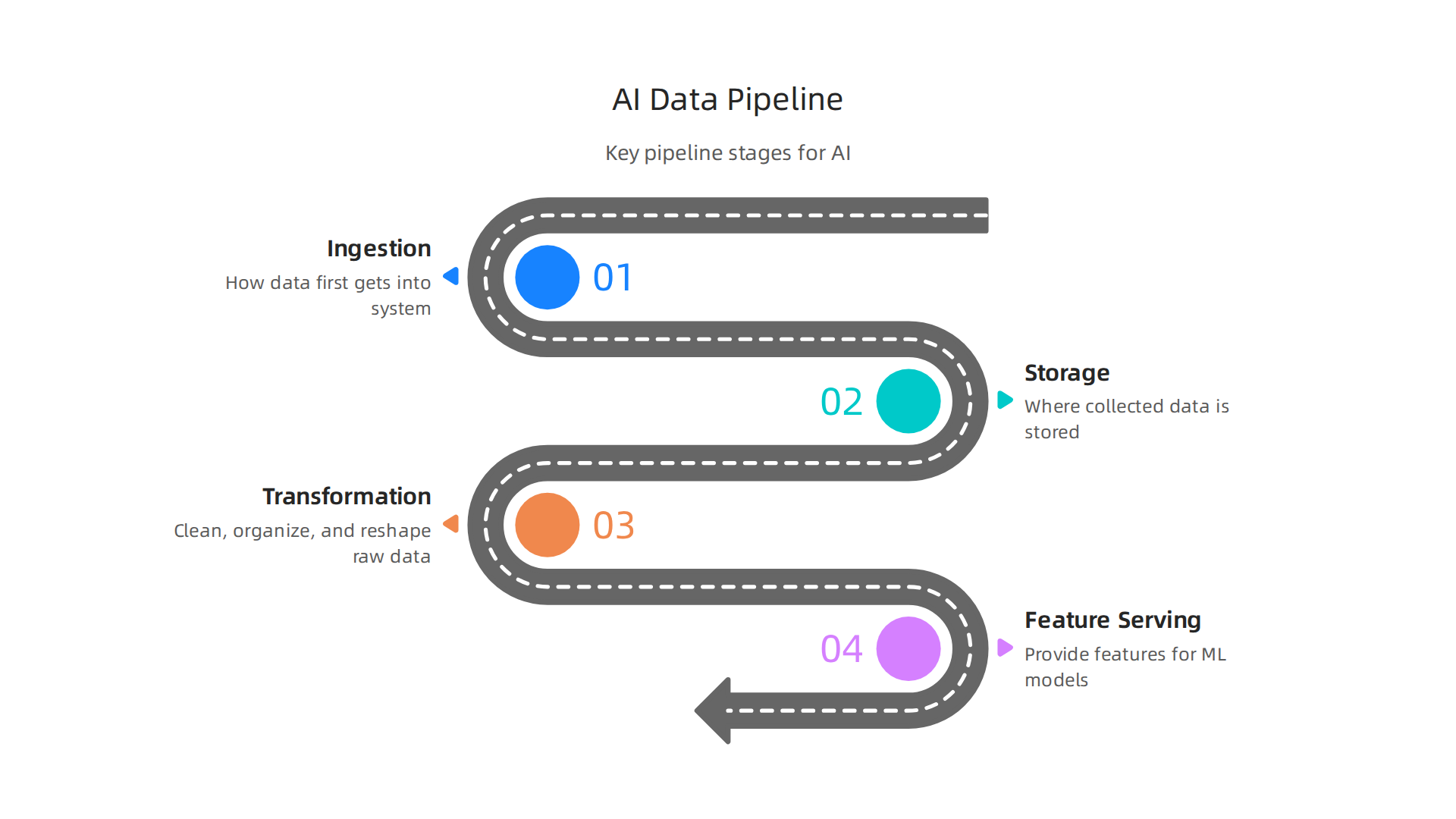
- Ingestion: This is how data first gets into the system. It can come from many places, like websites, apps, or other business tools. The goal is to collect this data and bring it into your main storage areas.
- Storage: Once data is collected, it needs a home. This could be a "data lake" for all kinds of raw data, or a "data warehouse" like a Snowflake data warehouse for more organized, clean data ready for analysis.
The type of storage depends on how the data will be used.
3. Transformation: Raw data is often messy. This step cleans, organizes, and reshapes the data to make it useful for AI models. It’s like taking raw vegetables and cutting them up, cooking them, and seasoning them for a recipe. This is where features for machine learning models are often created.
4. Feature Serving: This is a special part for AI. Machine learning models need specific pieces of data, called "features," to make predictions. A "feature store" is a place where these ready-to-use features are kept and delivered to AI models when they need them. It acts as a bridge between the people who prepare the data and the people who build the AI models Main Tools In 2026.
These steps make sure that the data AI uses is not only good quality but also easy to access and always ready.
Choosing the Right Tools and Methods
When building these data pipelines for AI, companies often face choices. It’s like deciding if you want to take a fast, direct road or a slower, scenic one, depending on where you’re going.
- Batch vs. Streaming Data:
- Batch processing is like collecting a big pile of data over time and then processing it all at once. This works well for things that don’t need instant updates, like monthly reports or training an AI model overnight.
- Streaming data is about processing data as it comes in, in real-time. This is crucial for things that need immediate action, like stopping fraud as it happens or giving instant recommendations on a website. Choosing between these depends on how quickly your AI needs to react.
- Feature Stores: These have become super important in 2026 for AI teams. A feature store does a few key things:
- It helps different AI models use the exact same features, making everything consistent.
- It ensures that when you train an AI model, the features it sees are the same ones it will get when it’s actually making predictions in the real world Feature Stores in 2026: Online + Offline Architecture ….
- It helps serve features very quickly for real-time AI applications, with targets often less than 10 milliseconds How to Build Feature Stores for Production ML Systems 2026.
- By having a central place for features, data scientists and engineers can work better together, speeding up how fast new AI ideas go from testing to actual use. To learn more about how machine learning works with data, check out Mastering Practical Machine Learning for Data Science in 2026.
- Observability Tools: These are like dashboard lights in your car. They help you see what’s happening inside your data pipelines and AI systems.
- They monitor if data is flowing correctly.
- They check if the data quality is still high.
- They alert you if an AI model starts acting strangely.
Having good observability means you can quickly find and fix problems, which is key for keeping your AI reliable.
Understanding these building blocks and choices is a big part of being data literate in today’s AI-driven world. It helps everyone, from the tech team to business leaders, make smarter decisions about how to use AI effectively. You can also explore how these trends affect business analytics in our guide to AI Data Analytics 2026 Trends That Deliver Real Results.
Understanding these building blocks and choices is a big part of being data literate in today’s AI-driven world. It helps everyone, from the tech team to business leaders, make smarter decisions about how to use AI effectively.
Labeling, Annotation Quality, and Human-in-the-Loop Processes
For AI models to truly learn and be helpful, they need to be fed a lot of examples. But these examples aren’t just raw data. They need to be "labeled" or "annotated" first. Think of it like teaching a child: you show them a picture of a cat and tell them, "This is a cat." Data labeling is the same idea. Humans look at data like images, text, or sounds and add tags or descriptions that tell the AI what it’s looking at. This labeled data is the foundation for training AI models. In 2026, making sure this labeling is done well is super important for AI success.
Making Sure Labels Are Good
Creating good labeled data isn’t as simple as it sounds. It needs careful planning to ensure the AI learns the right things.
- Designing Annotation Tasks: First, you need clear instructions for the people doing the labeling. These instructions are like a recipe. They tell the "annotators" exactly how to label different types of data. Clear, versioned guidelines are key to getting good results.
- Setting Quality Controls: Just like any important process, data labeling needs checks to make sure the quality stays high. Here are some ways companies do this:
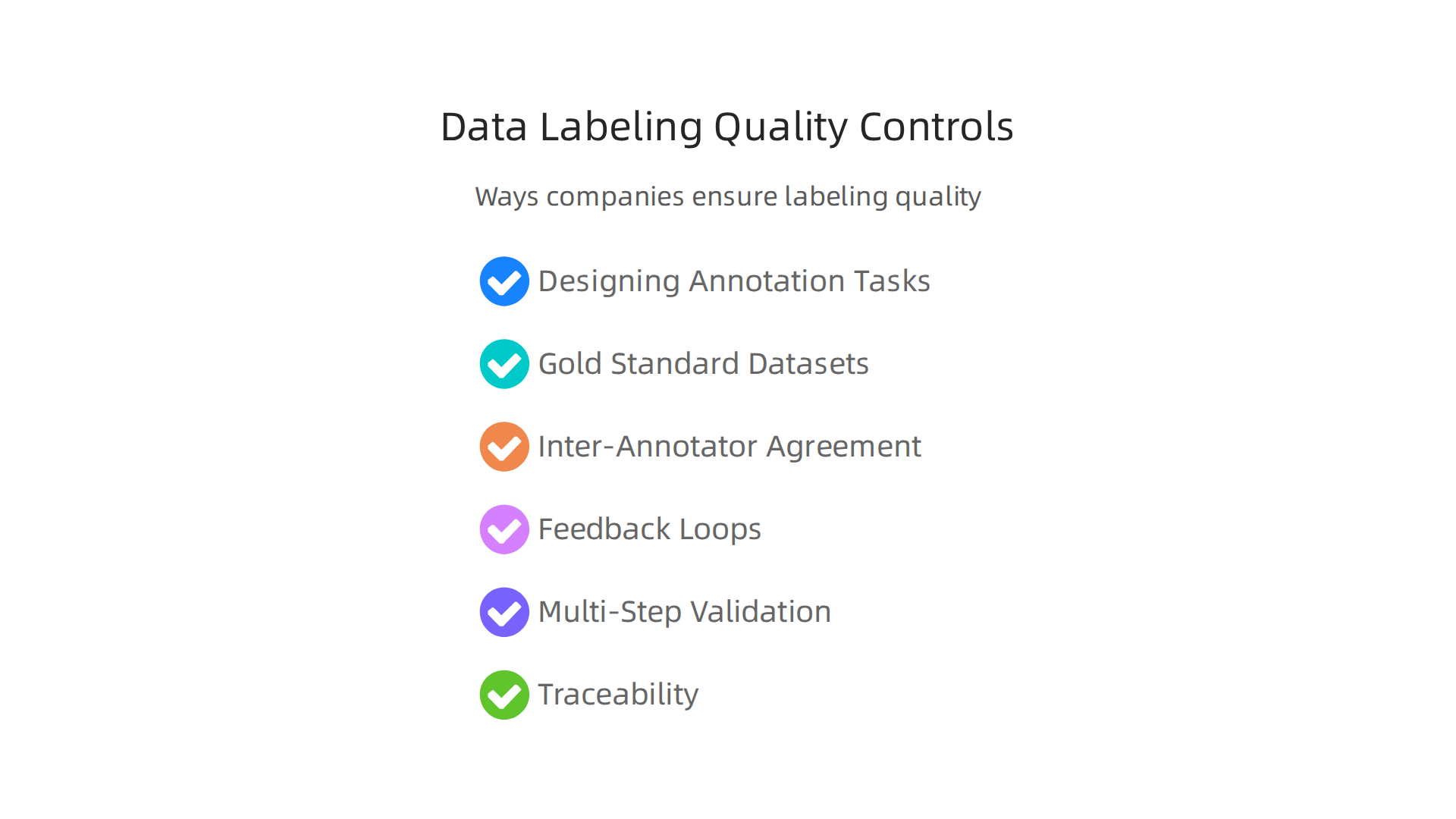
*   **Gold Standard Datasets**: This involves mixing in some data points that are already perfectly labeled by experts. If a new annotator labels these "gold standard" examples correctly, you know they're doing a good job.
*   **Inter-Annotator Agreement (IAA)**: This means having more than one person label the same piece of data independently. Then, you compare their labels. If everyone agrees, it's probably a good label. If they disagree, it shows there might be unclear instructions or a problem with understanding. Experts suggest that if IAA drops too low, it's a sign that the labeling guidelines might be broken and need fixing [Scaling Data Labeling in 2026](https://www.linkedin.com/pulse/quality-scale-hidden-mechanics-high-volume-data-labeling-olga-kokhan-q3d9f).
*   **Feedback Loops**: Giving annotators regular feedback helps them learn and improve. This can involve reviewers checking their work and pointing out areas for improvement.
*   **Multi-Step Validation**: High-quality data often goes through several review steps, not just one. This multi-layer quality assurance helps catch errors before they mess up the AI model [The Best Data Labeling Services in 2026](https://kili-technology.com/blog/the-best-data-labeling-services-in-2026-reviewed).
*   **Traceability**: It's helpful to know who labeled what, when, and following which guidelines. This helps track quality and find problems if they arise [2026 Data Labeling Guide for Enterprises](https://kili-technology.com/blog/2026-data-labeling-guide-for-enterrises-build-high-performing-ai-with-expert-data).
All these steps help build scalable labeling processes, meaning you can label more data without losing quality. This is a core part of developing high-performing AI.
Who Does the Labeling? Workforce Models
Companies have different ways to get their data labeled, depending on their needs, budget, and how sensitive the data is.
- In-house Teams: Some companies use their own employees to label data. This gives them a lot of control over quality and data security. It’s often used for very sensitive or complex data.
- Vendor-Managed Teams: Many companies hire outside companies that specialize in data labeling. These "vendors" have trained teams and tools to handle large amounts of data. This can be more cost-effective and faster, especially for big projects. When choosing a vendor, look for ones that use strong quality control methods like gold standard testing and consensus scoring The Changing Landscape of AI Data Labeling Hiring (2026).
- Hybrid Approaches: Some companies use a mix of both. They might label sensitive data in-house and outsource less sensitive or routine tasks to vendors.
No matter which model is used, having strong quality assurance (QA) mechanisms in place is critical. This means monitoring annotators, checking for biases, and making sure all labels meet the project’s standards Validate the quality of human and generated …. It’s all about making sure the primary source of artificial intelligence, which is the data, is as good as it can be.
The ability to manage and ensure the quality of labeled data is a key aspect of data literacy. It shows an understanding of how data directly impacts the intelligence and fairness of AI systems. To keep up with all the fast changes in AI, getting reliable, daily updates is super helpful.
Get clear daily AI updates from The AI Newsletter Worth Reading.
The ability to manage and ensure the quality of labeled data is a key aspect of data literacy. It shows an understanding of how data directly impacts the intelligence and fairness of AI systems. But beyond just making sure the data is good, we also have to keep it safe and private. This is where privacy, security, and compliance come into play for AI datasets.
Practical Controls for AI Datasets
For AI to work well and be trusted, the data it uses must be protected. This is true for any organization using AI in 2026. Here are simple steps to keep your AI data safe:
- Data Minimization: This means only collecting and keeping the data you absolutely need. If you don’t need someone’s name for your AI model, then don’t collect it. This helps reduce risks right from the start Privacy-Preserving Machine Learning: How to Collect Training Data in 2026.
- Anonymization: This is like taking out all the personal bits from the data so no one can tell who it belongs to. This way, the AI can still learn from patterns without knowing private details about individuals.
- Access Controls: Only certain people should be able to see or use sensitive data. This is like having a special key for important files. Your team needs to know who can access what, and why.
- Secure Storage: All your data needs to be stored in very safe places, both physically and digitally. This helps protect it from bad actors or mistakes. This is especially important for machine learning (ML) projects where large amounts of data are used.
Keeping Up with Rules and Regulations
The world of AI is always changing, and so are the rules about data. Being good at data literacy means understanding these rules and making sure your AI systems follow them.

- Evolving Regulatory Frameworks: Governments all over the world are making new rules for data privacy. Big ones include GDPR in Europe and CCPA/CPRA in California. These rules often ask for clear reasons to collect data, ways for people to say no to data use, and ways to ask for their data back or to be deleted Data Privacy Regulations in 2026: A Global Overview. There are many new state laws in the US taking effect in 2026 that also add more rules for businesses 2026 Data Security and Privacy Compliance Checklist.
- Risk Assessments: Before you use an AI system, especially for important decisions, you often need to check it for risks. This means looking for things like bias in the data, privacy problems, or security weaknesses. Performing an AI risk assessment is a key step in 2026 to ensure systems are used responsibly AI Risk & Compliance in 2026: What Enterprises Must.
- Vendor Risk Management: Many companies work with other companies to get or process data. It’s super important to make sure these partners also follow all the privacy and security rules. You need to know their data practices too.
- Documentation and Legal Basis: Keeping good records of how you collect, use, and protect data is vital. You also need a clear legal reason for processing any personal data for your AI models Data Privacy Compliance Guide for Intelligent Systems 2026. This helps show that your company is being responsible.
Understanding how to keep AI data private and secure is a crucial part of data literacy. It helps build trust and makes sure AI systems are fair and safe for everyone. To learn more about how companies are tackling these challenges, check out The Leaders Playbook for AI Governance in 2026.
Measuring Impact and Scaling Data Practices Across Teams
Once your company has good data practices in place to keep AI data safe and private, the next big step is to know if these efforts are actually helping. You also need to figure out how to share these good ways of working across all your teams. This is where we talk about measuring success and making data literacy a company-wide skill.
How to Know if Your Data Work Is Making a Difference
To see if your data efforts are paying off, you need simple ways to track them. These are called metrics and key performance indicators (KPIs). Think of them as scorecards for your data work.
- For Data Quality: You can look at how few mistakes are in your data. Are there fewer missing pieces of information? Is the data more complete? Better quality data means your AI systems will likely work better.
- For Data Program Strength: You can track how many teams are following the new data rules. How quickly are problems with data fixed? A strong data program in 2026 means everyone knows their role in handling data correctly. Companies often set up clear roles like "Data Owners" who are in charge of certain data sets and "Data Stewards" who help keep the data clean and accurate Data Governance Best Practices for 2026.
- For AI Model Performance: The main goal is to make your AI models smarter and more helpful. If your data quality goes up, your AI should make better predictions or choices. You can measure this by seeing if the AI makes fewer errors or gives more useful results.
Another important tool for tracking data is called data lineage. This is like a complete map that shows where every piece of data comes from, how it moves through different systems, and what changes happen to it along the way Data Lineage: The Foundation of Enterprise Data Infrastructure (2026). Knowing this path helps you fix problems faster and ensures your data is reliable. Many companies are also using "feature stores" as central places to keep ready-to-use data for their AI models, ensuring consistency and quality How to Build Feature Stores for Production ML Systems 2026.
Making Good Data Practices Grow Across Your Company
For data to truly help your business, everyone needs to be on board. It’s not just about one team knowing how to handle data well.
- Create Simple Playbooks: These are like step-by-step guides for different teams on how to collect, use, and protect data. They make it easy for everyone to follow the best practices without having to guess. These guidelines help companies build a strong data governance framework, which is like a blueprint for how all data should be managed Data governance framework explained: a 2026 guide.
- Offer Training on Data Literacy: This means teaching everyone in the company what data literacy is and why it matters. It helps people understand data better and use it wisely. Training can cover everything from understanding basic data analytics to how data impacts AI. To learn more about how data analytics works, you can check out What is Data Analytics: A Clear Guide to Understanding and Using Data in 2026.
- Give Reasons to Care: Sometimes, people need a little extra push to change how they work. This could mean giving rewards or recognition to teams that show excellent data practices. When everyone sees the benefits and is encouraged, it helps these good habits spread naturally.
By measuring the impact of your data practices and making it easy for all teams to adopt them, your company can build a stronger foundation for using AI responsibly and effectively. This means better decisions, safer data, and more successful AI projects in 2026 and beyond.
Get clear daily AI updates from The AI Newsletter Worth Reading.
Summary
This article explains why strong data foundations and widespread data literacy are essential for AI leaders in 2026. It defines data literacy and the core competencies technical and non-technical teams need, outlines who in an organization owns which data responsibilities, and shows how data quality, lineage, and governance underpin trustworthy AI. The guide covers practical pipeline patterns (ingestion, storage, transformation, feature serving), tooling choices like feature stores and observability, and workforce models for labeling and annotation with quality controls. It also explains privacy, security, and compliance actions—especially relevant under rules such as the EU AI Act—and how to pick metrics to measure success. Finally, it offers steps to scale best practices across teams through playbooks, training, and clear roles so leaders can build reliable, compliant, and performant AI systems.