
Why overfitting data is the silent risk in every ML project (and what this guide will do for you)
Imagine you’re teaching a student to recognize different animals. You show them pictures of cats and dogs over and over again. The student gets very good at telling those specific cats and dogs apart. But then, when you show them a brand-new picture of a different cat or dog they’ve never seen, they get confused.

This is a lot like what happens when a machine learning model faces the problem of overfitting data.
In simple words, overfitting data means your AI model learns the training examples too well. It memorizes every little detail and noise in the practice data instead of truly understanding the main ideas or patterns. This makes the model look really good on the data it was trained with. But here’s the trick: when you use that model with new, real-world data it hasn’t seen before, it often makes many mistakes. It fails to generalize what it learned, as experts explain in resources like the Overfitting in Machine Learning Explained from AWS and Google for Developers on Overfitting.
This problem is very common in how we build AI systems today. Modern machine learning projects rely a lot on vast amounts of data. The way we go about learning from data can lead to models that are too complex for the task at hand. This issue often comes up when we do things like data mining or when working with human-made inputs, such as in data annotation AI.
So, why should you care about overfitting data? The risks are big for anyone building or using AI products.
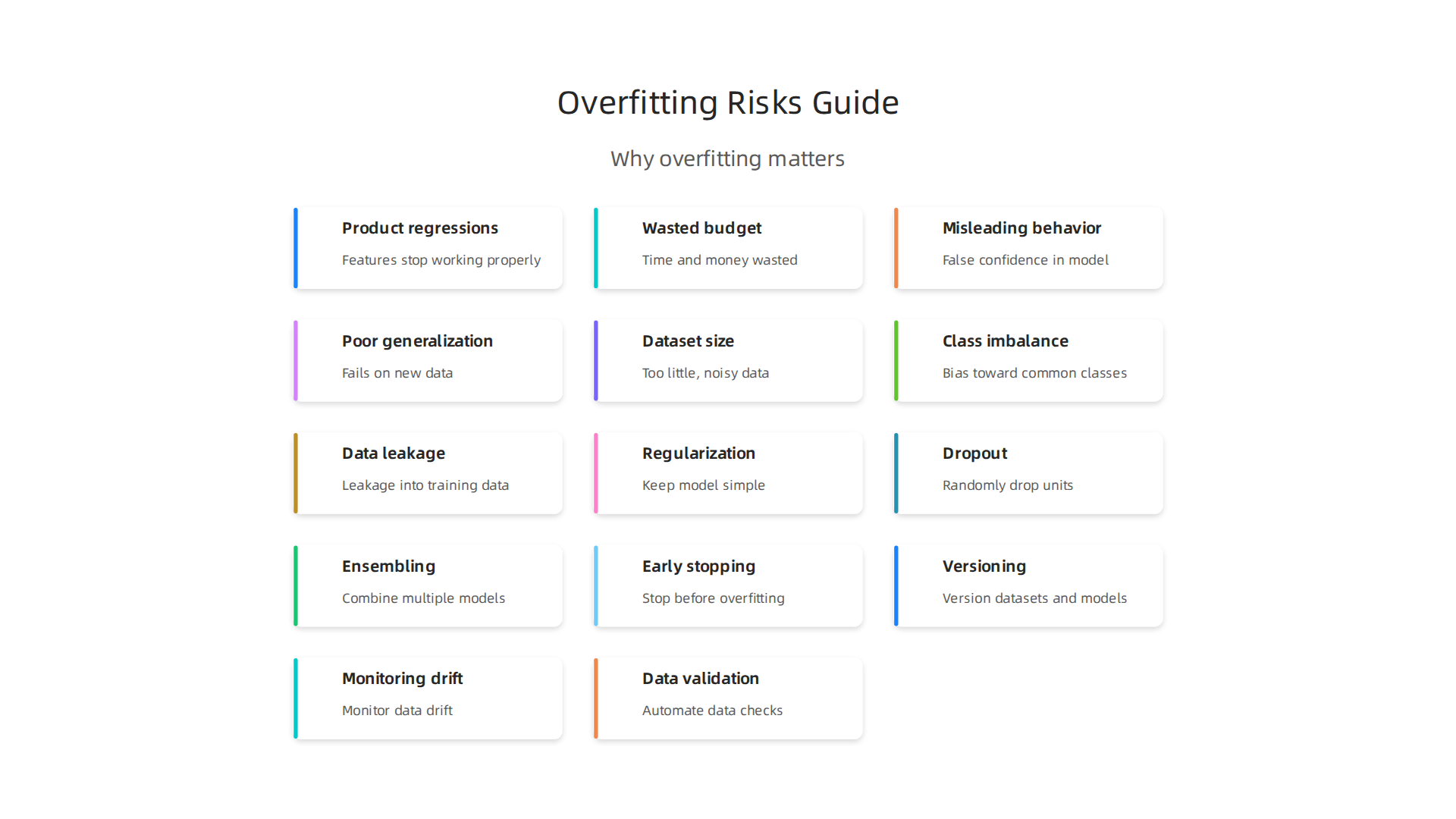
- Product regressions: Your AI-powered features might stop working as well, leading to unhappy users.
- Wasted labeling budget: If your model can’t use new data well, all the money and effort spent on collecting and labeling data is partly wasted.
- Misleading model behavior: A model that overfits can give you false confidence in its abilities. It looks smart in tests but falls apart in the real world.
- Poor generalization to production: This means your model won’t work reliably when it’s out in the wild, solving actual problems for real people.
This guide will walk you through understanding this silent risk and show you how to build stronger, more reliable AI models. We’ll cover ways to spot overfitting and steps you can take to make sure your AI learns wisely, not just memorizes.
Want to keep up with the fast-moving world of AI and make sure you’re always informed?
You can get clear daily AI updates from The AI Newsletter Worth Reading.

Now, let’s look at why overfitting data happens. Often, the problem starts with the data itself. There are three big data causes that can make your AI model learn too much from its training examples and struggle with new information.
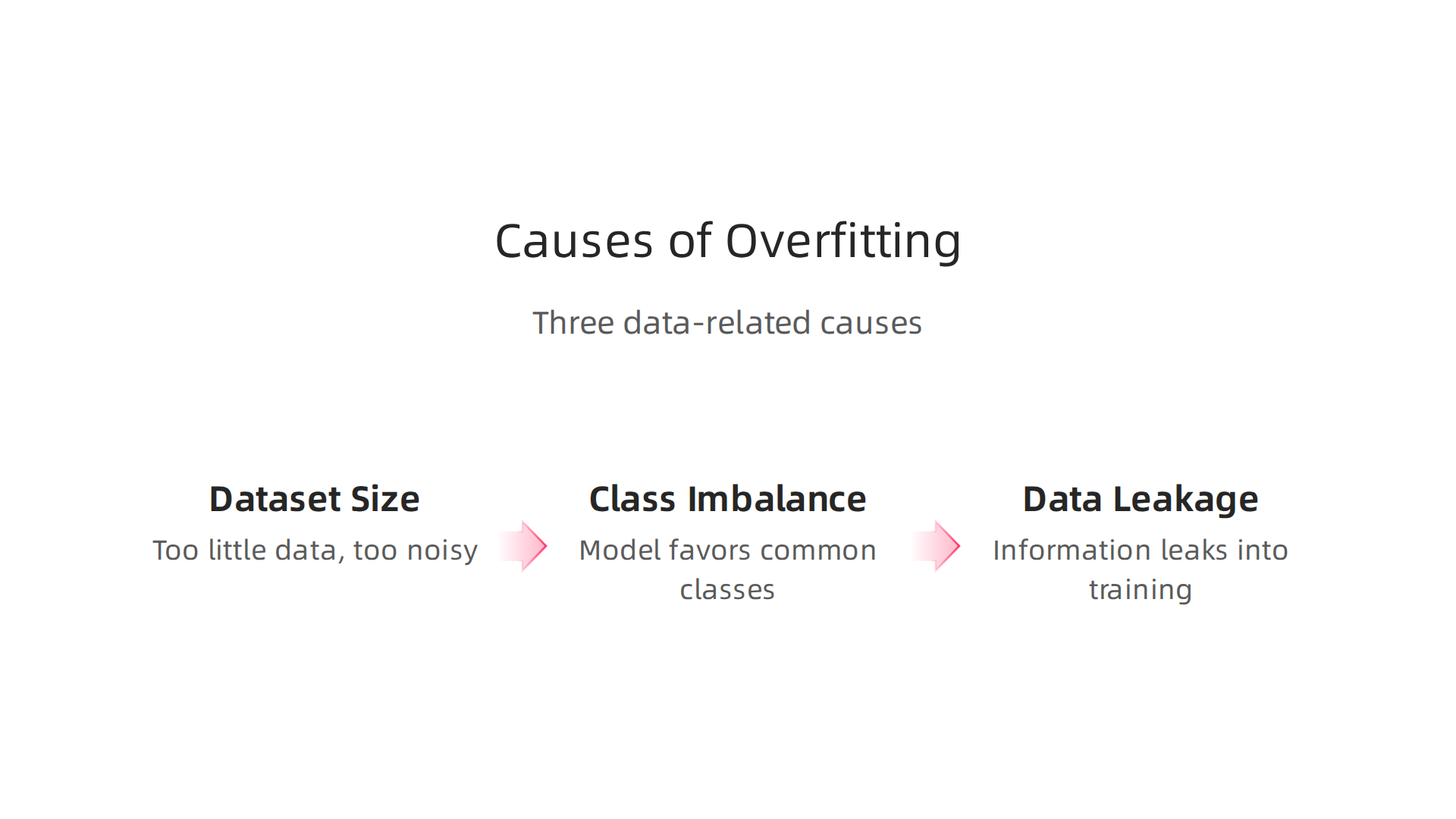
These are the size of your dataset, if your data is unbalanced, and if there’s data leakage.
Dataset Size: Too Little Data, Too Much Noise
Think back to teaching our student about animals. If you only show them two pictures of cats and two pictures of dogs, they might learn the tiny details of those four pictures rather than what makes a cat a cat or a dog a dog. This is what happens with AI models when they have a small dataset. They end up memorizing the "noise" or random quirks in that small batch of data instead of finding the real, important patterns that help them learn from data generally.
Another issue related to dataset size is having a "long-tailed distribution." This means you have a lot of examples for some things, but very few for others. For instance, if your AI is learning about rare diseases, you might have many examples of common colds but only a handful of examples for a very specific illness. When there are too few examples of certain types, the model can’t truly learn about them and might just memorize the few examples it has, as experts explain about models fitting too closely to training data, including noise, in sources like What is Overfitting in Deep Learning [+10 Ways to Avoid It]. This makes the model bad at seeing new, rare cases in the real world.
Class Imbalance and Unfair Splits
Imagine teaching your animal student again, but this time you show them 99 pictures of cats and only 1 picture of a dog. The student will get very good at identifying cats, but they’ll likely fail badly when they see a new dog. This is called "class imbalance." The model focuses mostly on the common "class" (cats) and ignores the rare one (dogs). This leads to overfitting data because the model appears to be accurate, but only for the most common items.
This problem gets worse if you don’t divide your data fairly into training and testing sets. If all the dog pictures accidentally end up in the training set and none in the testing set, the model will seem perfect on "dogs" during training. But it hasn’t truly learned anything useful. This is why using properly "stratified splits" is important. It means making sure each part of your data (training, testing) has a good mix of all types of examples, preventing your model from becoming too specialized in one area. This ensures the training data is not "unrepresentative," which is a common cause of overfitting, according to [How to Avoid Overfitting in Machine Learning](https://www.geeksfor Geeks.org/machine-learning/how-to-avoid-overfitting-in-machine-learning/).
Data Leakage: Cheating Without Knowing It
Data leakage is like accidentally giving the student the answers to the test before they even start. It happens when information that should only be in your "test" data (data the model hasn’t seen yet) somehow sneaks into your "training" data (data the model learns from). When this happens, the model uses this secret peek at the answers to perform very well on the test data. But it’s not because it truly learned the patterns; it just "cheated."
This makes your model look much better than it actually is. When you try to use it with truly new, unseen data in the real world, it will fail. Data leakage can happen in many ways, like when you do data mining and don’t properly separate information, or during data annotation AI if human annotators unknowingly include hints from the future. This leads to an overfitted model that fails to work on future observations reliably, as explained by Overfitting – Wikipedia. Being careful about how you collect and prepare your data is key to avoiding this sneaky cause of overfitting data.
So, besides the data itself, how we build and teach our AI models also plays a big role in whether they suffer from overfitting data.

Sometimes, the problem comes from models being too complex, training them for too long, or even trying to make the data bigger in the wrong way.
Overly Complex Models
Imagine you give a student a super fancy drawing kit with hundreds of different colored pencils and brushes, and then ask them to draw a simple apple. They might get so caught up in using every single tool to draw every tiny spot and shade that they make the apple look too detailed. This drawing would be amazing for that specific apple, but if you ask them to draw a different apple, it might look wrong because they memorized the first one, not what makes an apple generally an apple.
This is what happens with "over-parameterized models" in AI. These are models with many layers and connections, like our student’s big drawing kit. They have a huge number of "knobs" or settings to adjust. This makes them very flexible, but they can get too focused on the specific training data they see. Instead of truly [learning from data] to find general rules, they end up memorizing the training examples, including any little quirks or "noise" in that data. This means they perform poorly when faced with new, unseen information. Choosing the right kind of model is crucial, especially for specific tasks. For instance, you might want to select the best AI model for code optimize your 2026 workflow to avoid this issue in programming tasks.
Long Training Schedules
Think back to our student studying for a test. They might learn a lot at first. But if they keep studying for days and weeks after they’ve understood everything, they might start memorizing tiny details from the textbook, like the page number a specific fact is on, instead of the fact itself.
AI models can do the same. If you let them train for too many "epochs" or rounds, past the point where they’ve learned the main patterns, they start picking up on the irrelevant noise in the training data. This is often called "early stopping" when you try to prevent this. Continuing to train an already well-performing model usually leads to it becoming too specific, causing overfitting data. The model appears to perform perfectly on its practice data, but it fails badly when given new information.
Aggressive Augmentation Strategies
To get more training data, people often use "data augmentation." This means making small, artificial changes to existing data, like rotating pictures a little bit, flipping them, or changing their brightness. While this can be very helpful, doing it too much or in the wrong way can confuse the model.
If the changes are too aggressive or random, the model might try to learn the specific augmented versions instead of the true features of the original data. It’s like teaching the student that a dog is still a dog even when its head is upside down and blue. While some changes are fine, too many strange changes mean the model is still trying to perfectly fit the weird, altered training data, leading to overfitting data because it doesn’t learn general features for real-world use.
Optimization Settings and Generalization
When an AI model learns, it makes many small adjustments to its internal settings. How big these adjustments are is controlled by something called the "learning rate." Also, how many examples the model looks at before making an adjustment is called the "batch size." These settings might seem small, but they really change how well the model truly understands things versus just memorizing.
If the settings for learning rate or batch size are not chosen carefully, the model might take huge, sloppy steps in its learning, or tiny, slow steps. This can stop it from truly [learning from data] in a broad way, making it instead focus too much on the specific training answers. This affects its ability to generalize to new information, meaning it won’t perform well on data it hasn’t seen before. Researchers continue to study how these settings, along with other methods like regularization, improve how well AI models handle new data without overfitting.
Understanding these factors related to model building and training is key to avoiding overfitting data. It helps us build AI that can truly learn and adapt, not just parrot back what it’s already seen. To stay informed on how to build and manage smarter AI, make sure you get The AI Newsletter Worth Reading.
While fine-tuning AI models and their settings is important, how we manage and prepare our data is just as crucial for stopping overfitting data. The right strategies for your data can make a big difference, helping your AI truly learn instead of just memorizing.
Smart Data Augmentation and Synthetic Data
We talked before about not being too aggressive with data augmentation. The trick is to make small, useful changes to your existing data. Think about adding a bit of noise or slightly shifting images, but only in ways that still make sense for the real world. This helps the model see more examples without confusing it.
Sometimes, you might not have enough real-world data. This is where "synthetic data" comes in. This is data that’s created artificially, often by another AI. It can be a big help when real data is scarce, like if you have fewer than 10,000 examples for tuning your model. It’s also useful when real data has private information that can’t be used directly, or when you need more examples of rare situations, called "edge cases" How do you use synthetic data generation for AI training and.
However, synthetic data must be used carefully. The best way to use it is to mix it with your real data, not replace it entirely Top 25+ Synthetic Data Use Cases. You should always start with a base of real information. It’s like adding new practice problems to a textbook; you don’t throw out the original book. You also need to check how well your synthetic data performs against real data to make sure it’s actually helping the model learn, not leading to more overfitting data Evaluating Synthetic Data’s Effectiveness. Making sure your data annotation tech legitimacy checklist is in order can also help keep your data quality high, whether it’s real or synthetic.
Robust Data Splits and Detecting Leakage
Another key step is how you split your data for training, testing, and checking. You usually divide your data into three parts:
- Training data: What the model learns from.
- Validation data: Used to fine-tune the model during training.
- Test data: Used only at the very end to see how well the model works on completely new information.
The test data must be truly "unseen" by the model during its learning process. If any part of the test data accidentally slips into the training or validation sets, it’s called "data leakage." This is like giving a student the actual test questions to study from. The model will look like it’s doing great, but it’s only because it’s already "seen" the answers. This makes it impossible to know if it’s truly learning from data or just memorizing.
To prevent this, experts often use "cross-validation." This method splits your data into several groups, or "folds." The model then trains on some of these folds and tests on others, rotating through them. This way, every piece of data gets to be part of the test set at some point, helping to catch overfitting data early on Cross Validation in Machine Learning. Techniques like "nested cross-validation" can even further improve how well we check our models, especially with tricky datasets where data leakage might be a bigger problem Machine learning models and over-fitting considerations. Careful management of these data foundations is essential for strong AI. You can learn more about this by Mastering Data Foundations and Data Literacy for AI Leadership.
Beyond getting your data ready and splitting it correctly, we can also teach the AI itself to be more careful. This means using special rules and methods within the AI’s learning process to stop it from just memorizing the training examples. These methods help the AI get better at true learning from data and avoid overfitting data.
Algorithmic defenses: regularization, ensembling, and early stopping
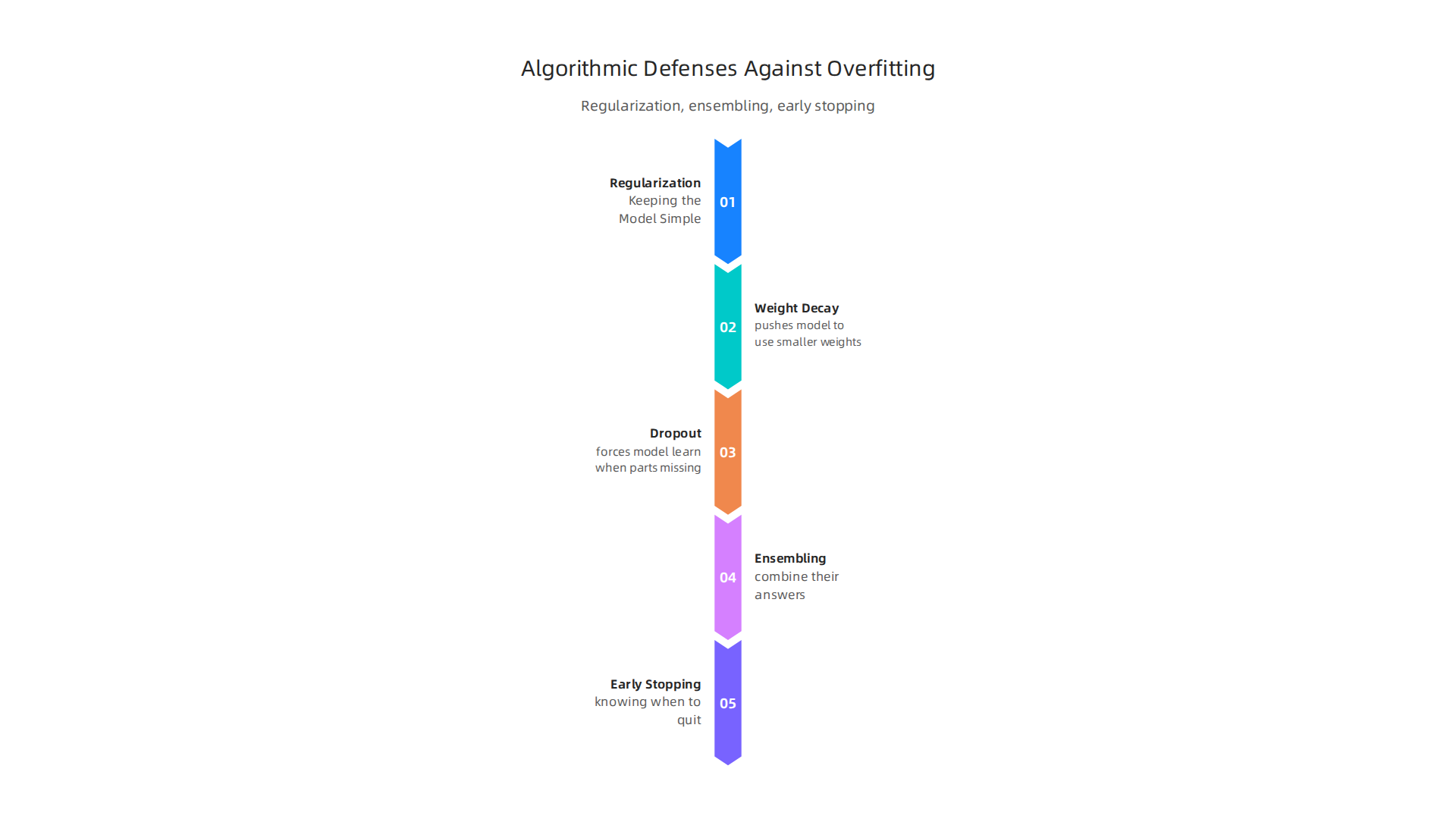
When an AI model is learning, it can sometimes get too focused on the training data. This is called overfitting data. To stop this, we use things like regularization, ensembling, and early stopping.
Regularization: Keeping the Model Simple
Think of regularization as a way to keep your AI model from becoming too complicated. A complex model might remember every tiny detail of the training data, even the noise, which makes it bad at handling new, unseen data. Regularization adds a "penalty" for being too complex. It makes the model try to find simpler patterns instead of memorizing everything. This helps the model generalize better to new information What Is Regularization in Machine Learning? (2026).
There are a few popular ways to do this:
- Weight Decay: This method gently pushes the model to use smaller "weights" or importance for its connections. Smaller weights usually mean a simpler model. This helps make sure the model does not become too specific to the training set.
- Dropout: Imagine if, during training, some parts of the AI model were randomly turned off for a moment. That’s what dropout does. It forces the model to learn to work well even when some of its "neurons" or connections are missing. This makes the model more robust and less likely to rely too much on any single path or feature, which reduces overfitting data Investigating the relationship between diversity and generalization in deep neural networks.
These types of regularization help the AI become more flexible and perform better on data it has not seen before Regularization in Machine Learning.
Ensembling: Many Models Are Better Than One
Another powerful trick is called ensembling. This means you train several different AI models to solve the same problem, and then you combine their answers. It’s like asking a group of experts for their opinions instead of just one. If one model makes a mistake, another model might get it right. By combining their strengths, the overall prediction becomes more reliable and less prone to overfitting data. Ensembling often improves how well the AI works on new data Findings of the Association for Computational Linguistics: ACL 2026. This method can be very effective, but it can sometimes take more computing power. Experts often look for ways to make ensembling more efficient, for example, by regularizing the way the models are combined Regularized Meta-Learning for Improved Generalization.
Early Stopping: Knowing When to Quit
Early stopping is a simple but clever way to prevent overfitting data. As an AI model trains, it usually gets better and better at its task. But at some point, it might start memorizing the training data instead of truly learning. When this happens, its performance on new, unseen data might actually get worse. Early stopping means we watch how the model performs on a separate "validation" set (data it hasn’t trained on). The moment its performance on this validation set stops getting better or starts to decline, we stop the training. This ensures we capture the model at its best, before it starts to overfit. This technique, along with others like weight decay, can be tuned together for even better results On Joint Regularization and Calibration in Deep Ensembles.
All these techniques help AI models learn in a smart way, making them much more useful in the real world.
Staying informed about the latest AI advancements is crucial. For daily updates on new AI models, research, and breakthroughs, consider subscribing to The AI Newsletter Worth Reading.
The previous sections talked about making AI models smarter during training. But what happens after an AI model is built and ready to be used in the real world? This is where MLOps comes in. MLOps stands for Machine Learning Operations. It’s about setting up good systems to keep AI models working well and avoid overfitting data even after they are deployed.
MLOps and tooling to prevent data-driven overfitting in production
To stop AI models from getting stuck on old information, we need smart ways to manage them.
Pipeline-level Practices to Keep Models Honest
Keeping Track of Everything: Versioning
Imagine building something important. You’d want to keep records of every change, right? MLOps does this for AI. It means keeping track of every version of your data, the AI model itself, and even the code used to build it. This way, if something goes wrong or the model starts showing signs of overfitting data, you can go back and see exactly what changed. Many teams use special tools to version datasets with DVC, lakeFS, or immutable paths and models.
Fair Tests: Reproducible Data Splits
When you train an AI model, you split your data into parts: one for training, one for testing. It’s super important that these splits are done the same way every time. If you don’t, your tests might not be fair, and you won’t truly know how well your model will act on new information. Making sure these data splits are reproducible helps in proper learning from data.
Watching for Changes: Monitoring for Concept Drift
The real world is always changing. What an AI model learns today might not be true tomorrow. For example, a model trained on old customer buying habits might struggle if new shopping trends emerge. This change in real-world data compared to the training data is called "concept drift" or "data drift." MLOps includes watching out for this. Tools can constantly compare new incoming data with the data the model was trained on. If the new data looks too different, it means the model might start to struggle and possibly show signs of overfitting data again, performing badly on new tasks. You need to keep an eye on how incoming data changes from what the model learned to prevent issues, which is covered in MLOps in 2026: Best Practices for Scalable ML Deployment. This kind of monitoring is a key part of ops technology for AI professionals.
Catching Overfitting After Deployment
Even with the best training, models can still run into trouble when they are out in the wild.
Automated Data Validation
Before new data even gets to your AI model, it should be checked. Automated data validation looks for problems like missing information, wrong numbers, or biases. Cleaning the data and identifying any problems is a key part of the MLOps Playbook for Success in 2026.

This helps ensure the model isn’t being fed bad information that could make it act strangely or appear to be overfitting data that isn’t truly representative. Thinking about careful data processing also relates to the field of data annotation tech legitimacy checklist.
Model Monitoring
Once your AI model is running, you need to watch its performance closely. Model monitoring tools track how well the model is actually doing its job. They look at its predictions and compare them to what really happens. If the model’s accuracy starts to drop, or its predictions become strange, it might be a sign that it’s struggling with new types of data it hasn’t seen before. Monitoring helps you spot these problems quickly, so you can fix them before they cause bigger issues. Experts say it’s important to monitor data and model performance daily to catch problems like overfitting data as soon as possible. This way, the model stays helpful and doesn’t just memorize old patterns.
Even with careful checks in MLOps, we still need good ways to truly know if an AI model is learning correctly or just memorizing. This is where how we test and measure our models becomes very important. We need smart ways to see if a model is showing signs of overfitting data on new, unseen information.
Smart Ways to Measure Learning and Avoid Overfitting
When an AI model is being built, how we test it really matters. If we don’t test it right, we might think the model is smart when it’s actually just memorizing its training data, which means it’s suffering from overfitting data.
Choosing the Right Tests: Evaluation Metrics
Think of a school test. If the test questions are exactly the same as the practice questions, a student might do well just by memorizing, not by truly understanding. AI models are similar. We need to choose "evaluation metrics" that truly show if the model understands new information, not just the information it was trained on. These metrics help us see how well the model can generalize its learning from data to real-world problems.
Fair Play for Models: Cross-Validation
One of the best ways to stop an AI model from getting too comfy with its training data is called "cross-validation." Instead of just splitting data into two parts (training and testing) once, cross-validation mixes things up. It divides your data into several small groups. The model is trained on some groups and then tested on a different, unseen group. This process is repeated many times, using different groups for testing each time.
This way, the model gets tested on all parts of the data, making sure it hasn’t just memorized one specific test set. It helps us see if the model performs well on data it has truly never seen during training. This is a powerful technique to prevent overfitting data and helps confirm the model has learned general rules, not just specific examples. For instance, cross-validation helps models perform well on unseen data by doing this kind of splitting and testing repeatedly.
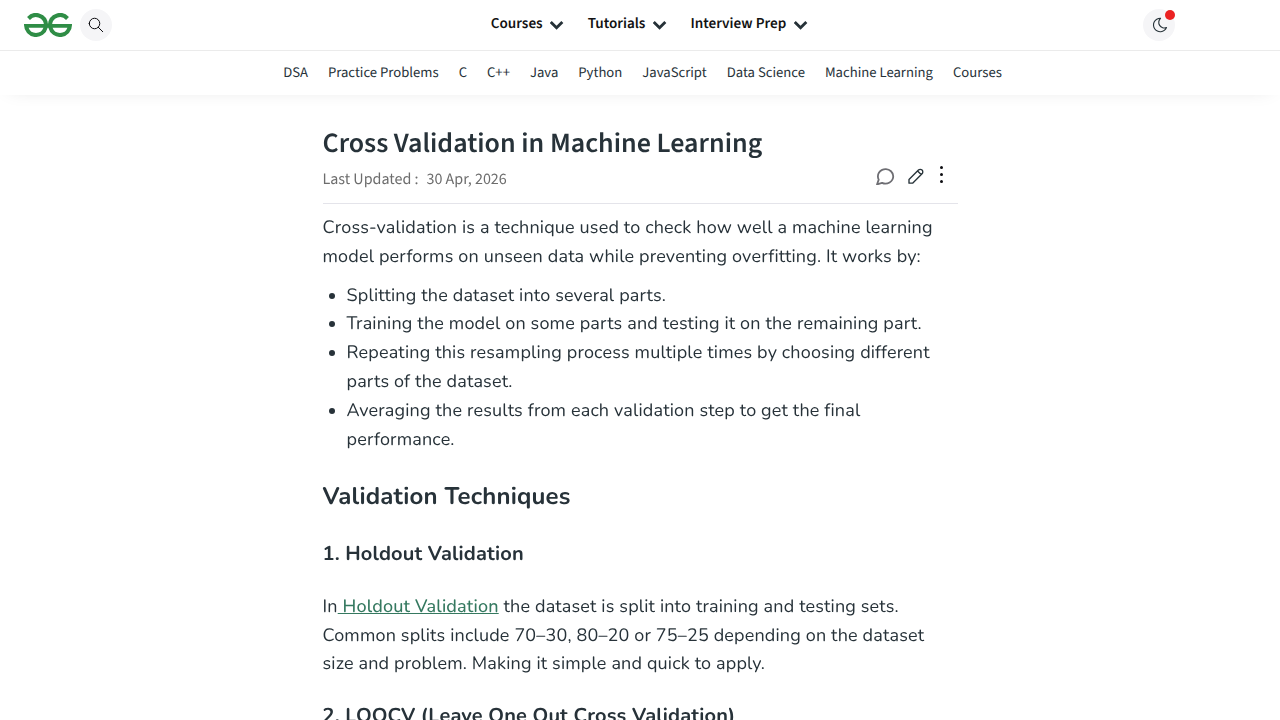
Some advanced methods, like Combinatorial Purged Cross-Validation, are even better at reducing the risks of overfitting in complex situations.
Knowing When a Model is Too Sure: Uncertainty Estimates
Sometimes an AI model can be very confident in its wrong answers. This overconfidence can be a sign of overfitting data. Imagine a student who is always 100% sure, even when they get things wrong. We want our AI models to be like students who know when they aren’t so sure.
"Uncertainty estimates" help us understand how confident a model is about its predictions. If a model gives an answer but also says it’s not very sure, that’s a useful signal. It means we might need to look closer at that prediction or even retrain the model with more data. Using these estimates, along with "distributional tests" that check if new data looks similar to old data, helps us catch models that are too sure of themselves on unseen information. Regularly reviewing how your AI models work can give you valuable insights into improving your overall approach to machine learning.
To stay on top of all the fast changes in AI, getting clear, daily updates is super helpful.
The AI Newsletter Worth Reading
Even with smart technical tools, people and processes play a big role in stopping AI models from just memorizing instead of truly learning.

We need clear rules and good ways of working together to avoid the human errors that can cause an AI model to start displaying overfitting data.
Organizational and process-level approaches: data reviews, guardrails, and education
Making sure AI models learn well and don’t overfit isn’t just about fancy math. It’s also about how we organize our work and what we teach our teams. Setting up good processes can catch problems early, making sure our models are robust and reliable.
Smart Data Checks and Safety Rules
Imagine building a house. You don’t just build it and hope it stands. You have plans, inspections, and rules. It’s the same for AI models. We need "data reviews" where experts check the quality of the data. This means looking for mistakes, making sure the data is clean, and checking for bias. A strong MLOps playbook suggests practices like validating and cleaning data to remove duplicates and manage missing information effectively to prevent problems like overfitting data down the line. Setting up these checks, often called "guardrails," helps make sure the data annotation ai process is legitimate and that data is prepared correctly.
Regularly checking your data for problems is a key part of MLOps. For example, "data drift" happens when new data coming in looks very different from the data the model was trained on. This can quickly lead to an overfitted model that doesn’t work well anymore. Best practices in MLOps for 2026 often include constantly monitoring for data drift by comparing new data against a known good baseline to catch issues fast. You can learn more about how companies lead with AI through proper guidelines by checking out The leaders playbook for AI governance in 2026.
Teaching Teams to Build Better AI
The people working on AI models need to know how to avoid problems like overfitting data.

This means training them on key skills:
- Spotting Data Leakage: This is when information from the test data accidentally gets mixed into the training data. If this happens, the model will seem to perform great because it "peeked" at the answers, but it won’t actually generalize well to new, unseen information. Teams need to learn how to prevent this mix-up.
- Performing Proper Holdouts: It’s super important to keep a part of your data completely separate. This "holdout" data is only used for the final test, like a surprise exam. It shows if the model has truly learned or if it’s just good at remembering specific examples.
- Prioritizing Data Quality: High-quality data is the bedrock of good AI. Teaching teams to value and work for clean, accurate, and fair data from the start makes a huge difference. This focus on
learning from dataand getting the foundations right helps avoid many issues that lead to overfitting data. Effective data validation includes steps like removing duplicates, handling missing values, and filtering biases according to The MLOps Playbook: 6 Best Practices for Success in 2026.
By putting these organizational steps and training into practice, companies can greatly reduce the chances of their AI models becoming overfitted and ensure they truly learn how to solve real-world problems. For more on building a strong data foundation, consider exploring Mastering data foundations and data literacy for AI leadership.
Summary
This article explains why overfitting is a common, hidden risk in every machine learning project and shows practical ways to prevent it. It covers the main data causes (small datasets, class imbalance, and data leakage), model and training causes (overly complex architectures, long training, bad augmentation, and poor optimization settings), and data strategies (careful augmentation, synthetic data, and robust splits). You’ll also learn algorithmic defenses like regularization, ensembling, and early stopping, plus evaluation techniques such as cross-validation and uncertainty estimation to spot when a model is merely memorizing. The guide stresses production practices—MLOps, versioning, monitoring for concept drift, automated data validation—and organizational steps like data reviews and team training. After reading, you’ll be able to identify common overfitting failure modes, apply concrete mitigations during training, and set up processes and tooling to catch overfitting after deployment.