

Introduction
Every week in 2026 brings another wave of AI breakthroughs. New models launch. New tools appear. New claims spread about what artificial intelligence can now do. For product leaders, developers, and founders, this constant flood creates a real challenge.

How do you separate real advances from hype? Staying on top of the AI breakthroughs in 2026 that actually matter is harder than ever, yet it is exactly what your job demands.
The answer to building successfully lies in a structured approach to ai product development. Without one, teams chase every new capability and never finish. With a clear process, you can move from idea to production with confidence. Industry experts who have mapped the AI Product Development in 2026 lifecycle agree that a phased approach is the only reliable way to ship working products. They start with problem validation, move through data engineering and model training, and end with deployment and ongoing monitoring.
This guide covers that full lifecycle. It pulls together the latest best practices from research and hands-on experience across leading ai companies and product teams. We will look at how smart teams define problems, gather quality data, build and test models, integrate AI into products, and keep improving after launch. Whether you are considering an ai tool for app development or wondering about the best ai for frontend development, this guide will help you make better decisions. The goal is to give you a practical roadmap you can use right away.
If you work in product, engineering, or strategy, staying informed makes a real difference. The AI Newsletter Worth Reading delivers clear, daily updates on the most important AI developments so you never miss a shift that affects your work.
Now let us dive into the real framework that successful teams use to build with AI in 2026.
The New AI Product Development Lifecycle
Here is the thing about building AI products in 2026. The old way of doing software development does not work anymore.
Traditional software development lifecycles follow a straight line. Plan everything upfront. Design the full system. Write all the code. Test it. Deploy it. Then move on to the next project. That approach assumes you know what the final product looks like before you start building.
AI products do not work that way.
With AI, you cannot fully predict how a model will behave until you train it on real data. The output changes as the data changes. The model drifts over time. User expectations shift as they interact with the system. A rigid plan made six months ago becomes useless by the time you ship.
That is why the best ai companies have adopted a completely different approach. They follow a structured, non-linear lifecycle built for the unique demands of ai product development.
The Six Stages That Matter in 2026
The modern AI lifecycle has six clear stages. According to the comprehensive AI Development Lifecycle Guide for 2026, every successful AI project moves through problem definition, data collection, model development, evaluation, deployment, and continuous monitoring. None of these stages happens in isolation. Each one feeds back into the others.
Stage one is problem definition. Before you write a single line of code or collect any data, you must clearly define what problem the AI will solve. What outcome matters to your users? What success looks like in measurable terms? Smart teams spend serious time on this stage because a poorly defined problem leads to a wasted build.
Stage two is data readiness. AI models learn from data. If your data is messy, incomplete, or biased, your model will be too. This stage involves collecting historical data, building pipelines for real-time data, cleaning and labeling everything, and setting up storage. Teams that rush this step almost always fail later.
Stage three is model development. This is where machine learning engineers pick algorithms, train models, and tune hyperparameters. But here is the shift that separates successful teams from the rest. They start simple. They try an off-the-shelf model first before building custom solutions. They run quick proofs of concept to test if the approach even works.
Stage four is evaluation and validation. Before any model reaches users, it must be tested thoroughly. Teams check for accuracy, fairness, bias, and edge cases. They compare model performance against the success metrics defined back in stage one.
Stage five is deployment and integration. The trained model needs to become part of your product. This means building APIs, connecting to backend systems, and ensuring low-latency responses. The integration phase is often harder than building the model itself.
Stage six is monitoring and continuous improvement. This is where AI products differ most from traditional software. Models degrade over time as real-world data shifts. Teams must constantly monitor for drift, retrain models, and update pipelines. Deployment is not the finish line. It is the starting point.
Why Cross-Functional Teams Win
Here is the most practical takeaway from this lifecycle. You cannot afford to have data scientists, engineers, and product managers working in separate silos.
When these teams collaborate from day one, the whole process runs smoother.

Engineers understand data constraints early. Product managers stay aligned on what the model can realistically deliver. Data scientists get clear feedback on how their models perform in real product conditions.
If you are evaluating whether to build AI capabilities internally or work with external partners, the enterprise AI tooling options in 2026 can help you decide the right approach for your team.
The key takeaway is simple. Build your ai product development process around iteration, not prediction. Plan for change. Involve everyone early. And treat every model launch as the beginning of a longer conversation with your users.
Data-Centric AI: Quality Over Quantity
Here is a truth that changes everything about ai product development. The size of your dataset matters less than the quality of your data.
Many teams fall into a trap. They think more data automatically means better models. So they collect millions of records, scrape the web, and dump everything into a training pipeline. Then they wonder why their model behaves unpredictably.
The reality is different. A small dataset that is clean, well-labeled, and representative almost always beats a massive dataset full of noise and errors.

This insight has led to a major shift in how successful ai companies build products. They have moved from a model-centric mindset to a data-centric one.
What Data-Centric AI Actually Means
Data-centric AI is a systematic approach to making your training data better throughout the whole product lifecycle. Instead of spending all your time tweaking model architecture and hyperparameters, you focus on curating, cleaning, and improving the data itself.
The core principles of data-centric AI emphasize that improving data consistency and fit has a bigger impact on model accuracy than changing model architecture. When you fix labeling errors, remove duplicate records, and add missing edge cases, your model learns faster and performs better in the real world.
This approach treats data as a strategic asset that needs active investment, not passive collection. According to the guide to data-centric AI from Cleanlab, teams that adopt this mindset see tangible improvements in model accuracy because they continuously analyze data and improve it based on model feedback.
Key Practices That Actually Work
So what does data-centric AI look like in practice? Here are the four practices that matter most in 2026.
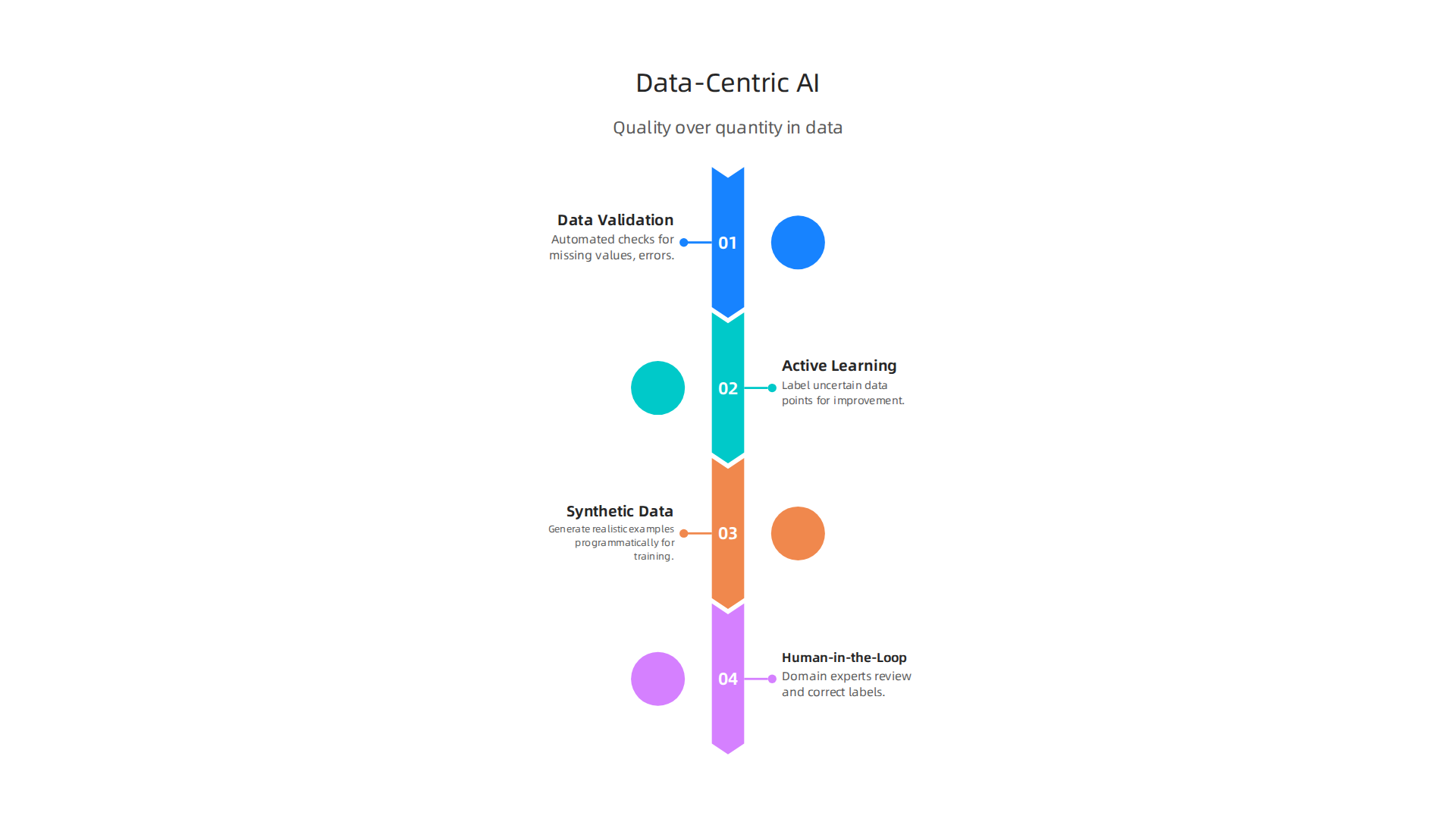
Data validation pipelines. Before any data reaches your model, it should pass through automated checks. These pipelines catch missing values, format errors, and outliers before they corrupt your training process. The goal is to fail fast and safely rather than discovering problems after deployment.
Active learning. Instead of labeling thousands of random examples manually, active learning helps your model identify which data points it is most uncertain about. Your team labels only those few examples that actually improve performance. This saves enormous time and money while delivering better results.
Synthetic data generation. Sometimes you cannot collect enough real-world data for rare edge cases. Synthetic data fills those gaps. You generate realistic examples programmatically and add them to your training set. This technique is especially valuable for scenarios involving privacy concerns or rare events.
Human-in-the-loop labeling. Automated labeling has limits. The best teams combine automation with human expertise. Domain experts review and correct labels, especially for complex cases. The data preparation best practices for 2026 stress that investing in dedicated resources for data cleansing and enrichment leads to significantly better model outcomes.
Why This Matters for Your AI Product Development
If you are building an AI product right now, the data-centric approach changes your priorities. Instead of chasing the latest model architecture, you should spend more time on your data pipelines. Instead of collecting more records, you should improve the quality of the records you already have.
The shift from model-centric to data-centric thinking is one of the most important AI data analytics trends in 2026. Teams that neglect data quality end up with models that fail in production. Teams that treat data as a first-class product built systematically outperform everyone else.
Getting this right takes focus and the right information. If you want to stay ahead of the latest developments in ai product development and data practices, The AI Newsletter Worth Reading delivers clear daily updates straight to your inbox.
Evaluating AI Models Beyond Accuracy
Here is a question that trips up many teams working on ai product development. How do you know if your model is actually good?
Most people check accuracy. They run a test set, see 95 percent, and call it a win. But here is the problem. Accuracy alone can trick you. A model can hit high accuracy while failing badly for certain groups of users. It can perform perfectly on your test data and fall apart in the real world.
In 2026, successful teams evaluate models across multiple dimensions. They look beyond a single number.
The Limits of Accuracy
Think about a fraud detection model. It might achieve 99 percent accuracy because only 1 percent of transactions are fraudulent. A model that simply predicts "not fraud" every single time would also hit 99 percent. But it would catch zero actual fraud.
This is why AI model evaluation standards now include metrics like precision, recall, F1 score, and fairness measures alongside accuracy. Each metric reveals something different about how the model behaves.
Fairness, Robustness, and Explainability
Your model needs to treat different user groups fairly. A loan approval model that performs well for one demographic but poorly for another is not safe to deploy. Teams use slice-based analysis to check performance across age groups, regions, and other sensitive attributes.
Robustness matters just as much. What happens when someone feeds your model slightly modified inputs? Tiny changes that a human would not notice can cause a model to make completely wrong predictions. Adversarial testing helps you find these weaknesses before attackers exploit them.
Explainability lets your team and your users understand why the model made a particular decision. When a model denies a loan or flags a transaction, people deserve to know why.
How to Evaluate Continuously
Evaluation is not a one-time step at the end of development. The best teams build evaluation into their daily workflow.
Slice-based analysis means you break your test data into meaningful subgroups and check performance on each one. If your model fails for a specific slice, you investigate whether the training data was missing examples from that group.
Adversarial testing means intentionally crafting inputs designed to confuse your model. You simulate attacks, typos, and edge cases to see how the model responds.
Bias audits use standardized tools to measure whether your model produces fair outcomes across different groups. These audits are becoming standard practice for ai companies that want to deploy responsibly.
Standardized Benchmarks Help
Frameworks like MLPerf and internal leaderboards give teams a consistent way to compare models. Instead of relying on any single metric, these benchmarks evaluate performance across many dimensions.
The evaluation framework for 2026 from industry practitioners recommends measuring seven dimensions: accuracy, safety, fairness, robustness, calibration, efficiency, and alignment. A model that scores well across all seven is much more likely to succeed in production than one that only looks good on accuracy.
This broader view of evaluation changes how you build. It pushes you to look at model behavior from every angle. And it helps you catch problems before your users do.
If you want to explore more about building and evaluating AI products, the breakthroughs that actually matter in 2026 article covers the key developments shaping the field right now.
Production-Ready AI: Deployment and Monitoring
You have built a solid model. You have checked it for fairness, robustness, and explainability. Now comes the hard part: getting it into the real world where it actually helps people.
Deploying AI at scale is different from running experiments in a notebook. In 2026, the teams that succeed treat deployment as a product engineering challenge, not a science project. They build the right infrastructure from day one.
What You Need to Deploy
Your deployment setup needs three core pieces working together.
First, a feature store. This is a central place where your team stores, shares, and serves the data your models need to make predictions. Instead of each team member rebuilding features from scratch, everyone uses the same trusted data. A feature store also helps with consistency. The same feature used during training should be the same one used when the model makes predictions in production.
Second, CI/CD pipelines for machine learning. Just like software teams automatically test and ship code, AI teams need to automatically test and ship models. When a new model version passes all evaluations, the pipeline should deploy it to production without manual steps. This reduces errors and speeds up delivery.
Third, a flexible serving infrastructure. Your model needs to run somewhere that can handle traffic. Cloud-native platforms like KServe and Seldon make this much easier. They run on Kubernetes, which means you can scale up and down based on demand. You can deploy multiple model versions at once and route traffic between them.
Why Monitoring Is Non-Negotiable
Here is a truth that surprises many new teams. A model that works perfectly on day one can fail on day thirty.
The world changes. User behavior shifts. New data comes in that looks different from what the model trained on. This is called data drift, and it quietly destroys model performance.
In production, data drift means your model starts making more mistakes. A recommendation engine that was spot on in January might feel outdated by March. A fraud detection model that caught every scam might start missing new attack patterns.
That is why monitoring is not optional. You need to watch for:
- Data drift: Has the distribution of incoming data changed?
- Model decay: Are predictions becoming less accurate over time?
- Operational health: Is the serving infrastructure running smoothly? Are response times acceptable?
Tools like Arize Phoenix and built-in monitoring in cloud platforms can alert your team when something goes wrong. The key is to catch issues before users notice them.
Choosing Your Platform
The best deployment platform for your team depends on your existing infrastructure. If you already use AWS, Amazon SageMaker gives you tight integration with IAM, CloudWatch, and other services. If you are on Google Cloud, Vertex AI provides a unified experience. For teams running Kubernetes, open-source options like Kubeflow and Seldon offer flexibility.
According to the latest analysis of MLOps platforms in 2026, the top platforms combine model serving, monitoring, and governance into a single workflow. This saves your team from juggling multiple tools and reduces the chance of something falling through the cracks.
A Simple Starting Point
If you are new to deploying AI, do not try to build everything at once. Start with a single model served through a platform like KServe. Add monitoring for data drift. Then expand to CI/CD pipelines and a feature store as your team grows.
The goal is to get a real model in front of real users quickly, then improve it based on what you learn.

Deploying AI is a skill you build over time. The teams that do it well treat it as a continuous practice, not a one-time event. And they never stop monitoring what their models are actually doing in the wild.
If you want to stay informed about the latest tools and strategies for building production AI systems, get clear daily AI updates from the The Deep View Newsletter. It keeps you ahead of the curve as the field evolves.
Building Responsible AI: Ethics, Governance, and Trust
Here is something every team building AI products needs to understand. Responsible AI is not a checkbox you fill in at the end. It is a core part of your ai product development process from the very first idea.
In 2026, regulations like the EU AI Act and new US executive orders demand built-in governance. You cannot wait until after launch to think about ethics. The rules require you to document how your model works, what data it uses, and how you handle risk.
This is actually good news. When you build trust into your product early, you save time and money later. You also avoid the nightmare of having to pull a model because it behaves unfairly.
What Responsible AI Looks Like in Practice
Responsible AI comes down to three things you need to bake into your workflow.
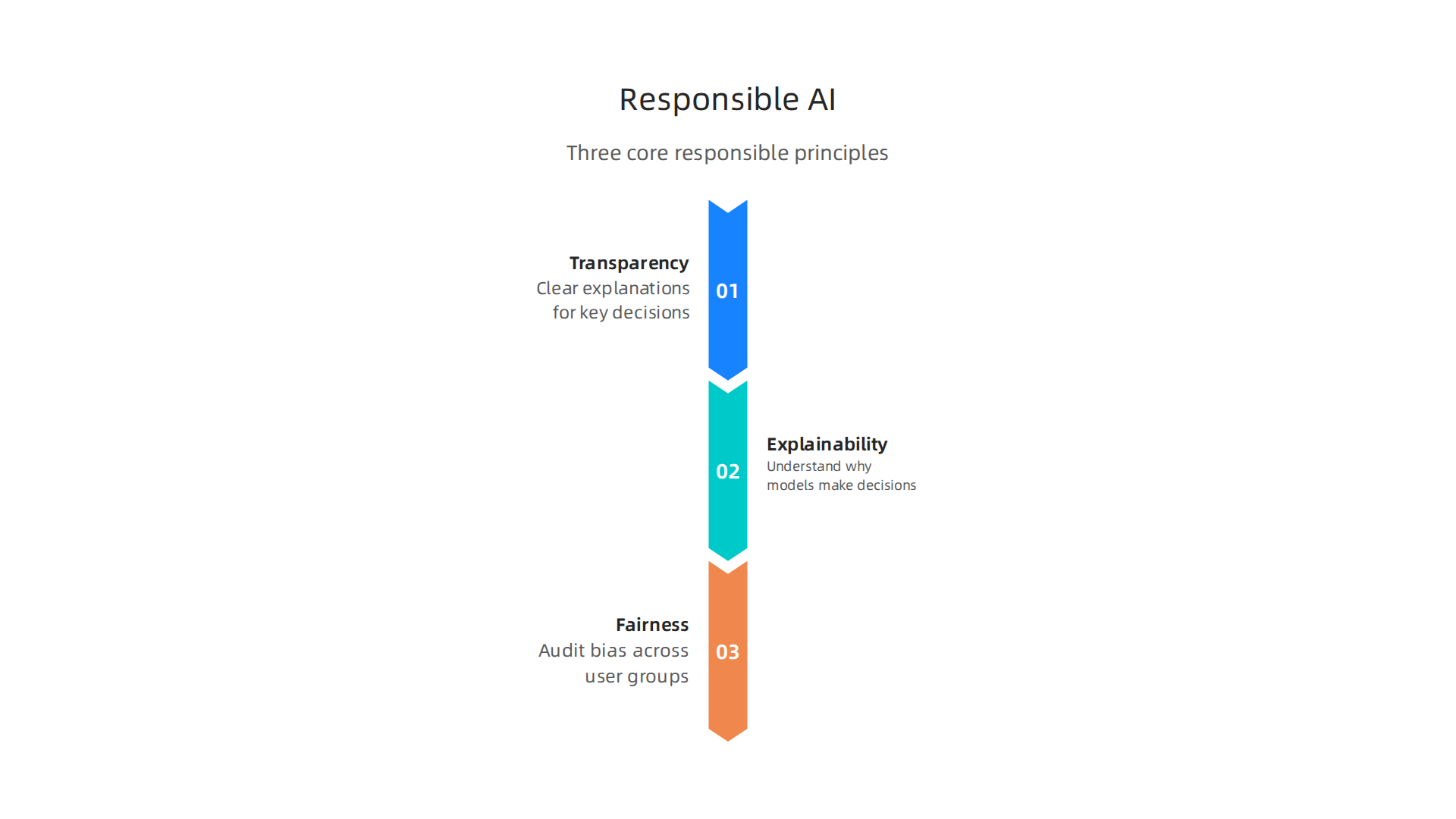
Transparency. Users and regulators want to know how your AI makes decisions. This does not mean you need to explain every line of code. But you do need to provide clear, human-readable explanations for high-impact decisions. If your model denies a loan or rejects a job application, someone needs to understand why.
Explainability. This is closely related to transparency but focuses on the model itself. Use explainable AI techniques that match the complexity of your model. Simple models are easier to explain, so start simple when you can. Save deep learning for problems where it really adds value.
Fairness. Bias can creep into AI systems through training data or model design. You need to audit for bias regularly. Run fairness tests before launch and keep running them after. The goal is to prevent discrimination, especially in areas like finance, healthcare, and hiring.
These three principles are not optional. They are becoming legal requirements. The EU AI Act, for example, requires disclosures for high-risk systems. Following a framework like the NIST AI Risk Management Framework helps you map your efforts to recognized standards.
How to Set Up Governance That Works
Governance is just a fancy word for having a system in place. You need clear rules about who owns each model, who approves changes, and how you handle problems.
Start by creating an AI ethics board or committee. Include people from legal, data science, product, and security. This group sets the standards and reviews high-risk use cases.
Next, build a simple inventory of all your AI systems. Record what each model does, who built it, what data it uses, and who is responsible. This inventory is your foundation for everything else.
Many leaders in the space agree that you should start small. Pick a few high-impact AI use cases first. Test your governance process on those before rolling it out everywhere. You can read more about how leading ai companies are handling this in our guide on AI without restrictions in 2026.
The Business Case for Responsible AI
Here is the bottom line. Users walk away from products they do not trust. Regulators fine companies that cut corners. If you want your ai product development to succeed long term, ethics and governance are not extras. They are the foundation.
Build them in from day one. Your team, your users, and your future self will thank you.
Summary
This article presents a practical, six-stage lifecycle for building AI products in 2026, arguing that traditional linear software processes no longer work for machine learning systems. It explains how teams should start with clear problem definition, invest in data readiness, run simple model proofs of concept, and apply rigorous evaluation before deployment. The guide emphasizes a data-centric mindset — prioritizing clean, representative data, active learning, and human-in-the-loop labeling — and explains why evaluation must go beyond accuracy to include fairness, robustness, and explainability. For production it covers feature stores, CI/CD for models, and monitoring for data drift and model decay. Finally, it outlines how to embed responsible AI and governance into every stage and why cross-functional collaboration and the right platform choices are essential to shipping and maintaining reliable AI products.