

Why ‘what is the best AI’ is a tricky and vital question in 2026
In 2026, it feels like artificial intelligence (AI) is everywhere. New AI tools and breakthroughs pop up almost every day. Because of how fast things change, many people ask: "What is the best AI?" It’s a simple question, but the answer is much harder than you might think.
The truth is, there isn’t one single "best AI" for everyone. The best AI depends on what you need it for. Think about it: a self-driving car uses AI very differently from an AI that helps you write emails. With so much new information, it’s easy to feel lost and not know which AI is truly helpful. This problem of too much information makes it hard to find the right solutions for your needs.
This guide will help you understand the world of AI better. We will start by explaining what AI really is, because a clear definition is important to know what you are even looking at.

For example, AI can be understood as engineered systems that learn and apply knowledge, showing intelligent behavior by looking at their surroundings and taking actions to reach goals [1]. We will also look at the interesting history of AI, from its first ideas to the powerful systems we see today.
We will explain how different AI systems work and what makes them good or not so good. You will learn how to judge if an AI tool is right for you and why sometimes you need explainable AI that can show its work, not just give answers. Finally, we will share simple ways to keep up with all the new AI trends. By the end, you will have a clear framework to answer the question of "what is the best ai" for your own needs.
Staying on top of the latest advancements can feel overwhelming, but it’s essential for anyone who wants to make smart choices about technology in 2026. Get clear daily AI updates from The AI Newsletter Worth Reading.
To really understand what is the best AI for you, we need to look closer at what AI actually is. It is like trying to pick the best type of car without knowing the difference between a small car and a big truck. Knowing these basic parts helps a lot.
What is AI, Really?
We often hear "AI," but it means many things. Think of it like this:
- Narrow AI (or Weak AI): This is most of the AI we use today. It is good at doing one specific task. For example, the AI that suggests movies you might like, the AI that helps your phone understand your voice, or the AI in a self-driving car. It is smart for its job, but it cannot do other things. A system that helps manage complex tasks for Congress often relies on this kind of AI [1].
- General AI (or Strong AI): This is AI that can think and learn like a human across many different tasks. It can solve problems, plan, and understand complex ideas. We do not have General AI yet, but it is a big goal for many researchers.
Important Parts of AI
Two big parts of AI you will hear about are Machine Learning and Deep Learning:
- Machine Learning (ML): This is a way for computers to learn without being told exactly what to do. Instead, you give them a lot of data, and they find patterns in it. For example, if you show an ML system many pictures of cats and dogs, it learns to tell them apart on its own. It is like teaching a child by showing them many examples. If you want to dive deeper into how this works, you can explore Mastering Practical Machine Learning.
- Deep Learning: This is a special type of Machine Learning that uses very complex computer setups called neural networks. These networks are inspired by how the human brain works. Deep Learning is very good at tasks like understanding speech, recognizing faces, and creating images. Many of the impressive AI breakthroughs you hear about in 2026 use Deep Learning.
How AI Learns: Different Branches
AI systems learn in different ways, and knowing these ways helps you pick the right tool for the right job.
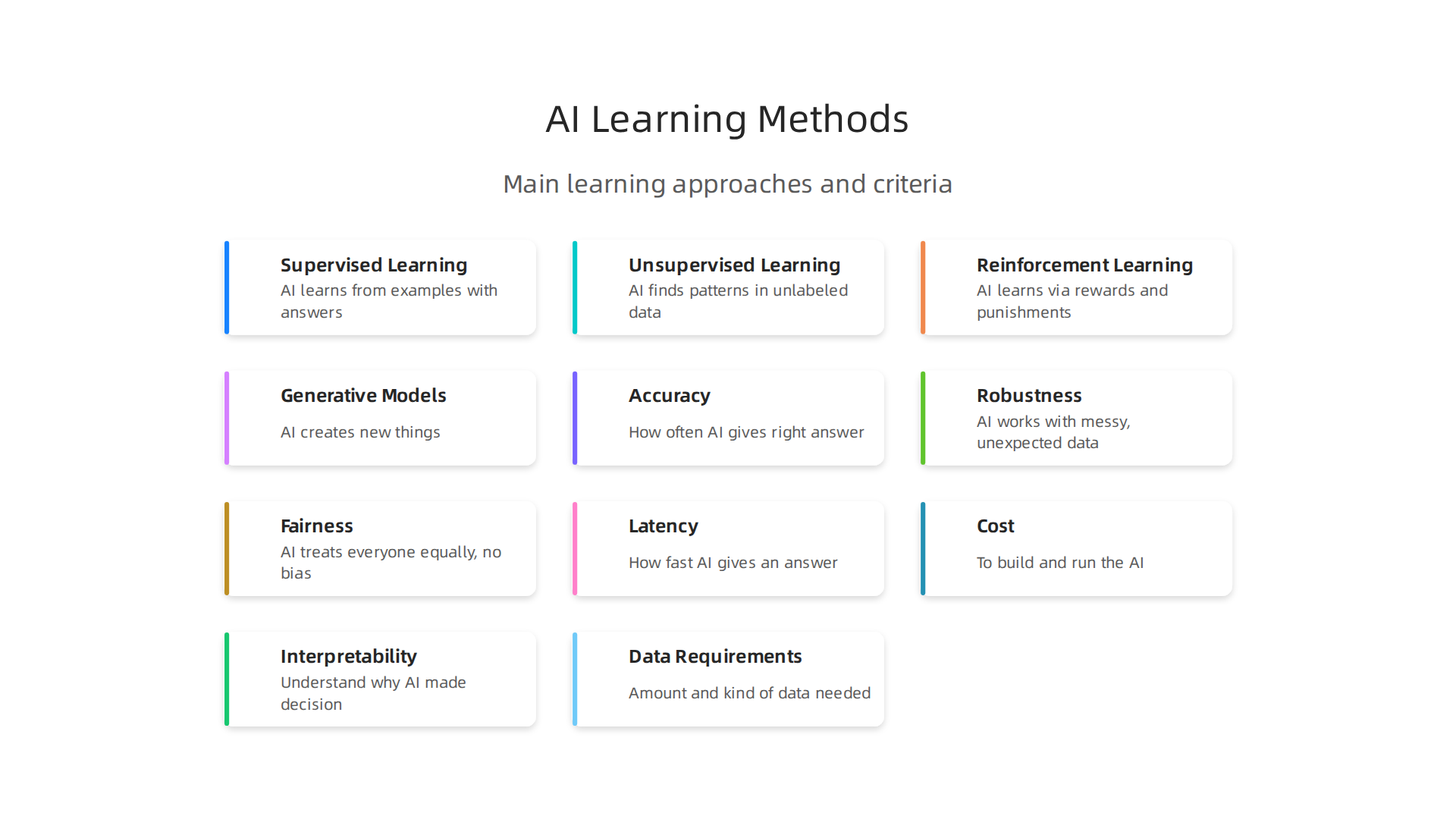
Experts often organize these different ways of learning into what they call an AI taxonomy, which is like a map of all the different types of AI [2]. Here are some main ways:
- Supervised Learning: This is when you give the AI a lot of examples with the right answers. For instance, you show it pictures of apples and tell it "this is an apple." The AI learns from these labeled examples to predict new ones. It is like a student with a teacher guiding them.
- Unsupervised Learning: Here, you give the AI data without any answers. The AI then looks for hidden patterns or groups within the data all by itself. It might find out that some customers buy similar things without you telling it to look for that.
- Reinforcement Learning: This is like teaching a pet with rewards. The AI tries things, and if it does something right, it gets a "reward." If it does something wrong, it gets no reward or a "punishment." Over time, it learns the best actions to reach a goal. This is used a lot in games and for robots learning to move.
- Generative Models: These are AI systems that can create new things. They can write new stories, make new images, or even compose music. If you ask a generative AI to draw a picture of a blue cat, it can make one up for you.
Understanding these fundamentals helps clarify why there is no single answer to "what is the best AI." The best AI tool is the one that fits your specific needs and learns in the way that makes the most sense for your problem.
The idea of "what is the best AI" has changed a lot over time, like how people used to think a horse was the best way to travel, but now we have cars and airplanes. Looking at the history of AI helps us see how our understanding of smart machines grew.
Early Days: Symbolic AI
Many years ago, in the mid-1900s, people started thinking about artificial intelligence. The very first ideas for AI were about making computers follow clear rules. This was called "Symbolic AI" or "Good Old-Fashioned AI" (GOFAI). Imagine teaching a computer like a child learning to count: you give it exact steps for every number. For a long time, the best AI was seen as a program that could perfectly follow these rules and solve problems like math puzzles or simple games. It was about logic and clear instructions.
The Rise of Machine Learning
Later, around the 1980s and 1990s, things started to change. People realized that telling a computer every single rule was too hard for more complex tasks. This led to a new wave of AI called "statistical machine learning." Instead of giving strict rules, researchers began feeding computers lots of data and letting them find patterns on their own. This was a big step. Suddenly, the best AI was one that could learn from examples, like how a doctor learns to spot a sickness after seeing many patients. This made AI much more useful for real-world problems.
Deep Learning and Big Breakthroughs
In the 2010s, something even bigger happened: deep learning. This is a special kind of machine learning that uses very complex computer setups like the human brain. With huge amounts of data and powerful computers, deep learning led to amazing breakthroughs. AI got very good at things like understanding speech, recognizing faces, and even playing complex games better than humans. This era showed us that the best AI could do things that seemed almost magical just a few years before. It made people wonder about the limits of artificial intelligence.
Today: Foundation Models and New Goals
Now, in 2026, we are in the era of "foundation models." These are very large AI systems, like those that can write stories, create images, or answer complex questions. They are "foundations" because many other AI tools can be built on top of them. This means the question of "what is the best AI" now often points to these large, adaptable models that can do many different things.
But today, we also care more about why an AI makes a certain choice. This is where "explainable AI" comes in. We want to understand how these complex systems work, not just what they do. Finding an AI that is both powerful and transparent is a big goal. As AI keeps growing, staying informed is key. To keep up with these fast changes and get clear, daily AI updates, consider subscribing to The AI Newsletter Worth Reading. Understanding today’s decoding AI trends 2026 helps us choose the best tools for the problems we face right now and in the future.
Modern AI systems, especially the big ones called foundation models, work because of several important parts. It’s like building a very smart robot: you need good parts, a good plan, and a good way to teach it.

The Power of Data
First, every modern AI needs huge amounts of data. Think of data as all the information the AI learns from. This could be billions of words from books and websites, millions of pictures, or hours of spoken conversations. For an AI to be really good, it needs this data to be both huge in amount and very good in quality. If the data is bad or wrong, the AI will learn wrong things. Finding the right balance between having a lot of data and making sure that data is top-notch is a big challenge. You can learn more about managing this information by understanding mastering data foundations and data literacy for AI leadership.
How AI Brains Are Built: Model Architectures
Next, we have model architectures. This is like the design of the AI’s brain. Today, many powerful AIs use very complex designs, often called "neural networks" because they are a bit like how our own brains work. These designs let the AI process all that data and find hidden patterns. Different types of problems need different "brain" designs. For example, the design for an AI that writes stories is different from one that recognizes faces. Surveys in 2026 show many types of these large model designs helping to shape what the best AI can do Large Language Models: A Survey of Architectures, Training ….
The Need for Speed: Compute Power
To handle all that data and run these complex brain designs, AIs need a lot of compute power. This means really fast computers and special chips that can do many calculations at once. Without powerful computers, training a modern AI would take forever. The more complex the AI model and the more data it needs to learn from, the more compute power it will require.
Learning Lessons: Training Paradigms
Then comes training. This is how the AI actually learns. It’s usually done in two main steps:
- Pre-training: The AI learns general things from a massive amount of data. It’s like a child learning to read many books to understand words and sentences in general. This step teaches the AI basic skills.
- Fine-tuning: After pre-training, the AI gets more specific lessons. You might show it examples of writing poems if you want it to be good at that, or examples of fixing code if you want it to be a good helper for programmers. This helps the AI become really good at one specific task. You can learn how to select the best AI model for code for these types of specific tasks.
There’s a give and take here: pre-training gives the AI a wide understanding, while fine-tuning makes it excellent at a narrow job.
Checking the Work: Evaluation Pipelines
Finally, we have evaluation pipelines. This is how we test if the AI is doing a good job. We give the AI tasks it hasn’t seen before and check its answers. We use special test datasets and benchmarks to compare how well different AIs perform. These benchmarks are very important for seeing which AI is truly the best at certain tasks in 2026 2026 Position Papers – ICML 2026. This helps us understand what works and what needs to get better.
Understanding these parts helps us see that finding "what is the best AI" depends on many things. It’s about having the right data, the right brain design, enough power, smart training, and good ways to check its work. All these pieces must work together for any artificial intelligence system to truly shine.
Understanding how an AI works is just the first step. The real question is, how do we know what is the best AI? It is not always about which AI is the strongest in every way. Instead, it depends on what you want the AI to do. To figure this out, we look at different important measures, often called criteria.
Practical Criteria for the Best AI
When we talk about finding the best AI, we look at a few key things:
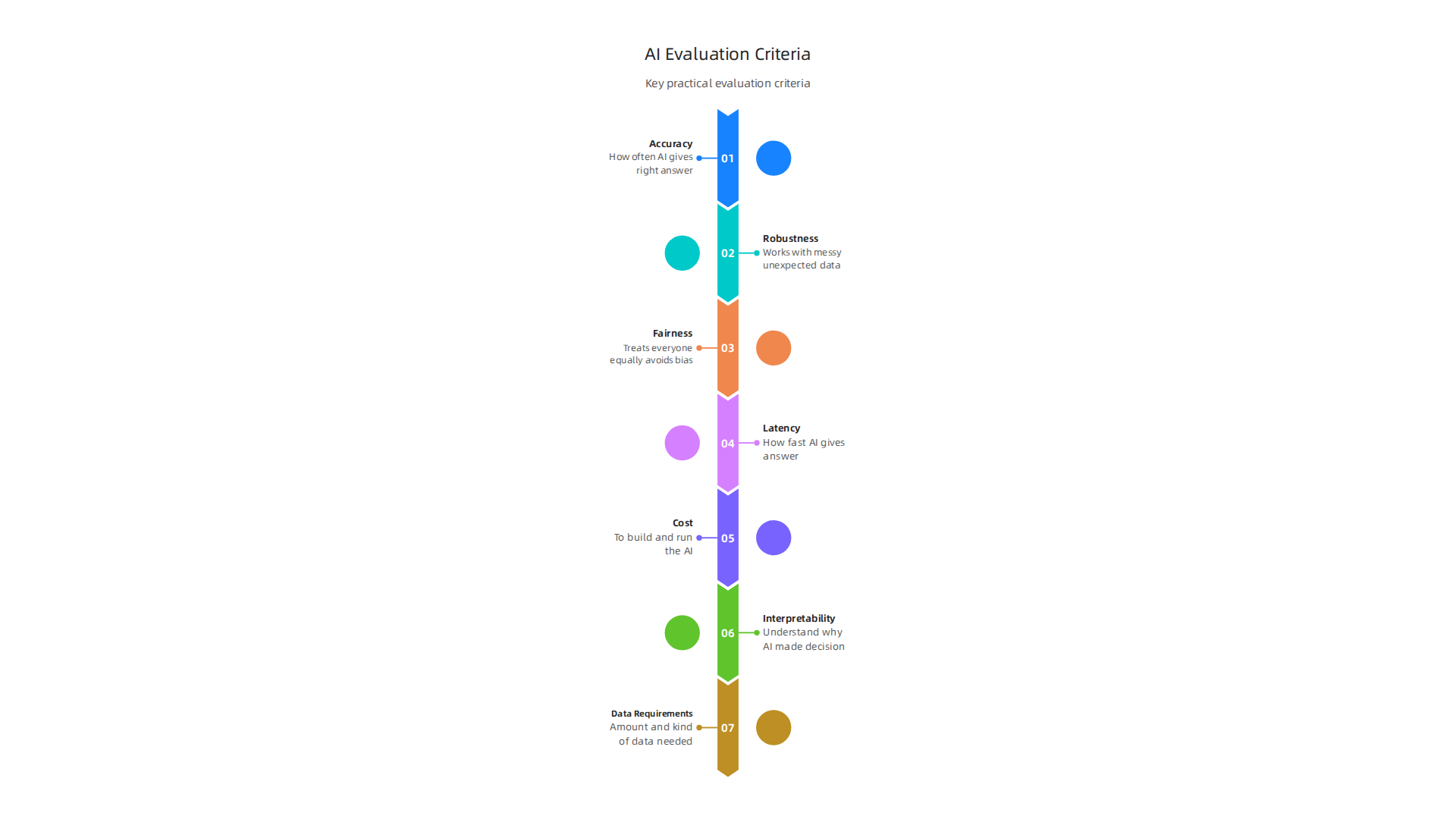
- Accuracy: How often does the AI give the right answer? For example, if an AI is identifying objects in a picture, how many times does it correctly name them? This is often the first thing people think about.
- Robustness: Can the AI still work well even if the information it gets is a little bit wrong or unexpected? A good AI should not break down easily. This means it can handle slightly messy data without failing. Learn more about how to make AI systems reliable by understanding understanding and preventing overfitting data in AI systems.
- Fairness: Does the AI treat everyone equally? This is very important. An AI should not make unfair choices based on things like a person’s age or background. For example, some AI models can have unfair biases, which is why understanding AI models female bias understanding risks and solutions for leaders 2026 is crucial.
- Latency (Speed): How fast does the AI give an answer? For some uses, like self-driving cars, speed is super important. A slow AI could be dangerous. If you need speed, you’ll want to know how to pick the fastest openai model for low latency ai.
- Cost: How much does it cost to build and run the AI? This includes the money spent on computer power and data. Some AIs are very expensive, so you need to weigh the benefits against the price tag.
- Interpretability (Explainable AI): Can we understand why the AI made a certain decision? Sometimes, AIs are like "black boxes" where we do not know how they got their answer. For important choices, like in medicine, it is better to have an "explainable AI" so we can trust its judgments.
- Data Requirements: How much and what kind of data does the AI need to learn? Some AIs need huge amounts of very specific data, which can be hard to get.
These ideas help us measure what matters when picking an AI, as explained in guides like Benchmarking AI Models: Measuring What Matters. Different projects will care about different things the most. For example, a chat tool might need high accuracy and speed, while an AI helping doctors might need high accuracy and explainability. It is about understanding what gives real-world value, as discussed in reviews of AI solution benchmarking metrics.
Benchmarks and How They Can Mislead
To compare AIs, people often use "benchmarks." These are like standardized tests for AIs. We give different AIs the same test and see which one scores highest.
However, benchmarks can sometimes be tricky or misleading. Here is why:
- Not like real life: A benchmark might test an AI on a specific problem in a controlled way. But in the real world, problems are often much messier and more complex. An AI that scores high on a test might not do so well in a real job.
- Too simple or too hard: Some benchmarks might be too simple, so all AIs perform well, making it hard to see which is truly better. Others might be too hard or focus on very specific things, not showing the AI’s full abilities.
- Not easily repeatable: Sometimes, the results from benchmarks are not easy for others to check or repeat, which makes it hard to trust the comparisons. Reports like BetterBench: Assessing AI Benchmarks, Uncovering Issues highlight these problems.
Choosing the Right Evaluation
So, how do you really find what is the best AI for your needs?
- Start with Your Goals: First, think about what you want the AI to achieve. What business problem are you trying to solve? Your evaluation metrics should link directly to these goals. For instance, if you want to reduce customer complaints, your AI’s success should be measured by how well it helps achieve that, as highlighted in guides on AI Model Evaluation Metrics: A GenAI Team’s Guide.
- Use Real-World Data: It is super important to test your AI with data that looks like what it will actually face when it is used. This means using data from your specific area or business, not just general test data.
- Mix and Match Metrics: Do not just look at one number, like accuracy. Use a mix of the criteria we talked about, such as accuracy, fairness, and speed, that fit your goals.
- Keep it Simple: Do not try to measure too many things. Pick a few key measures that truly show if the AI is helping you reach your goals. For a practical guide on this, consider understanding realistic AI a practical guide for business leaders in 2026.
Choosing the best AI is not about finding a single winner. It is about picking the AI that performs best for your specific tasks, given all the important factors like speed, cost, and fairness. Staying on top of these complex factors and the latest AI evaluation methods can be tough.
Get clear daily AI updates from The AI Newsletter Worth Reading.
Finding what is the best AI for your specific needs often depends on more than just speed or accuracy. Sometimes, it depends on whether you can understand how the AI makes its decisions. This is where "explainability" and "interpretability" come in. Explainable AI, or XAI, helps us open up the "black box" of complex AI systems, so we can see inside and understand their reasoning.

This helps us trust the AI more and use it better.
Main Ways to Make AI Explainable
There are different methods to help us understand AI better. These methods can be grouped into a few main families:
- Feature Attribution: Imagine an AI looking at a picture to decide if it’s a cat or a dog. Feature attribution methods tell us which parts of the picture (which "features") were most important for the AI’s decision. Two popular tools for this are SHAP and LIME, which are key techniques in 2026 for making AI explainable across different types of models, including those for deep learning and large language models (LLMs) AI Explainability 2026: SHAP, LIME, CoT Guide.
- Surrogate Models: Sometimes, an AI is so complex that it is hard to explain directly. In these cases, we can build a simpler, easier-to-understand AI model (a "surrogate") that acts very much like the complex one. We then explain the simpler model instead. This approach is often used as a "post-hoc" method, meaning it helps explain the AI after it has already made a decision A Systematic Review Of Explainable Artificial Intelligence Techniques For Trustworthy Machine Learning Systems – IJSRET.
- Example-Based Methods: This way of explaining AI works by showing you examples. For instance, if an AI makes a certain decision, it might show you past examples from its training data that are very similar to the current situation and led to the same decision. This helps you see the pattern it followed.
- Model Introspection: This method involves looking directly inside the AI model itself to understand its parts and how they work. For simpler AI models, like decision trees, you can literally see the rules it follows. For more complex models, researchers are finding new ways to "look inside" to understand how different layers or parts of the AI contribute to its overall choice.
When Explainability Matters Most
Explainable AI is not always a nice-to-have; sometimes, it’s a must-have. Here are some situations where it’s very important:
- Regulatory Compliance: Governments and important organizations are increasingly setting rules for how AI should work. For example, in 2026, the EU AI Act includes strict transparency rules for high-risk AI systems, and financial regulators also expect banks to use explainable AI AI Explainability: What Financial Regulators Expect and How …. This means companies need to show why their AI made certain decisions to meet these laws. For leaders, understanding these rules is part of having a strong leaders playbook for AI governance.
- Safety-Critical Uses: When AI is used in areas where mistakes can be dangerous, like in self-driving cars or medical diagnoses, explainability is crucial. Doctors need to understand an AI’s advice for patient care. The FDA, for example, requires AI software in healthcare to let doctors review the basis for recommendations, not just rely on the output FDA CDS Guidance: AI Explainability is an Engineering Rule.
- User Trust: People are more likely to trust and use an AI if they understand how it works. If an AI makes a strange decision, an explanation can help users feel confident that it’s not simply "guessing."
- Debugging and Improving AI: When an AI makes a mistake, explainability helps engineers figure out why. Was the data bad? Did the AI learn the wrong thing? Understanding its reasoning helps them fix issues and make the AI better.
When Explainability Might Not Be Necessary
While explainable AI is powerful, it’s not always needed for every project. For simpler tasks or those with very low risk, a "black box" AI might be perfectly fine. If an AI is just recommending a song you might like, or sorting spam emails, knowing exactly why it made that choice might not be as important. The key is to match the level of explainability to how important and risky the AI’s job is.
Beyond understanding how an AI makes decisions, there are many real-world things to think about when you choose and use artificial intelligence. It’s not just about finding what is the best AI in a lab setting. You also need to think about how it will work every day, stay safe, and follow the rules.
Making AI Work in the Real World
When you put an AI system into action, it’s called deployment. This is where the rubber meets the road.
- Keeping an Eye on AI: Once an AI is deployed, you need to watch it closely. AI models can sometimes "drift" over time, meaning their performance might change as they see new kinds of data. This "data drift" can make an AI less accurate. Regularly monitoring the AI helps you catch these issues early. To learn more about getting AI ready for use, check out The 2026 AI Product Development Lifecycle From Problem to Production.
- Updating Models: Just like your phone apps, AI models need updates. New data comes in, or you might find better ways to teach the AI. Keeping your AI models fresh is key to their long-term success. It also helps with problems like Understanding and Preventing Overfitting Data in AI Systems.
- MLOps: This fancy term just means bringing together all the steps of building, deploying, and managing AI models in a smooth, easy way. Think of it like a factory line for AI. Good MLOps helps companies manage many AI systems efficiently, making sure they run well and are cost-effective. Choosing the right platforms is also important for business growth, and you can explore this further by Picking the Right Top AI Platforms for Business Growth in 2026.
- Managing Costs: Running powerful AI can cost a lot. You need to think about the computers it needs, the people to manage it, and how much data it uses. Making smart choices here helps ensure your AI project stays within budget.
Safety and Following the Rules
Governments and industry groups are setting more rules for AI. This is important for making sure AI is safe and fair.
- Audits and Documentation: Companies using AI, especially in important areas like finance, must be ready to show how their AI works. This means keeping good records (documentation) and letting experts check the AI regularly (auditing). For example, banking regulators now expect banks to keep "continuous monitoring" of AI performance and have proper records Banking AI Explainability Is Now a Regulatory … – TechBullion. Understanding the risks involved is crucial, as detailed in Affinity AI Due Diligence Evaluate Technology Business and Risk.
- Risk Levels: Not all AI is equally risky. An AI that suggests movies is less risky than one that helps doctors make diagnoses or controls a car. New rules, like the EU AI Act, classify AI systems by how risky they are. Higher-risk AIs have more strict rules about things like transparency and documentation. International standards, such as ISO/IEC TS 6254:2025, also provide guidance on achieving explainability.
- Transparency Obligations: Starting in August 2026, the EU AI Act will make providers design AI systems to inform users when they are interacting with AI. They also need to add special marks to AI-generated content to show it’s made by AI. These guidelines help ensure that people know when they are dealing with artificial intelligence Guidelines on transparency obligations for providers and ….
These practical steps are just as important as choosing the right AI model itself. They help ensure your AI is not only powerful but also reliable, safe, and works within the rules.
Want to stay on top of the latest AI news and trends? Get clear daily AI updates from The AI Newsletter Worth Reading.
Putting artificial intelligence to work and making sure it follows the rules is a big job. It means busy people need good ways to keep up with all the new changes. You can’t just pick what you think is the best AI and forget about it. To make smart choices about AI, especially when asking "what is the best AI" for a specific task, you need a system to stay informed.
How busy professionals keep up: workflows, trusted sources, and decision frameworks
The world of AI moves super fast. For leaders and experts, it’s easy to feel lost in all the new tools and news. But there are smart ways to keep up without getting overwhelmed.

Setting Up Smart Workflows
Think of your learning as a simple system.
- Prioritized Reading: Instead of reading everything, pick a few good sources. This helps you get the most important news without feeling overloaded. Experts suggest choosing one or two trusted newsletters or websites that filter out the noise for you, like a weekly digest that covers 80% of what truly matters How to Keep Up with AI Technology: A Simple System. You can also set aside a small, fixed time each week to check these sources.
- Signal Filtering: This means learning to tell the difference between real breakthroughs and just hype. A good way is to ask yourself if the news is truly important to your work or if it’s just exciting. Some methods suggest a "hype filter" to shortlist only items with potential impact AI News Curation Strategies for ML Teams in 2026 – NeoBit Daily.
- Experiment Notebooks: Don’t just read about AI tools, try them out! When you test new AI features, you learn how they work firsthand. Keep a simple record of what you tried, what happened, and what you learned. This helps you see which tools might really be useful.
- Decision Checklists: When it’s time to choose an AI tool or strategy, use a checklist. This helps you make sure you’ve thought about all the important things, like how well the AI performs, its cost, and if it aligns with your goals. For example, when evaluating AI models, you should look at different factors like accuracy, speed, and how strong it is against problems Benchmarking AI Models: Measuring What Matters | Field Guide to AI. Understanding different AI models is key, and you can learn more about picking the right ones by reading about selecting the best AI model for code.
Finding Trusted Sources
With so much information out there, how do you know what to trust?
- Curated Newsletters: Look for newsletters that offer original ideas and are consistent in their publishing The Best AI Newsletters to Subscribe to in 2026 – DataCamp. They do the hard work of sifting through news for you. Some popular newsletters focus on daily digests, technical developments, or practical applications Staying Updated in AI | AI Essentials: Understanding AI in 2026.
- Reputable Websites and Blogs: Seek out sites known for deep analysis and factual reporting, not just quick headlines.
- Academic Papers: For truly in-depth and new research, sites like arXiv host papers on topics such as a comprehensive evaluation and benchmark for AI reviews A Comprehensive Evaluation and Benchmark for AI Reviews – arXiv. These can give you a clear look at the cutting edge of AI, including areas like explainable AI.
- Vetting Quickly: When you find a new source, check if it gives honest opinions, clear facts, and doesn’t just repeat what others say. A good source helps you understand why something matters, not just what happened. This helps you answer the question of "what is the best AI" to learn from.
By using these methods, busy professionals can stay on top of the fast-moving AI world, making better decisions without feeling overwhelmed. If you’re looking to dive deeper into how AI influences business, exploring how to use AI for business growth can offer more practical steps.
Summary
This article explains why asking "what is the best AI" has no single answer in 2026 and gives a practical framework to find the right AI for your needs. It defines core AI types (narrow vs general), lays out how systems learn (supervised, unsupervised, reinforcement, generative), and describes the building blocks—data, model architectures, compute, training, and evaluation. You’ll learn the concrete criteria that matter—accuracy, robustness, fairness, latency, cost, explainability and data needs—and why benchmarks can mislead if they don’t reflect real-world tasks. The guide also covers explainable AI methods, regulatory and safety concerns, and the operational practices (MLOps, monitoring, model updates) needed for reliable deployments. By reading this, you’ll be able to evaluate AI tools against your goals, choose suitable models and processes, and set up simple workflows to keep up with fast changes in the AI landscape.