

Why the future of AI matters now: scope, stakes, and what this guide delivers
The world of Artificial Intelligence (AI) is changing super fast, almost every day in 2026.

This quick progress is exciting, but it also brings big questions about how we use these powerful tools. It is not just about cool new tech anymore. We also need to think about what is fair and right, how to follow new rules, and how businesses can use AI safely and smartly. This mix of fast technical steps and unclear rules makes the future of AI a big puzzle for everyone.
Actually, many experts are already talking about the ethical risks and how to make sure AI is used responsibly. For example, some research looks at how to govern AI in daily work, focusing on ethical risks and ways to be responsible Governing AI in operations: ethical risks, accountability mechanisms. It is about making sure AI is used for good, not to cause problems. This means leaders need to understand the big picture.
This guide will help you sort through all the new ideas and challenges. We will give you clear ways to think about AI, a simple checklist to help you evaluate new AI tools, and ideas about what the future might look like. Our goal is to help you make smart choices and plan your strategy well in this quickly changing AI world. To dive deeper into how to handle these big changes, check out The Leaders Playbook for AI Governance in 2026.
Want to stay informed on the biggest AI news every day?
The AI Newsletter Worth Reading offers clear daily updates from The Deep View Newsletter.
The fast pace of AI means we must think carefully about how to use these tools in a fair and good way. This is where ethical frameworks come in. They are like guidebooks that help us make smart choices when building or using AI, ensuring we use AI for good and avoid problems.
Let’s look at some main frameworks that help us decide what is right for the future of AI.
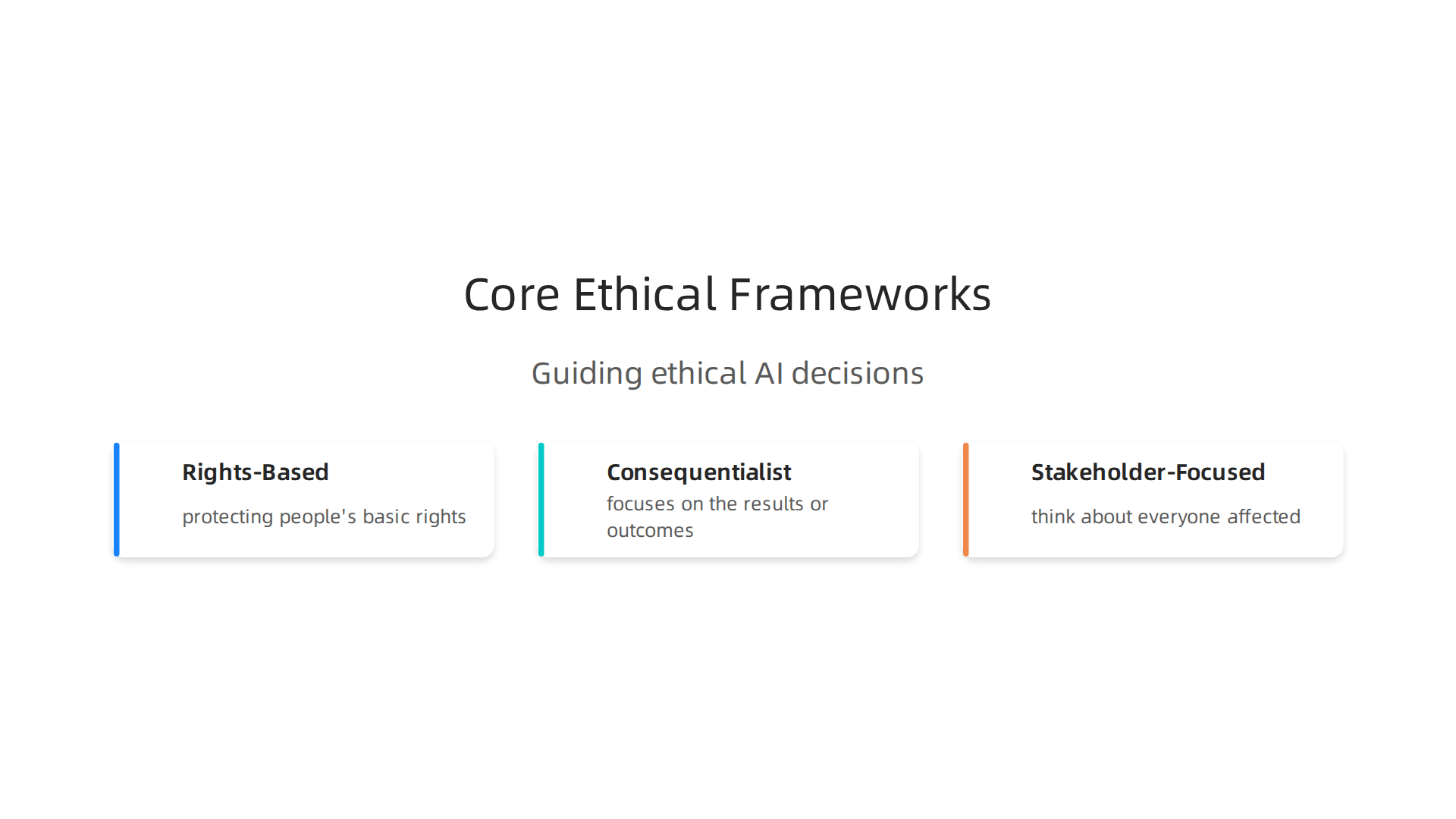
Rights-Based Framework
This framework is all about protecting people’s basic rights. It asks if an AI system respects things like privacy, fairness, and safety. For example, will an AI tool treat everyone equally? Does it keep personal information safe? If an AI system might harm someone’s rights, this framework helps us stop or change it. Many global reports, like the Global Index on Responsible AI: 2026 Report, often use human rights as a foundation for responsible AI.
Consequentialist Framework
This framework focuses on the results or outcomes of using AI. It asks: "What good or bad will happen if we use this AI tool?" The goal is to choose the path that brings the most benefit and the least harm to the most people. For instance, if an AI in healthcare could save many lives but might make a small mistake sometimes, a consequentialist view would weigh those outcomes.
Stakeholder-Focused Framework
This framework makes sure we think about everyone who might be affected by an AI system. "Stakeholders" are all the people, groups, or even the environment that an AI could touch. This includes users, employees, customers, and even society as a whole. It asks: "Who benefits and who is harmed? Have we listened to all their concerns?" This helps us build AI that works well for many different groups.
How to Pick the Right Framework
Choosing a framework depends on what you are trying to do with AI. Different situations might need different ways of thinking. Many guides help compare AI Governance Frameworks to find the best fit.
Here is a simple way to decide:
- For AI that directly affects people’s lives (like in healthcare or law enforcement): Start with the rights-based framework. You must make sure no one’s basic rights are harmed.
- For AI products or research where the main goal is a positive impact on many people: Use the consequentialist framework. Think about the overall good and bad outcomes.
- For any new AI project, especially one that could change how your company works or affects many groups: Always use the stakeholder-focused framework. Make sure you talk to everyone involved and understand their needs and worries.
By using these frameworks, you can make sure your AI decisions are not just smart, but also kind and responsible for the future of AI.

When we talk about the future of AI, it is easy to get lost in all the new ideas and exciting news. Every day, it seems like there is a new "breakthrough" or "game-changing" AI tool. But how can we tell what is truly important from what is just hype? We need a way to sort through all the noise and find the real signals of progress.
This is super important for building AI for good. Just as we learned about making ethical choices with AI, we also need to be smart about what new AI ideas we believe in and choose to use.
A Quick Checklist for New AI Ideas
To help you figure out if an AI breakthrough is real and useful, here is a simple checklist.
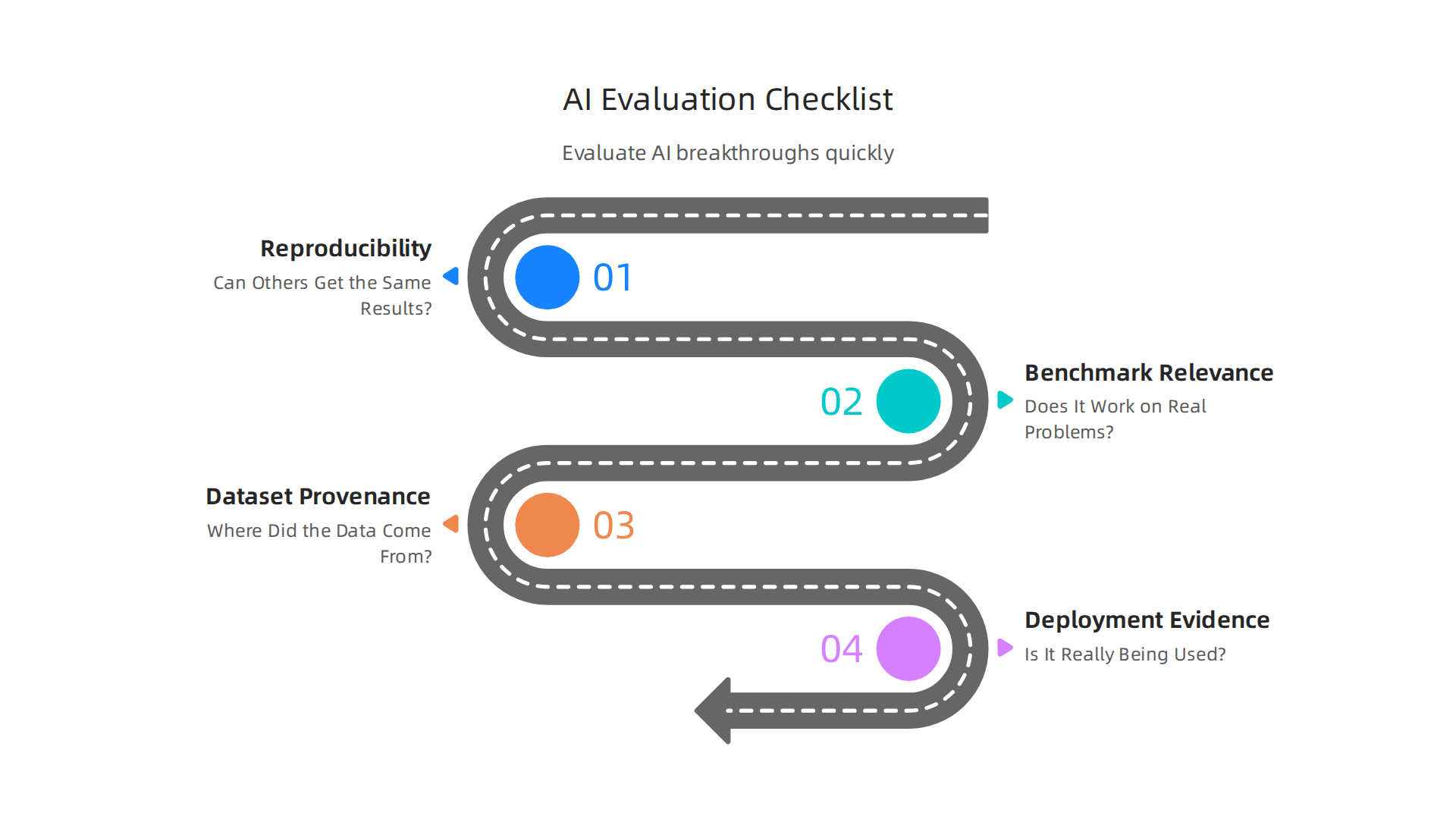
Think of it as your guide to spotting true progress in the fast-moving world of artificial intelligence.
1. Can Others Get the Same Results (Reproducibility)?
If someone says their new AI system can do amazing things, the first question is: can anyone else do it too? This means that if another group tries the same steps with the same tools, they should get very similar results. If they cannot, it might mean the first results were a lucky accident, or maybe some important steps were not shared. Showing how to repeat experiments is a key part of good science. In fact, many experts highlight the need for more open and repeatable AI research today, as noted in studies like "The Shift Toward Open and Reproducible AI Research". There are even checklists, like the AAAI-26 Reproducibility Checklist, that help researchers make sure their work can be checked by others.
2. Does It Work on Real Problems (Benchmark Relevance)?
An AI might be really good at solving a specific puzzle in a lab. But does that puzzle actually matter in the real world? "Benchmarks" are like tests to see how good an AI is. We need to check if these tests are like the real problems we want the AI to solve. If an AI scores high on a test that is too easy or does not match real-life challenges, then its "breakthrough" might not be as useful as it seems. Businesses looking at enterprise AI adoption in 2026 often look for AI systems that have proven their value on practical benchmarks.
3. Where Did the Data Come From (Dataset Provenance)?
All AI learns from data. So, the data it learns from is super important. We need to ask:
- Where did this data come from?
- Is it fair and does it include many different kinds of information?
- Is it clean and free from mistakes?
If the data is biased or not very good, the AI will also be biased or not very good. Think of it like cooking: if you start with bad ingredients, you will end up with a bad meal. Guidelines for AI studies now strongly suggest detailed reporting on source code and training data availability to ensure quality. If you want to dive deeper into how companies evaluate new technologies, you might find information on Affinity AI Due Diligence helpful.
4. Is It Really Being Used (Deployment Evidence)?
Sometimes, an AI looks great in a demo, but it is never actually used outside of a small test. True breakthroughs are often AI systems that are put into action and help people or businesses every day. If an AI is only talked about but never seen working in the real world, it might still be an idea rather than a proven solution. In 2026, many companies are moving AI from test projects to actual use, as shown in the State of AI in the Enterprise report by Deloitte.
Red Flags That Mean It Might Be Just Hype
- Secret Sauce: If the creators do not share how their AI works or cannot explain it simply.
- Too Good to Be True: If the claims sound unbelievably good without much proof.
- One-Time Success: If the AI only worked that one time and cannot be repeated.
- No Real-World Use: If it is only shown in a lab and not actually helping anyone yet.
- Vague Language: If they use big, fuzzy words that do not really say what the AI does.
By asking these questions and looking for these red flags, you can become much better at understanding the real impact of new AI discoveries and separate the exciting facts from the loud noise.
Staying informed about truly important advancements is crucial for anyone working with or interested in the The AI Breakthroughs in 2026 That Actually Matter.
Want to keep up with the fast pace of AI and get reliable insights?
Get clear daily AI updates from The AI Newsletter Worth Reading.
After learning how to tell true AI advancements from just buzz, let us now look at some big changes happening in AI from 2024 to 2026. These changes are really important for how we think about what AI should do and how we make AI products. They shape the future of AI in powerful ways.
3) Recent technical advances (2024–2026) that matter for ethics and product strategy
Big changes in AI over the last few years are making AI systems much more capable. These changes also bring new questions about fairness and safety. Here are some of the most important ones:
Bigger and Smarter AI Models (Model Scaling)
Imagine a brain getting much, much bigger. That is a bit like what "model scaling" means for AI. AI models are being made much larger and are trained on huge amounts of data. This allows them to learn more things and handle very complex tasks, like writing long stories or solving hard math problems.
Why this matters: These bigger models are very powerful, opening doors for amazing new products. However, they can also be harder to understand completely. This means we must be extra careful about how they make decisions. It also highlights why things like open and reproducible AI research are so important. Researchers even call for a clear statement about how software, trained models, and data are available, as discussed in the Checklist for Artificial Intelligence in Medical Imaging (CLAIM) and other guidelines. If we do not understand how they work, it is hard to ensure they are fair and safe, impacting the goal of AI for good.
AI That Understands More Than One Thing (Multimodal Learning)
Before, an AI might be good at understanding text, or good at seeing pictures, but not both at the same time. Now, "multimodal learning" means AI can take in and understand different types of information all at once. For example, an AI can look at a picture, listen to what is happening in the picture, and read a description of it to get a much fuller understanding. This is crucial for things like advanced robotics or even "digital twin technology," where AI needs to process many kinds of real-world inputs.
Why this matters: This makes AI much more like humans in how it understands the world. It can lead to richer, more natural interactions with AI products. But it also means that biases present in different types of data (like biased images and biased text) can combine, creating new challenges for ethical AI use. Understanding how image artificial intelligence works becomes even more critical.
Making Sure AI Does What We Want (Alignment Research)
"Alignment research" is all about making sure AI systems act in a way that matches human values and goals. It is about preventing AI from doing unexpected or harmful things, even by accident. Think of it as teaching an AI common sense and good manners. This research is key to ensuring a positive future of AI.
Why this matters: This area of research is critical for building trustworthy AI. It helps us feel safer about giving AI more important tasks. It also helps us address concerns like "what AI detector do colleges use" by aiming for AI that produces predictable and understandable results, rather than deceptive ones. Ensuring AI systems are aligned with human values is at the heart of responsible AI deployment, as many experts highlight the need for more open and repeatable AI research today, noted in "The Shift Toward Open and Reproducible AI Research" by Coakley et al., 2026 in arXiv.
After looking at how to make AI trustworthy and aligned with human values, it is clear that simply wishing for "AI for good" is not enough. Rules and guidelines are needed. This is why governments and groups around the world are working hard to make sure AI is used safely and fairly. In 2026, we see many different approaches to this.
4) Regulation, policy, and standards to watch (global view)
The way AI is being regulated around the world in 2026 is like a big, colorful quilt.
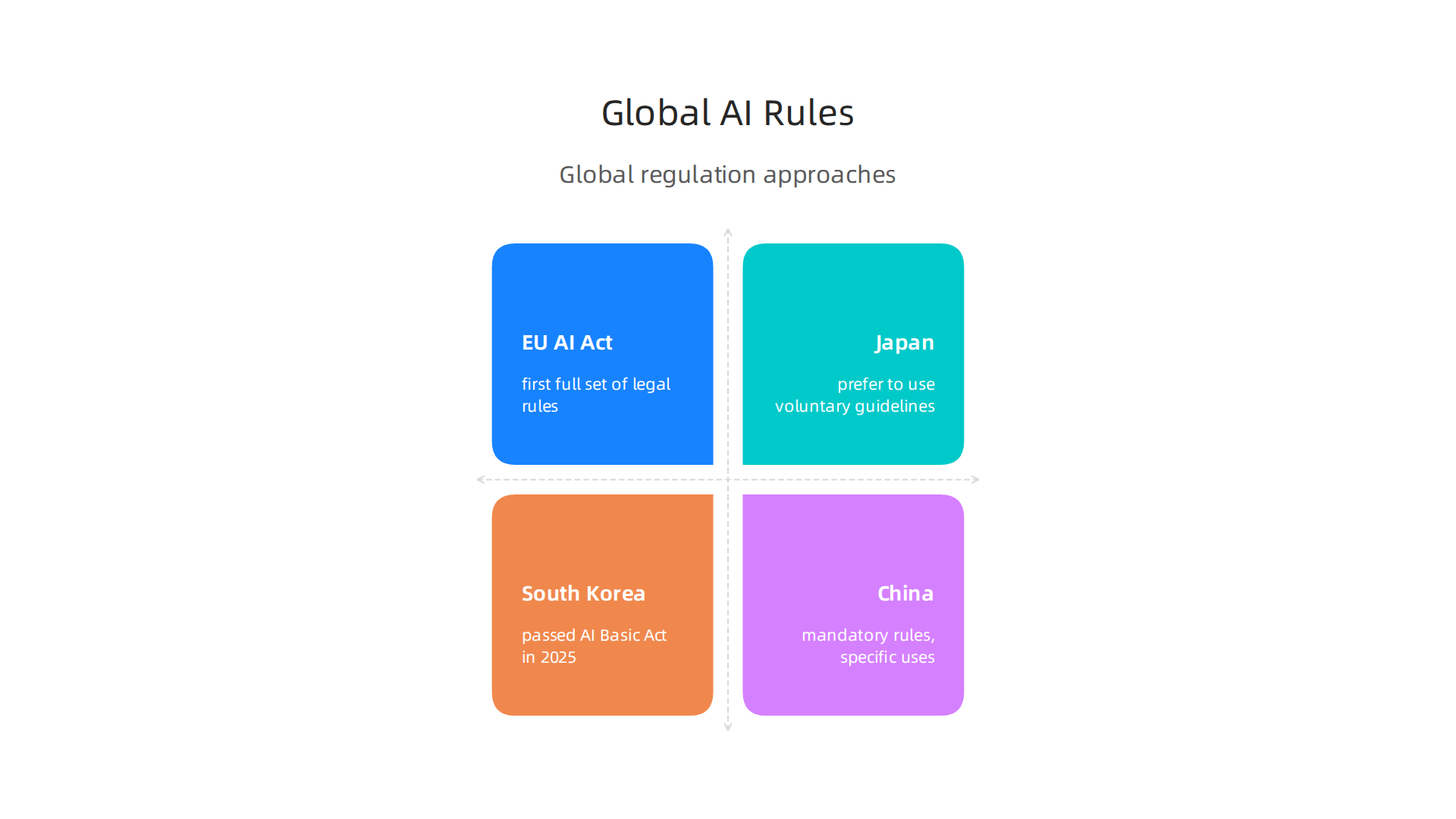
There is no single set of rules everyone follows. Instead, each country or region has its own ideas about how to manage AI. This mix of laws, rules, and suggested guidelines is very important for how companies make and use AI products, and for the overall future of AI.
Different Rules Around the World
Some places have chosen to create strict laws. For example, the European Union has the AI Act, which is the first full set of legal rules for AI anywhere in the world. It looks at different levels of risk from AI and has clear rules that must be followed AI Act | Shaping Europe’s digital future. This means companies making AI for Europe need to be very careful to follow these laws.
Other places, like Japan, prefer to use voluntary guidelines that businesses can choose to follow. These guidelines often focus on making AI human-centered. South Korea, on the other hand, passed its AI Basic Act in 2025, which also uses a risk-based approach AI Regulation Compared: EU, US, UK, China (2026) – Legalithm. Even in places like China, there are mandatory rules, but they might be layered and apply to specific uses of AI How 8 Countries Regulate AI in 2026: The Executive Comparison …. This shows how varied the global map of AI regulation is in 2026.
Important Standards and What They Mean
Beyond laws, there are also common standards being created. These are like best practice guides that companies can use to build better, safer AI.
- ISO/IEC 42001: This is the first international standard for how companies should manage their AI systems. It helps them set up good ways to build and use AI responsibly AI Governance and Regulation 2026: A Complete Guide to Global ….
- NIST’s AI Agent Standards Initiative: In the US, the National Institute of Standards and Technology (NIST) started a program in February 2026 to create standards for autonomous AI agents. This helps make sure these smart AI systems work together safely and securely NIST AI Agent Standards Initiative: Emerging Compliance …. You can learn more about managing AI by understanding the leaders playbook for AI governance in 2026.
What This Means for Leaders
For people running businesses, these different rules and standards mean you have to be smart about your plans. Sometimes, you will need to change your product ideas to meet strict laws, especially if you want to sell in a regulated market like the EU. Other times, it might be better to adopt voluntary standards. This shows your customers and partners that you care about making safe and fair AI, even if the law does not force you to.
Staying on top of these changes is a big job. It helps you avoid problems, build trust, and plan for the real future of AI in a world where AI is everywhere.
To keep up with all the fast-moving news in AI, get easy-to-understand daily updates.
The AI Newsletter Worth Reading
Now that we have looked at the global rules for AI, it is important to see how businesses are actually using AI today in 2026. Companies are quickly moving AI from small tests to big parts of their daily work.

This shift brings great value but also new risks that leaders must manage carefully. Many businesses are focusing on how AI can deliver value without causing harm, ensuring the real future of AI is a positive one.
5) Enterprise adoption patterns: where AI delivers value and where it introduces harm
In 2026, many companies have started using AI in their daily operations. Reports show that most organizations now use AI in at least one part of their business, meaning AI is now a main tool for them Ai Infrastructure Is…. Workers’ access to AI tools also grew by half in 2025 alone The State of AI in the Enterprise – 2026 AI report | Deloitte US. But figuring out where AI truly helps and where it might cause problems is key.
Where AI Brings Value with Less Risk
Many companies find great value in using AI for tasks that are clear and have fewer direct effects on people’s lives. These are often seen as "lower-risk" areas.
- Improving Customer Service: AI chatbots can help answer common questions quickly, making customers happier.
- Analyzing Large Amounts of Data: AI can look at huge piles of information much faster than people, finding trends that help businesses make smarter choices. This helps companies understand their data better, as explained in articles about AI data analytics 2026.
- Automating Simple Tasks: AI can take over boring, repetitive jobs, freeing up employees to do more creative work.
For these kinds of uses, AI can make work faster and better without causing big problems.
High-Risk Areas Where AI Needs Guardrails
However, some areas where AI is used can have a big impact on people’s lives. These are "high-risk" areas, and they need extra care to ensure AI is truly used for good.
- Hiring and Recruitment: Using AI to pick job candidates can be tricky. If the AI is not built well, it might accidentally favor or disfavor certain groups of people, leading to unfair hiring.
- Healthcare: AI can help doctors find diseases earlier or suggest treatments. But if an AI makes a wrong suggestion, it could harm a patient. This is why tools like the Checklist for Artificial Intelligence in Medical Imaging (CLAIM) are so important. It ensures that AI used in medical imaging is safe and reliable.
- Loan Approvals and Financial Decisions: AI used to decide who gets a loan could also be unfair if it has hidden biases. This means some people might not get help they deserve.
In these sensitive areas, companies must be very careful to make sure AI does not cause harm. In fact, nearly 9 out of 10 organizations have faced at least one security issue related to AI agents in the last year Artificial Intelligence Report 2026 | AvePoint #ShiftHappens Insights.
Controls and Monitoring for Safe AI Use
To avoid problems, businesses need to put good practices in place from the start.
- Check Your Data: AI learns from data. If the data is biased or wrong, the AI will be too. Companies need to carefully check the data they use to train AI.
- Watch AI Performance: After an AI tool is put into use, companies must keep watching how it works. They need to set clear goals and measure if the AI is meeting them fairly and correctly Enterprise AI Adoption Challenges: A 2026 Playbook.
- Have a Plan for Problems: Even with the best planning, things can go wrong. Companies need a clear plan for what to do if an AI system causes a problem or acts unfairly. This includes knowing how to fix issues and respond quickly. This kind of planning helps companies manage risks, as outlined in articles like How to build an AI incident response playbook for 2026.
- Be Transparent: Companies should be open about how they use AI, especially in high-risk areas. Explaining how AI decisions are made helps build trust.
By following these steps, companies can use AI to gain real value while also making sure they are responsible and safe. This thoughtful approach will help shape a positive future for AI for everyone.
After setting up good practices for AI, the next big step is to actually measure if they are working. This means looking closely at how AI systems perform and if they cause any problems. It’s how businesses make sure their AI tools are truly helpful and don’t create harm, helping to secure a positive future of AI.
How Companies Measure AI Success and Safety
To make sure AI is used for good, companies look at different measures. These help them know if their AI is working as it should and treating everyone fairly.
- How Well AI Performs: This is about checking if the AI does its job correctly and efficiently. Companies set clear goals for their AI tools. Then, they track things like how fast the AI works, how accurate its answers are, and if it’s helping save money or make customers happier. Businesses with strong ways to measure these things are much more likely to show the true value of their AI projects and make them bigger EnterpriseAIPlaybook_PereiraGraylinBrynjolfsson.
- Safety Problems: Companies keep track of any times the AI makes a mistake or causes an issue. This could be a small error in an automated email or a bigger problem in a system. Counting these "safety incidents" helps teams learn and fix things quickly.
- Fairness Checks: It’s super important that AI treats everyone equally. Businesses watch for any signs that their AI might be unfair or biased against certain groups of people. For example, they check if an AI used for hiring always picks people from a similar background. Learning how to spot and fix these issues is key to making AI fair for everyone. You can learn more about these issues by reading about AI models female bias understanding risks and solutions for leaders 2026.
- Protecting Privacy: AI systems often use a lot of data. Companies need to measure if this data is kept private and safe. They make sure the AI isn’t accidentally sharing personal information or using it in ways it shouldn’t.
Watching AI All the Time
It’s not enough to just check AI once. Companies need to keep an eye on their AI tools all the time.
- Regular Monitoring: Technical teams, like the AI engineers, often watch their systems daily. They use special tools to check how the AI is running and if there are any warning signs. For example, they can pull usage data from big AI platforms to see what tools employees are accessing AI Adoption: The Complete Enterprise Workbook 2026.
- Review by Leaders: Higher-level groups, like "risk committees," look at AI performance less often, maybe every month or every few months. They review reports and make sure the company’s AI goals are still being met safely.
Having a Plan for When Things Go Wrong
Even with careful watching, sometimes AI can still cause problems. That’s why having a clear plan is a must. These plans are often called "incident playbooks." They tell the AI teams exactly what steps to take if something unexpected happens, like an AI system giving a wrong answer or acting unfairly. This helps them fix the issue fast and learn from it. These playbooks are a big part of creating the leaders playbook for AI governance in 2026 and ensuring AI is used for good.
By carefully measuring performance, watching for problems, and having clear plans, businesses can use AI powerfully while making sure it benefits everyone.
Want to stay on top of all the breaking AI news?
The AI Newsletter Worth Reading delivers clear daily AI updates right to your inbox.
Scenarios for the Future of AI (2–10 years): Planning, Investment, and Governance Implications
Thinking about what AI might look like in the coming years helps everyone get ready. It’s like planning for different kinds of weather. What if AI keeps getting better little by little? What if it makes a huge leap very quickly? Or what if new rules slow things down? Let’s look at a few possible futures for AI and what they mean for businesses and leaders.
Three Ways the Future of AI Might Unfold
Experts often think about the future of AI: Five possible scenarios to help plan. Here are three big ones:
- Slow and Steady Growth: In this future, AI tools keep improving, but it’s a gradual process. We see small updates and better versions of what we already have.
- What this means: Businesses should keep investing in the AI they use now, making it a little better each year. They should also focus on teaching their teams how to use AI tools well. Rules for AI can also change slowly over time, giving everyone time to adjust.
- Big Jumps in What AI Can Do: Imagine AI suddenly learning to do much more than we expected. Maybe new technologies like advanced digital twin technology become super smart overnight. This future brings fast changes.
- What this means: Companies need to be ready to quickly change their plans. They should invest in new research and development (R&D) to keep up with the latest breakthroughs. Governments might need to create new rules quickly to keep up with the fast pace of change and ensure AI is used for good.
- Lots of Rules and Slow Rollouts: In this future, many new laws and rules are made about AI. Maybe there are worries about how AI might affect jobs, or concerns like what AI detector do colleges use become very important. These rules could slow down how quickly AI is used in the world.
- What this means: Businesses would need to focus a lot on making sure their AI follows all the new rules. Investment would go into making AI safe and fair, showing how AI can be used for good. Leaders would work closely with lawmakers to help shape these rules, making sure they are helpful and don’t stop good AI from growing.
Getting Ready for Any Future
No one knows exactly what the future of AI will be. But by thinking about these different paths, leaders can get ready for anything. This means having plans for how to invest money, how to set up rules, and what kind of new things to research. Being flexible and always learning is key to success. To learn more about how leaders are preparing, check out this guide on decoding AI trends 2026 breakthroughs investment and governance.
Summary
This guide explains why the fast-moving future of AI matters today and gives leaders practical ways to navigate it. It reviews three ethical frameworks—rights-based, consequentialist, and stakeholder-focused—and explains when to apply each to reduce harm and protect rights. You’ll get a simple, actionable checklist to separate genuine AI breakthroughs from hype, including reproducibility, benchmark relevance, dataset provenance, and real-world deployment. The article also covers major technical trends (model scaling, multimodal learning, alignment), global regulations and standards to watch, and where AI delivers clear value versus where it introduces high risk in enterprises. Finally, it outlines how organizations should measure performance, monitor safety and fairness, and prepare for three plausible futures so teams can invest, govern, and respond effectively as AI evolves.