
Introduction: Staying Ahead in AI Requires the Right Education
Artificial intelligence is moving fast. Really fast. Every week brings a new model, a new tool, or a breakthrough that changes what machines can do. For professionals who want to stay relevant, keeping up with this pace isn’t optional anymore. It’s essential.

The challenge? Information overload. Between LinkedIn posts, YouTube tutorials, paid courses, and free resources, it is easy to feel lost. Everyone claims their training is the best. Hype drowns out signal. And with the global AI in education market projected to grow from $7.52 billion to $10.6 billion in 2026 alone, countless new courses are launching every month. Sorting the valuable ones from the noise takes serious effort.
That is where this guide comes in.
We have done the hard work for you. This article curates the best online course AI options available right now. Each recommendation was evaluated based on expert reviews, real-world outcomes, and practical relevance to today’s job market. Whether you are looking for an ai engineers course to build production systems, an agentic ai course to master autonomous agents, or a google ai course to learn from one of the industry leaders, you will find honest, actionable picks here.
Staying ahead means learning the right things in the right order. According to the latest AI in education statistics, 80% of the workforce will need AI upskilling by 2027. That means the window to build these skills is closing fast. Investing your time in the wrong course is a risk you cannot afford.
The courses we selected cover the full spectrum. Some are beginner-friendly, others are deep technical dives. Some require no coding, others help you become a full-fledged AI engineer. No matter your starting point, there is a path forward.
And if you want to keep up with every major AI update beyond this article, consider subscribing to The AI Newsletter Worth Reading for clear daily insights that cut through the noise.
Ready to find the right training for your goals? Let’s dive in.
If you are new to AI and feel overwhelmed by technical jargon, start here. AI For Everyone is the best online course AI entry point for people who do not write code. Andrew Ng, a co-founder of Coursera and former chief scientist at Baidu, designed this course specifically for non-technical professionals, managers, and leaders.
What You Will Learn
This course cuts through the hype and gives you a clear mental model of what AI can and cannot do. You will learn:
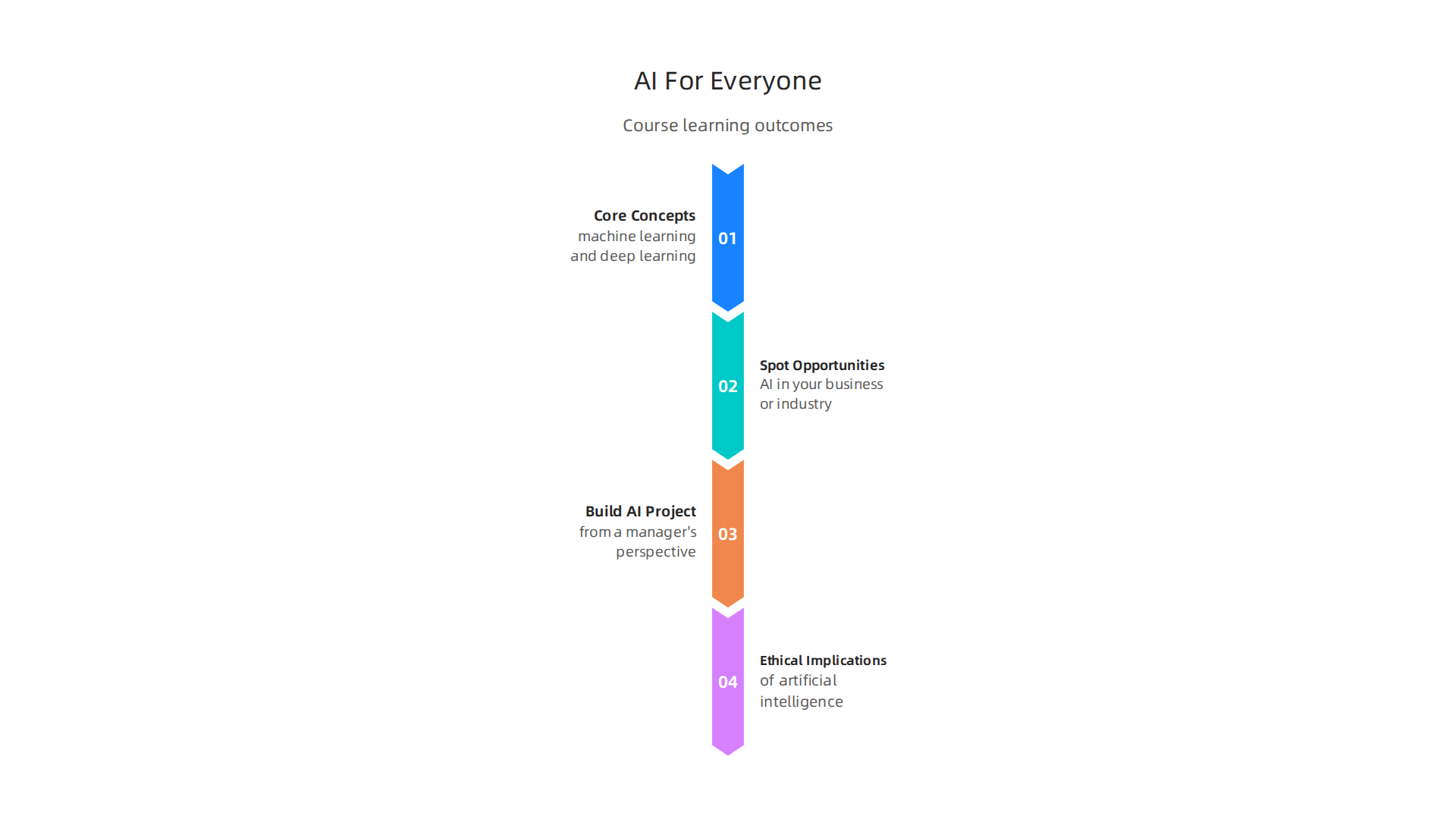
- The core concepts behind machine learning and deep learning
- How to spot opportunities for AI in your business or industry
- What building an AI project actually looks like from a manager’s perspective
- The ethical and societal implications of artificial intelligence
The best part? You do not need any coding experience. No Python. No math beyond basic arithmetic. It is pure conceptual learning that helps you talk about AI with confidence.
Why This Course Stands Out in 2026
With so many options for an ai engineers course or an agentic ai course flooding the market, beginners often jump into deep technical training too early. That is a mistake. Without a solid foundation, you will struggle to understand what the advanced tools are even doing.
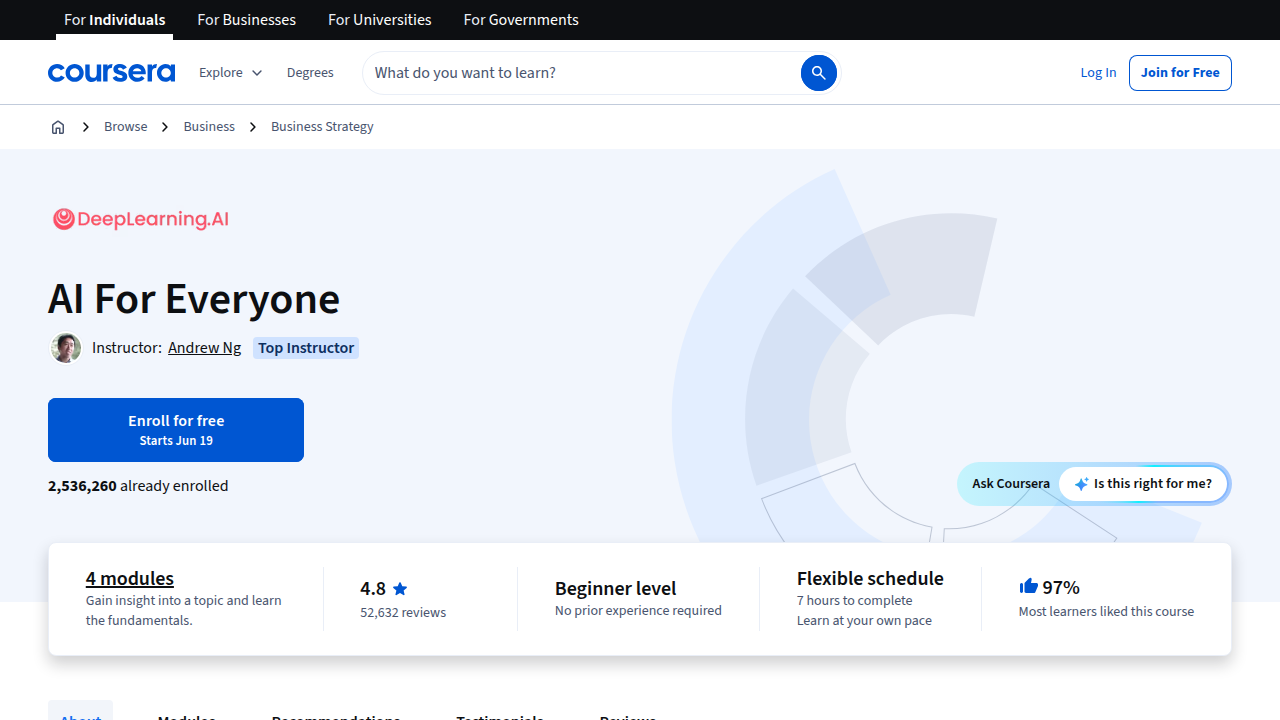
This course solves that problem. It acts like a roadmap for your brain. According to a detailed student review, Andrew Ng "has an amazing teaching style" that makes complex ideas simple and engaging. Over 4.8 million learners have enrolled, and the course holds a near-perfect 4.9 out of 5 rating on Coursera.
Light Workload, Big Impact
Busy professionals love this course because it respects your time. The total workload is roughly 4 to 6 hours spread over one week. You can finish it during a long weekend or in short daily sessions during your commute.
You get a globally recognized certificate from DeepLearning.AI upon completion. And the course is free to audit. You only pay if you want the verified certificate.
Who Should Take It
- Project managers who need to lead AI initiatives
- Marketing and sales leaders exploring AI tools
- Executives making strategic decisions about AI adoption
- Career changers who want a gentle introduction before committing to a full google ai course or similar deep dive
Your Next Step After Finishing
Once you understand the fundamentals, you will be ready to explore more advanced paths. Check out our guide on AI jobs in 2026 to see what skills employers are looking for after you complete this foundational training.
The bottom line: If you only take one introductory online course AI this year, make it this one. It is the fastest way to go from confused to confident.
2. MIT Professional Education’s ‘Applied Machine Learning’ Program
You finished the overview course and now you want to build things. That is where this program shines. MIT Professional Education’s Applied Machine Learning program is a rigorous, university-level experience for people who are ready to write code and work with real data.
What You Will Learn
This is not a lecture-only course. You will use Python and scikit-learn to solve problems with actual datasets. The curriculum covers:
- Supervised and unsupervised learning techniques
- Model evaluation and tuning
- Feature engineering and data preprocessing
- Building a project portfolio that proves your skills
By the end, you will know how to take a messy dataset and turn it into a working model. That is the kind of hands-on ability employers look for in 2026.
Why Choose This Program Over Other Options
Many ai engineers course options skip the hard parts. They show clean examples and never let you struggle. This MIT program does the opposite. It expects you to already know basic programming. In return, you get a credential from one of the most respected universities in the world.
For context, a recent ultimate review of Andrew Ng’s Machine Learning course still gives it top marks for theory. But for real coding practice, MIT’s applied program is in a different league.
You also get networking opportunities with instructors and classmates who work in industry. Those connections can lead to job offers, collaborations, and mentorship.
Who Should Enroll
- Software engineers who want to add machine learning to their toolkit
- Data analysts ready to move into modeling roles
- Technical product managers who need to understand how ML models are built
- Anyone who loved the theory from an introductory online course AI and now wants to code
How It Compares to Other Courses
A google ai course might have brand power, but MIT’s program goes deeper into the mechanics. An agentic ai course teaches autonomous agents, but you need to master supervised learning first. This program gives you the foundation you need before jumping into advanced topics.
The workload is heavier than a weekend overview. Expect 8 to 12 hours per week over several months. But the payoff is real: you finish with skills you can apply immediately at work.
Your Next Step
After you complete this program, you will be ready for deep learning and large language models. Read our guide on mastering practical machine learning for data science in 2026 to see how this certification fits into a complete learning path.
And as you move through your AI journey, staying updated on new breakthroughs matters. Get clear daily AI updates from The AI Newsletter Worth Reading so you never miss important developments.
3. Coursera’s ‘Machine Learning Specialization’ by Andrew Ng & Stanford
If you are not ready for the heavy coding of MIT’s program yet, or if you want a rock-solid foundation in machine learning theory first, this is the place to start.

Andrew Ng’s Machine Learning Specialization on Coursera is the most famous online course AI beginners have turned to for over a decade. In 2026 it remains the gold standard for understanding how algorithms actually learn.
What You Will Learn
This is a completely updated version of the classic course. The new curriculum now includes modern topics like neural networks and decision trees alongside the traditional linear regression and support vector machines. Each module has hands-on assignments in Python using real-world case studies. You will solve problems like handwritten digit recognition and spam classification.
The format is beginner-friendly. You do not need prior experience with machine learning tools. As one detailed Andrew Ng’s Machine Learning Course review notes, the course is designed for complete beginners and is 100% free to audit. If you want the verified certificate, it costs around $50. That is a tiny price for a credential that employers recognize worldwide.
Why Choose This Specialization
Many ai engineers course options rush you into coding libraries without explaining the math behind them. Ng does the opposite. He takes complex algorithms and explains them in simple, intuitive ways. The course covers:
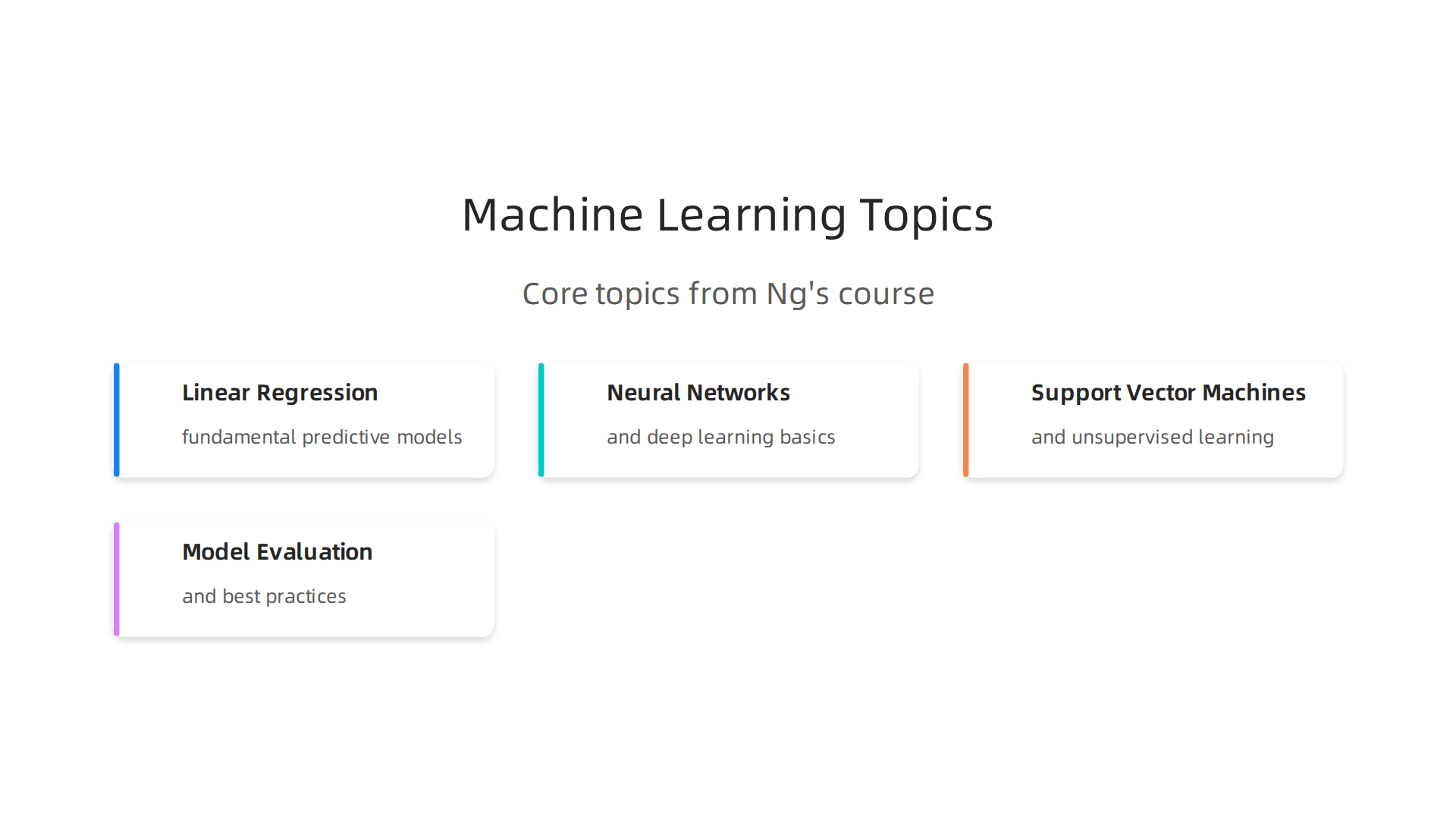
- Linear and logistic regression
- Neural networks and deep learning basics
- Support vector machines and unsupervised learning
- Model evaluation and best practices
By the end, you will understand why a model works, not just how to run a line of code. That conceptual foundation is what separates strong data scientists from people who only know how to call scikit-learn.
How It Compares to Other Options
A google ai course can teach you to use their specific tools quickly, but it usually skips the core theory. This Stanford specialization builds the theory first. If you later want to study an agentic ai course that covers autonomous agents, you will need the foundation this course provides. Think of it as the prerequisite for everything else.
The specialization takes about 11 weeks at 5 to 7 hours per week. You can audit for free and upgrade only when you want the certificate.
Your Next Step
After finishing this course, you will have the credential and the knowledge to apply for data science and machine learning roles. For a complete picture of how this fits into a career, read our guide on ai jobs 2026 the skills certifications and portfolio that get you hired. It will show you exactly how to turn this course into a job offer.
4. Fast.ai’s ‘Practical Deep Learning for Coders’
What if you could build and deploy a working AI model on your very first day of learning? That is the promise of Fast.ai’s Practical Deep Learning for Coders. While Andrew Ng’s course builds theory first, Fast.ai flips the order. You start writing code immediately and learn the theory as you go.
This top-down approach is perfect if you already know how to code (a year of Python experience is enough) and you want to see results fast. By the end of lesson two, you will have trained and deployed your own deep learning model. That is a huge confidence boost.
What Makes This Course Different
Fast.ai focuses on modern architectures that matter in 2026. You will work with transformers (the engine behind tools like ChatGPT) and diffusion models (used for image generation). The course covers computer vision, natural language processing, tabular data, and recommendation systems. All of this is completely free. You just need a computer and an internet connection.
The format is nine lessons, each about 90 minutes long. You follow along using Jupyter notebooks on the Practical Deep Learning for Coders course page. There are no quizzes with tricks. Instead you get hands-on exercises that teach you how to debug models and improve accuracy.
The community around Fast.ai is also one of the best. Forums are active. Course creators answer questions. And many students share their projects and job wins after finishing.
Who Should Take This Course
This online course AI is designed for developers who want to move fast. If you have tried a google ai course but felt it skipped important concepts, this will fill the gaps. If you eventually want to study an agentic ai course (building autonomous AI agents), the practical skills here will give you a solid starting point.
Many people who complete this course also go on to work as ai engineers course graduates. The projects you build (like a pet breed classifier or a movie recommendation system) make a strong portfolio piece.
How It Compares to Others
Unlike the Coursera specialization, which takes weeks of lectures before you build anything, Fast.ai gets you productive in hours. You learn PyTorch, fastai, and Hugging Face tools. But you also learn why things work. The course introduces calculus and linear algebra only when you need it.
If you want to see where these skills lead, check out our guide on best AI tools for businesses. It shows how the models you learn to build here are used in real companies.
Your Next Step
The entire course is free and open to anyone with basic coding experience. You can start today. Once you finish, you will have a practical understanding of deep learning that you can immediately apply to projects or job applications.
And if you want to keep up with the fast-changing AI world while you learn, consider The AI Newsletter Worth Reading. It delivers clear daily updates so you never miss a breakthrough.
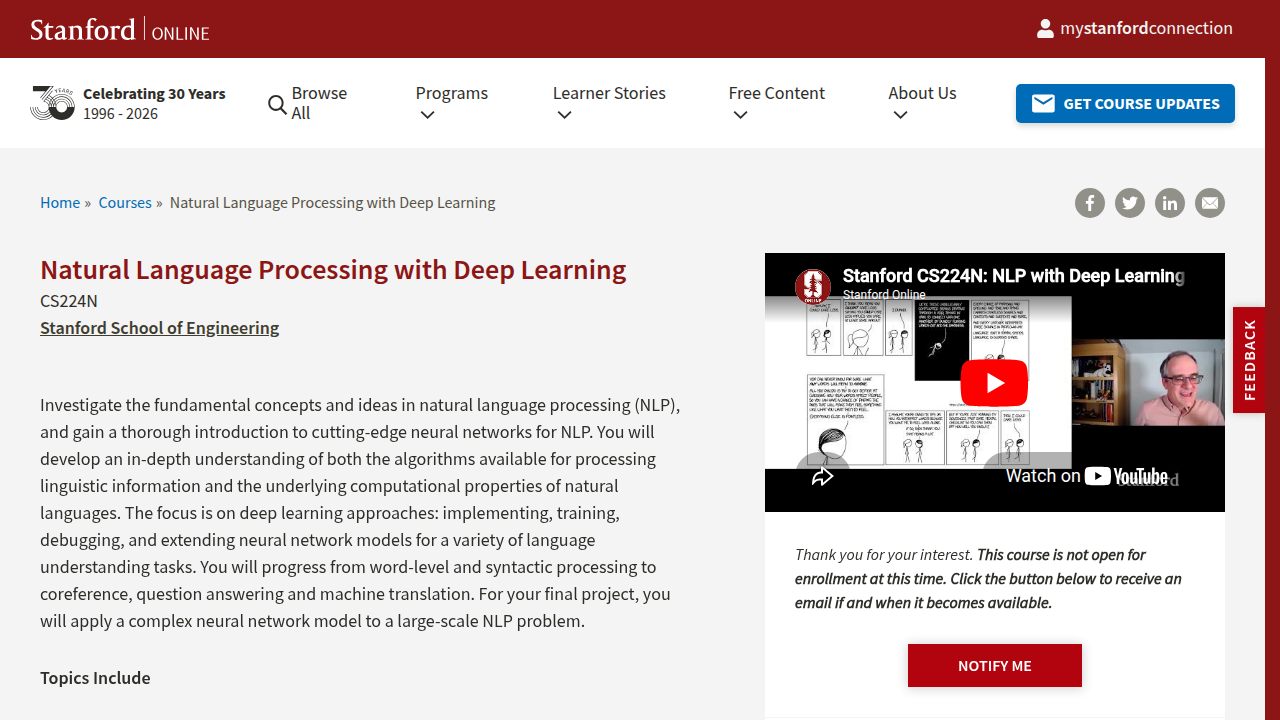
5. Stanford Online’s ‘CS224n: Natural Language Processing with Deep Learning’
Have you ever wondered how ChatGPT understands your questions so well? The magic behind it is natural language processing (NLP). And the gold standard for learning NLP at a deep level is Stanford Online’s CS224n course.
This course is not for beginners. It expects you already know machine learning basics and can code in Python. But if you are ready for the challenge, it will teach you how large language models (LLMs) truly work under the hood.
What You Will Learn
CS224n covers the architecture that powers today’s most advanced AI systems. You will study attention mechanisms, transformer models, and fine-tuning techniques. The lectures are delivered by Stanford researchers who actually helped invent many of these methods.
By the end, you will understand how to build and train your own NLP models from scratch. You will work on real assignments that involve tokenization, sequence modeling, and transfer learning. This is exactly the kind of hands-on experience that top companies look for in an ai engineers course graduate.
Who Should Take This Course
This online course ai is designed for engineers who already have a strong technical foundation. If you completed a google ai course and want to go deeper into language models, CS224n is the natural next step. It is also excellent preparation if you plan to study an agentic ai course later, because understanding NLP is crucial for building autonomous agents.
The workload is heavy. Each week includes lectures, readings, and programming assignments. Expect to spend 10 to 15 hours per week on this course. But the payoff is real. Graduates of CS224n often land roles at top AI labs and research teams.
Why It Matters in 2026
In 2026, NLP skills are in higher demand than ever. Every major tech company is racing to improve their language models. This course gives you the theoretical depth to innovate, not just use existing tools. To see where these skills lead, check out our guide on AI jobs and the certifications that get you hired.
Your Next Challenge
CS224n is tough. It will push you harder than Fast.ai or Ng’s course. But if you complete it, you will have a deep understanding of how modern NLP works. You will be ready to contribute to real research or build production-grade language systems.
This course is free to audit through Stanford Online. The lecture videos, slides, and assignments are all available.
If you are ready to go beyond surface-level learning, this is your next step.
6. Google Cloud’s ‘Professional Machine Learning Engineer’ Certification Path
Stanford’s CS224n taught you how to build language models from scratch. That is research-level work. But in 2026, most companies need engineers who can take those models and put them into production. That is where Google Cloud’s Professional Machine Learning Engineer certification comes in.

This online course ai path focuses entirely on MLOps, deployment, and building reliable ML pipelines.
What You Will Learn
The certification is built around hands-on labs using Vertex AI and TensorFlow. You will learn how to design, build, and manage production ML systems. Topics include data preparation, model training, hyperparameter tuning, model evaluation, and automated pipelines.
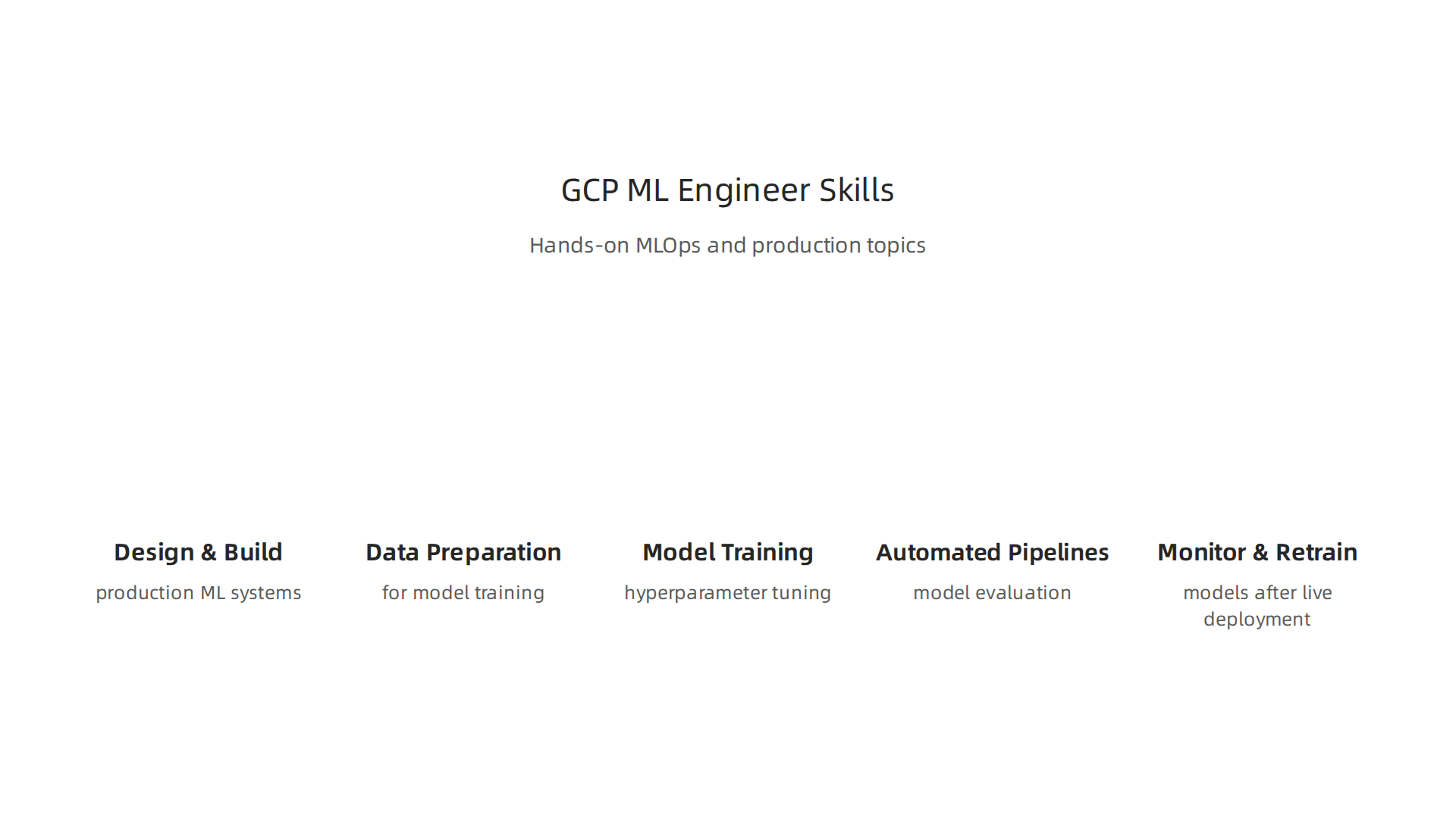
You also cover monitoring and retraining models after they are live. The goal is to make sure your models keep working well in the real world.
This is not just theory. You run actual labs where you deploy models to the cloud, set up CI/CD for machine learning, and use Google’s tools to manage experiments. By the end, you can handle the entire lifecycle of an ML project.
Who Should Take This Path
This certification is perfect for engineers who already know machine learning basics but want to become an ai engineers course graduate that companies actually hire. If you have taken an google ai course like TensorFlow Developer Certificate, this is the natural step up. It is also useful if you plan to later study an agentic ai course, because autonomous agents need robust deployment and monitoring systems.
You do need some experience with Python, basic ML concepts, and familiarity with Google Cloud. Expect to spend three to six months studying, depending on your background. The official Google Cloud learning site offers guided labs and practice exams.
Why It Matters in 2026
In 2026, every business that uses AI struggles with moving models from notebooks to production. Engineers who can bridge that gap are in high demand. This certification proves you can do exactly that. To see how cloud skills fit into the bigger picture, check out our guide on top AI platforms for business growth.
Your Next Step
If you want to turn your AI knowledge into real impact at work, the Professional Machine Learning Engineer path gives you the practical, production-ready skills employers need. It is a clear credential that opens doors to roles like ML engineer, AI architect, and cloud ML specialist.
Stay up to date on the latest AI learning resources and industry trends. Subscribe to The AI Newsletter Worth Reading for daily updates you can actually use.
7. Hugging Face’s ‘NLP Course’ (Free & Open Source)
You have spent time learning to deploy models on Google Cloud. But what if you want to work with the most advanced language models without paying a cent for tuition? That is where Hugging Face steps in. Their online course ai path has become the go‑to resource for engineers who want to understand transformers from the inside out.
What You Will Learn
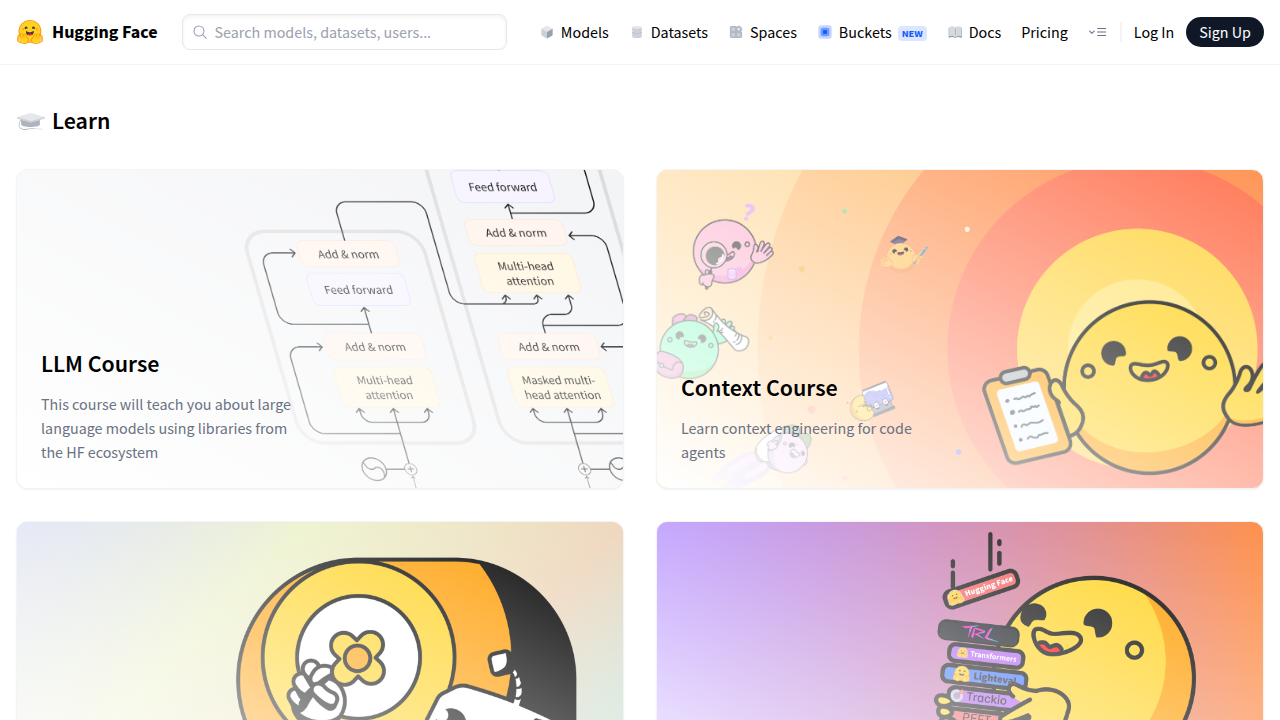
The course started as a pure NLP curriculum. In 2026, Hugging Face has expanded it into the LLM Course, covering both classic NLP tasks and modern large language models. You start with the basics of the Transformers library, then move through pipelines, tokenizers, datasets, and fine‑tuning. Later chapters dive into advanced topics like building reasoning models and curating high‑quality datasets. The course is completely free, ad‑free, and maintained by the engineers who build the Hugging Face ecosystem.
Hands‑On from Day One
This is not a lecture series. From chapter one, you are writing code. You learn to load a model from the Hugging Face Hub, fine‑tune it on your own data, and share your results back to the community. You also practice building live demos with Gradio. If you have ever wanted to take a pretrained BERT or GPT model and make it do something useful, this course shows you exactly how. It is a perfect ai engineers course for anyone who learns by doing.
Who Should Take This Path
If you already understand basic machine learning and want to specialize in language, this is your next step. The course assumes you know Python and have some experience with PyTorch or TensorFlow. It is ideal for engineers who plan to later study an agentic ai course, because autonomous agents rely heavily on language model pipelines. And because Hugging Face is the largest open‑source AI community, you get instant access to thousands of models and a network of developers who can help you debug.
Why It Matters in 2026
Most AI projects today involve language models. Knowing how to use the Hugging Face ecosystem is a skill that transfers to almost any role, from research to product engineering. The course also teaches you about responsible AI and carbon footprint tracking, topics that matter more every year. To see how this fits into the broader landscape of AI companies, check out our list of top AI companies in 2026.
Your Next Step
The best part? The entire course is available now at huggingface.co/learn. No credit card needed. No sign‑up required.
Just open the first chapter and start building. According to the official course introduction, each chapter takes about 6 to 8 hours to complete. That means you could go from beginner to a fine‑tuned model in a few weekends. If you want a free, community‑backed path that teaches you what actually matters in 2026 NLP and LLM work, this is it.
8. Coursera’s ‘Generative AI with LLMs’ by DeepLearning.AI & AWS
The Hugging Face course is fantastic for learning the nuts and bolts of transformers. But what if you want a structured curriculum with a certificate and deep dives into production deployment? That is where this online course ai path from DeepLearning.AI and AWS shines.
What You Will Learn
This course covers the full lifecycle of large language models. You start with the fundamentals of how LLMs work and how to choose the right model for your task. Then you move into fine‑tuning, which means taking a pre‑trained model and teaching it your own data. You also learn reinforcement learning from human feedback (RLHF), the technique that makes models like ChatGPT so helpful. Finally, you practice deployment using Amazon SageMaker.
Hands‑On with Industry Tools
Every concept comes with a lab. You use Amazon SageMaker to run training jobs and deploy models. You also use Hugging Face libraries inside the AWS environment. This gives you real experience with the tools that power many AI products in 2026. If you already know Python and basic machine learning, you can follow along comfortably. The labs are designed for professionals, not beginners.
Who Should Enroll
This is an ai engineers course made for engineers who already understand ML basics. You should know what a neural network is and have trained a simple model before. You do not need to be a deep learning expert. The course fits well between advanced theory and hands‑on practice. If you plan to study an agentic ai course later, this foundation in LLMs will help you build autonomous agents that actually work.
Why It Matters in 2026
Companies need people who can take a generic LLM and turn it into a product. Fine‑tuning, RLHF, and deployment are the skills that make you hireable. According to the 2026 AI upskilling guide, 80% of the workforce needs to retrain, and knowing how to customize models is a huge advantage. The course also covers responsible AI, which is becoming a must‑know topic.
Your Next Step
If you want a certificate from DeepLearning.AI and AWS to add to your resume, this course is a smart choice. You can find it on Coursera and start learning in a few minutes. For daily updates on the AI field, you can also get the The AI Newsletter Worth Reading and receive clear insights straight to your inbox.
To see how these skills connect to real‑world roles, check out our guide on the top AI jobs in 2026.
Summary
This article curates the best online AI courses in 2026, evaluating options for total beginners through advanced engineers and practitioners. It explains what each course teaches, who should take it, expected workload, and how it fits into a career progression—from Andrew Ng’s non‑technical introduction to MIT’s applied coding program, Fast.ai’s rapid hands‑on deep learning, Stanford’s CS224n for NLP, Google Cloud’s MLOps certification, Hugging Face’s LLM‑focused lessons, and DeepLearning.AI/AWS generative AI labs. The guide highlights free and paid paths, practical project and deployment training, and which courses build immediate job‑ready skills versus theoretical depth. Readers will learn how to match a course to their goals, avoid common pitfalls (like jumping to advanced topics too soon), and plan next steps to translate learning into real roles or projects. It also points to follow‑up resources and recommends staying current with daily AI updates to keep skills market‑relevant.