

Introduction: Why Quant Data Science is the New Business Imperative
Do you ever feel like you are drowning in data but starving for real answers? You are not alone.
Business leaders today face an overwhelming flood of information. Every department produces reports. Every tool generates dashboards. Every meeting produces more charts and spreadsheets. The problem is not a lack of data. The problem is separating the signal from the noise.

That is where quant data science comes in.
Quant data science is not just another buzzword. It is a rigorous, data-driven approach that helps you make better decisions even when the future feels uncertain. Think of it as a reliable framework that cuts through the clutter and points you toward what actually matters.
At its core, quant data science combines statistics, mathematics, and computational thinking to turn raw numbers into actionable strategies. It is the science of learning from data, as one widely cited definition of data science on Wikipedia puts it. The field uses techniques from statistics, computer science, and domain knowledge to extract meaningful insights for everything from product launches to investment decisions.
This article will help you understand what quant data science really means. We will explore the core techniques that make it work. We will look at practical ways to apply these methods in your own work. And we will cover the skills you need, whether you are pursuing a clear guide to understanding data analytics or aiming for a data science masters degree.
Because here is the thing. The companies that thrive in 2026 will not be the ones with the most data. They will be the ones that know how to use it wisely. Quant data science gives you that wisdom.
And if staying ahead of fast-moving trends like this matters to you, The AI Newsletter Worth Reading delivers clear daily updates so you never miss a breakthrough.
Let us dive in.
What is Quant Data Science? A Clear Definition for Business Leaders
Let us get specific. You have heard the term tossed around, but what does quant data science actually mean for someone running a business?
Here is the simplest way to think about it. Quant data science is a math-heavy approach to making decisions when you do not have perfect information. It blends advanced statistics, probability theory, and computational thinking into a single framework. But the real magic is in what it prioritizes.
Most people think data science is about predicting the future. Quant data science cares more about understanding uncertainty and measuring risk.
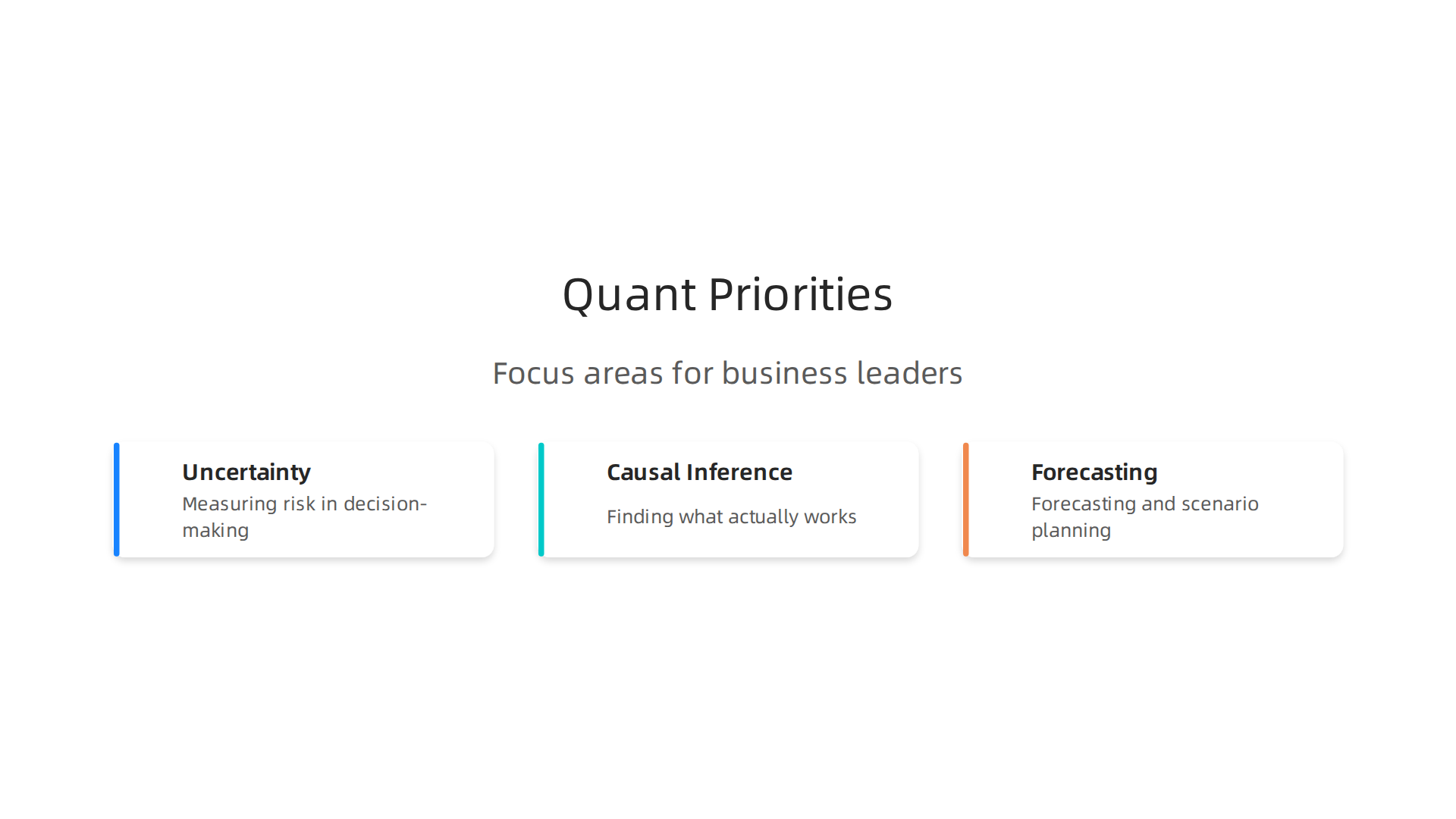
It asks questions like: How sure are we about this result? What would happen if we changed one variable? Is this really cause and effect or just coincidence?
This is a big shift from how many organizations use data today. A lot of teams just build dashboards that show what happened. Quant data science goes deeper. It uses rigorous methods to figure out why it happened and what will probably happen next if you make a specific move.
The field actively combines computational methods and inferential reasoning to extract knowledge from data. Top programs like the Stanford University data science major teach students to master this blend of computation and inference specifically for decision-making. That is the heart of quant data science.
This approach also leans heavily on what researchers call the quantitative side of data science. One helpful paper from the Harvard Data Science Review explains how quantitative methods focus on patterns and processes, seeking patterns for predictions and generative processes for deeper understanding. Quant data science lives on that quantitative side. It is not about storytelling or soft interpretations. It is about numbers, probabilities, and testable logic.
So how is this different from regular data science?
Think of it this way. General data science includes everything from cleaning messy spreadsheets to building chatbots. It is a big umbrella. Quant data science is a focused subset underneath that umbrella. It trades breadth for mathematical depth.
A regular data scientist might build a model that predicts customer churn. A quant data scientist would build that same model but also calculate exactly how much risk you are taking if you ignore it. They would tell you the probability that your marketing campaign actually caused the lift, not just that sales went up.
This focus on actionable decision-making under risk is what makes quant data science so valuable for business leaders. It does not just hand you a prediction. It hands you a decision framework with clear trade-offs.
If you want to see how these rigorous, data-driven approaches are reshaping real business strategies in 2026, check out our coverage of AI data analytics trends that deliver real results. The principles are very much the same.
Core Quantitative Techniques for Business Decision-Making
So what does quant data science actually look like in practice? When you strip away the math, three core techniques do most of the heavy lifting.
Each one helps you answer a different kind of business question.
Bayesian Inference: Updating Your Beliefs with Data
This is probably the most powerful tool in the quant data science toolbox. Here is the idea in plain English. You start with what you already know. That is your prior belief. Then you collect new data and use it to update that belief. The result is a smarter, more accurate belief.
Think about dynamic pricing as an example. An airline starts with a prior belief about how many seats will sell at a certain price. As ticket sales come in, the Bayesian model updates that belief in real time. It tells the airline exactly how much uncertainty remains. Should they lower the price or hold steady? The model quantifies the risk of each choice.
This same approach works for insurance risk assessment, fraud detection, and personalized marketing. A Bayesian data science for business guide from PyMC Labs explains how combining prior knowledge with data and quantifying uncertainty leads to better decisions. That last part is the real differentiator. Most models give you a single number. Bayesian models give you a range of possible outcomes with probabilities attached.
Causal Inference: Finding What Actually Works
Here is a frustrating reality. Two things happen at the same time, but that does not mean one caused the other. Sales went up right after you launched a new ad campaign. Was the campaign the reason? Or was it just a busy season?
Causal inference methods answer that question. A/B testing is the most famous example. You split your audience, show one group the new campaign, compare results. But there are more advanced tools too. Methods like instrumental variables and difference-in-differences help you isolate cause and effect even when you cannot run a clean experiment.
For business leaders, this is where quant data science earns its keep. It stops you from wasting money on things that look effective but are not.
Time Series Analysis and Monte Carlo Simulations
The third set of techniques handles forecasting and scenario planning. Time series analysis looks at historical data points over time and finds patterns. Think stock prices, monthly sales figures, or website traffic. It predicts future values by understanding past behavior.
Monte Carlo simulations take this further. Instead of one prediction, they run thousands of possible scenarios. Each scenario uses slightly different assumptions. The result is a probability distribution of outcomes. You can say things like: "There is an 85 percent chance our revenue will be between 10 and 12 million next quarter." That is far more useful for planning than a single number.
These techniques require solid data management to work well. If your data is messy or incomplete, even the best model will fail.
If all this sounds like a lot to learn, you are not alone. Many business leaders start by building their own skills first. Our guide on how to succeed as a data analyst in 2026 walks through the practical steps to get hands-on with these techniques.
And if you want to stay on top of how these methods keep evolving, The AI Newsletter Worth Reading delivers daily updates that connect new research to real business applications.
Key Tools and Platforms for Quant Data Science in the Enterprise
You have the techniques down. Now you need the right tools to actually run them. The good news is you do not need a giant budget or a team of PhDs. The ecosystem has matured a lot. In 2026, most of the heavy lifting can be done with open-source tools, cloud services, or low-code platforms
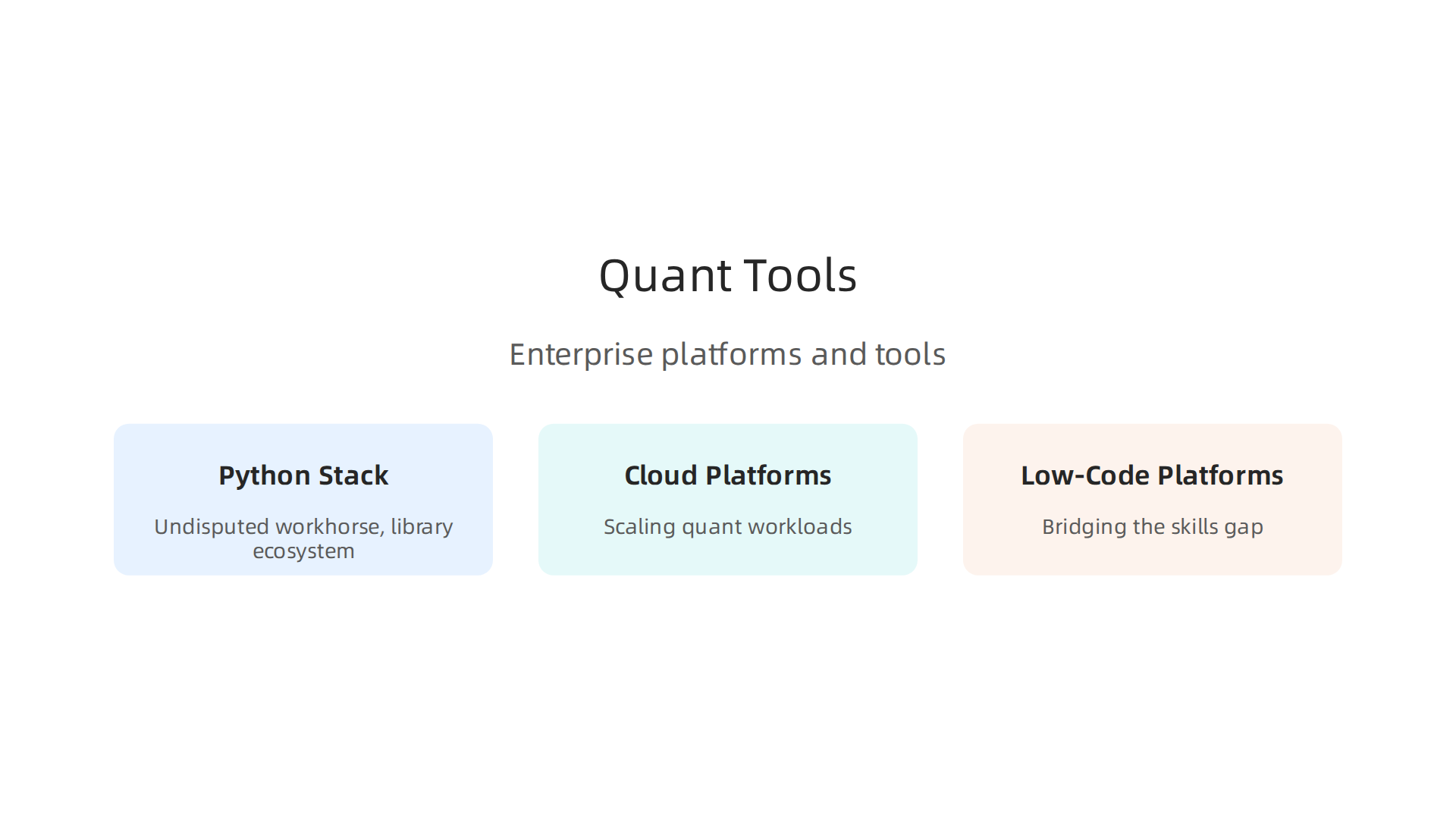
that put power in your hands.
The Python Stack: Where Quant Data Science Lives
Python is the undisputed workhorse of quant data science. Its library ecosystem handles everything we talked about in the previous section. For Bayesian inference, PyMC is the gold standard. It gives you an intuitive syntax for building probabilistic models and runs on top of PyTensor for fast computation. The same team behind PyMC also built CausalPy, which brings causal inference into the same workflow.
For causal inference specifically, libraries like EconML and DoWhy from the PyWhy ecosystem are widely used in industry. A Reddit thread on tools for causal inference shows that professionals rely heavily on EconML, PyWhy, and statsmodels for their daily work. Stan is another heavy hitter for Bayesian modeling, especially when you need advanced sampling methods.
The full list of Python libraries for data science in 2026 is impressive. It includes powerhouses like Polars for fast data processing, PyTorch for deep learning, and Scikit-learn for traditional machine learning. But for quant data science specifically, the probabilistic and causal libraries are where the magic happens.
Cloud Platforms: Scaling Quant Workloads
When your models get big or your data grows, running everything on your laptop stops working. That is where cloud platforms like AWS SageMaker and Azure ML come in. These managed services handle the infrastructure so you can focus on the model itself.
SageMaker, for example, gives you built-in algorithms for Bayesian optimization and time series forecasting. It integrates with the Python libraries you already use. You can spin up a training job, run a Monte Carlo simulation with a million scenarios, and shut it down when you are done. You only pay for what you use.
Azure ML offers similar capabilities with strong support for MLOps and model monitoring. Both platforms let you collaborate across teams, which is critical when you are working on something like enterprise AI tooling in 2026.
Low-Code Platforms: Bridging the Skills Gap
Not everyone on your team needs to write Python code. Low-code platforms like Dataiku and Alteryx let business analysts and domain experts build quant data science workflows without deep programming skills.
Dataiku gives you a visual interface for building pipelines. You can drag and drop steps for data cleaning, feature engineering, and model training. Under the hood, it still uses the same Python libraries. But the interface makes it accessible to people who understand the business problem but do not code every day.
Alteryx works similarly, with a focus on data blending and analytics. It connects to your databases, spreadsheets, and cloud sources in one place. For many mid-size companies, these platforms are the fastest way to get quant data science running without hiring a full team of specialists.
The takeaway is simple. Pick the tool that matches your team’s skill level and your data volume. You can always start small and scale up as your needs grow. The Python listicle we referenced covers the libraries you need to master, but remember that cloud and low-code options exist to accelerate adoption.
Applications of Quant Data Science in Business Strategy
Knowing which tools to use is only half the battle. The real question is where you apply them. Quant data science techniques are not just academic exercises. They solve real business problems every day. In 2026, companies that use these methods make smarter decisions faster.

Let’s look at three areas where they deliver the most value.
Finance: Smarter Risk Management
In finance, quantitative risk management relies on probabilistic models. These models help portfolio managers optimize their asset mix and run stress tests. Instead of guessing what might happen, you simulate thousands of scenarios. You see the range of outcomes and plan accordingly. A major case study library shows that advanced techniques like algorithmic trading can cut costs while improving performance. Banks and investment firms use Bayesian models to estimate the probability of default, market crashes, and other low-probability but high-impact events. The result is a portfolio that balances return and risk much better than traditional methods.
Marketing: Attribution and Customer Lifetime Value
Marketing teams use quant data science to figure out which campaigns actually drive sales. Bayesian hierarchical models are great for marketing attribution. They also help estimate customer lifetime value. You can predict how much a customer will spend over their relationship with your brand. One data science leader shared how advanced segmentation lifted email engagement from 12,000 to 20,000 active users. That is a 66% improvement in marketing ROI. Instead of blasting every customer with the same message, you tailor offers based on predicted value. Companies that master this approach see 15-25% improvement in marketing ROI, according to a comprehensive data science case study roundup. For a broader look at how AI is transforming data analytics in 2026, check out this guide on AI data analytics trends for 2026.
Operations: Demand Forecasting and Inventory Optimization
In operations and supply chain, causal inference helps with demand forecasting and inventory optimization. Instead of just spotting patterns, you understand what drives demand. That means you order the right amount of stock and reduce waste. A manufacturing plant used data science to cut unplanned downtime by 18%. They combined sensor data with predictive models to catch problems before they happened. Another facility reduced energy waste by 12% in the first quarter using similar techniques. These are not hypothetical results. They come from real-world case studies in manufacturing that show quant data science pays for itself quickly.
Quant data science is reshaping how companies make decisions across every department. If you want to stay ahead of the curve, keeping up with the latest AI and data trends is essential. Subscribe to The AI Newsletter Worth Reading for clear daily updates that help you apply these techniques in your own work.
Integrating Quant Data Science into Your AI Strategy
You have seen how quant data science drives better decisions in finance, marketing, and operations. But here is the real opportunity. The biggest wins come when you weave these methods directly into your AI strategy. Standard machine learning models often give you a prediction without telling you how sure it is. Quant data science changes that. It adds a layer of mathematical rigor that makes your AI systems more trustworthy.
Better model interpretability and uncertainty estimation
Most black-box AI models cannot explain why they make a certain call. That is a problem in regulated industries like healthcare, insurance, and banking. Quant methods like Bayesian inference solve this. They give you a probability distribution instead of a single number. You know not just the prediction but also how confident the model is. In practice, this means you can tell a doctor "we are 85% sure this patient has condition X" instead of just "yes or no." That is a much more useful signal. The FDA has issued official guidance on using Bayesian methodology in clinical trials precisely because this approach handles uncertainty so well. When you combine quant data science with your AI pipeline, you build systems that regulators trust and that business leaders can act on.
Rigorous model evaluation through hypothesis testing
Standard machine learning evaluation often just checks accuracy on a holdout set. Quant data science goes further. You can run formal hypothesis tests to compare models. You can quantify the risk of deploying a new algorithm versus sticking with the current one. This is especially valuable when AI systems have direct financial or safety consequences. Instead of crossing your fingers, you have data-backed confidence that the change is an improvement. The same Bayesian framework that helps with uncertainty also gives you a statistically sound way to compare models and set thresholds for action.
More robust and trustworthy AI systems
When you combine quant data science with machine learning, you get the best of both worlds. Quant methods handle data scarcity by incorporating prior knowledge. They also prevent overfitting better than many deep learning approaches. Recent data shows that Bayesian data science helps businesses make better decisions by dealing with incomplete information effectively. The result is AI that does not just guess but thinks about its own limits. That is the kind of system you can rely on in production.
If you want to go deeper into what makes AI truly reliable in practice, this guide to understanding realistic AI in 2026 offers a practical view for leaders who need results that hold up under pressure.
Common Challenges in Quant Data Science and How to Overcome Them
Even with the best integration, quant data science comes with its own set of hurdles.
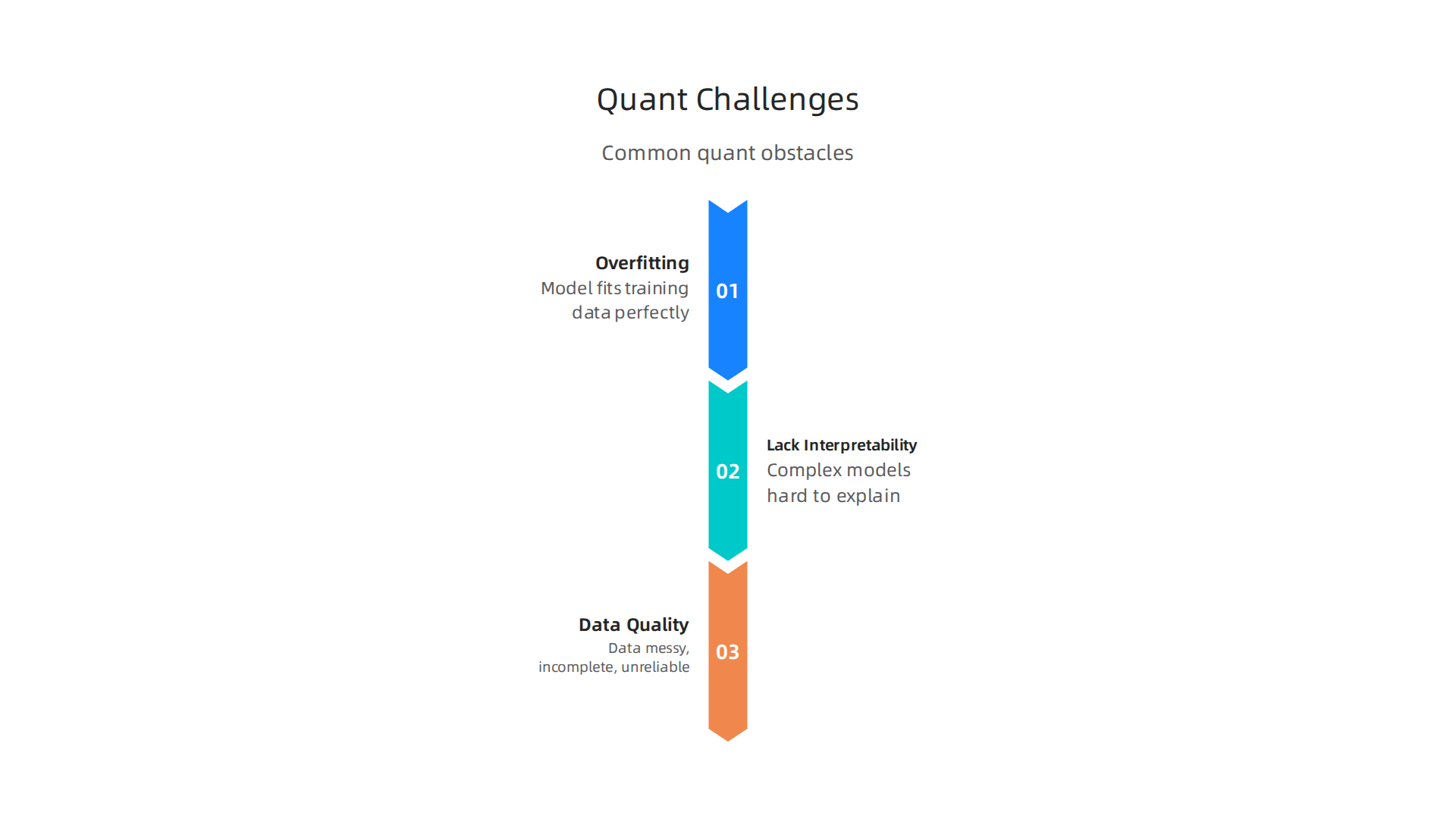
Let’s look at the most common ones and how to handle them.
Overfitting and model complexity
One of the biggest traps is building a model that fits your training data perfectly but fails in the real world. This is called overfitting. It happens when your model is too complex and starts learning noise instead of the true signal. The solution is disciplined validation. Use techniques like cross-validation, regularization, and early stopping. Always test your model on unseen data. A good rule is to keep your model as simple as possible while still getting good results. The PDF Quant Interview Prep document lists these exact strategies for avoiding overfitting, including regularization and ensemble methods.
Lack of interpretability
Complex models like deep neural networks are powerful but hard to explain. Business stakeholders often need to understand why a model makes a certain decision. If they don’t trust the model, they won’t use it. Quant methods like linear models, decision trees, and Bayesian approaches offer better interpretability. You can also use tools like SHAP or LIME to explain any model’s predictions. The key is to balance accuracy with explainability from the start. If you are looking to build these skills, the top data analytics certifications in 2026 for AI careers can help you learn how to create models that stakeholders can trust.
Data quality and availability
Quant models need clean, reliable data. In the real world, data is often messy, incomplete, or hard to get. This is especially true in finance, where markets change quickly. As the team at Optiver points out, markets are very non-stationary. Distributions shift, relationships change, and what worked yesterday may not work today. The solution is to build robust data pipelines that clean and validate data automatically. You should also use data augmentation and Bayesian methods that can work well with smaller datasets. Always document your data sources and transformations so you can debug issues later.
Putting it all together
These challenges are real, but they are not impossible. With the right validation, interpretability, and data management practices, you can build quant data science systems that perform well in production. And if you want to stay on top of the latest AI trends that affect quant work, subscribe to the The AI Newsletter Worth Reading for clear daily updates.
Building Quant Data Science Capability in Your Organization
So you understand the challenges. Now, how do you actually build a quant data science team that delivers? It takes more than just hiring smart people. You need the right setup from the start.
Hire for depth and breadth
The foundation is talent. You need people who are strong in math, statistics, and programming. But you also need people who understand the business. A pure mathematician might build a beautiful model that no one in the company can use. A pure business expert might ask great questions but lack the technical skills to answer them. The sweet spot is people who can do both. When you look at the differences between quantitative analysts and data scientists, the key insight is that both roles need a strong mix of analytical skills and business sense. That is why firms like Two Sigma look for people who combine real world data skills with deep quantitative ability, as you can see in their quantitative research and data science careers page.
Build a culture of experimentation
Hiring the right people is step one. Step two is giving them room to work. A quant data science team cannot succeed if every model needs approval from three layers of management before it gets tested. You need a culture where experimentation is normal. Where failing fast is okay as long as you learn from it.

This kind of culture starts at the top. Executive buy-in is nonnegotiable. Leaders need to understand that not every model will work, and that is fine. The goal is to learn and improve, not to be perfect on the first try.
Invest in tools and training
The third piece is investment. Your team needs good tools. They need clean data pipelines, solid compute resources, and time to learn. A lot of organizations skip this part. They hire great people but give them old laptops and messy spreadsheets. That is a recipe for frustration. The long term advantage comes from treating your quant team as an asset you grow, not a cost you manage. If you want to learn more about how to build these skills at the individual level, check out this guide on how to succeed as a data analyst in 2026. It covers the practical steps for building the kind of analytical capability your organization needs.
Put these three pieces together, and you have a foundation that will serve you well as your quant data science practice grows.
Summary
This article explains why quant data science is a business imperative and how it turns raw numbers into actionable decisions under uncertainty. It defines quant data science as a math-heavy subset of data science that prioritizes uncertainty quantification, risk-aware decision-making, and causal understanding rather than just predictions. The piece walks through core techniques—Bayesian inference, causal inference, time series analysis, and Monte Carlo simulations—and shows where they deliver the most value in finance, marketing, and operations. It also covers practical tools (Python libraries, cloud platforms, and low-code options), integration strategies to make AI systems more trustworthy, and common implementation challenges like overfitting and data quality. Finally, the article offers guidance on building team capabilities, creating a culture of experimentation, and investing in the right infrastructure so organizations can scale quant practices effectively.