
In 2026, it feels like artificial intelligence is everywhere, doesn’t it? Especially generative AI. These smart computer programs can create new things like text, pictures, or code just by learning from what they’ve seen before. For businesses, this brings exciting chances to work faster and smarter. But with so many new tools and ideas popping up every day, it can be really hard to tell what’s truly helpful and what’s just a lot of noise.
Many companies are trying to figure out the best way to use these new generative AI platforms.

An enterprise AI platform is like a big system that helps businesses build and use AI tools safely. It is designed to work with a company’s own data and rules, making sure everything is secure and follows the law. This means that exciting tools like the Azure AI Foundry Model or other powerful programs need to be chosen carefully.
This guide is here to help you cut through all that hype. We will give you a clear roadmap to understand what enterprise generative AI platforms are and how to choose the right ones for your business. We will talk about:
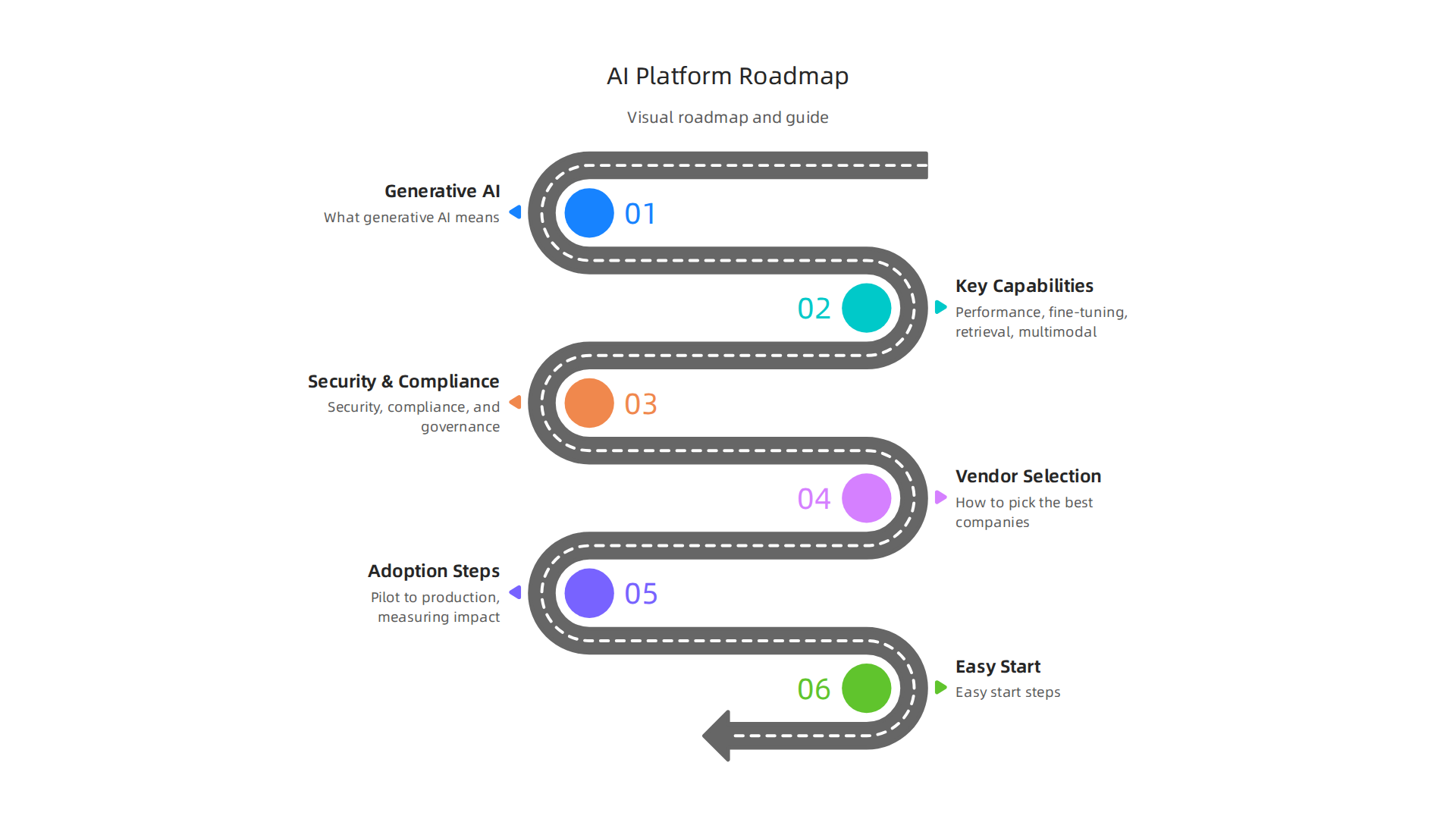
- What generative AI means for big companies
- How to look at different tools and decide which are best
- Making sure your AI is safe and secure
- Different ways to set up and use AI in your company
- How to pick the best companies that offer these AI tools
- Easy steps to start using AI in your daily work
You’ll learn about important ideas like an AI taxonomy, which is like a map that helps organize all the different types of AI technologies. This will help you understand how tools like Smartlead AI or other future AI tools fit into the bigger picture. We want to help you pick the top AI platforms for business growth in 2026 that actually make a difference for your company.
To stay updated with clear, daily insights into the fast-changing world of AI, you can sign up for The AI Newsletter Worth Reading.
Enterprise generative AI platforms are not just fancy tools; they are like a special toolbox for big companies. They help businesses really use AI to make new things, like writing help or creating images, but in a safe and organized way.
What Makes Up These Platforms?
Think of these generative AI platforms as having many layers that work together.
- Access to AI Models: This is the base. It lets companies use different smart AI models. Sometimes these are big, ready-made models, like the ones that make up the Azure AI Foundry Model. Other times, they can be smaller, special tools like Smartlead AI. These platforms often use an AI gateway, which is like a control center that helps manage all these different models.
- Data Pipelines: These are like tubes that carry information. They make sure the right data gets to the AI models and that the new things the AI creates go where they need to go. This keeps everything flowing smoothly.
- Orchestration: This layer makes sure all the different parts of the AI system talk to each other and work together correctly. It’s like a conductor making sure all the musicians play at the right time.
- APIs (Application Programming Interfaces): These are like special plugs that let the AI platform connect with other computer programs a company already uses. This makes it easy to add AI features to existing tools.
- User Tools and App Builders: This part helps people who are not AI experts use the platform to build new applications. It makes it simpler to create tools that use AI, like new apps or websites, moving beyond just having the basic AI models. This allows for faster AI product development lifecycle within the company.
Why Are They So Valuable for Businesses?
Companies get a lot of good things from using these dedicated generative AI platforms:
- Faster Work: They help businesses build and launch new AI tools much quicker. This means they can react to new ideas and customer needs faster than before.
- Easy to Reuse: Once a company builds an AI tool using the platform, it’s easier to use that same tool or parts of it for other projects. This saves time and money.
- Safe and Sound: These platforms come with built-in rules for safety and security. They help make sure the AI follows all the company’s guidelines and legal rules. This is super important when dealing with private customer information.
- Cost Control: By having all AI work in one place, companies can better watch and manage how much they spend on AI projects. It helps them get the most value for their money.
- Smart Features: Enterprise generative AI platforms can handle advanced tasks. This includes:
- Multimodal AI: This means the AI can work with different types of information, like text, pictures, and sounds, all at once.
- Retrieval-Augmented Generation (RAG): This is a smart way for AI to look up facts from a company’s private documents and use them to give very accurate answers. For many business uses in 2026, RAG is better than just fine-tuning a model because it costs less and is more flexible, especially with lots of data that changes often. You can find more details in this RAG vs Fine-Tuning vs Long-Context: The 2026 Cost Crossover analysis.
- Fine-Tuning: This is when you teach a general AI model to become really good at a specific task by showing it lots of special company data. In 2026, methods like LoRA and QLoRA are popular for fine-tuning.
These powerful features make enterprise generative AI platforms much more than just simple tools. They are complete systems designed to give businesses a real edge. They are helping companies turn the promise of AI into actual working solutions and building what some call future tools AI.
The powerful features of enterprise generative AI platforms definitely give businesses a real edge. But how do you know which platform is the best fit for your company? It’s important to look closely at their key capabilities. Choosing the right one means understanding what each platform does well and how it can help with your specific needs. Think of it like picking the right tool for a big job.
Key Platform Capabilities to Evaluate
When looking at different generative AI platforms, companies in 2026 need to check several important things. These are the main points to consider:
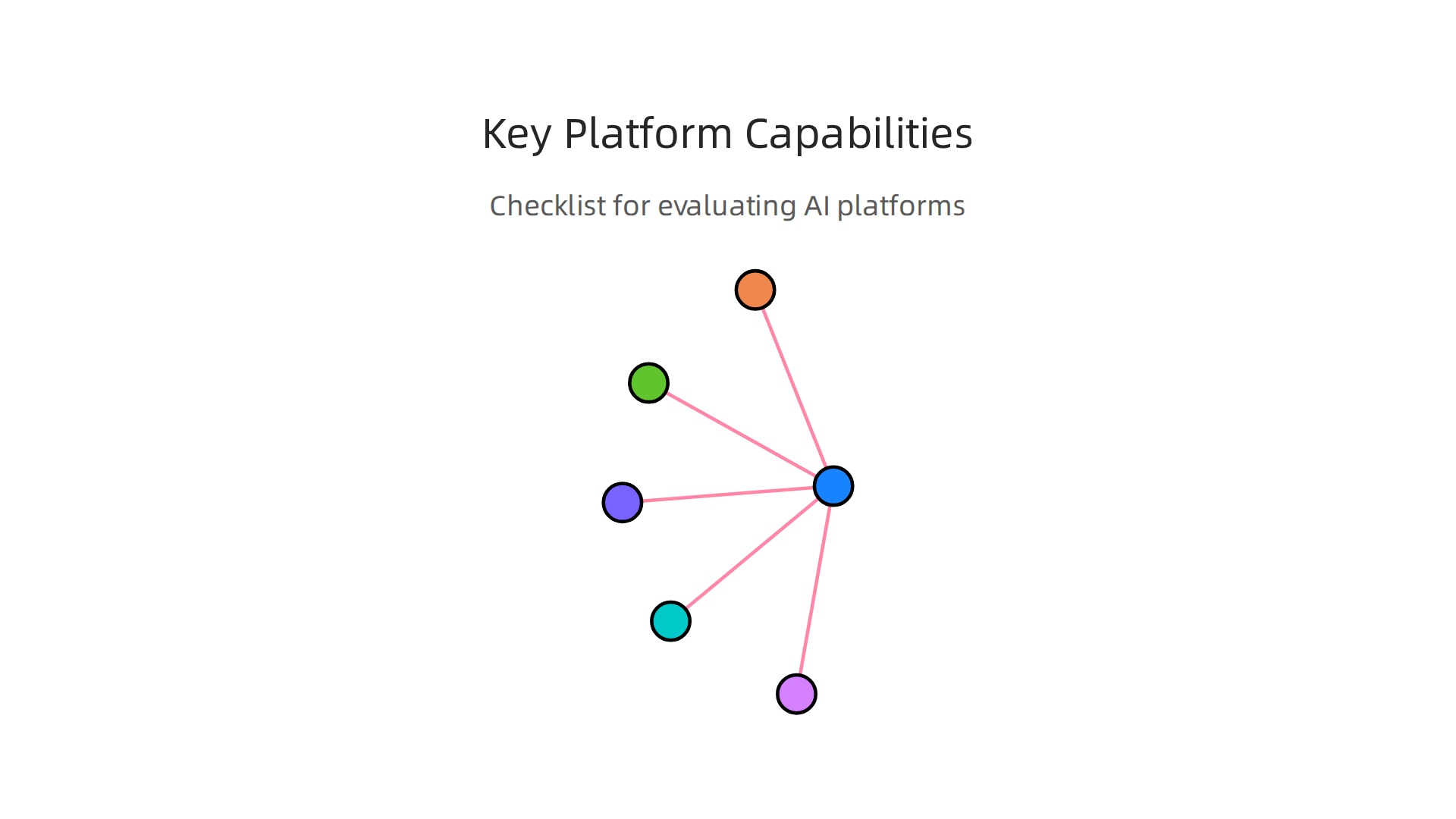
- Model Performance: This is about how well the AI models actually do the tasks they are given. For example, how accurately does an AI write a report, or how well does it recognize objects in a picture? You want an AI that gives good, useful results. Some platforms might use advanced models like the Azure AI Foundry Model or specialized tools like Smartlead AI, each with different performance levels.
- Latency (Speed): This refers to how quickly the AI responds. For many business uses, waiting too long for an answer is not good. Faster response times are crucial for things like customer service chatbots or quick data analysis. For example, a 2026 study on RAG performance showed that some setups can respond in less than a second for certain tasks, while others take longer depending on the complexity and how they handle the data involved in the task. When looking at tools for enterprise AI in 2026, speed often plays a big role.
- Context and Window Handling: This talks about how much information the AI can remember and use at one time. Imagine a conversation where the AI forgets what you said a few sentences ago. Good context handling means the AI can keep track of longer discussions or bigger documents, making its answers more relevant. The amount of "context" an AI can handle is a major factor in its usefulness, as seen in many LLM Comparison studies for 2026.
- Retrieval Augmentation (RAG) Support: As we talked about earlier, RAG helps AI find and use facts from a company’s private documents. It’s really important for getting accurate, up-to-date answers. When evaluating a platform, check how well it handles RAG processes, like how it finds and ranks information. Poor retrieval can lead to wrong answers, which is why optimizing RAG pipelines for precision is key, as highlighted in some best practices guides. You can evaluate RAG using frameworks that check its quality from start to finish.
- Fine-Tuning and Adapter Support: Sometimes a general AI model needs to learn specific company jargon or styles. Fine-tuning helps with this. Platforms that make fine-tuning easy using methods like LoRA or QLoRA are very valuable. This is because these methods can make a general model much better at specific tasks without needing a lot of computing power. In 2026, these are often the go-to methods for making an AI truly specialized for an organization’s data.
- Multimodal Pipelines: This capability means the AI can work with different kinds of data at the same time, such as text, pictures, and sounds. For example, an AI might analyze a customer’s written complaint, a screenshot of an error, and a voice recording of their call all at once. This makes the AI much more powerful and versatile for real-world business problems. Multimodal AI is a big trend in generative AI for 2026.
Practical Metrics and Trade-Offs
When choosing among generative AI platforms, businesses must think about what matters most for their specific needs. It’s not always about picking the fastest or most powerful AI. Sometimes, a slightly slower AI that is much cheaper to run or easier to integrate with existing systems is the better choice.
For example, when comparing RAG and fine-tuning, RAG often wins for large or constantly changing data because it’s more flexible and can be cheaper in the long run. However, fine-tuning can sometimes offer better response times for very specific, stable tasks. A clear decision framework for RAG vs Fine-Tuning in 2026 can help you weigh these options.
You’ll need to look at specific numbers. How many requests per second can the system handle (throughput)? What’s the typical delay (latency)? What is the cost for each AI interaction? Companies should also consider how easy it is to manage and monitor these AI systems once they are up and running, which is part of the ultimate guide to AI model deployment in 2026.
The best choice depends on what you want the AI to do. A small company might focus on cost-effective solutions, while a large enterprise might prioritize speed and complex multimodal features. Thinking through these points helps companies make smart choices about their future tools AI strategy.
Keeping up with all these changes and deciding on the best platform can feel like a lot. To stay informed about the rapidly moving world of AI, you can sign up for our daily updates.
Get clear daily AI updates from The AI Newsletter Worth Reading.
Choosing the right generative AI platform is not just about how well it performs or how much it costs. For companies in 2026, it’s also about making sure these powerful tools are used safely and follow all the rules.

This means looking closely at how each platform handles security, compliance, and good governance.
Security, compliance, and governance: what enterprise leaders demand
When businesses pick generative AI platforms, they have to think about many important rules. These rules come from governments and from the company’s own guidelines. For example, where data is stored (data residency), who can see and use the AI (access controls), and how actions are recorded (audit trails) are all critical. Companies also need to manage the risks that AI models might bring, which is known as model risk management. The right platform will offer features that help meet these needs.
In 2026, many frameworks guide how AI should be used safely. The NIST AI Risk Management Framework and the EU AI Act are key examples, requiring businesses to constantly check and prove their AI systems are safe and fair. These rules are not just suggestions; they are mandatory for many organizations using AI systems, especially those that deal with sensitive data or perform high-risk tasks. An AI security and governance guide for 2026 can help businesses understand these complex requirements.
Here are some important things to look for in generative AI platforms related to security and rules:
- Data Residency: Can the platform keep your company’s data in a specific country or region? This is often a legal requirement.
- Access Controls: Does it let you decide exactly who can use the AI and what they can do with it? This is crucial for protecting sensitive information.
- Audit Trails: Does the platform keep a clear record of every action the AI takes and every person who interacts with it? This helps track things if something goes wrong.
- Model Risk Management: Does the platform offer ways to understand and lessen the risks of using AI, such as making unfair decisions or giving wrong information? This is a core part of enterprise AI governance in 2026.
Practical ways to manage AI
Beyond basic features, companies need strong ways to manage their AI systems day-to-day. These are often called governance patterns:
- Model Catalog: Imagine a library for all your AI models. A model catalog helps companies keep track of every AI they use, what it does, and how it was made. This makes it easier to manage and update them.
- Lineage: This is like a family tree for your AI models and data. It shows where the data came from, how it was used to train the AI, and how the AI has changed over time. This helps ensure transparency and accountability.
- Policy Enforcement: This means the platform can automatically make sure the AI follows company rules and legal guidelines. For instance, it can block the AI from sharing certain types of sensitive data. In 2026, strong controls include prompt-level enforcement and output monitoring to redact private information before it leaves the system, as noted in The 2026 AI Security & Governance Checklist.
- Red-Team Testing: This is like hiring a team of hackers to try and break your AI system in a safe way. It helps find weaknesses before bad actors do. For companies looking into enterprise AI tooling in 2026, platforms that support this kind of testing are invaluable.
- Incident Response: What happens if the AI does something it shouldn’t, or if there’s a security breach? Having a clear plan to deal with these problems quickly is very important. This includes creating audit trails and being ready for AI-specific incidents, which are major AI governance requirements in 2026.
Even advanced generative AI platforms like those built using an Azure AI Foundry Model or specialized tools like Smartlead AI need these governance layers. While AI gateways can help manage access, the platform itself must provide the tools for comprehensive control. For business leaders, understanding these features means they can make sure their future tools AI strategy is not just smart, but also safe and responsible. Choosing the right platform means considering all these moving parts in the 2026 AI product development lifecycle.
Now that we’ve talked about choosing smart and safe generative AI platforms, let’s look at how to actually put them to work and keep them running well. This is where integration, deployment, and MLOps come in. These are all about making sure AI systems can grow and fit smoothly into a company’s daily operations.
Integration, deployment, and MLOps: patterns that scale
Getting generative AI platforms to work with a company’s existing tools is super important. It’s not enough for an AI to be smart; it also needs to connect easily. This is where different integration patterns become very useful.
- API-First: Many modern AI platforms are built "API-first." This means they offer clear, simple ways (like special digital plugs) for other computer programs to talk to them. This makes it easy to add AI features into apps or services without a lot of extra work.
- SDKs (Software Development Kits): These are like toolkits for developers. They give programmers ready-made code and tools to build new features using the generative AI platform. This can speed up how fast a company can use new AI ideas.
- Event-Driven Architectures: Imagine a system where things happen in real-time. If a new piece of data comes in, the AI can react right away. This "event-driven" way of working helps AI systems stay up-to-date and responsive, like a Smartlead AI platform quickly responding to customer queries.
- Data Connectors: To be truly useful, generative AI platforms need to connect to a company’s important information. Data connectors are tools that help link the AI to different databases and other business systems. This helps the AI use trusted company data to do its job better, ensuring production-grade generative AI is grounded in trusted enterprise data, as experts noted in 2026 discussions about deployment patterns Production-Grade Generative AI in 2026.
Making AI work smoothly with MLOps
MLOps stands for Machine Learning Operations. It’s a set of practices that help businesses build, test, deploy, and monitor their AI models in a reliable and efficient way. Think of it like a factory line for AI, making sure everything runs perfectly. For generative AI models, MLOps includes:
- CI/CD for Models: This means Continuous Integration and Continuous Delivery. In simple terms, it’s about making small, regular updates to AI models and quickly getting them ready for use. This helps keep the AI sharp and bug-free. The roadmap for a Generative AI Engineer in 2026 highlights the importance of deploying models and setting up CI/CD for machine learning Generative AI Engineer Roadmap 2026.
- Monitoring and Observability: After an AI model is launched, it needs to be watched closely. Monitoring checks if the AI is working as expected, and observability helps understand why it’s working that way. This involves looking at how the model behaves and its performance.
- Rollback Strategies: Sometimes, a new AI model or an update might not work out. A rollback strategy is like having an "undo" button. It lets companies quickly switch back to an older, working version of the AI model if there’s a problem. This is a key part of having an Ultimate Guide to AI Model Deployment in 2026.
- Cost Optimization: Running powerful generative AI models can be expensive. MLOps practices also focus on finding ways to use these models efficiently to save money, without losing quality. This is crucial for managing large-scale operations, especially with models like an Azure AI Foundry Model.
Successfully deploying generative AI platforms means thinking beyond just the AI itself. It’s about building a strong system around it that allows for easy connections, smooth updates, and constant checks. This platform-level thinking is important for scaling AI in organizations, as discussed in a framework for AI Deployment Strategy: A Framework for Enterprises. When businesses master these patterns, they can truly get the most out of their future tools AI investments and deliver real value.
To stay up-to-date with all the latest developments and insights in AI, make sure to get clear daily AI updates. The AI Newsletter Worth Reading can help you keep pace.
After mastering how to set up and manage generative AI platforms, the next big step is choosing the right one for your business. With so many options out there, it can feel like comparing apples to oranges. That’s why having a clear way to compare vendors is key.
Vendor Comparison Framework and Pricing Models (How to Compare Apples-to-Apples)
To pick the best generative AI platform, you need a simple plan. This plan helps you look at each vendor fairly. Here are the main things to check:
1. How well does it fit your needs?
First, think about what you actually need the AI to do. Does it write emails, answer customer questions, or help with design?
- What it can do: Look at the platform’s main features. For example, some platforms are great at something called "retrieval-augmented generation" (RAG). This helps AI use your own company’s documents to give very accurate answers. Experts noted in 2026 that RAG is very important for enterprise AI because it gives better results than other methods Fine-tuning vs. RAG for Enterprise AI in 2026. There are also tools for letting AI call functions or understand text better Technical Performance | AI INDEX REPORT 2026.
- How well it performs: Does it work fast? Is it accurate? Some AI models are faster and more precise than others, especially when looking at things like "first-contact resolution rate" for customer service questions Measuring AI Adoption: Metrics for Business Impact in 2026. You can check out lists that compare many different large language models (LLMs) to see how they stack up LLM Comparison 2026: 30+ Models Benchmarked & Ranked.
2. Is it safe and secure?
AI systems handle important data, so security is super important.
- Privacy rules: Make sure the vendor follows important privacy laws like GDPR or the EU AI Act. The EU AI Act, for example, has strong rules about how AI-generated content must be labeled AI Act | Shaping Europe’s digital future – European Union.
- Security standards: Look for vendors who follow security frameworks like the NIST AI Risk Management Framework (RMF) or ISO/IEC 42001. These guidelines help make sure the AI is used responsibly and safely in 2026 An Ultimate Guide to AI Regulations and Governance in 2026. Having good security practices, like prompt and output filtering, is part of a strong AI security plan AI Security And Governance Guide 2026.
3. What is the total cost?
The price tag for generative AI platforms is not just the monthly fee. You need to think about the "Total Cost of Ownership" (TCO). This includes all costs over time.
- Direct costs: This is what you pay the vendor.
- Hidden costs: Don’t forget costs for preparing your data, connecting the AI to your other systems, and the ongoing work to keep the AI running smoothly. Also, consider the cost of people needed to supervise the AI’s work AI KPIs Your CFO Will Actually Trust.
- Return on Investment (ROI): Businesses should link every AI project to clear goals like saving money or making more sales. If you don’t, it’s just expensive tech From Pilot to Profit: Building Sustainable Generative AI Programs in ….
4. What are the service agreements?
"Service Level Agreements" (SLAs) are like promises from the vendor. They tell you how reliable the platform will be.
- Uptime: How often will the AI be working without problems?
- Support: What kind of help can you expect if something goes wrong? These promises are important for business operations.
5. How well does it work with other tools?
A great generative AI platform should fit right in with your existing software. If you already use certain tools, your new AI should be able to connect with them easily. Think about how a Smartlead AI or an Azure AI Foundry Model integrates with your current setup. This is often done through "APIs" or "data connectors," as we talked about earlier.
Common Ways AI Platforms Charge Money
Understanding pricing models helps you budget better.
- Consumption-based: You pay for what you use. This might be based on how many requests you send to the AI, how much data it processes, or how many "tokens" (small pieces of text) it uses.
- Seat-based: You pay a fee for each person who uses the AI platform, similar to many other software tools.
- Committed usage: You agree to use a certain amount of the AI service over time, often getting a better price in return.
When choosing generative AI platforms, it’s about more than just the fancy features. It’s about finding a partner whose platform aligns with your company’s needs,

keeps your data safe, offers clear pricing, and works well with your existing tools. This detailed approach helps ensure you pick a solution that truly adds value and isn’t just a future tools AI that looks good on paper.
For more on making smart choices for your company’s tech stack, you might find our guide on Picking the Right Top AI Platforms for Business Growth in 2026 helpful.
After carefully picking the right generative AI platform, the real work of putting it into action begins. It’s not enough to just buy the best tools. You need a clear plan to use them well, from a small test to making them a core part of your business. This journey, often called an adoption roadmap, helps you get the most out of your investment.
Adoption roadmap: from pilot to production and measuring impact
Bringing generative AI platforms into your business needs more than just excitement about new tech. It needs careful steps to make sure they actually help you reach your goals. Here is a step-by-step plan for how businesses are adopting AI in 2026:
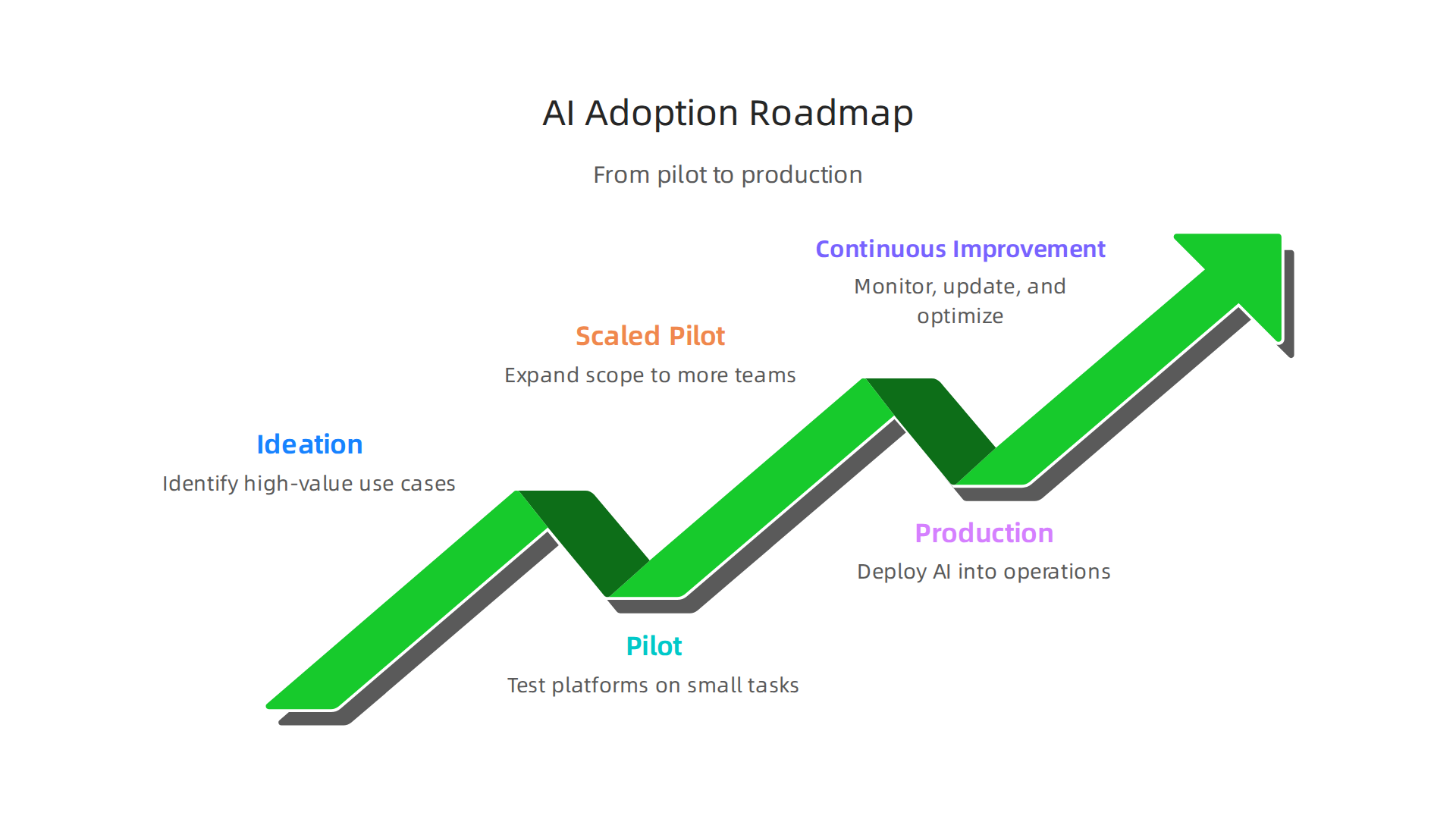
Step 1: Ideation and finding good use cases
Before anything else, think about where AI can really make a difference. What problems can it solve? Where can it save time or money? Smart businesses look for clear, specific tasks that happen often and where the results can be easily measured. For example, using AI to help customer support or extract info from documents can pay back quickly, often in less than nine months The Three Patterns That Pay Back Under 9 Months. It’s best to pick a few ideas that are high-impact but not too complicated to start with Generative AI Use Cases by Industry [2026 Guide].
Step 2: Pilot projects (Small tests)
Once you have a few good ideas, start with small pilot projects. This means testing the generative AI platforms with a small group or for a limited task. The goal here is to prove that the AI actually works and brings value. You should set up clear ways to measure success right from the start. What does the process look like without AI? How long does it take? What does it cost? This helps you see the real impact of the AI later AI Pilot to Production: Why 95% of AI Projects Stall.
Step 3: Scaled pilots (Bigger tests)
If your small pilot goes well, it’s time to expand. A scaled pilot means trying the AI with more people or in more parts of your business. This helps find any issues that might come up when more people use the system. It also shows you how to integrate the AI with other tools you use, whether it’s an Azure AI Foundry Model or a Smartlead AI system. Getting the AI to fit into your existing tools is key for smooth operation.
Step 4: Production and full rollout
When the scaled pilot is successful, you can move to full production. This means the AI becomes a regular part of your daily business. It’s important to make sure the AI is stable, secure, and always available. At this stage, you need to set up constant monitoring and ways to improve the AI over time. Many companies find that a well-defined architecture and a focus on specific workflows lead to the best results when bringing generative AI to full use Production-Grade Generative AI in 2026: Patterns Dextralabs Use in ….
Step 5: Continuous improvement
AI is not a one-time project. It needs ongoing care. You should keep checking how it’s doing, gather feedback, and make changes to make it even better. This includes updating the models, adding new features, and making sure it stays secure. This continuous effort ensures your generative AI platforms stay valuable and competitive. Many businesses use what’s called "MLOps" or Machine Learning Operations to manage and improve their AI models over time Ultimate Guide to AI Model Deployment in 2026.
Practical steps for making these changes
For your company to use AI successfully, you need to manage the changes well.
- Teams working together: Get different teams, like IT, legal, and the people who will actually use the AI, to work together. This helps make sure everyone is on the same page.
- Data readiness: Make sure your data is clean, organized, and ready for the AI to use. AI is only as good as the data it gets. This often involves clear rules for how data is handled and filtered before the AI sees it The 2026 AI Security & Governance Checklist.
- Security check: Get your security team to sign off on the AI. Make sure it follows all the privacy rules and security standards we talked about earlier. Frameworks like the NIST AI Risk Management Framework are key for responsible and safe AI use in 2026 Generative AI Governance: Enterprise Framework 2026.
- Measuring what matters: It is super important to measure the real impact of your AI. Are you saving money? Making more sales? Is it making customers happier? KPIs, or Key Performance Indicators, help track these things. KPIs for AI success include pilot to production rate, time to value, and how much components from past AI projects can be reused 5 AI KPIs That Predict Success in Enterprise AI. Without clear measures, an AI project can just be an expensive toy Dr. Walid Alrawi’s Post – LinkedIn.
By following these steps, your business can move beyond just experimenting with generative AI platforms. You can turn them into powerful tools that truly drive growth and create real value. For more insights on building your AI capabilities, explore our guide on The 2026 AI Product Development Lifecycle.
Want to stay on top of all the fast-moving AI news and breakthroughs?
Get clear daily AI updates from The AI Newsletter Worth Reading.
Summary
This article explains what enterprise generative AI platforms are, why they matter for businesses in 2026, and how to choose, deploy, and govern them safely. It walks through the platform layers—model access, data pipelines, orchestration, APIs, and user tools—and shows why features like RAG, multimodal support, and fine-tuning matter. The guide covers how to evaluate platforms by performance, latency, context handling, security, and total cost of ownership, and it provides vendor-comparison criteria and common pricing models. It also outlines governance needs such as data residency, access controls, audit trails, model catalogs, and red-team testing. Practical integration and MLOps patterns (API-first, SDKs, CI/CD, monitoring, rollback) are described so teams can scale reliably. Finally, the article offers a step-by-step adoption roadmap—from ideation and small pilots to scaled rollouts and continuous improvement—so organizations can turn AI pilots into measurable business value.